Responding to something I posted on Facebook saying the US “has signed a colonialist and exploitative agreement with Venezuela on oil rights (an unsurprising outcome after the US coup against that country some months back),” someone responded, “Yeah, let’s have China control Venezuelan oil.”
This is how I answered:
I’ve got a better idea. How about we let VENEZUELA control Venezuelan oil. And while we’re at it, support the democratic elements in Venezuelan politics (who are not a part of the new T-backed government). And simultaneously with that, let’s get serious already, 40 years behind when we should have, about switching to fully renewable green energy. We have the technology. We know the benefits. And we sure as heck have the sun, wind, and water.
I didn’t get into the weeds about the Venezuelan pro-democracy movement. It’s enough to know it exists and has been heavily repressed by the last several Venezuelan presidents.
But this isn’t the whole story. The comment from this other person reflects a mindset that I find disturbing. If you follow the thinking implicit in that post, it says that the US should control all the important resources in the world.
Historically, most economic or political empires (and in the last 500+ years, especially the US and our European allies) have been exploiters and colonializers of resources that should be under the control of the Indigenous people whose land they’re on—and when our control is questioned, we go to war. Every modern war, and many ancient ones going back at least to Biblical times, is based on wanting resources someone else claims or protecting resources someone else wants. The ethnic and religious cloaks these struggles might be wrapped in don’t change that underlying reality.
In 2026, we are even seeing our own president blowing up decades long alliances that have kept a fragile peace in Europe and North America, because he wants the resources of places like Venezuela, Canada, and Greenland. But in 2026, we are old enough to know better. Diplomacy-based peace and stability are hard to obtain and easy to lose. But the past 80 years have shown they are indeed possible and can spread to other corners of the world—not by force, but by the power of example.
It will take decades to undo the damage T has inflicted, to create better safeguards against authoritarianism here in the US, and to rebuild the shattered trust of the US around the world. It’s difficult—but it’s doable.
Chris Brogan borrowed an idea from James Altucher: “Write a list of ten things every day. They can be 10 anythings. Ten terrible dates. Ten places to visit. Ten desserts I want to eat this year. Whatever.”
I won’t commit to making a list daily, but I was inspired to create these two after reading Chris’s post (which includes several samples of his own lists).
World Issues
Help figure out how the 30-40% of food that’s wasted can instead be rechanneled to feed those who are starving–and help that get implemented (perhaps this is a place I can target my speaking; see Personal Goal #2, below)
Help amplify the voices of those better qualified than I am to show countries how to solve disputes without going to war
Help build more bridges between/among Left and Right/”woke” and “non-woke”/Muslims and Jews and Christians, etc.
Corollary #1 to #3: Explore and amplify alternatives to counterproductive communication styles: calling-in instead of calling out, respect and listening while searching for common ground instead of shaming
Corollary #2 to #3: Help people to understand that they are not stuck–that just because they have been caught in bad patterns doesn’t mean they are trapped there forever
Continue to demonstrate that baking environmental and social justice directly into companies’ products, services, and mindsets can be highly profitable–find ways for this idea to gain much more traction in the mainstream business world (without having to join that world)
Expose more companies to principles such as biomimicry, multiple function, and circular economy so that they can better understand the financial benefits of deep reimagining, deep re-invention, and regenerativity
Show companies that solving these big problems while increasing profitability requires a mixture of Great Leaps and Kaizen, different in different situations–and that they can do both at once
Corollary to #5: Bring the holistic and systemic analysis that helps determine the right solutions in the right situations, and recommend implementation strategies
Help change mindsets from despair to active, participatory hope: helping everyone I meet understand that he/she/they have the power to effect meaningful change, in their own lives AND in the wider world. Show how ordinary people (usually working with others) have created movements that changed history.
Personal Issues
Probe, discover, and overcome whatever internal barriers are still preventing me from achieving at a higher level–both in terms of impact and revenue–made good progress on this but clearly still have work to do
Book more speaking gigs that pay a fee, whether virtual or live-stage or hybrid–especially international speaking that allows me to explore more parts of the world
Land two or three new long-term consulting clients in the profitable social/environmental justice part of my business
Find steady, decently-paying markets for articles or other types of content, as I had before
Create the right offer for more readers/viewers/listeners to engage with me and come into my orbit
Implement more of the enormous amount of good advice I’ve been given over the past few years
Pick one of the several projects I’ve been tossing around, start it and run it: launch the retreat, the course, the pay-to-participate mastermind/mentoring group OR (not and) the resume-method licensing program
Address issues of fatigue and focus, including lack of motivation, lack of follow-through, and more
Keep up with the torrent of email, LI and FB messages, etc. and figure out a way to spot and respond to the important ones
Continue to be a force in my grandson’s life, even if his parents move out of the area
And what are yours?
Please feel welcome to comment with some of your own goal lists. You don’t need ten things. Even one or two. And yes, you can share a whole list of ten if you want to. Just keep in mind that comments will be moderated and abusive or spammy ones will be removed.
An article called “Build Back Better,” offered eight ways we can mitigate the climate crisis as we reopen. It’s on the Singapore-based Eco-Business site (often a wealth of fresh thinking to my American eyes)
I’d only read a couple of paragraphs when I got the idea to start a community on the theme of building back better—but not just for climate change. I envision a portal with resources and ideas to create better futures in criminal justice/policing, nonviolent defense, immigration, equitable housing, transportation, community food self-sufficiency, education, the work world, democracy… There’s a ton of great stuff out there, but I’m not aware of a one-stop resource that crosses silos, and disciplines, reaches people with a wide range of passions, interests, skills, and demographics, and has the power to create change.
While it certainly builds on the work I’ve been doing for several years at Going Beyond Sustainability, I see it as a community project that would seek ideas both from thought leaders/subject experts and from “ordinary” people (none of us is actually ordinary; all of us are unique).
And use social media, press outreach, and other tools to get it in front of leaders in government, business, academia, nonprofit, etc. After all, every major site started small, even Google, Amazon, Facebook, and Twitter. Using the power of the Internet, this could evolve rapidly to a place that journalists and politicians turn to for sources and advice.
I got so juiced that I stopped reading, ran off to GoDaddy, and scooped up build-back-better dot net (not using the domain syntax because there’s no site up yet so I don’t want it clickable). Most of the more obvious variations were already taken, which tells me there could be some traction in the concept. Only after I secured the domain did I go back and finish reading the article. UPDATE, JULY 9: I’m now thinking it might be better to come up with a cool, brandable single-word name (and I have a few possibilities in mind)–rather than a three-word name whose meaning isn’t all that obvious.
So…who wants to play? If it’s going to fly, it’s going to need volunteers:
Thinkers and doers: researchers, authors, activists, business and community leaders, students, etc., who could post ideas-in-progress and let the community help those ideas evolve into workable solutions
Web designers who can handle complex threading and submission forms that allow people to submit and subscribe by specific idea, by topic heading, and overall—and who have a deep understanding of Internet security and SEO
Topic leaders who are experts in their subject and can moderate submissions so the spammers, trolls, and nut-jobs have to play someplace else—but who will put up actual ideas that are submitted in their area, even if they personally don’t see them as workable. (That would be an ideal opportunity to help them think their idea through. Post the submission and immediately post a comment that doesn’t put down the idea but grounds them in reality, with questions like “have you thought about what could happen if…?” “Do you think this could also be useful in (a different discipline)?” “What resources would this
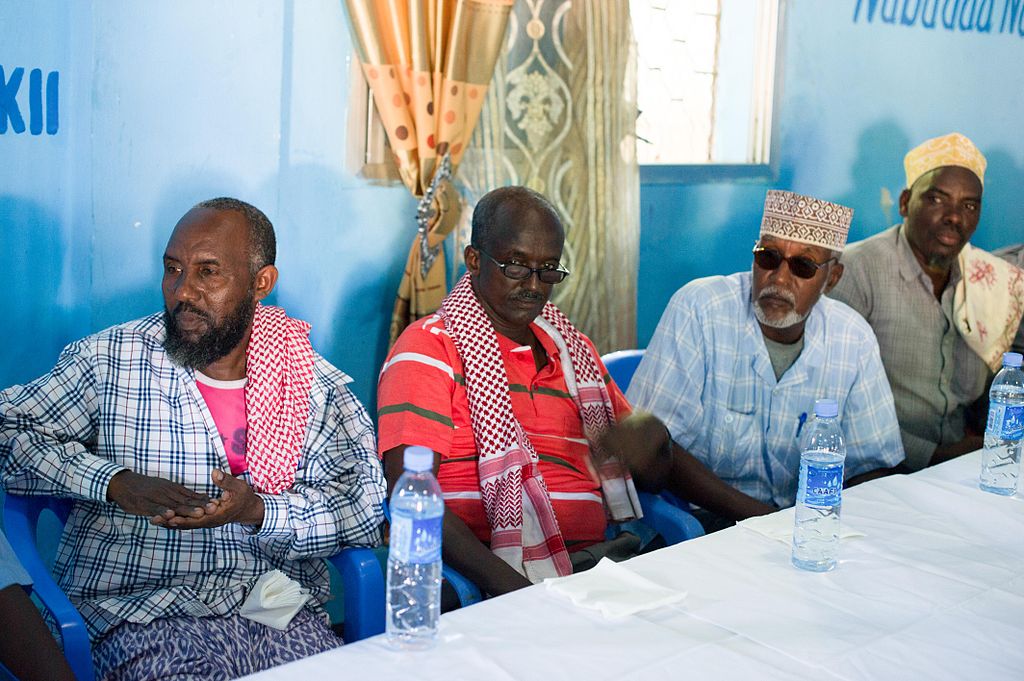
Residents of Wadajir, Somalia attend a meeting on community policing. Photo by David Mutui, courtesy Wikipedia Commons
require and how would you go after them?”
Influencers (including journalists, bloggers, marketers, people operating successful online communities, people with a big fan base or lots of social media connections) who can bring the site to the attention of their networks
Revenue generators who would work on commission to raise money for hack-proof site operation, and eventually raise enough to start paying volunteers
Obviously, this is only a preliminary sketch. If you’d like to be part of this, use my contact form (on my sister site, Going Beyond Sustainability) to get in touch.
50 years ago today, October 15, 1969, my life changed forever. That was the day I became an activist, for real.
Yes, there was a time when as a toddler, I destroyed the cigarettes my parents’ party guests left lying around on the coffee table to protect the air quality of our apartment. Yes, there was the one-kid boycott I started that summer of 1969 of a movie theater that charged me for an adult ticket and made me sit in the children’s section (and I have still never been back to that theater). Yes, I grew up in a social change household and my mom dragged me around with her as she campaigned for Eugene McCarthy in 1968. Yes, I had already decided to become a vegetarian, although my mom had extracted a promise to wait until I stopped growing. So I was predisposed. But I wasn’t an activist yet.
But that day, I participated in the national Vietnam Moratorium Day—which is why I still remember the date—and went to my first peace rally. Alone, I walked the few blocks from our apartment building on Loring Place at Tremont Avenue to NYU’s Bronx campus (now Bronx Community College), where I listened to the speakers.
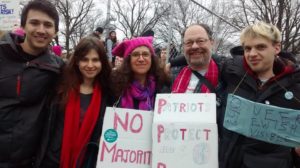
Marching at the Women’s March on Washington with my wife and children (from left: son-in-law Bobby, daughter Alana, wife Dina, me, son Rafael)
I was 12 years old, and had just started 9th grade.
One of the speakers, who was probably only about 6 years older than me, proclaimed, “The Vietnam war is an undeclared war.”
I hadn’t known that.
And with this statement, my whole world came crashing down. All my faith in the checks and balances of the American system of government that I’d learned from social studies teachers turned out to be a lie. I started questioning everything I knew.
I still show up at many demonstrations. In the photo above, I’m holding a sign that says “Patriots Protect People and Planet” that I made for that protest: the Women’s March counterinaugural on January 21, 2017. A few days later, I turned it over and wrote “Another Jew for Human Rights,” and brought it to protest the administration’s first attempt at a Muslim ban. Both sides of that sign have gotten quite a workout the past 2-3/4 years.
But I learned early that showing up at demonstrations isn’t enough.
When my carefully constructed world fell apart on that October day in 1969, I started looking for ways to make a difference. To find that path back to the democracy I’d been promised, to make sure the system worked so the next time the US went to war, it would have at least been vetted by Congress (little did I know how THAT would play out! Most American wars since then have also been undeclared.) And to work for peace.
So peace and democracy were my first causes. A few months later, the first Earth Day added the environment to my focus. Over the years, I took up many others: human rights/opposing discrimination, safe energy, affordable housing, food and transportation justice, social change journalism, dialogue across differences, and many subsets and intersections of these.
Before long, I was joining organizations, writing and publishing about social change actions (starting with articles in an alternative paper at my high school when I was 15), planning events from speakers to rallies to the safe energy “swim-in” where I gave my first TV interview dripping wet in my bathing suit, building coalitions, doing the hard work of helping to build movements–and making tons of friends, by the way. In fact, I’m going to a meeting of our Western Massachusetts Jews for Immigration Justice meeting this afternoon, where we’ll debrief a successful mass rally we held last week and plan our next steps.
Many of these were just as accidental or based on a random insight as my original peace activism.
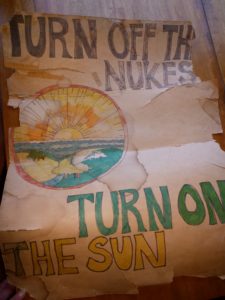
Sign by Nancy Hodge Green, used at Seabrook, 1977. Photo by Shel Horowitz.
My paths to human rights and opposing discrimination came in part from being told I was too young to count when I was an early activist, in part from my own coming out as bisexual as a 16-year-old college freshman, in part from being hired at age 22 for my one and only paid organizing job—charged with building a near-defunct Gray Panther chapter in Brooklyn (as a VISTA Volunteer with pay the first year of $82 a week in NYC!), in part from a growing awareness of disability issues as a 6-year member of Northampton’s official city Disability Committee, and in part from seeing the urban poverty all around me in the various cities I lived in as a child or during college internships—such as the ghetto neighborhood in Washington, DC I walked through on my way to work, or the one I biked through to visit my then-girlfriend (now wife of 36 years) in Brooklyn.
But it also comes from inserting myself into situations where some people might think I don’t belong—whether attending poetry gatherings in black neighborhoods or staying in Arab and Druze villages in Israel or visiting a colleague in Ramallah (Palestine).
Founding Save the Mountain was an accident of geography. I had only been living in the neighborhood we saved for just over a year when a developer announced plans to destroy it. And my work this past summer on immigration justice was also an accident.
Yet, after all these years, I am still deeply involved in those first three issues that found me: peace, the environment, and democracy. I’ve changed the way I participate—for instance, speaking to the business community on how social change and environmental healing can be profitable—but they are still very much a part of who I am.
I am grateful to that long-ago young man, and I wish I knew his name to say thank-you. I wouldn’t be the person I am today without his speech.
When I started, I was told I was too young to make change, and now, at 62, I’m beginning to hear that I’m too old, But as teen activist Emma Gonzales would say, I “call B.S.” on both claims. Like many of my friends and mentors, I expect to continue being an activist into my 90s and even 100s, if I live that long.
As a supporter of Elizabeth Warren’s presidential campaign (and a resident of Massachusetts who’s seen the positive impact she has had on the state she represents), I got asked to do a survey of what issues I felt were most important.
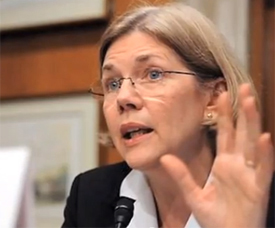
Senator Elizabeth Warren of Massachusetts
While it was tempting to check every choice, I limited myself to 12 of the 32 options.
And then there was an open question: “Is there anything else you’d like to share about why you’re in this fight?” This is what I wrote:
I see the two biggest challenges as peace and climate change. The US has a major role to play in both, starting with STOPPING our support for repressive governments around the world. To get there, we have to have meaningful electoral reform to secure our own democracy, meaningful gun policies that make it at least as hard to get a gun as it is to get a license to cut hair, and policies/tax codes that eliminate all subsidies for fossil and nuclear while encouraging a rapid transition to solar, wind, hydro, and other true clean renewable technologies–including a deep conservation retrofit program. I’ve been a supporter of yours since your first run in Massachusetts (where I live) and an activist for 50 years starting at age 12.
Go and read it. I’ll wait. And yes, I know it’s almost a year old–but it’s still completely relevant.
It makes so much sense to me! It’s not that DT’s ardent followers can’t see the criminal behavior, the looting of the public treasury, the constant lying and bullying, the attempt to accuse someone else of whatever it is he’s accused of today. It’s that they define corruption very differently than the rest of us to.
Of course, if this is accurate, it poses a big challenge for activists. When facts don’t matter at all because ideology is paramount, it’s really hard to change people’s minds.
I think it can be done, one conversation at a time. And those conversations have to be handled very carefully. They have to:
Respect the other person as a person (that means no name calling, among other things)
Seek common ground even when it’s hard to find
Avoid making the other person feel diminished, stupid, heartless, etc. and at the same time, not condoning the diminishment or insult of others (in the form of prejudice
This is a huge challenge. I recognize that. I’ve had some of these conversations. Van Jones has had some.
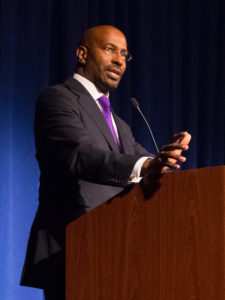
Van Jones, activist, speaking in 2015. Photo Credit: Department of Labor, Shawn T Moore
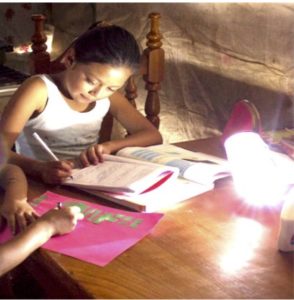
Social-good products like this solar-powered LED lamp make a difference AND a profit
Too often, businesses think of sustainability as a “have to” instead of a “delighted to.” Let’s change that attitude! Here are three among many reasons why business leaders should be thrilled to embrace deep sustainability:
The powerful business case. More and more stakeholders are demanding that the companies they patronize address wider environmental and social issues; those who fail to do this are starting to lose market share. Not only that, but going green the RIGHT way can substantially lower costs of energy, raw materials, and other goods while building in customer loyalty and tolerance for higher prices. To say it another way, greening your company can significantly up profitability! Companies in the Fortune 500 figured this out some years ago. Pretty much all of them have sustainability departments (under various names) and have made huge progress in the past decade. Of course, we still have a long way to go. But many smaller companies are resistant. Because they see expenses, not income streams, they dig in with their old, inefficient ways. But certainly, the low-hanging fruit–taking the steps with quick payback–increases profitability directly, by raising income and lowering costs.
The ability to market sustainable goods, services, and processes to three different types of consumer: the Deep Green, who makes purchasing decisions contingent on social responsibility; the Lazy Green, who will do the right thing if it’s convenient; and the Nongreen, who is indifferent or even hostile to a sustainability agenda, but who will happily buy green products and services if they are positioned as superior (more comfortable, more durable, less toxic, etc.). Of course, these three kinds of customers need three different sets of marketing messages–something many green companies don’t understand, and thus leave a lot of money on the table.
The power of business to go beyond sustainability—to regenerativity. To actually make things better: identify/create/market *profitable* offerings that turn hunger and poverty into abundance, war into peace, and catastrophic climate change into planetary balance. Lifting people out of poverty (and creating new markets), ending war, solving climate change as ways to make money: how cool is that?
I’ve spent the last several years studying this trend and have written an award-winning book, Guerrilla Marketing to Heal the World, that shows how in detail. It’s been endorsed by over 50 business and environmental leaders, including Seth Godin and Chicken Soup for the Soul’s Jack Canfield. You can learn more at the Guerrilla Marketing to Heal the World page at GoingBeyondSustainability.com (I think it’s by far the best of my 10 books, several of which have won awards or been translated and republished in other countries).
Progressives can be a gloomy lot. Too often, we focus on all the things wrong with society, all the problems we need to fix. I say “we,” because I’ve certainly done my share of that global kvetch.
But every once in a while, we actually win a major victory. I’ve been actively involved in a few of them, and I have to tell you, they feel great.
One of my favorite members of Congress, Rep. Alan Grayson (D-Fla) knows the importance of celebrating our victories. He sent out an e-mail with the headline, “Hey, We Progressives Won Something.”
I opened the e-mail and discovered what we won: we didn’t go to war against Syria. And Syria destroyed its chemical weapons stockpile, under international supervision. The massive outcry of opposition certainly helped us get there.
Grayson gives us a lot to celebrate:
Let’s celebrate the war that never happened.
Let’s celebrate NOT having to hold sad and somber funerals for young Americans who would have lost their lives fighting in Syria.
Let’s celebrate NOT having to nurse and care for the wounded veterans who would have returned from the U.S.-Syrian war.
Let’s celebrate Congress NOT having to appropriate billions of tax dollars in emergency spending to support U.S. military operations in Syria.
Let’s celebrate NOT having to attend bitter marches protesting the U.S. war in Syria.
Let’s celebrate NOT having to rebuild Syria’s roads and bridges and schools, so that we can have a shot at rebuilding our own.
Let’s celebrate peace.
We won the battle, and the military-industrial complex lost the war.
We should be proud of our victories, because our victories matter. I know that politics sometimes can seem discouraging right now. Progressive often seem to lose, and lose frequently. But, you know what? Sometimes we win. And when we win, we save lives. We promote equality. We serve the cause of justice. We improve people’s lives.
Indeed, we do! Our actions–as individuals, and especially when we band together–actually do make a difference. Think how much poorer the world would be if the likes of Nelson Mandela, Lech Walensa, Wangari Maathai (the tree-planting woman of Kenya, who won a Nobel Prize for her work establishing a greenbelt in her country), Gandhi, Gray Panthers founder Maggie Kuhn, and Martin Luther King, Jr. had not walked it.
And you don’t need to be an activist. The world is richer for the presence of scientists like the brilliant energy strategist Amory Lovins, who is still very much alive–and Jonas Salk, Rachel Carson, and George Washington Carver, who are not…writers like Harriet Beecher Stowe, Alice Walker, and even Chicken Soup’s Jack Canfield (his The Success Principles is the one self-help book I regularly recommend)…and ordinary people whose names you won’t recognize, who turned their lives into blessings for the world. I’m going to honor one of those unknown heroes by name: my late mother, Gloria Yoshida, who was a civil rights volunteer in the 1960s. If a black person was told an apartment had already been rented, my 5’3″ white, Jewish mom was one of the people who would go and try to rent it afterwards. I remember her yelling at our own landlord, who towered over her, and looked pretty ashamed as she lit into him because “you just don’t want to rent to them because they’re black.”
That family history made it easier for me to take on a long list of causes over the past 40 years–even organizing the movement that saved a threatened mountain while all the “experts” said “this is terrible, but there’s nothing we can do.”
What are YOU doing to make the world better? Please share in the comments section, below.
Last Wednesday, my local paper’s lead story was a profile of two long-time peace activists: Frances Crowe, age 94, and Arky Markham, 98. I’ve known them both for decades; you can’t be involved in peace and social justice issues in our area for long without encountering them. I saw both of them at the peace demonstration last Monday, in fact.
31 years ago, when I was actively freelancing for this same paper, I published an interview with a different pair of legendary local peace activists, and was thrilled when the paper ran it on the front page.
Of course, these four wonderful people are just the tiniest fraction of people doing good work for peace in our neighborhood and around the world.
Let’s tell our newspapers we want more stories like that on the front page :-).
Note: you may have to be a subscriber to view the link, but you should be able to at least see the headline and lead paragraph.
All through the Vietnam era, we used to hear that war was terrible in so many other ways, but good for the economy. It put people to work, it allowed companies facing hardship to find customers, etc. etc.
This was always a misleading argument, as war spending created far fewer jobs than many other categories.
It seems today’s market is much more aware of the potential economic devastation of war. Consider this bit of news:
Incidentally, money spent on energy efficiency and going green has a much higher rate of return for the economy. Green energy spending creates more jobs, consumer spending, and long-term consumer savings that frees up cash for more spending, while war drives us deeper into debt.