Responding to something I posted on Facebook saying the US “has signed a colonialist and exploitative agreement with Venezuela on oil rights (an unsurprising outcome after the US coup against that country some months back),” someone responded, “Yeah, let’s have China control Venezuelan oil.”
This is how I answered:
I’ve got a better idea. How about we let VENEZUELA control Venezuelan oil. And while we’re at it, support the democratic elements in Venezuelan politics (who are not a part of the new T-backed government). And simultaneously with that, let’s get serious already, 40 years behind when we should have, about switching to fully renewable green energy. We have the technology. We know the benefits. And we sure as heck have the sun, wind, and water.
I didn’t get into the weeds about the Venezuelan pro-democracy movement. It’s enough to know it exists and has been heavily repressed by the last several Venezuelan presidents.
But this isn’t the whole story. The comment from this other person reflects a mindset that I find disturbing. If you follow the thinking implicit in that post, it says that the US should control all the important resources in the world.
Historically, most economic or political empires (and in the last 500+ years, especially the US and our European allies) have been exploiters and colonializers of resources that should be under the control of the Indigenous people whose land they’re on—and when our control is questioned, we go to war. Every modern war, and many ancient ones going back at least to Biblical times, is based on wanting resources someone else claims or protecting resources someone else wants. The ethnic and religious cloaks these struggles might be wrapped in don’t change that underlying reality.
In 2026, we are even seeing our own president blowing up decades long alliances that have kept a fragile peace in Europe and North America, because he wants the resources of places like Venezuela, Canada, and Greenland. But in 2026, we are old enough to know better. Diplomacy-based peace and stability are hard to obtain and easy to lose. But the past 80 years have shown they are indeed possible and can spread to other corners of the world—not by force, but by the power of example.
It will take decades to undo the damage T has inflicted, to create better safeguards against authoritarianism here in the US, and to rebuild the shattered trust of the US around the world. It’s difficult—but it’s doable.
The first thing I do when I get online each morning is read a few things:
Poems of the day from Rattle, The Academy of American Poets, and Second Coming.
Heather Cox Richardson and Robert Hubble for analysis of the craziness in the US government right now and how people are fighting back.
Seth Godin for his deep insight, creative thinking, and common sense in the business and learning worlds, and news roundups from among The Guardian, New York Times, and/or Associated Press. (Disclosure: I donate to The Guardian and Associated Press)
Bob Burg, with his daily sermon on succeeding by treating people right, is often on the list.
Today, Godin opened my eyes to a completely new understanding of economics with one sentence:
The price variation in any market reflects not what the market will bear, but what the people in that market can bear to charge.
Brilliant. And I don’t think I’ve come across this anywhere else. It changes everything, doesn’t it?
He backs up his thesis with examples as different as the pricing of luxury handbags and concert tickets. He discusses how rock musicians who allow promoters to scale tickets out of the range of affordability for most of their fans pay a price in loyalty. And he talks about how that particular dynamic came out of outsourcing concert pricing to third party vendors like Ticketmaster who don’t really give a flying f about the fans as long as they can find enough who are willing to pay hundreds of dollars when they could just as easily spend $10 on a movie in the theater or nothing to watch it at home.
I’ve made those choices many times. I paid $6 in 1972, as a 15-year-old without a lot of cash, to see the Rolling Stones in Madison Square Garden. That’s only $46.24 in today’s money. Most of the time, if a concert or theater ticket is more than $100, I will choose a different form of entertainment. I think I have made four exceptions: The Who, my all-time favorite rock band that I had never seen in concert; tickets for touring Broadway productions of “Hamilton” and “Wicked”; also an actual Broadway show, but I’m not sure which one it was.
The three that I remember were actually worth the money and I didn’t regret spending it. But if I had spent that much for some of the mediocre concerts I’ve seen by top acts, I would have been furious, feeling totally ripped off. I saw many of them as either a concert reviewer or an usher, and thus didn’t pay to be ripped off. But it was frustrating even to give up an evening for something that wasn’t worth it and was charging a lot, even though I wasn’t paying. it was an insult to the fans.
But concerts are by definition discretionary purchases. Let’s look at price elasticity in other contexts that Seth didn’t mention—such as necessities.
Many have jumped in price far beyond inflation. Housing is one of them. But housing is something we have to have. Other societies consider housing a basic right. There is no homelessness problem in Cuba. Medical care and higher education, two other sets of services that have shot up in price here in the US, are also provided to everyone there. But they have an authoritarian government and they have deep poverty.
When I visited in 2019, the biggest complaint that I heard, and I heard it from almost everyone I met, is the inability of wages to keep up with the cost of living. Most workers make about $20 US a month. Doctors make $60 or $70. Our guide told us that the only reason his wife is able to afford to be a doctor is because he makes far more than the typical Cuban income from his clients’ tips. Sometimes, it is about trade-offs.
But sometimes, it’s not. Europe proves that decent, democratic governments can afford to treat healthcare as a right and keep higher education extremely affordable as well (housing, not so much). And they’ve also made huge progress in greening the economy.
China also has an authoritarian government. But the streets of its cities are crowded with relatively inexpensive electric cars (which is to say, still totally out of reach for most Chinese—but enough can afford them that massive traffic jams are common). This transition was quite conspicuous between my first trip to China in 2016 and my return in 2024. I rode in several of them and was impressed with how well they seem to be designed. Those stubborn trade-offs with their moral dilemmas.
Yet, for the past year, we have an authoritarian government in the US. The ugliness of its actions and policies would have been unthinkable just a few years ago.
But unlike Cuba and China, the benefits are not accruing to ordinary people. This government is about benefiting billionaires and openly, blatantly lining its leader’s and his friends’ pockets while collecting undeserved and insincere tributes from those who understand that they can flatter their way to what they want, even if they want things that are absolutely at odds with the interests of us ordinary people.
Seth’s thesis is not the whole picture, though. It’s a both-and, not an either-or. Price sensitivity is certainly an issue in purchase decisions—but so is sensitivity to what your market could pay without feeling exploited and ripped off. In my own business, I’ve kept my pricing far lower than most, because that makes me affordable to the solopreneurs and microbusinesses I enjoy serving. I don’t want to live in the corporate world enough to charge too much for my preferred clients, and those huge corporations have in-house people who do what I do. I also recognize that money is one means to an end, and there are others—such as what I referred to earlier: volunteering or reviewing instead of buying tickets
It is also quite possible to make a good profit serving the bottom economic tier. I recommend two great books on this: The Fortune at the Bottom of the Pyramid: Eradicating Poverty Through Profits by C.K. Prahalad (out of print; that’s a link to a used copy) and Business Solution to Poverty by Paul Polak and Mal Warwick. That link takes you to bookshop.org, where your purchase supports the independent bookstore of your choice instead of lining the pockets of an oligarch who has aided and abetted the authoritarian government that has taken over the US.
I woke up this morning thinking I would celebrate the US’s 249th birthday by celebrating real patriotism. But first, I opened my email while taking a walk—and saw that former US Secretary of Labor Robert Reich had already written most of what I’d say.
Bullies win by convincing their opponents that they are powerless. Not only are we not powerless, citizen action has toppled many ruthless dictatorships. Researchers Erica Chenoweth and Maria Stephan say that if just 3.5% of the population withdraws consent, the government is likely to fall—and that nonviolent dissent is more effective than armed struggle.
Happy birthday, USA! Let’s celebrate by doing one thing today to impede the fascist trend we face. This post is one of at least two that I’m doing, along with taping a radio interview this afternoon calling attention to a very undemocratic piece of legislation our governor is trying to push through. Please tell us your pro-democracy action in the comments.
Most of the time, Unilever is one of the better corporate citizens. It’s done a lot of good in the business world for environmental and human rights efforts. Many of its business units, beginning with Ben & Jerry’s in 2012, are certified B Corporations (a business structure that allows environmental and social good to be factored in alongside profitability)–and the parent company has been undertaking a Herculean effort (ongoing since 2015) to get the entire corporation B-corp certified.
Israel’s position is unusual because it is treated differently than other governments, in two different ways. Some people grant Israel special status because of its history, and some use that history to condemn it and even question its existence. Here are some of the reasons why Israel-Palestine conflict is treated differently than elsewhere:
The Pro-Israel Reasons Why Israel is Treated Differently
European and US guilt in the aftermath of World War II, when it became obvious that millions of Jews, Roma, lesbians and gays, people with disabilities, and political opponents of the Nazi dictatorship could have been saved by other nations and were instead murdered in Germany and the lands it occupied.
Extremely effective pro-Israel lobbying that has demonized Arabs, Muslims, and Palestinians (overlapping groups, but not interchangeable) both within the Jewish community and in the wider culture. I recommend the film “Israelism” as the quickest way to gain understanding of how this has worked. This has been so effectively percolated into the culture that any attack on the Israeli government—even in its current super-brutal iteration—is labeled antisemitism.
The industrialized world’s continued reliance on fossil fuels from the Arab lands—and the widely-held view within the US government that Israel is our foreign-policy surrogate and enforcement agent in the Middle East (one of the most important strategic regions in the world: a crossroads of trade since ancient times and a place where political, energy, and military control conveys enormous influence over Europe, Africa, and western Asia).
The Reasons Why Others Condemn Israel
In the larger population, this role as US surrogate gets translated into accepting at face value the common belief that Israel is a bulwark of Western democracy in a region lacking in democracies. And that, in turn, causes conflict with those who criticize Israel’s appalling record of violence and subjugation in the Gaza war. The democracy meme is partially true. If you are a white Jewish citizen of Israel, you have rights under a democracy—but those rights are limited for your Israeli Arab neighbors and do not exist for your Palestinian neighbors in East Jerusalem and just outside Israel’s borders.
Pretty much every Israeli and Palestinian has experienced direct harm: the loss of loved ones, the destruction of and/or eviction from property, denial of human rights. For 76 years, Israel has oppressed Palestinians, dating back to independence in 1948—and Arab nations have repeatedly waged wars and nongovernmental attacks against Israel. More recently, Israel has initiated several wars. On my second trip to Israel and Palestine ten years ago, I listened to a man who had been only 11 years old when the Israelis told his family not to take a lot of their possessions because they would be back in a few weeks (scroll down in the linked article to the section on Bar-Am). He’s one of many whose story I’ve heard over the years that describe the oppression, loss, and bitterness —as the many Israeli Jews who’ve recounted their own losses through terrorism have also experienced. The gruesome toll affects people on both sides.
The denial of rights to ethnic and religious minorities within Israel and to majorities in the Palestinian Territories, the violence done to these populations, and the forced resettlement have all combined to make Israel a pariah in the eyes of many.
Unfortunately, what should be anger directed at the government of Israel is often misdirected into attacks on Jews. And it doesn’t help that so many people who should know better equate any criticism of Israel with antisemitism.
Mind you—antisemitism is real and it is not OK. But there’s a big difference between “Israel, stop bombing civilians, stop denying food access, stop destroying hospitals, stop killing journalists,” etc. and saying that the heinous Hamas attack of October 7, 2023 was justified or that the Jews as a people should be destroyed. Those latter constructs are antisemitic. The former are legitimate criticisms of a government gone amok.
But legitimate criticism of violent and discriminatory Israeli policies and actions, even those before October 7, cannot justify what Hamas did. There is NO justification for kidnapping, killing and raping innocents because they happen to be Jewish and living in Israel—just as there is NO justification for killing and torturing innocents because they happen to be Palestinian, Arab, and/or Muslim. And there is also no justification for treating Israel far more harshly in the diplomatic arena than other countries brutalizing occupied populations. If it’s wrong when Israel does it, it’s also wrong when other countries do it. Not to make that clear is another form of antisemitism.
And How Does This Relate to Unilever and Ben & Jerry’s
What Unilever is doing to Ben & Jerry’s is just a less intense version of the censorship and repression on college campuses last spring when Palestinians and their allies demanded justice and peace. What it says is “we espouse values of multiculturalism but we don’t actually believe it. In fact, we believe in demolishing entire populations based on ethnicity, religion, or other factors that we say shouldn’t matter. And we will bring repression down upon the shoulders of those who defend the groups we want to marginalize.”
To make real change, we have to make space for dissenting voices, especially from marginalized populations. That gets stripped away when criticism of Israel’s malignant actions are blocked. If you agree, click to tell Unilever to stop stomping on dissent at Ben & Jerry’s. You’re welcome to copy and modify my message:
As a proud Jew and an activist for 55 years who’s worked on peace, Middle East, the right to dissent, environmental, business as a social change agent, and immigration justice among other issues, I take strong issue with Unilever’s unilateral abrogation of Ben & Jerry’s right to protest genocidal policies in Gaza. With the Board’s independence written into the acquisition agreement, the umbrella entity of Unilever is not obligated to agree with their position and nor does that position have to be thought of as representing the whole corporation—but you are obligated to let them express it. Palestinian rights are compatible with Jewish rights, and the world needs to stop accepting the argument that criticism of Israel’s government is antimsemitism.
Specific policies within Project 2025 are a fascist’s dream and a progressive’s nightmare. To list just some proposals, it would:
Choke off many types of legal immigration (even for survivors of crimes)
Cut off federally funded student loans from up to 10.7 million US students at schools that grant in-state tuition to DACA recipients and undocumented students
Ban most immigration from 13 countries that refuse to receive deported nationals
Repeal ALL Temporary Protected Status (TPS) designations (putting about 700,000 long-term US residents at risk of deportation)
Stop processing refugee immigration applications
Eliminate work permits for many immigrants, denying them jobs and creating a burden on taxpayers
Require immediate expulsion if Customs and Immigration Service denies an application, even for simple paperwork errors, and even for people with valid Green Cards
Force state and local governments to provide driver’s license and other data to the feds—pretty much ending Sanctuary communities around the country
Eliminate ALL privacy protection for those without documents, leading to risk of harassment by private vigilantes and deportation or incarceration by federal agencies
Evict from public housing mixed-status families that include citizens or green card holders and people without documents
Immigration justice activists will also be badly hurt by non-immigration-related parts of both Project 2025 and Trump’s own hate-filled speeches such as how to handle dissent and dissenters.
“We pledge to you that we will root out the communists, Marxists, fascists and the radical left thugs that live like vermin within the confines of our country that lie and steal and cheat on elections…They’ll do anything, whether legally or illegally, to destroy America and to destroy the American Dream…the threat from outside forces is far less sinister, dangerous and grave than the threat from within. Our threat is from within…”
—Donald Trump, speaking at a rally in Claremont, NH, November 11, 2023
Attack Trump’s perceived enemies not only among Democrats (including Biden, Harris, and their families) and progressives but also Republicans who he sees as betraying him
Move control of the Federal Communications Commission (which regulates TV, radio, telephone, etc.) and other public protection agencies directly under the White House while eliminating the Departments of Education and Commerce entirely
Permanently eliminate career managers and replace them with political appointees loyal to Trump
Coupled with the recent Supreme Court Trump v. United States decision giving presidents they like unlimited powers to quash dissent, including even assassinating their enemies, we need to take these threats—and all the other threats wrapped up in Project 2025 and in Trump’s own words—VERY seriously.
Sitting out this election or voting 3rd-party is not an option if you want to protect democracy and prevent fascism. Without ranked-choice voting, any vote other than for the Democratic nominee is a vote for Trump and his brand of fascism. Is Harris perfect? Certainly not. But elections in a two-party, winner-take-all election are not about getting the perfect candidate. They are about who we’d rather be organizing against or trying to impact!
Although on a number of key issues–especially immigration justice and the war in Gaza–Harris is far from where we want her to be, we activists across the country will have a much better chance to extract concessions from a Harris-Walz administration than from the fascist alternative. As Abraham Josephine Riesman wrote in Slate, progressives do influence the Biden administration: “They have, at times, responded to pressure from their left wing in Congress (the so-called Squad and others), as well as pressure from unions and advocacy campaigns…”
National partners in the immigration justice movement (led by those most directly impacted) confirm that progressive organizing campaigns have led to recent wins (e.g. TPS for Haitian asylum seekers, legal paths and freedom from deportation for undocumented spouses and children of US citizens). Currently the ACLU and immigration justice groups are suing the Biden administration for their new anti-asylum executive orders. Under a Biden-Harris or a Harris-Walz administration, these suits and advocacy efforts can move forward. We don’t know what repressive steps would be taken if MAGA were to win.
As we continue to fight to save lives in Gaza and on the US/Mexico border, we must be assured of the best environment possible to continue to influence legislators and the administration, speak up and speak out, and push the news media to take stands in favor of peace and justice. With Biden and Harris, we have been able to push for better policies and we have had some wins. We need to elect Harris and Walz so that radicals will not be hunted down as they were during the McCarthy era and so we can build our movements to be as large and inclusive as possible. This is a long-term fight, and electing Harris and Walz is just the first step.
In fact, we urge you to vote for Democrats for every contested office this time so that Harris and Walz can get things done without getting blocked by Congress, state legislatures, governors, and judges at every turn. The choice this time is clearer than it’s ever been.
Lifelong activist Shel Horowitz wrote this on behalf of Jewish Activists for Immigration Justice, which unanimously endorses it and ran an abridged version in its newsletter. An author, international speaker, TEDx Talker, and expert in turning business into a force for social justice and environmental healing, his award-winning 10th book is Guerrilla Marketing to Heal the World. Download excerpts from the book at http://goingbeyondsustainability.com Shel acknowledges Holly Bishop and D. Dina Friedman, whose significant edits made this piece stronger.
She got endorsements from practically every delegate pledged to Biden once he withdrew.
The whole idea of HAVING a VP is to have a mechanism in place if the president can’t continue. Listing them in reverse chronological order, LBJ, Harry Truman, Calvin Coolidge, Teddy Roosevelt, Chester Arthur, Andrew Johnson, Millard Fillmore, and John Tyler all became president without ANYONE voting them into that office. They were sitting VPs when the president died. If people feel that Kamala’s nomination was unfairly undemocratic, they have the option not to vote for her on November 5.
If you have a socially or environmentally conscious business…
If you are an activist on any issue…
If you work in any way to better the lives of disempowered people—whether the disempowerment is social, cultural, medical, geographical, or any other cause…
Please read this next paragraph VERY carefully. It’s from today’s Letters from an American by Heather Cox Richardson (emphasis added):
How religion and authoritarianism have come together in modern America was on display Thursday, when right-wing activist Jack Posobiec opened this weekend’s conference of the Conservative Political Action Conference (CPAC) outside Washington, D.C., with the words: “Welcome to the end of democracy. We are here to overthrow it completely. We didn’t get all the way there on January 6, but we will endeavor to get rid of it and replace it with this right here.” He held up a cross necklace and continued: “After we burn that swamp to the ground, we will establish the new American republic on its ashes, and our first order of business will be righteous retribution for those who betrayed America.”
This is a major Washington conference of influencers. Take it seriously! That is one of many ways fascism rears its ugly and dangerous head. Trump actually quoting Hitler, repeatedly, without attributing him is another. A series of Supreme Court decisions and new repressive state laws add more heads to this horrible Hydra.
The good news is they can’t do this without our help. Staying home on Election Day helps the wannabe fascists. And since most parts of the US don’t have ranked-choice voting yet, so does voting for a third-party candidate in the general election. Oh, and showing up helps our cause and hurts theirs. Show up to lobby your Members of Congress and your state and local elected officials. Show up in the streets to participate in protests against harmful policies or support demonstrations for those you favor. And show up to vote!
If, as I do, you disagree enough with Biden’s policies that you have a hard time voting for him, show that in the primary. Show up to vote and don’t vote for him. Either leave the president line blank or vote for an alternate candidate. My Primary is March 4 and I will either vote for Dean Phillips, who is slightly left of Biden, or write in Green Party candidate Cornell West.
But I recognize that Biden, barring some major development like a major health crisis, will be the nominee. And even though I live in a reliably Blue state, I recognize that his likely opponent will contest the results if they are anything less than an overwhelming victory for Biden.
First they came for the socialists, and I did not speak out—because I was not a socialist.
Then they came for the trade unionists, and I did not speak out—because I was not a trade unionist.
Then they came for the Jews, and I did not speak out—because I was not a Jew.
Then they came for me—and there was no one left to speak for me.
And speak out! Speak out for the socialists, the trade unionists, and the Jews. Speak out for Arabs and Muslims, for immigrants from anywhere, for people in the LGBTQ community, for those with disabilities, for those who Trump has threatened with retribution that includes rounding up and detaining opponents.
Speak out. For democracy. For decency. Speak out, ultimately, for yourself.
Lakey sees the increasing polarization of modern US society as a forge: a way of generating the heat necessary to create lasting social change (toward freedom and equality or toward authoritarianism—“the forge doesn’t care”).
This is not a new trend. The Scandinavian countries had their huge social revolution of the 1930s in times of great polarization (something he chronicled in his earlier book, Viking Economics). The trick is to harness that energy and channel it toward gaining mass support. He walks his talk, too; in the summer and fall of 2020, he led or co-led numerous workshops on what to do if the Trumpists tried to seize power after losing the election, training thousands of people.
He charges us to express our best concepts—not just what’s wrong with the system but the vision to make it better—in ways that feel like common sense to working-class people who want the system to work for them, too. After all, most of us actually do want a system that promotes equal access, a fair economy, and real democracy. We have to show them that our vision “has a spot for you,” even if that “you” finds the movement’s tactics disruptive and uncomfortable.
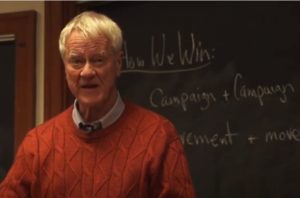
But he says progressives have largely lost that vision since the 1970s; we need to get it back. If we can get the diverse movements working together to confront their common opponents, we foster an intersectional “movement of movements” capable of creating real change—as the Scandinavians did then, with farmers, unionists, and students joining together to drive the moneyed elite from power. He warns us that polarization will get worse, because economic inequality is built so strongly into the culture. He says that we should consider organizing campaigns as “training for [nonviolent] combat.”
And we should expect those campaigns to take a while. Campaigns are well-planned (but adaptable) and sustained over time. It might take years, but you can win. One-offs (like the Women’s March at Trump’s inauguration) don’t typically accomplish change on their own. Traffic disruptions don’t make change; they just piss potential allies off. Disrupting banking operations is much more strategic because the bank is the perpetrator of the evil. How is the specific goal of the campaign advanced by this action? If it doesn’t advance the cause, don’t do it. A campaign he was involved with moved $5 million into credit unions and cooperative enterprises in one campaign that started in a living room and grew to encompass 13 states.
Oppression is only one lens we can look at things through—there are many others (he didn’t elaborate). The elite seeks to divide us (by color, gender, values, etc.)—but canny organizers look for the cracks in those divisions, and expand them. And stays optimistic, not getting stuck in “can’t be done” but figuring out how to do it.
Campaigns often start small. We can build our skills when the stakes are lower and make our mistakes then. Later, as the big challenges arise, we know how to handle them. You can lose a lot of battles and still win the campaign (eventually). And any tactic will be greeted with “this will never work” skepticism. But “Anyone who is arguing for impossibility” should remember the Mississippi Summer volunteers. When news got out of the abduction of Goodman, Schwerner, and Cheney, Lakey (a trainer of volunteers for trhat movement) expected most of the next volunteer wave to abandon their commitments—but nearly all of them stayed, mentored by Black SNCC activists who had been living with the overt racism for decades.
The best-known antidote to terror is social solidarity. Get close to people. Organize campaigns not just with those who share your goals but those who are “willing to be human with you.” Make your peace with the personal risk, face it head-on. We risk by driving on the highway, we risk by NOT meaningfully addressing climate change. Accepting the possibility that you might die in service of the common good is liberating (and it’s not the worst way to die).
SNCC survived in the Deep South without guns; they would not have survived with them. Erica Chenoweth shows us that nonviolent movements have twice the success rate of violent ones.
If you want innovation, conflict helps to get you there. Yet, conflict resolution is a crucial skill, and it’s expanded enormously in recent decadesWe need those tools and people who will jump into the fray (to use them). But if our tools are too highly structured, you need to add interventions in informal settings.
Lakey expects surveillance and isn’t worried about it: “I think it’s a wonderful thing. We take that as pride: we are so important that they put staff time and energy into knowing what we’re up to—so we’re making a difference. Gandhi told India, if you gave up fear of them, the British would be gone. If people spread fears about Trump, invoice him for the hours because you’re doing his work.”
Open letter to the government of the City of Northampton, Massachusetts
Context: Residents of a tiny one-block street called Warfield Place have been fighting to preserve a line of beautiful cherry trees planted several decades ago. The city (pop. 28,726) has claimed that the street needed to be redone and these trees are at the end of their useful life, while residents said the trees could easily survive for a few more years–and that many other streets with more traffic and worse infrastructure conditions deserved higher priority. Both sides have brought in arborists who support their positions. The residents recently brought in support from national leaders in the Buddhist community, and ordained the trees as Buddhist priests. Neighbors were actively negotiating with the city, as well as seeking help in the courts. Thursday morning, the city brought in heavy equipment and a large police presence and destroyed the trees.
For the numerous stories chronicling the controversy over the past several months, visit http://gazettenet.com and use the search tool at the top to look for “warfield place cherry trees” (nonsubscribers get five free articles per month). See more pictures of the trees in bloom taken by Shel Horowtiz (author of this open letter and owner of this blog) and protest signs at (20+) Facebook
A Warfield Place cherry tree in bloom, May 2, 2021. Photo by Shel Horowitz.
A Warfield Place cherry tree–close-up of flower, May 2, 2021. Photo by Shel Horowitz.
It was shocking to read in yesterday morning’s Daily Hampshire Gazette that the sacred cherry trees the community has fought so hard to preserve that it actually ordained them as Buddhist priests–the trees that hundreds of local residents and many others from farther afield, including several of national stature, signed petitions and joined protests and wrote letters to the editor to save–were torn down with no warning, even while the city was aware that a judge was considering a restraining order, and even while the city and the residents of the street were still negotiating.
The trees were murdered at 9:00 a.m. and the restraining order that would have prevented their untimely death was given at noon.
Why the rush? Why the need to act unilaterally when many people were willing to work out a solution that made sense for all parties: the city, the residents, and of course, the trees?
This is the legacy of Public Works Director Donna LaScaleia and Mayor David Narkewicz. All the considerable good work of the 10-year Narkewicz administration will not sustain its former reputation for progressive policies and fostering democracy. When people remember this adinistration, they will not remember how it stood against racism and for inclusion, how it was a champion of addressing climate change. Their memories will be rooted in this horrible and utterly avoidable incident.
It was an attack not only on these beloved trees, but an attack on democracy–on the ability of people to feel they have influence over their own lives, and their ability to have their concerns listened to, and, hopefully, acted on.
And it was also an attack on separation of powers in government; the city was aware that a judge was considering the injunction that was eventually granted (too late), but couldn’t be bothered to let that process play out.
And of course, removing living trees goes against the Narkewicz administration’s long-stated goals of mitigating climate change locally. Trees are far and away our most effective weapons against climate catastrophe.
I think what may have happened was a felt need to be right at all costs–not to admit that there could have been one of several other ways forward that would have had far more positive outcomes, such as:
Harnessing the neighbors’ considerable energy into a working committee that would actively participate WITH the Department of Public Works Director to develop solutions that worked for the city and the residents. Even if the ultimate outcome were the same, the residents would have owned it.
Moving Warfield Place off the calendar for a few more years until the trees died naturally, while adding plantings of newer trees so when that day came, the street would have a decent tree-canopy-in-process.
Redirecting the construction funds to a city block whose need for repair was undisputed.
This need to be right, to save face, culminated in an extreme wrong. The city engaged in a “process” that not only disenfranchised the Warfield Street residents, ending in a hostile unilateral action–it undermined Northampton’s reputation as a citadel of democracy, a place that values its citizens’ public discourse and involvement. This violation of residents’ real concerns makes it harder for the next administration to get people to even trust–let alone become involved in–city government. And the city has even created a construct where it faces accusations of a hate crime–even though Mayor Narkewicz spent so much of his decade as mayor creating a wonderful climate of acceptance and even embrace of diversity.
It’s very sad. It’s irreversible–the trees are gone, democracy was seriously weakened, and the city’s reputation is in tatters–and it was completely avoidable. I expected better of Northampton and am deeply disappointed.
While we can’t bring the trees back, and this action has done potentially permanent harm to Northampton’s civic virtue, it is still possible to atone. I ask in all seriousness: How, specifically, will the city make restitution? How will this administration restore confidence in the city? How will the city offset the negative climate impacts of the tree destruction? And how will the city make the residents and neighbors of Warfield Place whole again? It won’t be easy, especially this close to the end of this administration, but it has to be done, and done very soon. What exactly is the plan?
Americans think of ourselves as a “can-do” people. Over the course of its history, the US has often been in the vanguard, with the rest of the world playing catch-up later. The US was especially good at technology, pioneering innovations ranging from the interchangeable parts that made mass production possible to the amazing moon missions that took less than seven years from JFK’s speech at Rice University to Neil Armstrong’s “giant leap for mankind” as he became the first person ever to set foot on the lunar surface, to enormous leadership in green energy from the 1970s into the 1990s.
And Americans often see ourselves as the greatest country in the world. In many ways, that image is correct. We have amazing natural and scenic resources, a wide diversity of people, cultures, ecosystems, and more. We are very resilient, even scrappy at times. We have a democracy that has not only lasted but expanded. We’ve birthed may popular movements for justice and liberation, and experiments in new ways to form community, that went around the world.
And despite the perception of American exceptionalism–that we’re a beacon to the rest of the world–there are many areas where the US is far, far below “the best in the world.” This could be a much longer list, but here are a few examples:
Although US police forces are far more heavily armed than those in many other countries, our crime levels are worse than most countries; we are the 50th most dangerous out of 132 countries ranked.
59.5 percent stemmed from a race/ethnicity/ancestry bias.
18.6 percent were motivated by religious bias.
16.9 percent resulted from sexual-orientation bias.
2.2 percent stemmed from gender-identity bias.
2.1 percent resulted from bias against disabilities.
0.7 percent (58 offenses) were prompted by gender bias.
My guess is that these terrible statistics don’t even count police murders of people of color.
What is the Real America?
Technically, America is much more than the US. It’s everything from the northern tip of Alaska to the southern tip of Argentina–and Americans live anywhere within. But right now, I’m just talking about the US.
And the answer is…all of the above, and more. Our diversity is part of our resilience and our strength. But our education (in school and out, and that includes social media) tends to sharpen our existing divisions and make it hard to find people who disagree with us–let alone have those meaningful, structured conversations that explore how we can work together with people who are not like us.
And it hasn’t helped that the current president has repeatedly and publicly embraced racism, misogyny, ableism, and difference, while promoting suppression of real news and science, monolithic social mores that ignore or (sometimes even physically) attack different perspectives, and dictatorships in other countries. A president who has put children in cages, essentially closed the borders to legitimate asylum seekers (long before COVID), slashed the safety net, appointed a likely child abuser to the Supreme Court, and made a mockery of our cherished democracy.
This Moment: A Time for Action
Many things are changing in our society this year:
The pandemic has changed the way we interact–and created a ridiculous ideologically based divide between those who take precautions and those who don’t
Anger around police mistreatment has created a mass movement
COVID has shown that our entire society can pivot, that all those “impossible”changes around issues from climate change to racism are actually less drastic than what we’ve already changed
In short, the cauldron is bubbling. What emerges depends on what we put in–but this could be a time to Make America Great, finally.