Trying to make sense of these complex issues isn’t easy. It’s something most progressive Jews struggle with constantly. This is very much a personal piece, based on grappling with this situation since I was a small child. I don’t claim that this post speaks for anyone other than myself.

To complicate things, the words “zionism” and “antisemitism” have wildly different meanings to different people. I define zionism as the tenet that Jews, like other ethnic and cultural groups around the world, have the right to a homeland of our own.

The version of zionism I was raised with was an idealistic extrapolation of this principle that embraced the social experiments in Israel, such as intentional communities (notably the kibbutz and the moshav), women’s equality extending even to compulsary military service, and the commitment to agriculture and reforestation that would “make the desert bloom” as it had in biblical times. This happy, upbeat vision even had a soundtrack: happy, upbeat Israeli songs in Modern Hebrew such as “Tzena, Tzena,” popularized here in the US by the politically progressive quartet The Weavers in 1951.

But it was also rooted in the shameful slogan, “a land with no people for a people with no land”: a racist lie that ignored the thousands of years of Palestinian history dating back at least as far as the Old Testament battles with the Philistines, a lie that was used to justify the Naqba (also spelled Nakba)—the expulsion of tens of thousands of Palestinians from what is now Israel—and the continuing oppression of Palestinians both within the Green Line that marked Israel’s 1948 borders and in the West Bank and Gaza, which are still majority-Palestinian but have been under Israel’s control since the 1967 war.

Another myth underpinning the idealistic version of zionism is the idea that Israel, the lone democracy and only non-Muslim country in the region, was our democratic outpost, the only place championing human rights in a region that was openly hostile to Jews and to Israel: the little David surrounded by heavily armed Arab Goliaths who wanted to drive Israel into the sea.

The human rights champion part would be great if it were true. But Israel’s society is stratified. In 1986, when we first visited, there was still a clear prejudice in favor of Jews of Eastern European origin or born in Israel or Palestine; Sephardic Jews from Spain and Portugal were second-class citizens, third class for those from Turkey, Iran, and the Arab countries, fourth class for those from Africa—and the non-Jewish Arab populations, whether Muslim, Christian, or Druze, were at the very bottom.

The first two classes had integrated by the time we returned in 2014, but the rest of the stratification remained. Discrimination against Arabs and Palestinians remains rampant. From roadside checkpoints to destruction of their villages and orchards, long imprisonments, and more, Israel has fomented oppressive conditions for the populations under its heel.

This certainly didn’t start under Netanyahu, but he has made it much worse, culminating in the genocide of the Gaza war and its continuing aftermath.

Another strain of zionism is the post-Holocaust push for a Jewish homeland so there would always be a refuge for Jews, historically marginalized, ostracized, expelled, and murdered for more than a thousand years—a way of giving teeth to the “Never again” slogan that sprouted as the truth of those awful years started to come out. It was that experience that gave wings to the dream of a Jewish state.

The movie “Israelism” is a really good analysis of how we Jews in the US were raised to believe we were doing good for the world in our zionism—how good a job the propagandists for Israel did at inculcating these messages and beliefs across US Jewish society—even as our heroes from David Ben-Gurion and Chaim Weitzmann to Golda Meir secretly embraced ethnic cleansing and driving the Palestinians out.

*                                   *                                   *

Antisemitism is prejudice against Jews. It’s an odd choice of word, because Arabs are also Semitic peoples. For progressive Jews, it is something completely separate from criticism of Israel or sympathy to the Palestinian cause. I claim a right to criticize Israel, just as I criticize the government of my own country (especially in its brutal and disgusting current incarnation). In fact, I’ve criticized and protested against every US president since Nixon, who was elected when I was eleven—yes, even Carter, Clinton, Obama, and Biden. They all did things I thought were wrong, and I wasn’t shy about writing letters or showing up for—or even organizing—demonstrations or lobbying my elected officials to change those policies.

But in the right-wing Jewish world, any criticism of the Israeli government, even the current genocidal one that by comparison makes even the horribly cruel Stephen Miller look relatively tame, is labeled antisemitism. Ditto any endorsement of the Palestinian cause. Somehow, these people can’t envision a world that has room for both Jewish and Palestinian homelands.

These would-be censors have gone so far as to add a rider to a military spending bill protecting Israel from boycotts. This passed the US House last September but, thankfully, as far as I can tell, has not been taken up in the Senate. We’ve also seen the punishment of pro-Palestinian students such as Lebanese Mahmoud Khalil and Turkish Rumeysa Ozturk, imprisoned and deported (Khalil) or threatened with deportation (Ozturk) over their criticism of Israel.

This ridiculous conflation of opposing the Israeli government with hating Jews goes back decades. In the 80s, I was in a group called New Jewish Agenda that advocated a two-state solution. For this, we were ostracized and marginalized within the mainstream Jewish community. We did not get speaking opportunities at synagogues. I am amazed to watch Jewish Voice for Peace emerge from similar marginalization in recent years to become the main US Jewish voice for Palestinian rights. I’ve been thrilled to see integrated Israeli-Palestinian peace groups such as Combatants for Peace and Standing Together get those synagogue speaking opportunities in the last 20 years or so.

And yet that right-wing narrative is so embedded in mainstream Jewish institutions that I know many people who are in pretty much basic agreement with me on so many other issues but can’t overcome their own Islamophobia or anti-Arab bias. They still see any criticism of Israel, especially from non-Jews, as antisemitism. They call NYC Mayor Sohran Mamdani, who constantly makes pro-Jewish statements and has Jewish advisors, an antisemite even as they paint their signs for the next No Kings march—because Mamdani has accurately called out the Netanyahu government’s war crimes, protection of anti-Arab extremists, and oppression of its own Palestinian population.

In fact, this post was inspired by a conversation on Facebook that started with me praising Mamdani for his comment in response to having higher poll ratings than Netanyahu among NYC Jews: “My focus is on delivering for each and every New Yorker, and I’m proud to be the mayor of the city with the largest Jewish population in the country” and pointing out that he has made many pro-Jewish statements in his time campaigning for and serving as Mayor.

That generated two comments from this camp. “I am not at all impressed with him. His stance on Israel and Jews is dangerous and deplorable.” and, in response, “I agree. Look, he’s entitled to his opinion about the Middle East. But keep it to yourself, Zohran. Your job is to make NYC a more liveable city. Focus on that and you’ll get great support. Stop talking about Bibi (who I dislike, too, but for different reasons).”

My immediate response was:

I have actively looked into a bunch of accusations that claim Mamdani is antisemitic. If I could find any, I’d immediately stop supporting him. However, what I find each time are the ACCUSATIONS of antisemitism rather than any actual speech or action that is against Jews. He has been loud and consistent in condemning Netanyahu and Israel’s present government, yes. But that’s not antisemitism. It is condemning genocidal, brutal attacks on Palestinians and Lebanese and claiming to do so in the name of all Jews. Well, I am Jewish and I condemn Netanyahu and his genocide. Just as I speak out as a citizen of the US against the brutal policies of this government and its insistence that the government only has to represent right-wing so-called able-bodied, cis, straight, mostly male Christian Nationalists—who are not Christian, if you read Christ’s words—so I speak out against what is happening in my name over there.
What’s even worse is the way right-wing Jews insist on conflating criticism of Israeli policies with hating Jews. IMHO, that leads directly to more antisemitism, because the haters say, “look, the Jews are telling us that all Jews support Israel’s government and that government represents all Jews. THAT leads to wildly negative outcomes. Ignorant people will ingest that sick messaging and then commit pogroms—just as ignorant people in the US right have attacked immigrants, trans people, and others who got on this administration’s bad side.
This post is a longer response.


Facebooktwitterpinterestlinkedinmail

Democracy itself is at stake in this election. If you choose not to vote, or you cast a vote for a 3rd-party candidate, you may never have the right to vote again. You’ve probably heard about the Heritage Foundation’s Project 2025—but have you looked at the details? Fasten your seatbelts—this one’s scary! Heritage’s president, Kevin Roberts, actually said it out loud: he’s attempting to conduct “the second American Revolution, which will remain bloodless if the left allows it to be…There are parts of the plan that we will not share with the Left: the executive orders, the rules and regulations.

But what they did commit to paper is bad enough: an approximately 900-page blueprint for a fascist takeover of the US including an agency-by-agency roadmap for the first six months of a second Trump administration. Project 2025, written with input from somewhere between 85 and 100 senior Trump advisors and endorsed by J.D. Vance in his foreword to the main author’s book, will attack our freedom in many directions. Here are five of the awful things they are planning to do:

  1. Viciously attack immigrants with massive deportations and detentions that would be far, far worse than the criminal cruelty of Trump’s first administration (this link outlines all the immigration points I summarize below)
  2. Attack women’s reproductive rights, LGBTQ rights, and women’s equality—starting with banning abortion in all 50 states.
  3. Act as if the climate crisis doesn’t exist: wildly ramp up dirty energy sources like oil, coal and nuclear while destroying green energy programs. According to the Sierra Club, “Project 2025 is essentially a death sentence for federal climate and environmental protections.
  4. Eliminate DEI (Diversity, Equity, and Inclusion) programs—and further enable Trump’s long history of open and blatant racism, from the 1970s right up to his recent race-based attacks on Kamala Harris, to be just the outward face of seriously cruel policies..
  5. Eliminate the right to vote for millions of people, through obscenely difficult registration procedures, reduction of polling places in areas that vote Democratic, and even bringing armed thugs to polling places to discourage voters of color—and, from all appearances, try to maintain power indefinitely. Trump even publicly told a so-called Christian Nationalist audience (if you look at what Christ said, they’re not Christians), “You got to get out and vote. In four years, you don’t have to vote again. We’ll have it fixed so good you’re not going to have to vote.

Because this article is a project of Jewish Activists for Immigration Justice, let’s look more closely at the horror of Project 2025’s immigration proposals. You can find equally horrifying parts attacking civil rights, social equity, women’s reproductive freedom, the environment, and even education itself. According to the Niskanen Center, a centrist think-tank, Project 2025 would demolish legal immigration and make the US less safe while inflicting significant damage to the US economy

Specific policies within Project 2025 are a fascist’s dream and a progressive’s nightmare. To list just some proposals, it would:

  •       Choke off many types of legal immigration (even for survivors of crimes)
  •       Cut off federally funded student loans from up to 10.7 million US students at schools that grant in-state tuition to DACA recipients and undocumented students
  •       Ban most immigration from 13 countries that refuse to receive deported nationals
  •       Repeal ALL Temporary Protected Status (TPS) designations (putting about 700,000 long-term US residents at risk of deportation)
  •       Stop processing refugee immigration applications
  •       Eliminate work permits for many immigrants, denying them jobs and creating a burden on taxpayers
  •       Require immediate expulsion if Customs and Immigration Service denies an application, even for simple paperwork errors, and even for people with valid Green Cards
  •       Force state and local governments to provide driver’s license and other data to the feds—pretty much ending Sanctuary communities around the country
  •       Eliminate ALL privacy protection for those without documents, leading to risk of harassment by private vigilantes and deportation or incarceration by federal agencies
  •       Evict from public housing mixed-status families that include citizens or green card holders and people without documents

Immigration justice activists will also be badly hurt by non-immigration-related parts of both Project 2025 and Trump’s own hate-filled speeches such as how to handle dissent and dissenters.

“We pledge to you that we will root out the communists, Marxists, fascists and the radical left thugs that live like vermin within the confines of our country that lie and steal and cheat on elections…They’ll do anything, whether legally or illegally, to destroy America and to destroy the American Dream…the threat from outside forces is far less sinister, dangerous and grave than the threat from within. Our threat is from within…” 
Donald Trump, speaking at a rally in Claremont, NH, November 11, 2023

Note that the “vermin” wording is one of several times Trump has plagiarized from Adolf Hitler. That’s not a coincidence.

If Trump gets back into the White House, many progressives might have to organize from inside the walls of prisons and detention centers. Proposals to stop dissent from those who lean Democrat and other supposed “enemies” include:

Another deeply worrisome batch of proposals would centralize government power in the White House and eliminate even the weak protections against corporate greed that now exist: Project 2025 aims to:

  •       Move control of the Federal Communications Commission (which regulates TV, radio, telephone, etc.) and other public protection agencies directly under the White House while eliminating the Departments of Education and Commerce entirely
  •       Permanently eliminate career managers and replace them with political appointees loyal to Trump

Coupled with the recent Supreme Court Trump v. United States decision giving presidents they like unlimited powers to quash dissent, including even assassinating their enemies, we need to take these threats—and all the other threats wrapped up in Project 2025 and in Trump’s own words—VERY seriously.

And to those who voted “uncommitted” in the Democratic primary to protest Biden’s way-too-enabling response to Netanyahu’s massive crime in Gaza, let’s not forget that Trump has not only called for detaining/deporting Pro-Palestinian students and their allies but has told Israel to “finish the problem,” encouraging the Israelis to continue on the path toward genocide.

Sitting out this election or voting 3rd-party is not an option if you want to protect democracy and prevent fascism. Without ranked-choice voting, any vote other than for the Democratic nominee is a vote for Trump and his brand of fascism.  Is Harris perfect? Certainly not. But elections in a two-party, winner-take-all election are not about getting the perfect candidate. They are about who we’d rather be organizing against or trying to impact!

Although on a number of key issues–especially immigration justice and the war in Gaza–Harris is far from where we want her to be, we activists across the country will have a much better chance to extract concessions from a Harris-Walz administration than from the fascist alternative. As Abraham Josephine Riesman wrote in Slate, progressives do influence the Biden administration: “They have, at times, responded to pressure from their left wing in Congress (the so-called Squad and others), as well as pressure from unions and advocacy campaigns…”

National partners in the immigration justice movement (led by those most directly impacted) confirm that progressive organizing campaigns have led to recent wins (e.g. TPS for Haitian asylum seekers, legal paths and freedom from deportation for undocumented spouses and children of US citizens).  Currently the ACLU and immigration justice groups are suing the Biden administration for their new anti-asylum executive orders.  Under a Biden-Harris or a Harris-Walz administration, these suits and advocacy efforts can move forward.  We don’t know what repressive steps would be taken if MAGA were to win.

As we continue to fight to save lives in Gaza and on the US/Mexico border, we must be assured of the best environment possible to continue to influence legislators and the administration, speak up and speak out, and push the news media to take stands in favor of peace and justice.   With Biden and Harris, we have been able to push for better policies and we have had some wins.  We need to elect Harris and Walz so that radicals will not be hunted down as they were during the McCarthy era and so we can build our movements to be as large and inclusive as possible.  This is a long-term fight, and electing Harris and Walz is just the first step.

In fact, we urge you to vote for Democrats for every contested office this time so that Harris and Walz can get things done without getting blocked by Congress, state legislatures, governors, and judges at every turn.  The choice this time is clearer than it’s ever been.


Lifelong activist Shel Horowitz wrote this on behalf of Jewish Activists for Immigration Justice, which unanimously endorses it and ran an abridged version in its newsletter. An author, international speaker, TEDx Talker, and expert in turning business into a force for social justice and environmental healing, his award-winning 10th book is Guerrilla Marketing to Heal the World. Download excerpts from the book at http://goingbeyondsustainability.com Shel acknowledges Holly Bishop and D. Dina Friedman, whose significant edits made this piece stronger.

Facebooktwitterpinterestlinkedinmail

Today, I spent two hours with my heartstrings tugged at a concert of the Jerusalem Youth Chorus—where Palestinian teens and 20-somethings from East Jerusalem sing—and compose—together with their Israeli Jewish counterparts from West Jerusalem. In June 2014 (a time of relative peace), I attended an equally moving concert in the Galilee (northern Israel) by Diwan Saz, a modern combo whose performers that night included a 10-year-old Bedouin boy (with a gorgeous voice) and a Chassidic rabbi, among others.
Those hopeful events seem far away an out of reach as we mourn the tragic and avoidable loss of over 4000 lives on both sides this month.
We have to somehow prevent even greater losses of life—and to reset!
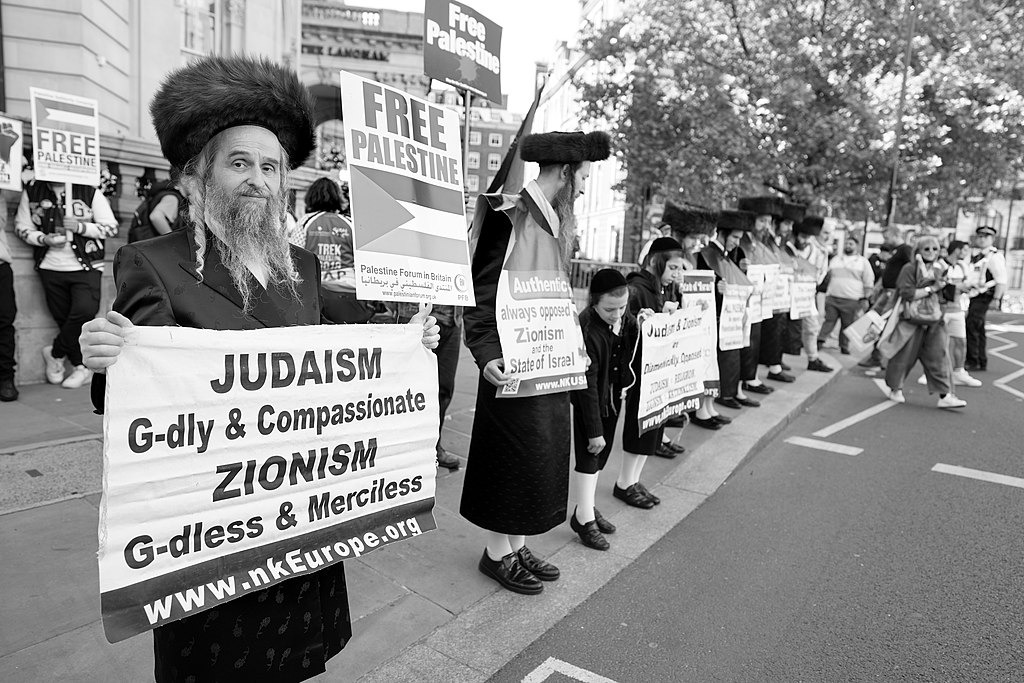
Ultraorthodox Jews protest in London for Palestinian rights. Photo by Alisdare Hickson from Woolwich, United Kingdom, CC BY-SA 2.0, via Wikimedia Commons
Let’s start with some points I hope everyone can agree on:
  1. Innocent people have been killed and hurt for decades, and nothing will bring them back
  2. The violence has not worked, no matter who commits it
  3. Both Arabs and Jews have claims on the land going back thousands of years
  4. They also claim common ancestry with both honoring a heritage that started with Abraham. They eat very similar foods, speak languages with many cognates, and have both had to adapt to the harsh desert that surrounds them.
  5. It is long past time to find a workable solution
From that very rudimentary framework, could we perhaps evolve to:
  1. We all are carrying deep hurts. An eye for an eye doesn’t just leave everyone blind, because it will eventually leap from eyes to other things. So an eye for an eye, ultimately, leaves no one standing. Can we accept not only that the past is filled with violence, cruelty, and the spewing of hatred/dehumanization—but that all sides would benefit from moving past this?
  2. Can we look to the world for other examples of long-standing hostility and violence transforming into something better—such as the Truth and Reconciliation process in South Africa and Sierra Leone and the peace process in Northern Ireland?
  3. Can we finally break the cycles of fear, hatred, and grief that seem to lock everyone into ever-deeper and more destructive cycles of violence?
  4. Can the barriers—both physical and psychological—between the two cultures be removed so that Israelis and Palestinians who are kept apart by laws and physical barricades learn to work, play, and live together; there already are several small projects that are a great start, such as:
  • Neve Shalom/Wahat as-Salam, a cooperative multicultural village;
  • Numerous other musical collaborations, including  Daniel Barenboim and Edward Said’s West-Eastern Divan Orchestra and many lesser-known ensembles;
  • Combatants for Peace, which presents touring programs featuring one person who fought in the Israeli army and another who was involved in the Palestinian resistance, now working together for peace despite some of them experiencing injuries, imprisonment, and all of them mourning the loss of friends and family members in the conflict

It takes great courage to organize for peace when the leaders of both communities feed their population an unending diet of hatred for the other side. In the Middle East and around the world, many people have been killed for trying to make peace.

I have visited Israel and Palestine twice and have family and friends (both Palestinian and Israeli) in both  Israel and Palestine (in the West Bank). I’ve stayed in the homes and hotels of Palestinians, with a Chassidic family, in a Druze village, a Transcendental Meditation village, a kibbutz, and an Israeli settler community on the West Bank. I’ve met with a blogger in Ramallah and with leaders of several Israeli peace organizations. I’ve also participated in Middle East peace groups in the US going back to the early 1980s. The vast majority I’ve talked to over the years, no matter what their ethnic or religious heritage, just want peace. The governments are not giving it to them. Surely there are better ways to solve things than yet another war in a long and brutal series of wars!
Perhaps we can take our cue from songwriter Nerissa Nields, who answers the old labor union song “Which Side Are You On? with “The world says ‘you can figure it out. Haven’t you noticed I’m round?‘”
Facebooktwitterpinterestlinkedinmail

Jews, who were forced away from Israel/Palestine more than 2000 years ago, have the “right of return” automatically. They can come and instantly claim Israeli citizenship, and the government helps them resettle–even offering intensive Hebrew language instruction. But Palestinians, who were only forced off their land in 1948, have no such right–even though some of those people are still alive and no one is more than four generations into the exile. Meanwhile, in many parts of the country, Palestinians can’t get building permits from Israeli authorities. “But they still need places to live. They still have children.” So they build illegally, and when Israel wants to up the repression, the government bulldozes these houses.

That inequity made CNN political commentator and journalist Peter Beinart (latest book: The Crisis of Zionism) very uncomfortable. As he struggled with the ethics of this inequality, he began learning more. Beinart is Jewish, has lived in South Africa, Israel, and the US,  and is very aware of the ethical teachings in classical Judaism about treating the stranger well, doing good deeds, being a good guest when you travel to others’ lands, and treating people fairly.

Over 200 people gathered on Zoom June 8, 2021 to hear Beinart discuss the prospects for peace and justice in the Middle East in a program for Critical Connections entitled “Palestinian Rights, Jewish Responsibility.” At least five rabbis were in the room, as were large contingents from both the mainstream and progressive Jewish communities. A number of Muslims were in the audience, as well.

Originally a supporter of two separate states, Beinart now sees that as impossible because of the ways the Israeli government has carved up the West Bank into “Bantustans” with Jewish settlements separating once-contiguous Palestinian areas. Instead, he has joined many Palestinian thinkers in calling for a single multiethnic state, sharing power, with parallel more-or-less autonomous governments for internal governance within each community, and offering equality for all.

Both Israelis and Palestinians would be safer with this model–just as South Africa is safer for whites as well as blacks, and Northern Ireland is safer for both Protestants and Catholics, he says. Once the dominant group gives up its total control and need to dominate, the oppressed group starts to get less hostile because the repression has eased off.

He says the late Israeli writer Amos Oz is wrong in calling for a “divorce” between Israeli and Palestinian society. “The marriage will not be easy. But it is essential.” And just as activists in the US have begun to make land acknowledgements to the indigenous people who had the land before Europeans, “acknowledgments and apologies [for past wrongs] have great healing power.”

Beinart took many tough questions, particularly from mainstream Jews worried about the security of Israeli Jews under that scenario.

  • On antisemitism from the Left: “We cannot deny that some on the Left are antisemitic–especially in recent weeks [during the exchange of bombs and rockets between Israel and Gaza]. All the Palestinian intellectuals and activists I know condemned those acts. But virtually all Palestinians will be anti-Zionist,” because Israel has dispossessed their families. It didn’t help that major Israeli statesmen made incendiary remarks. Abba Eban, for example, claimed that a return to the 1948-67 frontiers would be “Auschwitz borders.” Beinart made this distinction between antisemitism and anti-Zionism several times, and pointed out that the Palestinian statesman Edward Said was on record as appreciating the impetus behind Zionism–though not its effects on his people. Beinart also stood unequivocally against antisemitism from any source: “If Jews are being dehumanized, as Jews, we should speak up.”
  • On whether either side had a right to call the other fascist: He did not feel that Palestinians should see Jews as Nazis. But he also recognizes that there is a massive power imbalance and had strong criticism for those Jews who see Palestinians as akin to the Nazis: “If you see Palestinians as Nazis, you erase the moral responsibility of power. You frame it as survival, but the issue is denial of basic rights.
  • On how to negotiate in good faith: Both sides have made offers, but their offers were unacceptable to the other side. NNo matter how many offers have been tendered, they haven’t been able to reach common ground for a meaningful agreement so far.
  • On the safety of Israeli Jews in a single multicultural state and the danger of falling into Lebanon-style permanent civil unrest: Growing up in South Africa, he noted there was great fear among whites about what would happen when apartheid ended and blacks took power. South Africa is only about 10 percent white, while Israel/Palestine would be much more Jewish. Jews, he said, have enough economic privilege and enough political and social organization to protect their interests. He also noted several important differences between Israel/Palestine and Lebanon: Lebanon had a weak economy, a weak government with weak restraints on executive power, low literacy, and multiple invaders (Israel and Syria).Israel/Palestine is in a much stronger position. It has much higher per capita income and literacy levels, including among Palestinians, which according to political science research is correlated with democratic stability. For Jews, it also has strong judicial, parliamentary and media institutions that check executive power—those are a foundation upon to build in a state that offers equality to Palestinians
  • On whether comparisons between Israel and South Africa’s apartheid-era regime are apt. He noted that Israelis and Palestinians have vastly different experiences on a whole range of situations, from border checkpoints to land claims to obtaining various types of permits–and that numerous Israeli groups have described the occupation as apartheid. I didn’t hear him directly take a position–but he did say, “Self-determination does not mean the right for a given ethnic, religious or racial group to have a state that grants it rights that are denied to people of other ethnic, religious or racial groups in that same state.”
    . And “to be stateless is to be under the power of a government but” not to have the rights afforded citizens, or to have any agency in dealing with state power.
  • On why American Jews need to get involved and not see the conflict as an internal matter that only concerns Israeli Jews: US Jews have skin in the game because our government has a long history of supporting and funding even very extreme Israeli government positions.
  • On how to end anti-Jewish terrorism: “You have to show that nonviolence can work. When you respond by criminalizing BDS [boycott-divestment-sanctions] and calling it antisemitic, you doom nonviolence. [PLO President Mahmoud] Abbas has cooperated on security for 15 years. When you continue building [Jewish West Bank] settlements [despite that cooperation], you strengthen Hamas.” He also praised organizations such as Encounter, that provide opportunities for Jews and Palestinians to meet in structured formats, in a society that makes meaningful contact quite difficult, noting that “Israeli media doesn’t do a good job of presenting the reality of Palestinian existence. He does see hope in social media connections, and described a Clubhouse room that attracted many perspectives and was going 24/7 during the Gaza conflict: “Many of the Israelis were exposed to the Palestinian perspective, some for the first time.” This is a bilateral problem, though; he expressed concern about an “antinormalization” movement among Palestinians..

Author’s note: I have done my best to render material within quote marks as accurately as I can, but they are from handwritten notes–and while accurate in substance and meaning, may vary from his exact words. Also, I’ve grouped comments that were thematically related; this article does not attempt to put Beinart’s remarks in the sequence they were presented.

To read or subscribe to Beinart’s blog, visit peterbeinart.substack.com

Shel Horowitz is Editor of Peace and Politics Magazine and a peace activist for over 40 years. His latest book is Guerrilla Marketing to Heal the World.

Facebooktwitterpinterestlinkedinmail