“In a world that seems like chaos, your reflections are rebellious, daring and needed.”
My birthday sparked a lovely exchange with a devoted fan of the daily Gratitude Journal I’ve been posting on Facebook since March (and plan to turn into a book). She gave permission to post her comments, but not her identity. Hers are in regular type, and my responses are in italic:
Happy Happy Birthday! And I love all the gratitude and aha moments that you share. That level of reflection is an art unto itself. Sometimes being present is the best present we give to ourselves and others. HAPPY BIRTHDAY! Celebrate well!
Thanks for your sweet and thoughtful message. It means a lot that the work I do here is appreciated by you and others.
It really is. And what a journal to capture the rollercoaster that is that life-is-so-daily, so stand up for what you believe in, get outside to appreciate the places around you, love your people and carpe diem.
You teach us and re-affirm that with every post. In a world that seems like chaos, your reflections are rebellious, daring and needed. Your posts remind all your readers that little moments matter, that meals matter, that who we spend time helping matters, that community is important. All those messages are needed in the cacophony of today’s world.
And that’s exactly why I do it! I believe that modeling the world I want to live in actually does help create that world. I try not to attack people personally even as I vehemently disagree with them (though some in the current administration, as well as some of the trolls, make that very challenging). I try to share more posts about people repairing the world than destroying.
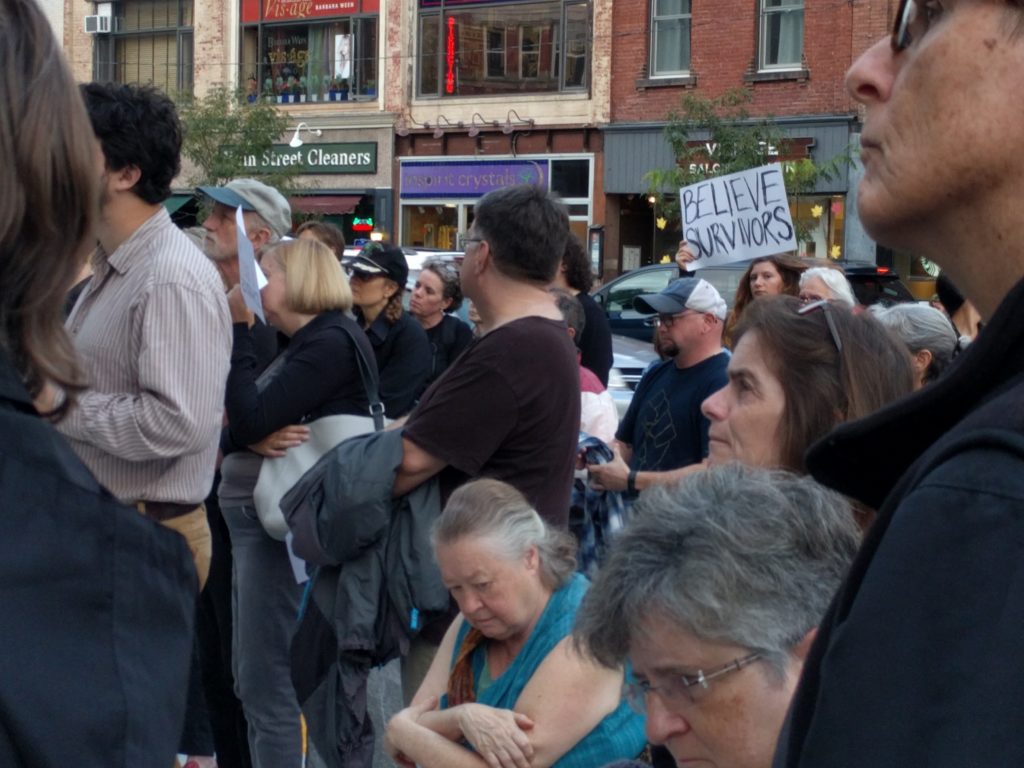
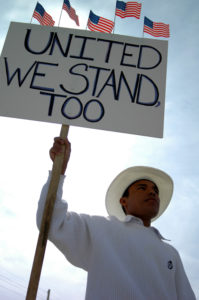
#WeBeleiveHer demonstration supporting Christine Blasey Ford -Northampton, MA, 9-27-18. Photo by Shel Horowitz
This month, in my newsletter, I’ll be reviewing Our Search for Belonging: How Our Need to Connect is Tearing Us Apart, by Howard J. Ross with Jonrobert Tartaglione. Ross, of course, wrote well before Brett Kavanaugh was nominated to the Supreme Court. But as I was reading, the relevance of his work to the Kavanaugh/Ford hearings stood out for me.
I am a survivor of childhood sexual assault. The attack happened when I was 10 or 11, but I didn’t tell anyone until I was 16. That didn’t make it any less real or any less painful. It was the defining trauma of my life.
The Senate hearings brought something home to me:
White, straight men with economic privilege attacked Dr. Ford for speaking out, for not speaking out right away, for not presenting enough evidence (when the Republicans refused her attempts to call witnesses or have an outside investigation). White, straight men with power were in such a great rush to vote in someone who made obvious lies under oath and may well have been a serial sexual assailant that they belittled her and lionized him. Meanwhile, white, straight men without economic privilege made death threats against her and forced her from her home. White, straight men defended the high school and college rape culture even while accepting Kavanaugh’s unconvincing explanation that he was far too pure to have participated in that oppressive culture–despite considerable evidence to the contrary on his own calendars and yearbook.
In Ross’s paradigm, those white straight men have set up an us versus them situation. They’ve turned Dr. Ford–and by extension, any survivor of sexual assault, including me–into “other”–something to marginalize, ignore, and/or discredit (my choice not to say “someone” is deliberate, because dehumanizing is a lot of what happens in these “other” situations). While both the Left and the Right engage in this kind of behavior, from my point of view, the Right uses the tactic both more viciously and more consistently).
Watching the highlight video clips, I found Ford quite credible. Watching Kavanaugh attack her, I perceived a sense of entitlement, attempts to dehumanize, and even the tired old tactic of calling the whole thing out as a partisan attack–not to mention that his testimony was crammed with false statements. It sickened me, just as watching Clarence Thomas use similar tactics to deflect similar accusations against him sickened me in 1991. To the Kavanuaghs and Thomases of the world, as a survivor of sexual assault, I will always be an outsider, even though I am male.
In Ross’s view, one key piece of identity politics is the difference in perception between members of the dominant and non-dominant groups: members of dominant groups typically don’t often think about the experience of those in non-dominant groups. Yet, a person of color or a woman or someone who identifies as another type of minority experiences daily reminders that society puts up physical, psychological, economic, and other barriers.
The Kavanaugh/Ford hearings illustrate that difference in perception really well.
I think many of us perceive ourselves or are perceived by others as outsiders in various ways. I have certainly experienced that as a Jew, as a northeastern progressive, as an activist, as someone involved in various liberation struggles. Yet, to a person of color or a Muslim, I would be perceived as part of the in-group that excludes them. That these categorizations are fluid was brought home to me when I ran for City Council in my town, in 1985. I knocked on the door of a man who said, “You’re Jewish, I’m Polish. We’re both Eastern European. We have to stick together against the Irish and Italians who run this town.” I had seen the Polish population as very much a part of the majority culture in this area, and I, as a Jew, was an outsider; he saw it differently, and that opened my eyes.
In the Kavanaugh case, the ignoring strategy no longer worked, so he moved to attempts to discredit, presenting a wide range of emotional behaviors in the process.
Back when I was representing domestic violence survivors in their family law cases, I witnessed a very high proportion of the abusive men on the other side cry in court. For a long time, I thought it was intentionally manipulative, but after a while I came to see it as genuine decompensation as they confronted for perhaps the first time their inability to control the realities they had constructed. For once, someone else — their victims, the court — was writing the script, and they simply couldn’t handle it. The mirror held up to their behavior undid them, at least temporarily; even more so, the loss of control over their little worlds.
If I had had any doubts previously about the truth of the allegations against Kavanaugh, they disappeared when I heard him sniffling his way through the small part of the hearings I listened to yesterday. The angry outbursts I read about later further sealed the deal. I found myself not just certain the assaultive behavior had occurred, but concerned about his wife and daughters — a man who would come that undone during high profile hearings is almost certainly still engaging in those behaviors, in my experience, and I’d wager he’s still a problem drinker as well.
The old white guys in the Senate, and the one in the White House, are similarly breaking down. They are grasping desperately at their control of the world, the reality they have lived for decades, and they are angrily and sometimes tearfully acting out as it is slowly but certainly removed from their collective grip.
The fall of white male supremacy really is happening right now, in painful slow motion, and it is deadly for sure: survivors of domestic violence are at the most risk when they finally decide to leave.
Now more than ever, we need to support one another, we need to make collective safety plans, and we need to keep working to leave white male supremacy behind.
When an American father-to-be asked Dear Abby for advice because his Indian wife wanted to use an ethnic-heritage name and he didn’t, she responded:
…Not only can foreign names be difficult to pronounce and spell, but they can also cause a child to be teased unmercifully…Why saddle a kid with a name he or she will have to explain or correct…from childhood into adulthood?
Seeing this as a social justice issue, I could not let her answer go unchallenged. Here’s what I wrote:
Abby, I’ve been reading your column since 1981, but your answer to “Making Life Easy” made me cringe! Part of what makes the US great is our habit of celebrating our cultural diversity, with festivals, ethnic cooking, and yes, our children’s names.
First, every culture will have names that are hard to pronounce and spell–but also easier ones. My own children’s names, Alana and Rafael, are both derived from Hebrew and celebrate their Jewish heritage. Honoring that culture felt all the more important because we live in a community where Jewish is exotic. We rejected names that were too hard to pronounce, like Chanoch; Recognizing that most Americans can’t pronounce the ch, I didn’t want my son to be “Hano.” “Making Life Easy”‘ and his wife will have hundreds of beautiful, pronounceable Indian names to choose from, such as Priya or Krishna.
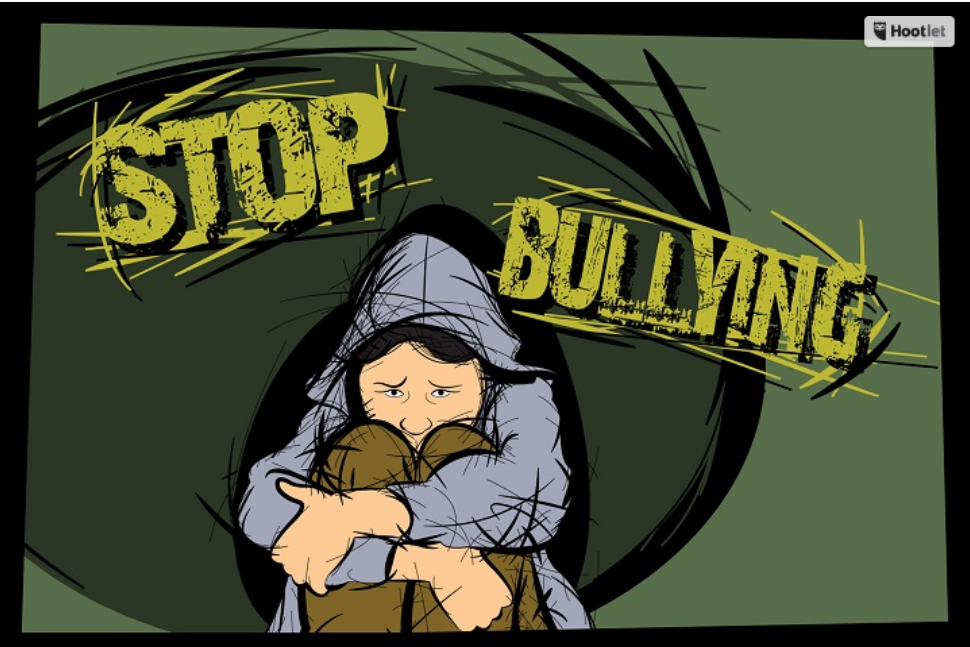
This beautiful anti-bullying poster came from the US military’s health site, health.mil
Second, the argument about teasing is weak. Bullies will find a reason to tease. If the kids have ordinary names, bullies will pick on them for their skin color or ethnic background, for their good grades or their bad grades, for whatever point of difference they find. And bullies also tease kids about Western names (growing up as Sheldon, I speak from personal, painful experience; names like Sheldon and Norman were often chosen by American Jewish families that wanted to seem more assimilated). The way around this is not to remove any possible fuel for their bad actions–impossible anyhow–but to create a culture in the home and school that teaches respect for and acceptance of difference. This responsibility falls on both parents and educators. My own kids attended a school with zero tolerance around bullying, a school that created a welcoming and accepting culture for all types of children–and we reinforced this in the home, as my mother reinforced it for me when I was growing up.
I believe the self-acceptance I developed as the parent of self-accepting kids proud of their heritage and happy to celebrate the heritage of others helped me find my way to the work I do: working with businesses to identify/create/market profitable offerings that turn hunger and poverty into abundance, war into peace, and catastrophic climate change into planetary balance. I could not have thought so big if I hadn’t learned to feel pride in who I am and my power to make a difference.
Not ashamed to sign my real name.
Shel Horowitz, Hadley, MA
PS: whether or not you publish this letter, please share it with “Making Life Easy.” Ignoring his wife’s wishes could cause both marital discord and shame in the child’s culture of origin.
<End of my letter>.
What do you think? Please add your comment, below. And BTW, I found this list of 100 recommended but unusual boy names, which features ethnic choices such as Arian, Bodhi, Camilo, Cortez, Dimitri, Dangelo, and Enoch–in just the A through E part of the list, and just one gender.
Why This Matters: A Metaphor for Something Much Deeper
Why am I going on about this? Why does it matter? Isn’t it just some people having fun making a feel-good film?
Answer: I do marketing and strategic profitability consulting for green and social change organizations, as well as for authors and publishers–and I’m also a lifelong activist. This combination of activism and marketing gives me another set of lenses to filter things, as well as a magnificent toolkit to make the world better. My activism also brings a strong sense of ethics into the marketing side.
Both as a marketer and an activist, I pay careful attention to how we motivate people to take action–to the psychology of messaging, One category for this post is psychology; click on that category to get posts going back many years. I worry deeply about our tendency as a society to crowd out facts with emotions. (I also worry about another tendency, to crowd out emotions with facts, but that’s a different post.)
And this is an example of crowding out facts with emotion. While this particular instance is innocuous as far as I can tell, we see examples of overreach on both the left and right, and they work to push us apart from each other, talk at each other instead of seeking common ground, and push real solutions farther and farther out of reach.
My inbox is full of scare-tactic emails from progressive, environmental, or Democratic Party organizations. Because I’m in the biz and understand what they’re doing, I leave most of them unopened. I just searched my unread emails for subject lines that contain the word “Breaking” and came with hundreds, including this one from a group called Win Without War:
An unarmed man with a small flag stops four Chinese tanks in Tiannanmen Square, Beijing,
It’s a clear attempt to generate hysteria, to have people perceiving tanks in the streets with their guns pointed at dissenters.
Only in the body of the email do we find out what’s really going on:
Shel —
Last night, the Washington Post broke the story that Donald Trump has ordered a giant military parade with tanks, guns, and troops taking over the streets of our nation’s capital. [1] This is the kind of parade that dictators around the world use to intimidate their enemies and, more importantly, their own citizens.
This is what authoritarian dictatorships look like.
But Trump can’t change the fact that we still live in a democracy — which means Washington, D.C.’s local government gets to have a say before Donald Trump’s tanks roll down its streets.
Note the use of mail merge software to appear personal. Does that really fool anybody anymore? But OK, even when you know it’s a mail merge, it still generates at least a small warm fuzzy.
More importantly, note that the actual content is totally different from the expectation in the headline. We can argue the foolishness of Trump wanting a military parade (I think it’s foolish, and an expensive attempt to stroke his ego)–but in no way is this the same as attacking demonstrators in the streets of Washington, DC.
The right wing is at least as bad. I don’t subscribe to their e-blasts, but I found this juicy example (with an introduction and then a rebuttal by the site hosting this post) in about ten seconds of searching.
And then there are DT’s own Tweets, news conferences, and speeches, both during the campaign and since he took the oath to uphold the constitution as President of the United States (an oath he has been in violation of every single day of his term). They are full of lies, misrepresentations, name-calling, bullying, and fear-mongering. They are hate speech. I will not give them legitimacy by quoting them here; they’re easy enough to find.
As a country, we are better than this..
How You Can “Vaccinate” Yourself Against Sensationalist Fear-mongering
Before sharing any news story or meme, run through a series of questions to help you identify if it’s real.And if it passes that test, pop on rumor-checking site Snopes and check its status. For that matter, go through a similar questions for advertising claims.
The questions will vary by the situation. Here are a few to get you started:
Does the post link to documentation? Are most of the linked sites reputable? If they advance a specific agenda, does the post disclose this? (Note that THIS post links to several reputable sites, including NPR, New York Times, history.com, Wikipedia, Youtube, Google, CNN, Snopes, and my own goingbeyondsustainability.com and greenandprofitable.com. Yes, I am aware of the issues in using Wikipedia or Youtube as the only source. I am also aware that Google gives them a tremendous amount of “link juice” because on the whole, they are considered authoritative. For both those citations, I had plenty of documentation from major news sites.) Strong documentation linking to known and respected sources is a sign to take the post seriously.
Does the post name-drop without specifics? See how the Win Without War letter mentions the Washington Post but leaves out the link? Remember that ancient email hoax citing longtime NPR reporter Nina Totenberg? Name-dropping to buy unsusbstantiated respect is not a good sign.
Are the language and tone calm and rational, or screaming and sensationalist or even salacious?
Is the post attributed? Can you easily contact the creator?
And last but far from least, the most important question: Who benefits from the post’s point of view ? What are their relationships to the post’s creator? (Hello, Russian trollbots!). Don’t just follow the money. Follow the power dynamics, too.
I could go on but you get the idea. Please share your reactions in the comments.
The latest nonsense emanating from the keyboard of Our Shameless Tweeter
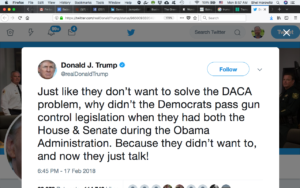
DT’s Tweet on Democrats failing to pass gun control
is a good chance to parse out what he really means when he says or posts something. I’ve watched what he does pretty closely for the past 2+ years, and I’ve spotted some patterns worth sharing. Let’s start with five that show up in this Tweet:
He blames his failure to act on others
He deflects by bringing in unrelated issues (DACA, this time)
When he creates a mess, he blames others—and almost never accepts responsibility or offers a meaningful apology (DACA wasn’t a problem until HE yanked the rug out from under those kids—and oh yeah, it was none other than DT who revoked the Obama restrictions on people with mental illness acquiring guns))
If he feels criticized, he defaults to bullying or name-calling
He sees anything connected to Obama as hopelessly tainted
And plenty of others:
He takes credit when others accomplish something
He attacks randomly at the first whiff of criticism—lashing out even at those who’d thought of him as a friend or ally—and his wrath extends both to individuals and entire populations (women, people with disabilities, Mexicans, Muslims…)
Having lived his entire life in extreme monetary privilege, he has zero understanding of the hardships people at the bottom of the ladder endure, and zero empathy for those who endure them
He loves to waste taxpayer money on grandiose, useless (or even harmful) projects like the border wall , the politically suicidal move of the US Embassy in Israel to Jerusalem, or the massive military parade he demanded recently
Driven by Id, he acts impulsively, often in direct opposition to the few of his advisors willing to risk giving him honest advice—and doesn’t mind risking a war or other extreme negative outcomes in the international arena
He acts in a vacuum, without studying trusted journalistic sources or even reading intelligence briefs
He appoints people with little or no relevant experience and charges them with destroying the agencies they are supposed to run
He shows no understanding of checks and balances, freedom of the press, the reasons why government officials aren’t allowed to take money from foreign governments, or of constitutional law generally; he seems to think he should have absolute power and that he can use the presidency to enrich his personal fortune
Last in THIS list but certainly not least, he has been accused by at least 20 women, including his first wife, of being a sexual predator (this doesn’t count the many consensual encounters, including the recent disclosures involving Stormy Daniels and other porn stars)—and acknowledged his predatory behavior in the infamous Access Hollywood video
In short, the man has a disgraceful personal reputation as a serial liar, molester, and fraud—before we even look at his terrible handling of domestic and foreign issues as president.
Will someone please write a guide for me now? Please explain how this backstabbing, hypocritical incompetent cheater can still find people who thinks he is doing a good job.
But many times, I’ve heard phrases like “she’s basically a good person” used similarly.
Language is very important, and framing even more so. I agree that these phrases (for either gender) have been used to excuse all sorts of horrible behavior that should never be accepted. But change happens when we meet people where they are and find ways to move them further. This is typically a slow, gradual, incremental process. And the only way it ever works is if you approach your opponent with the idea that he/she is basically good. We as activists must be especially careful to keep that understanding top-of-mind. Far too often, we demonize our opponents and drive even more wedges, when change might happen if opened sincere opportunities to be heard, to listen, and to grapple with our differences instead of building walls of name-calling and accusation. It’s a marketing activity. And we market our ideas to those who disagree by finding pieces of their ideas we can agree with and build from, or at least that we can respect.
Sometimes, we even need to validate that they feel they haven’t been given a fair shake, and then show how the way to get that fair shake is not by pushing others down who are climbing up behind them, but by building ladders to help everyone rise. This is slow, difficult work, but also immensely rewarding. I’m no expert in this area, but I’ve seen it work miracles.
Effigy of “the Donald,” photographed by Shel Horowitz at the Climate March, April 2017, Washington, DC
Sometimes, it’s quite challenging. I heard DT speak in 2004 and was repulsed even then. His behavior in the last few years is beyond despicable. When I think about how I would behave if I had the chance to confront him, I can’t find much good—but I do see him as reachable through his misery. I see him as a deeply unhappy person, traumatized by a tyrannical father, someone who hasn’t found contentment even while accumulating a vast fortune, celebrity status, and the most powerful job in the world.
So I would go into the room searching for what it would take to make DT a happy person and give him a purpose in making the world better, knowing that the answer would eventually end the abuse, lies, misogyny, racism, and all the other crap he brings to the table.
Have you seen the infamous Pepsi ad that’s been called “tone-deaf” by progressives, and which Pepsi pulled quickly? Before you read the rest of this post, please write your impression of it in the comments.
And I agree with Whoopi: the message is about inclusion.
Yes, it is co-opting the movement. Advertisements have always co-opted cultural memes. If you wear $60 torn jeans, you can thank the hippies and grunge-punks who wore their clothes to rattiness. For that matter, Bud commercials and Wheaties cereal boxes have been co-opting sports culture for decades (it feels like millennia).
I’m old enough to remember when hijab-wearing women and people of color and same-sex couples would not have been allowed anywhere near a commercial. What I see most of all is a message to DT that we are united in our diversity (and that includes the cops, who are actually our allies most of the time–and which the movement made a big mistake in automatically trashing in the 1960s).
I also agree with Whoopi that water is my preferred drink over any kind of soda.
That Pepsi was attacked to the point where they pulled the ad is much more shocking to me than the ad itself.
But I guess I shouldn’t be shocked. Here in the Blue Bubble, behind the “Tofu Curtain” (not a phrase I invented) in Massachusetts’ Hampshire/Franklin Counties—one of the bluest parts of a very liberal state—those accusations of “tone deaf” are all-too-familiar. Two among many examples:
A program in which cops in the schools did something sociable with the kids was kiboshed and the very progressive police chief (an out lesbian who was seen at Pride Day marches long before she became chief) was trashed as tone-deaf
Two towns over, several years ago, a production of “West Side Story” was canceled because some people thought the whole idea of the play was racist. I don’t know if they read the script or saw the movie, but to me, that movie makes a statement against racism, just like Twain’s Huckleberry Finn (which has also been criticized for racism, because it uses the N-word—even though it was written in the 19th century when that was the term used and the whole premise of the story is to show the absurdity and cruelty of racism)
It reminds me of the days when the left (my teenage self included) would practically canonize any extreme statement that happened to be made by a person of color or one who identified as any shade of LGBTQ, even if that statement incited violence against innocent people who happened to be white and straight. I should have spoken out against those outrages 45 years ago, but I was just as hoodwinked.
I’m not talk about any false unity of sweeping real grievances under the rug. But I am objecting to the shrill side of political correctness that demonizes the Other without even listening, even when the Other is mere steps away on the political spectrum, dividing instead of uniting and leaving us all at risk when the real forces of repression sweep in.
My wife and I were both deeply moved watching a filmed performance of George Takei’s Broadway musical, “Allegiance,” set primarily in an isolated internment camp holding Japanese-Americans during World War II.
“Allegiance” musical-logo
While according to Wikipedia, the play exaggerates the anti-Japanese racism and conditions at the camps in pursuit of the salable story, it has a whole lot to say about ethics, families whose values conflict, and prejudice—98 percent of which still applies even if that is true. Each major character pursues his or her own truth, and acts in the way s/he feels is best for both the person and the wider Japanese-American community. But those ways are in such conflict that a family is torn asunder for 60 years.
Even if the story hadn’t been so engaging, the quality of singing is amazingly high, especially from Lea Salonga (Keiko) and Christopheren Nomura (Tatsuo).
Takei (who is absolutely brilliant as the grandfather and also plays the very emotional role of the male lead as an old man) says he worked on this project for 10 years. But the show ran only several months. Fortunately, it was preserved on film.
It is worth remembering that the Japanese-Americans, many of them citizens, were rounded up during the administration of FDR, a liberal Democrat. That their property was confiscated, their freedom taken away, and the conditions in the camps were often miserable. And that once they were allowed to enlist, Japanese-American men were put in situations where massive numbers would die.
Now, under a right-wing Republican president Takei could not have anticipated when he and his colleagues started work, other ethnic and religious groups are being targeted. We who are not part of those groups must ensure that what happened to the Japanese in America and their Japanese-American US citizen children must never happen again to any ethnic or religious group.
There also news of leftists attacking people who they feel enable racism and sexism, although I’ve found only one documented incident in a pretty thorough search (that was a Fox video of a beating, which I will not share, because I don’t post violent videos on my blog). But I did see a picture posted of a protestor holding a sign that said “rape Melania.”
Rainbow Peace banner at a demonstration. Photo by Michele Migliarini
And just as I condemn the wide-ranging violence (hundreds of reported incidents) BY Trump supporters, I also condemn the acts of physical and psychological violence AGAINST them. Holding a sign advocating rape is psychological violence. It is not acceptable. As Trump said, “Stop it!” And as Michelle Obama said, “when they go low, we go high.”
The two big messages of the Democratic Convention were Hope and Inclusion. Hope, of course, was one of the two themes (along with Change) that propelled Barack Obama to the presidency in 2008.
I have plenty of issues with both Obama and with Hillary Clinton—but government is supposed to be bipartisan, not spoil-sport-losers-blocking everything. The Democrats even allowed George W. Bush to govern, despite his awful, destructive policies from which the country is still recovering. That Obama has been able to get anything done in this climate (and as those two links above prove, he’s done quite a bit) is remarkable. That the Republican Party has thwarted the will of the people over and over again these 8 years is shameful.
Obama also has a tendency to “roll over and play dead” unnecessarily. To name one example, that he gave up so easily on filling the Supreme Court vacancy caused by Scalia’s death is shocking—and very bad precedent. As a former community organizer, Obama should have had a clue about how to break he deadlock—keep the apparatus that twice elected him president active, to deluge Republican legislators with calls and letters supporting particular pieces of Obama’s agenda—to keep people involved and motivated while at the same time disassembling Republican intransigence, making its revelry in being “The Party of No” politically difficult. Obama could have organized a backlash in the 2010 election and accumulated massive majorities in both houses. But he let his eager champions wither on the vine.
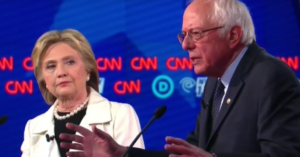
Hillary Clinton and Bernie Sanders
Inclusion may not be as powerful as hope, but it’s a very strong meme nonetheless. This year’s Republican candidate openly embraces hostility to inclusion—attacking Mexicans and Muslims along with immigrants in general, mocking disabled people, and even attacking the patriotism of decorated war hero Senator John McCain. So it’s a good move for Hillary Clinton to reclaim the emotional territory she gave up to both Sanders and Trump during primary season—and in this case, I do think it’s genuine. The first night of the convention, especially, was all about outreach to those who’ve felt disenfranchised (including the millions of supporters of Bernie Sanders). Clinton’s good dose of Policy Wonk may also be the antidote to Trump’s sketchy sound-bite promises about how he would govern.
The themes of inclusion, hope, and competence were in tremendous contrast with the Republican Convention, whose dominant message was fear—expressed in xenophobia. The other message of the Republicans was “we don’t have to give a crap about people we can beat up”–a big rallying point for those who agree, but a big push-away for anyone who might be a potential victim–and that’s a LOT of people. This is essentially the message of fascism, and it scares me to see it coming out of the mouth (and Twitter feed) of a nominated major-party candidate for President.
And this is why I will vote for Hillary even though my own politics are closer to Jill Stein’s, and even though I live in a state that will vote Democratic no matter what. I am not thrilled about voting for Hillary, but I will vote for her. I consider Trump the greatest threat to democracy and liberty in my lifetime. His repeated use of Hitlerian memes is very troubling. And I think very deliberate. I want Trump’s margin of defeat to be so “YUGE” that we never see his ugly politics again.
Looking at the election as a whole, I’d bet that Trump, a master marketer for decades, has studied NLP (Neurolinguistic Programming—an extremely powerful approach to getting inside people’s minds through the use of deep psychological triggers) and is far better at getting his (loathsome) message across than Clinton is. The Republicans have been using sound bites that appear to be based in NLP techniques for over 30 years, but Trump has taken it much deeper. Clinton, by contrast, is an old-school politician who hasn’t quite figured out the 21st-century shift in marketing from push to interactive. And Sanders has probably not studied marketing but he’s a natural. His brand is wrapped in an integrity that neither party nominee can offer—and he has a long background in (and deep understanding of) community organizing as well as electoral politics. When he started as a politician, Vermont was not exactly a progressive hotspot. I believe he helped create the climate where his state is now among the bluest in the nation.
Interestingly, all three are around the same age, spanning from Clinton’s 68 to Sanders’ 74 (Trump just turned 70)—yet the oldest, Sanders, had the strongest appeal to youth. And the younger candidates, from O’Malley to Rubio, were all eliminated months ago.