There’s a long list of basic psychology principles that the guy in the White House doesn’t seem to understand. For starters,

  • He values feigned loyalty and obsesquiousness more than real friendship, and he never seems to have loyalty to anyone else—not even his wives and kids—with the possible exception of his abusive late father. He thinks some dictators, including the murderous Vladimir, are his friends and doesn’t notice how they play on his need for flattery to accomplish an agenda diametrically opposed to our country’s interests (I write as a US citizen).
  • He thinks he has the right to desecrate and destroy public property.
  • He thinks he can establish his greatness by slapping his name—or the name of our continent (which he doesn’t even seem to understand is NOT the name of our country)—on landmarks he had nothing to do with.
  • He squanders our tax dollars on these personal vanity projects, on the illegal war, and on the persecution of immigrants and his perceived enemies—even when he says it will all be privately paid for or funded by another government, as he claimed for his ballroom and the border wall, to name two prominent examples.
  • He also not only accepts but actively solicits payments that sure look like bribes or blackmail attempts: from media, from universities, from nonprofits, from billionaires, from corporations and foreign leaders with business before the government, etc.
  • And he thinks the laws—he’s violated dozens of them—don’t apply to him because he’s president (which, unfortunately, the Republican majorities in Congress and on SCOTUS have perpetuated by refusing to hold him in check).

But the one I want to talk about today is his perverse idea that attempting to censor or punish the press makes the problem the press is reporting on go away. This crazy mindset has been one of his hallmarks since his first presidential campaign.

This kind of “thinking” is more dangerous than it seems on the surface. By surrounding himself only with people who will give him bad advice to advance their own agendas but never criticize him and by blasting attacks on those who question anything he does, he takes away the guardrails on his actions. He is an impulsive person who not only acts without thinking things through, over and over again, but has somehow internalized a belief that he knows more than the experts on any question, no matter how far outside of his actual knowledge base.

In his first term, he had Cabinet members who could help him navigate at least some of the shoals. Those guardrails don’t exist in his second administration, with a Cabinet composed largely of incompetents, grifters, or both, and unofficial advisors or former advisors who’ve wielded real and destructive power, which, interestingly enough, often ends up benefiting those advisors directly (talking about you, Mssrs Musk and Kushner).

And that has led the US into a downward spiral. This president who said he would not start wars invaded Venezuela in a coup after killing civilians in multiple attacks on their boats. He listened to another of his thug-dictator friends and started the unwinnable war in Iran that no previous US president would touch, leaving an enemy in a far stronger position and the US far weaker than before the war. He has torched decades-long alliances for capricious reasons—even making repeated threats against other nations’ sovereignty—leaving the rest of the world to understand that the US can’t be trusted and they’d better make their way in the world without allying with us. His changing-all-the-time tarrifs and his squandering tax dollars in a war against his own residents (in the name of immigration policy) have wrecked the economy and alienated many in his own base.

It will take decades to undo the damage, hold the perps responsible, and build trusted relationships again

Please remember all of this when you vote on or before November 3rd (and if voting before, please vote in person, as he has ordered the post office to sabotage mail-in voting). The best way out of this morass is to provide unassailable majorities of Democrats in both houses of Congress. Believe me, I know the Dems are far from perfect. We need to get out of the hole we’ve dug ourselves where we have to vote for a lesser evil rather than a greater good. All the way back in 2007, I endorsed a whole package of voting reforms that I’d love to see, including a parliamentary system and ranked-choice voting (known at that time as instant-runoff), which would combine to give us a lot more choices. I’d add a few more to that list today, but I’ll let it stand as my thinking at the time. But in the current framework, the only way to get the Republicans out is to get the Democrats in.


Facebooktwitterpinterestlinkedinmail

The two big messages of the Democratic Convention were Hope and Inclusion. Hope, of course, was one of the two themes (along with Change) that propelled Barack Obama to the presidency in 2008.

The danger with memes like Hope and Change is that they leave people greatly disappointed when not much appears to change. Obama actually has a pretty powerful record of accomplishment (and here’s a shorter but more up-to-date list prepared by the Democratic Party). But he’s somewhat diffident about claiming it—and his legacy is much less than it could have been because of the concerted effort of the GOP to deny him any victory no matter how small. Here, for instance, is Mitch McConnell, early in Obama’s presidency, saying the President is not sufficiently bipartisan, despite Obama’s unprecedented and massive outreach to the other side at the expense of that agenda of hope and change—something even Fox News noticed. (Of course, by 2010, McConnell was openly saying his top priority was making sure Obama was a one-term president.)

I have plenty of issues with both Obama and with Hillary Clinton—but government is supposed to be bipartisan, not spoil-sport-losers-blocking everything. The Democrats even allowed George W. Bush to govern, despite his awful, destructive policies from which the country is still recovering. That Obama has been able to get anything done in this climate (and as those two links above prove, he’s done quite a bit) is remarkable. That the Republican Party has thwarted the will of the people over and over again these 8 years is shameful.

Obama also has a tendency to “roll over and play dead” unnecessarily. To name one example, that he gave up so easily on filling the Supreme Court vacancy caused by Scalia’s death is shocking—and very bad precedent. As a former community organizer, Obama should have had a clue about how to break he deadlock—keep the apparatus that twice elected him president active, to deluge Republican legislators with calls and letters supporting particular pieces of Obama’s agenda—to keep people involved and motivated while at the same time disassembling Republican intransigence, making its revelry in being “The Party of No” politically difficult. Obama could have organized a backlash in the 2010 election and accumulated massive majorities in both houses. But he let his eager champions wither on the vine.

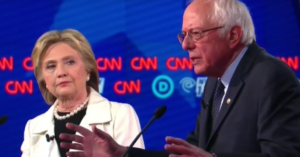
Hillary Clinton and Bernie Sanders

Inclusion may not be as powerful as hope, but it’s a very strong meme nonetheless. This year’s Republican candidate openly embraces hostility to inclusion—attacking Mexicans and Muslims along with immigrants in general, mocking disabled people, and even attacking the patriotism of decorated war hero Senator John McCain. So it’s a good move for Hillary Clinton to reclaim the emotional territory she gave up to both Sanders and Trump during primary season—and in this case, I do think it’s genuine. The first night of the convention, especially, was all about outreach to those who’ve felt disenfranchised (including the millions of supporters of Bernie Sanders). Clinton’s good dose of Policy Wonk may also be the antidote to Trump’s sketchy sound-bite promises about how he would govern.

The themes of inclusion, hope, and competence were in tremendous contrast with the Republican Convention, whose dominant message was fear—expressed in xenophobia. The other message of the Republicans was “we don’t have to give a crap about people we can beat up”–a big rallying point for those who agree, but a big push-away for anyone who might be a potential victim–and that’s a LOT of people. This is essentially the message of fascism, and it scares me to see it coming out of the mouth (and Twitter feed) of a nominated major-party candidate for President.

And this is why I will vote for Hillary even though my own politics are closer to Jill Stein’s, and even though I live in a state that will vote Democratic no matter what. I am not thrilled about voting for Hillary, but I will vote for her. I consider Trump the greatest threat to democracy and liberty in my lifetime. His repeated use of Hitlerian memes is very troubling. And I think very deliberate. I want Trump’s margin of defeat to be so “YUGE” that we never see his ugly politics again.

Looking at the election as a whole, I’d bet that Trump, a master marketer for decades, has studied NLP (Neurolinguistic Programming—an extremely powerful approach to getting inside people’s minds through the use of deep psychological triggers) and is far better at getting his (loathsome) message across than Clinton is. The Republicans have been using sound bites that appear to be based in NLP techniques for over 30 years, but Trump has taken it much deeper. Clinton, by contrast, is an old-school politician who hasn’t quite figured out the 21st-century shift in marketing from push to interactive. And Sanders has probably not studied marketing but he’s a natural. His brand is wrapped in an integrity that neither party nominee can offer—and he has a long background in (and deep understanding of) community organizing as well as electoral politics. When he started as a politician, Vermont was not exactly a progressive hotspot. I believe he helped create the climate where his state is now among the bluest in the nation.

Interestingly, all three are around the same age, spanning from Clinton’s 68 to Sanders’ 74 (Trump just turned 70)—yet the oldest, Sanders, had the strongest appeal to youth. And the younger candidates, from O’Malley to Rubio, were all eliminated months ago.

Facebooktwitterpinterestlinkedinmail