There’s a long list of basic psychology principles that the guy in the White House doesn’t seem to understand. For starters,

  • He values feigned loyalty and obsesquiousness more than real friendship, and he never seems to have loyalty to anyone else—not even his wives and kids—with the possible exception of his abusive late father. He thinks some dictators, including the murderous Vladimir, are his friends and doesn’t notice how they play on his need for flattery to accomplish an agenda diametrically opposed to our country’s interests (I write as a US citizen).
  • He thinks he has the right to desecrate and destroy public property.
  • He thinks he can establish his greatness by slapping his name—or the name of our continent (which he doesn’t even seem to understand is NOT the name of our country)—on landmarks he had nothing to do with.
  • He squanders our tax dollars on these personal vanity projects, on the illegal war, and on the persecution of immigrants and his perceived enemies—even when he says it will all be privately paid for or funded by another government, as he claimed for his ballroom and the border wall, to name two prominent examples.
  • He also not only accepts but actively solicits payments that sure look like bribes or blackmail attempts: from media, from universities, from nonprofits, from billionaires, from corporations and foreign leaders with business before the government, etc.
  • And he thinks the laws—he’s violated dozens of them—don’t apply to him because he’s president (which, unfortunately, the Republican majorities in Congress and on SCOTUS have perpetuated by refusing to hold him in check).

But the one I want to talk about today is his perverse idea that attempting to censor or punish the press makes the problem the press is reporting on go away. This crazy mindset has been one of his hallmarks since his first presidential campaign.

This kind of “thinking” is more dangerous than it seems on the surface. By surrounding himself only with people who will give him bad advice to advance their own agendas but never criticize him and by blasting attacks on those who question anything he does, he takes away the guardrails on his actions. He is an impulsive person who not only acts without thinking things through, over and over again, but has somehow internalized a belief that he knows more than the experts on any question, no matter how far outside of his actual knowledge base.

In his first term, he had Cabinet members who could help him navigate at least some of the shoals. Those guardrails don’t exist in his second administration, with a Cabinet composed largely of incompetents, grifters, or both, and unofficial advisors or former advisors who’ve wielded real and destructive power, which, interestingly enough, often ends up benefiting those advisors directly (talking about you, Mssrs Musk and Kushner).

And that has led the US into a downward spiral. This president who said he would not start wars invaded Venezuela in a coup after killing civilians in multiple attacks on their boats. He listened to another of his thug-dictator friends and started the unwinnable war in Iran that no previous US president would touch, leaving an enemy in a far stronger position and the US far weaker than before the war. He has torched decades-long alliances for capricious reasons—even making repeated threats against other nations’ sovereignty—leaving the rest of the world to understand that the US can’t be trusted and they’d better make their way in the world without allying with us. His changing-all-the-time tarrifs and his squandering tax dollars in a war against his own residents (in the name of immigration policy) have wrecked the economy and alienated many in his own base.

It will take decades to undo the damage, hold the perps responsible, and build trusted relationships again

Please remember all of this when you vote on or before November 3rd (and if voting before, please vote in person, as he has ordered the post office to sabotage mail-in voting). The best way out of this morass is to provide unassailable majorities of Democrats in both houses of Congress. Believe me, I know the Dems are far from perfect. We need to get out of the hole we’ve dug ourselves where we have to vote for a lesser evil rather than a greater good. All the way back in 2007, I endorsed a whole package of voting reforms that I’d love to see, including a parliamentary system and ranked-choice voting (known at that time as instant-runoff), which would combine to give us a lot more choices. I’d add a few more to that list today, but I’ll let it stand as my thinking at the time. But in the current framework, the only way to get the Republicans out is to get the Democrats in.


Facebooktwitterpinterestlinkedinmail

On Monday, the US Electoral College will be officially deciding whether Donald Trump will be president of the United States.

Caricature of Donald Trump by DonkeyHotey, Creative Commons License: https://www.flickr.com/photos/donkeyhotey/5471912349/sizes/m/in/photostream/

Alexander Hamilton had several reasons for proposing this convoluted structure. Some of them were not so noble, like giving more power to slave states. But one is worth noting: providing a check against the office going to someone unfit to hold it.

And just because that body has never found a winner unfit doesn’t mean it can’t. This time, there are a whole bunch of reasons why it might want to exercise that power. Some of them are about his complex financial empire, some about his personal actions—and some about the questionable integrity of this year’s voting process. Any one of these should be enough to say, “Hey, wait a minute, this is not OK.” Here are ten among many.

  1. Refusal to divest of investments that could influence policy
  2. Unlike every major party presidential candidate in decades, refusal to disclose his taxes
  3. Probable intervention by a foreign government (Russia), according to the CIA (Central Intelligence Agency)—and the request by some Electors for a briefing on this
  4. His opponent winning the popular vote by an astounding 2,833,224 votes
  5. Trump has been named in at least 169 separate lawsuits—for fraud, antitrust violations, discrimination, and sexual harassment (among other issues). One is especially worth highlighting: A consolidated fraud case (including two class action suits plus one filed by New York State’s Attorney General that Trump settled for $25 million alleged that his Trump University was a scam
  6. Interference in legitimate recount efforts in three states where exit polls showed a Democratic victory but the state was called for Trump
  7. Refusal to accept intelligence briefings, a daily part of every president’s morning since forever
  8. Threats to the First Amendment guarantees of freedom of speech, press, and assembly
  9. Threats and incitements to violence against a vast range of people, from Hillary Clinton to an 18-year-old college student
  10. Insults both to whole classes of Americans and to individuals who disagreed with him

This, unfortunately, isn’t even the whole story. I haven’t discussed the ludicrous lack of government experience among his Cabinet picks…his own inexperience in any government position…the consistent lying…the well-documented cheating of vendors…the lease he has with the federal government for his new Washington, DC hotel which bars any government employee…his insistence on remaining Executive Producer of Apprentice, as if running the country were a side hustle…the extremist agenda he has embraced…his refusal to meaningfully condemn the hundreds of hate crimes in the aftermath of the election…and on and on it goes.

I hope the Electors in the Electoral College do their patriotic duty, and (in the words made famous by Nancy Reagan) “just say no.”

Note: dozens of petitions to the Electoral College are circulating. Here’s one I like. It allows you to write your own letter (be polite!)

Facebooktwitterpinterestlinkedinmail

Regardless of where they fall on the liberal-conservative spectrum, many of my friends face a choice between a candidate they find deeply flawed and one they find completely unacceptable. They differ on which candidate they will vote for with gritted teeth and a hope for a better future vs. the one they see must be stopped at all costs—but fundamentally, it’s the same question. And I know plenty who find neither candidate acceptable and will either vote third-party or skip that line on the ballot.

The US presidential election has become a shambles. As a country, we deserve better.

And we can get better!  Proof is as close as this coming Tuesday’s primary election in my own Hampshire County, Massachusetts.

One district over from me, much-loved State Representative Ellen Story is giving up the seat she was first elected to in 1992. Six candidates are on the ballot to replace her, and all six bring impressive credentials, endorsements, and a track record of community service. Ellen herself has no major enemies—pretty remarkable in 24 years in state politics, especially in a fractious town where even Town Meeting takes two weeks. In my town, we do Town Meeting in one night, twice a year.

I’ve listed a few simple reforms in bold, below. Adopting them throughout the US would go a long way toward reclaiming our democracy.

Reform #1: IRV
The state rep election is a perfect case study of why we need ranked voting (a/k/a Instant Runoff voting). You name your first choice, and if your candidate is eliminated, your vote goes to your second choice. If that candidate is eliminated, the vote goes to your third choice, and so on down the line until there’s a clear victor. We need this locally, and we need it nationally. Several other countries use it, as do a few cities in the US. For the first time in a US national election, people would be able to vote their consciences without feeling they were throwing their support to the worst candidate if they picked someone unlikely to win.

I don’t vote in that election, but I’ll be happy with whoever wins. And I do get to vote in two county-wide races. I consider two of the three candidates for Sheriff highly qualified, as are both of the candidates for Governor’s Council (an obscure Massachusetts office that helps select judges). I’m voting for Melissa Perry and Jeff Morneau, but I don’t think I’ll be badly served as a voter if my first choices don’t win.

The Key Difference Between Local and National Elections

Reform #2: Undo Citizens United and Change the Way We Finance Campaigns
Why did these races draw so many strong candidates while at the national level, we have to scratch our heads and hold our noses?

I believe we can sum up the answer in just two words: CAMPAIGN FINANCE. These local campaigns are cheap to run and use little paid advertising. So the candidates are not beholden to any special interest.

On the national level, campaigns cost billions and special interests hold major sway over the candidates they fund. It’s not a coincidence that the only candidate who was able to galvanize progressives was also the only candidate to fund his candidacy through direct populist appeal to small individual donors. Nobody thought a year ago that Bernie Sanders would be any kind of serious candidate. Yet he won numerous primaries and—for the first time in decades—proved that you can run a national campaign without becoming a puppet of your funders. As the devastating effects of the Citizens United Supreme Court decision allowing essentially unlimited corporate money to flow to campaigns become palpable, this is key for the future direction of American politics.

It’s also not a coincidence that Trump originally garnered support by claiming he was too rich to be influenced by those special interests and he would self-fund his campaign. That turned out to be just another Trump lie, but it was the public line through most of the primary season. However, in this ABC News link, it’s obvious that this was a sham even as far back as January.

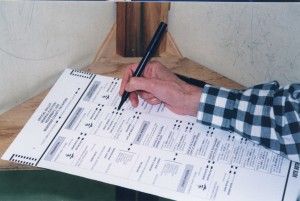
A voter marks a ballot. Photo by Kristen Price.

Reform #3: Hand-Countable Paper Ballots
We will never know who really won the US presidential elections of 2000 and 2004. In both cases, the decision hung on a single state, and in both states, the outcome was highly suspect. These are only the most dramatic among many elections that were very close. In far too many, the use of electronic voting machines without paper ballots means there’s no way to tell if the votes were counted accurately. This is simply unacceptable. Electronic voting machines and regional tabulation machines are far too easy for a hacker to flip—or to simply go out of alignment and count votes for people the voter didn’t vote for. The law should mandate that an electronic total is preliminary, and that election officials will hand-count within the week if the margin of victory is narrow or if there are any reports of irregularities. And those ballots should be properly archived so they can be checked later if accusations surface on the basis of new information.

Reform #4: Parliamentary Allocation
Most of the world uses a parliamentary system in the legislature. If a party gets enough votes to pass a threshold (many countries use 5%), it gets a share of the seats in the legislature. This is another way to make sure minority viewpoints are represented.

Reform #5: Eliminate Winner-Take-All Electoral College
Nebraska and Maine have been apportioning electoral votes by who wins each Congressional District. Why are the other 48 states still using the weird 18th-century throwback of giving all electoral votes to the person with the most? This disenfranchises any of us who live in a “safe” state. Our vote doesn’t really count unless we live in a swing state. Isn’t that crazy?

Left and Right can agree on these and a few other reforms. Let’s join forces and get this done.

Facebooktwitterpinterestlinkedinmail

As a professional marketer and speaker, I look at speeches differently from a lot of other people. I look not only at what the speaker says, but at how effectively the ideas and emotions are communicated: how it impacts the listener. Michelle Obama’s speech at the Democratic National Convention [link to a transcript] gets an almost perfect 9.9 from me. I think when people remember the great speeches of the 21st century, this one has a good chance of making the list. Just as we remember 20th-century orators like Winston Churchill, Martin Luther King, and Maya Angelou, we will remember Michelle as an orator alongside Barack. People are still talking about Barack Obama’s speech at the 2004 National Convention, and about his speech in Cairo early in his presidency. I predict that people will be remembering Michelle Obama’s speech [link to the video] years from now. Why?

  • Without ever calling the Republicans out, she made a clear distinction not only in the candidates’ values, but also in their origins; Mitt Romney constantly struggles to connect with people less fortunate than he, while Michelle Obama gripped the audience with the unforgettable images of Barack picking her up in a car so old and rusty she could see through the floor to the pavement…of his proudest possession back then, a table he fished out of a dumpster.
  • She reminded us over and over again of the hope and promise of the 2008 campaign, and connected this year’s campaign to that same hope, even while the youth who were so inspired four years ago are disappointed in what Barack Obama has accomplished. Her message to youth was clear: we are not done yet, and we are still here for you—but you need to get out there and vote (italics are taken directly from Michelle Obama’s speech):

And if so many brave men and women could wear our country’s uniform and sacrifice their lives for our most fundamental rights—then surely we can do our part as citizens of this great democracy to exercise those rights. Surely, we can get to the polls and make our voices heard on Election Day. If farmers and blacksmiths could win independence from an empire. If immigrants could leave behind everything they knew for a better life on our shores. If women could be dragged to jail for seeking the vote. If a generation could defeat a depression, and define greatness for all time. If a young preacher could lift us to the mountaintop with his righteous dream. And if proud Americans can be who they are and boldly stand at the altar with who they love—then surely, surely we can give everyone in this country a fair chance at that great American Dream.Because in the end, more than anything else, that is the story of this country — the story of unwavering hope grounded in unyielding struggle.

  • As my wife, D. Dina Friedman, pointed out immediately afterward, she positioned some of Barack’s liabilities, such as his insistence on building consensus with Republicans who not only won’t reach consensus but who are actively sabotaging his efforts, as strengths:

I love that for Barack, there is no such thing as “us” and “them” — he doesn’t care whether you’re a Democrat, a Republican, or none of the above. He knows that we all love our country. And he’s always ready to listen to good ideas. He’s always looking for the very best in everyone he meets.

  • She reached out to many constituencies: veterans, teachers, firefighters, poor people working class people, those with disabilities, single moms, grandparents, dads, people facing serious illness, those in the struggle for women’s reproductive rights, recent grads under pressure of student loans or other crippling debt, those who remember the civil rights movement and Martin Luther King’s “I Have a Dream” speech, gays and lesbians and those who stand with them in the struggle for marriage equality. And time after time, she reached out to moms and identified as a mom.
  • Above all, her delivery was from the heart. She connected to her audience as a person, a mom, and as an advocate for the best of American values. She was both sincere and enormously likable. Even her little hint of a stammer came across as endearing. She didn’t need props or PowerPoint. My guess is she didn’t even need the teleprompter that no doubt was in her view.

So why do I give a 9.9 and not a 10? I deduct one tenth for staying behind the lectern. That is much more distancing; when I speak, I stand to the side of the lectern, so there’s no barrier between me and my audience, yet I can still see my notes. However, she was able to overcome that distance and connect personally and viscerally with the live audience and those watching from afar. If Barack Obama does win a second term, I think Michelle Obama will deserve some of the credit.

Facebooktwitterpinterestlinkedinmail

Yesterday, the fate of Minnesota’s Senate seat, undecided since the November election, was finally decided; the margin, out of 2.9 million votes cast, all of 312. Congratulations to Senator Al Franken.

In 2000, George W. Bush’s winning margin in Florida (and thus the presidency of the United States), was 537 votes, in an election whose legitimacy is still hotly debated (and to me, will never be legitimate). The hanging-chads issue alone could have swung the election to Gore by thousands of votes–just one among many irregularities. But in any case, it was close enough that it was possible to steal.

Years ago, I managed a friend’s campaign for local office; he was declared the winner by seven votes, and in the recount, his margin of victory slipped to four.

Four votes determined that election. If just five more people had shown up up to vote for his (entrenched incumbent) opponent, he would have lost.

Of course, it’s not enough that every vote counts. Who counts the votes is also an issue; witness the calamity in Iran.

Facebooktwitterpinterestlinkedinmail