From today’s NY Times email newsletter, “The Morning”:

President Trump does not seem interested in de-escalating anything in Minneapolis. This week, he said that one justification for the shooting of Renee Good might have been that she had been “disrespectful” to officers. Being disrespectful is a form of speech, though — one protected by the Constitution.

With Trump, it’s always a clue that if he accuses someone of bad behavior, he is doing/has done it himself. This is on the same day that news broke about Trump giving the finger and two F-bombs to a Ford employee who called him out as a “pedophile protector”—which the Times mentioned in that same newsletter. The link above is to The Guardian, because the Times uses paywalls.

But Trump showing the emotional maturity of a two-year-old yesterday is just the latest in a lifetime flinging insults at individuals, groups, and whole countries. This is what he said about racism in 1989  (followed by the response decades later by a Black commentator whose offer to Trump to tour Baltimore after Trump disparaged that city was declined). 1989 was also the year he ran a full-page ad in all four of NYC’s daily newspapers calling for the death penalty for five Black youths falsely convicted of rape and later exonerated.

And ever since he rode that golden escalator to announce his candidacy in 2015, it’s been a nonstop barrage. He mocked a reporter’s physical disability. He called Africa, Haaiti, and El Salvador “shithole countries” and called for increased immigration from Norway (a White-predominant country) in 2018 and—just a month ago, on December 9, 2025—not only admitted the comment (which he’d denied at the time) but bragged about it and added Somalia to the list. For years, his racism led him to deny that Obama was born in the US. If that lie were true, Obama would have been ineligible to serve as President. He repeatedly attacks and insults his opponents—Biden and Harris, of course—but even former loyalists that he drove away, including then-Vice President Mike Pence and one of his biggest loyalists in Congress, Marjorie Taylor Greene. And his history of insulting and objectifying women—individuals as well as women as a class—is just as bad as his racism and ableism.

Worst of all, the vile xenophobic anti-immigrant rhetoric of his first campaign and term has not just increased. It has morphed into something truly evil: a war against immigrants that empowers a poorly trained, poorly vetted goon squad army of ICE and CBP agents to rain terror down on immigrant neighborhoods, whose residents are snatched from cars, homes, workplaces, and even their immigration court hearings—with zero due process and extreme violence—and sent to far-away gulags in the US and in countries where these victims have no connection. The conservative Cato Institute lists a multipronged attack on immigrants and citizens, from revoking legal status of people who came here legally to multiple attacks on the Constitution and due process. This is unlike anything in US history. It’s even more extreme than the detention of Japanese immigrants and descendants during World War II—for which the US has apologized and made reparations. Many US citizens have been caught in these sweeps and illegally detained. And much of what ICE is doing is a wildly illegal expansion of the powers they are chartered with. They are not supposed to take a police role other than in matters of illegal immigration (as I document in the Appendix, below). And they are not supposed to shoot people. Yet, Time Magazine reports today that  “Immigration agents have fired at or into civilian vehicles in at least 13 instances since July.” That would include the two people shot since the murder of Renee Nicole Good last week, in Portland, Oregon. At least four of those were fatal. Add to that the 32 people who died in ICE custody in the past year.

Trump’s hypocrisy takes many other forms, too. Examples:

  1. He’s praising protesters in the streets of Tehran even as he decries them in any state that voted for Kamala Harris.
  2. Killing more than 100 Venezuelan sailors (95 as of November when this article was written), then invading the country and kidnapping its (admittedly thuggish) leader on the pretext of interdicting drugs, but pardoning the biggest drug dealer of them all, former President Hernandez of Honduras. Of course, we all know and he hasn’t tried to hide that it’s really about the oil.
  3. Claiming to be a law-and-order president but inciting the January 6, 2021 riot at the Capitol and then pardoning even those rioters who physically attacked police officers.

Please let your Representative and two Senators in the US Congress know that you find this unacceptable and you want them to withhold funding from ICE until it starts obeying all relevant laws on search and seizure, delineation of responsibility, due process, and use of force. If they balk at that, defund the agency at least until Minnesota is allowed to fully participate in the investigation of Good’s murder—and then keep pressing for more accountability. And please share this post widely.


Appendix: Perplexity.AI Report on what ICE is and is Not Allowed to Do

I asked Perplexity, the AI engine I tend to use for serious research and factchecking, “In what situations is US Immigration and Customs Enforcement allowed or not allowed to act as local police do?” Because both AI and traditional search engines may or may not return the same results for the same search, and because AI results are not written by a human and therefore not subject to copyright, I’m copying the entire answer. Drawing on ten different sources including the BBC, the Massachusetts state government website, and the ACLU, it is quite illuminating:

 is a federal civil immigration agency, not a general police force, so it can enforce federal immigration and certain federal criminal laws but cannot simply “act like” local police enforcing state or local law. Its actions are further limited by the U.S. Constitution, federal statutes, and by how much local police choose or are allowed (under state law) to cooperate.?

What ICE is allowed to do

  • Enforce federal immigration law. ICE can stop, detain, and arrest people it has probable cause to believe are removable (deportable) from the U.S., and can place them in immigration detention and initiate deportation cases.?

  • Enforce certain federal crimes. ICE can investigate and bring cases involving immigration-related crimes like human trafficking, document fraud, and smuggling under federal criminal statutes.?

  • Make public?space arrests with probable cause. In public places, ICE may arrest someone if agents have probable cause the person is removable and likely to escape before a warrant can be obtained; they may also execute valid arrest warrants in public.?

  • Enter homes with judicial warrants or consent. ICE may enter a private home only with the occupant’s voluntary consent or a judicial warrant signed by a judge; an internal ICE “administrative” warrant alone does not authorize entry into a private residence.?

  • Conduct raids and surveillance within legal limits. ICE can conduct operations at homes, workplaces, and in communities and can use data collection and digital surveillance tools, subject to constitutional limits on searches and seizures.?

  • Request help from local law enforcement. ICE can ask local agencies to notify them when someone is being released or to hold a person briefly through “detainers,” and can enter formal agreements (287(g)) that deputize some local officers to perform limited immigration functions.?

What ICE is not allowed to do

  • Cannot enforce state or local non?immigration laws. ICE does not have authority to enforce purely state or local offenses (like routine traffic violations or most state criminal laws) unless a separate federal authority applies.?

  • Cannot enter homes using only an ICE form. An ICE administrative warrant (Form I?200/I?205) does not let agents force their way into a private home; without consent or a judicial warrant, they must stay outside or in common/public areas.?

  • Cannot force local police to act as immigration officers. Local agencies cannot be compelled to carry out civil immigration enforcement; they decide whether to cooperate, and many jurisdictions legally limit that cooperation.?

  • Cannot use detainers as binding orders. ICE detainers are requests, not mandatory orders; local agencies may violate state law or the Constitution if they hold someone past their release time without proper legal authority.?

  • Must comply with the Constitution. ICE arrests, searches, and detention are constrained by the Fourth Amendment and due process requirements, just like other law enforcement; unconstitutional stops, searches, or holds can lead to liability.?

How ICE differs from local police

  • Scope of authority. Local police are generalists enforcing broad state and local criminal laws within a limited geographic area, while ICE has a narrow subject?matter focus (immigration and related federal crimes) but nationwide reach.?

  • Civil versus criminal. Much of what ICE does is civil (removal/deportation) rather than criminal prosecution, so ICE can detain someone for immigration violations even when no crime is charged, which is different from typical local policing.?

  • Limits on cooperating with ICE. Many cities and states have “sanctuary” or similar policies that allow cooperation on serious criminal matters but forbid or restrict participation in routine civil immigration enforcement.?

When ICE and local police can overlap

  • Joint operations on crime. Local police may work with ICE when investigating federal crimes (for example, human trafficking or gang cases) where immigration issues also arise.?

  • 287(g) agreements. Under 287(g) “jail?enforcement” agreements, certain local jail officers are trained and authorized to perform specific immigration tasks (like issuing charging documents or detainers) under ICE supervision, but they still must follow constitutional and state?law limits.?

  • Information sharing and notifications. Where allowed by state and local law, police may share booking information or give ICE notice of a person’s release, even if they cannot legally hold the person longer just because ICE asked.?

Situations where ICE is more restricted than local police

  • Protected or sensitive areas (policy?based). For years, ICE policies limited enforcement in places like schools, hospitals, and churches, though recent DHS actions have rescinded some of those “sensitive location” protections; policy can be more restrictive than what the Constitution alone requires.?

  • Entering private spaces. Local police with state?court warrants for state crimes may enter a home to arrest a suspect; ICE, by contrast, often relies on administrative warrants that do not permit entering a home without consent, so ICE’s ability to mimic a home arrest by local police is more limited.?

If you want, a follow?up can focus specifically on how these rules work in Massachusetts and what they mean for day?to?day interactions with ICE.




Facebooktwitterpinterestlinkedinmail

Are you as appalled as I am about the blatant suppression of dissenting voices in mainstream media lately? They’re even going after the court jesters—first Colbert, now Kimmel, and there will be others.

But we can express our displeasure. Here’s the letter I wrote to Disney, parent company of ABC (if you want to write your own letter, the address is responsibility@twdc.com).

Subject: Your removal of Kimmel was completely unjustified

Body:
I read the transcript of what Jimmy Kimmel said. I didn’t see any glorying in violence or in Kirk’s murder. What I read was the notation that “MAGA people” were “desperately trying to characterize this kid who murdered Charlie Kirk as anything other than one of them.” (Source: USA Today: https://www.usatoday.com/picture-gallery/entertainment/tv/2025/09/17/jimmy-kimmel-show-photos/86209850007/)

The only part of that statement that is even an opinion is the word “desperately.” The rest is a statement of facts. See, for instance, Donald Trump calling it “radical left political violence” (https://time.com/7316299/charlie-kirk-shot-death-donald-trump-speech-transcript-political-violence/). In that same speech, Trump noted several instances of political violence against right-wingers—but he didn’t criticize the murder of MN lawmaker Melissa Hortman or numerous other attacks on liberals and progressives in that speech—see https://www.usatoday.com/story/news/politics/2025/09/11/donald-trump-charlie-kirk-melissa-hortman/86089962007/: “Hortman was not mentioned in Trump’s Sept. 10 address touching on several recent instances of political violence, including his own survived assassination attempt and the shooting Rep. Steve Scalise, R-Louisiana in 2017. He did not mention other attacks on Democrats including an arson attack at Pennsylvania Gov. Josh Shapiro’s house, a kidnapping plot against Michigan Gov. Gretchen Whitmer and an assault on former House Speaker Nancy Pelosi’s husband in their home.”)

See also this article that cites SEVEN right-wing pundits blaming Democrats or the radical left for Kirk’s death: https://www.usatoday.com/story/news/politics/2025/09/11/donald-trump-charlie-kirk-melissa-hortman/86089962007/

In short, Kimmel was forced out not for hate speech, but for reporting on a double standard that exists and is easily verifiable. Shame on you!

My wife and I were getting tired of Netflix and were planning to try Hulu. Guess what: you will not get a subscription from us. Nor will you be getting any admission fees at Disney properties. We will make other choices and do business with companies that do not try to suppress dissenters just to curry favor with a would-be dictator.

I have written four books on business ethics as a success principle. Your lack of ethics in this matter will not endear you to the millions of Americans who care about the business practices of companies they deal with.

Facebooktwitterpinterestlinkedinmail

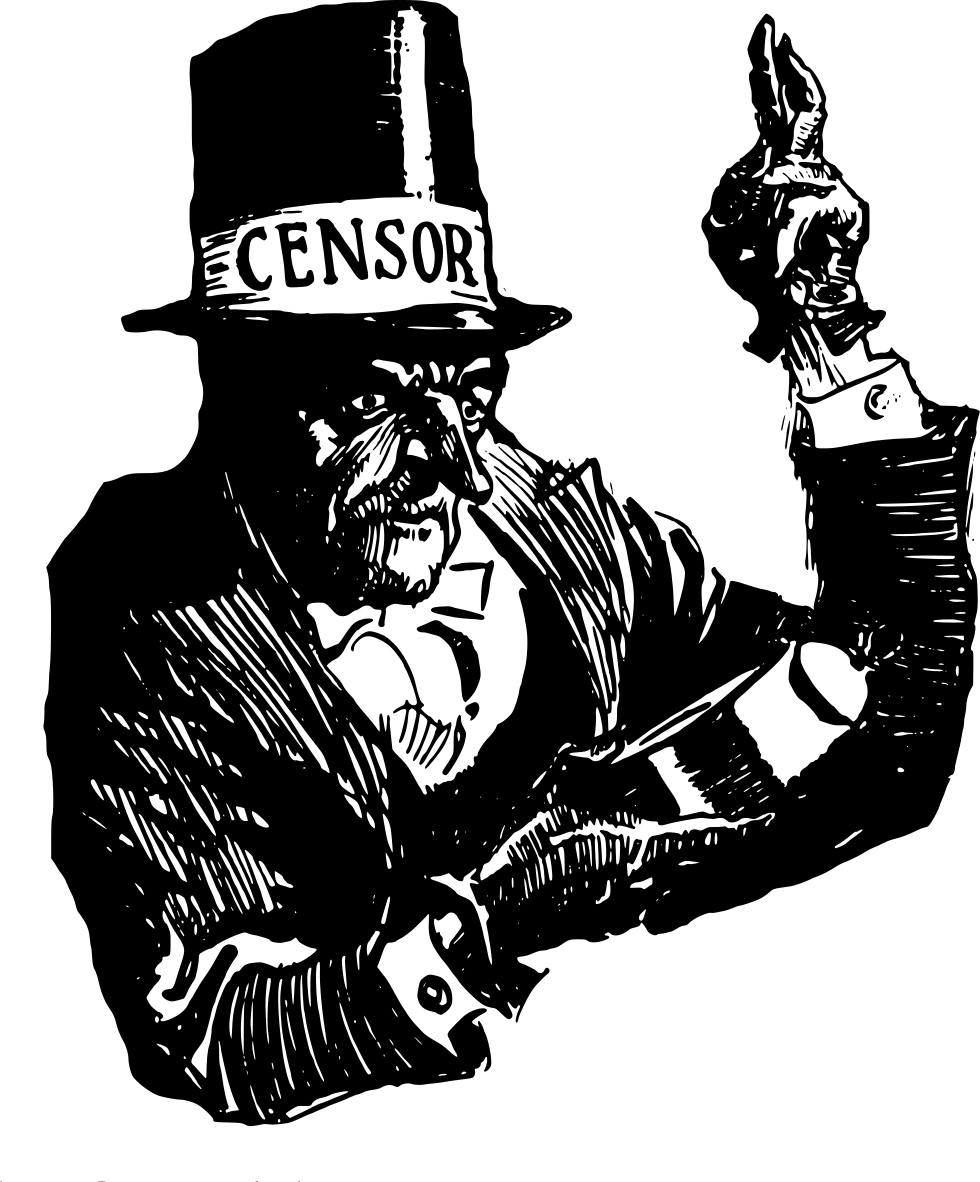
The best comment on the firing of Jimmy Kimmel (under heavy pressure from the current administration) comes from Jon Stewart. Broadcasting from a room decked out in full Trumpian gold, Stewart takes on the role of a TV host who literally has a censor (offstage) looking over his shoulder and whispering “corrections” in real time that Stewart immediately incorporates. This monologue is both hilarious and extremely scary.

In case you don’t get the reference, “Fuhrer” is the German word for “Leader.” Stewart, I’m sure, is quite deliberately referencing the media censorship strategies of Hitler and other dictators.

Give this one your full attention. Visuals are a big part of the joke—and you’ll miss a lot if you multitask. https://www.mediaite.com/media/tv/shut-the-fck-up-jon-stewart-hushes-audience-during-government-approved-administration-compliant-monologue

Facebooktwitterpinterestlinkedinmail

When Unilever acquired B&J’s, the agreement guaranteed the ice cream company the right to an independent Board empowered to continue B&J’s decades of social and environmental activism as they see fit. But apparently, Unilever, one of the largest consumer packaged goods (CPG) conglomerates in the world, disagrees with the Board’s repeated attempts to support the people of Palestine, a situation much more dire now after more than a year of constant Israeli attacks that have killed more than 43,000 Palestinians and injured and/or made homeless hundreds of thousands more, including thousands who’ve had their replacement homes or shelters destroyed and had to flee multiple times.

Most of the time, Unilever is one of the better corporate citizens. It’s done a lot of good in the business world for environmental and human rights efforts. Many of its business units, beginning with Ben & Jerry’s in 2012, are certified B Corporations (a business structure that allows environmental and social good to be factored in alongside profitability)–and the parent company has been undertaking a Herculean effort (ongoing since 2015) to get the entire corporation B-corp certified.

But now, Unilever is censoring the B&J’s Board and threatening to dissolve the Board and sue individual Board members. And, once again, B&J’s is suing the parent company over censorship around Gaza.

Israel’s position is unusual because it is treated differently than other governments, in two different ways. Some people grant Israel special status because of its history, and some use that history to condemn it and even question its existence. Here are some of the reasons why Israel-Palestine conflict is treated differently than elsewhere:


The Pro-Israel Reasons Why Israel is Treated Differently

  • European and US guilt in the aftermath of World War II, when it became obvious that millions of Jews, Roma, lesbians and gays, people with disabilities, and political opponents of the Nazi dictatorship could have been saved by other nations and were instead murdered in Germany and the lands it occupied.
  • Extremely effective pro-Israel lobbying that has demonized Arabs, Muslims, and Palestinians (overlapping groups, but not interchangeable) both within the Jewish community and in the wider culture. I recommend the film “Israelism” as the quickest way to gain understanding of how this has worked. This has been so effectively percolated into the culture that any attack on the Israeli government—even in its current super-brutal iteration—is labeled antisemitism.
  • The industrialized world’s continued reliance on fossil fuels from the Arab lands—and the widely-held view within the US government that Israel is our foreign-policy surrogate and enforcement agent in the Middle East (one of the most important strategic regions in the world: a crossroads of trade since ancient times and a place where political, energy, and military control conveys enormous influence over Europe, Africa, and western Asia).


The Reasons Why Others Condemn Israel

  • In the larger population, this role as US surrogate gets translated into accepting at face value the common belief that Israel is a bulwark of Western democracy in a region lacking in democracies. And that, in turn, causes conflict with those who criticize Israel’s appalling record of violence and subjugation in the Gaza war. The democracy meme is partially true. If you are a white Jewish citizen of Israel, you have rights under a democracy—but those rights are limited for your Israeli Arab neighbors and do not exist for your Palestinian neighbors in East Jerusalem and just outside Israel’s borders.
  • Pretty much every Israeli and Palestinian has experienced direct harm: the loss of loved ones, the destruction of and/or eviction from property, denial of human rights. For 76 years, Israel has oppressed Palestinians, dating back to independence in 1948—and Arab nations have repeatedly waged wars and nongovernmental attacks against Israel. More recently, Israel has initiated several wars. On my second trip to Israel and Palestine ten years ago, I listened to a man who had been only 11 years old when the Israelis told his family not to take a lot of their possessions because they would be back in a few weeks (scroll down in the linked article to the section on Bar-Am). He’s one of many whose story I’ve heard over the years that describe the oppression, loss, and bitterness —as the many Israeli Jews who’ve recounted their own losses through terrorism have also experienced. The gruesome toll affects people on both sides.
  • The denial of rights to ethnic and religious minorities within Israel and to majorities in the Palestinian Territories, the violence done to these populations, and the forced resettlement have all combined to make Israel a pariah in the eyes of many.

Unfortunately, what should be anger directed at the government of Israel is often misdirected into attacks on Jews. And it doesn’t help that so many people who should know better equate any criticism of Israel with antisemitism.

Mind you—antisemitism is real and it is not OK. But there’s a big difference between “Israel, stop bombing civilians, stop denying food access, stop destroying hospitals, stop killing journalists,” etc. and saying that the heinous Hamas attack of October 7, 2023 was justified or that the Jews as a people should be destroyed. Those latter constructs are antisemitic. The former are legitimate criticisms of a government gone amok.

Rabbi Jill Jacobs, the head of the rabbinic human rights organization T’ruah, has a helpful article on how to tell the difference.

But legitimate criticism of violent and discriminatory Israeli policies and actions, even those before October 7, cannot justify what Hamas did. There is NO justification for kidnapping, killing and raping innocents because they happen to be Jewish and living in Israel—just as there is NO justification for killing and torturing innocents because they happen to be Palestinian, Arab, and/or Muslim. And there is also no justification for treating Israel far more harshly in the diplomatic arena than other countries brutalizing occupied populations. If it’s wrong when Israel does it, it’s also wrong when other countries do it. Not to make that clear is another form of antisemitism.


And How Does This Relate to Unilever and Ben & Jerry’s

What Unilever is doing to Ben & Jerry’s is just a less intense version of the censorship and repression on college campuses last spring when Palestinians and their allies demanded justice and peace. What it says is “we espouse values of multiculturalism but we don’t actually believe it. In fact, we believe in demolishing entire populations based on ethnicity, religion, or other factors that we say shouldn’t matter. And we will bring repression down upon the shoulders of those who defend the groups we want to marginalize.”

To make real change, we have to make space for dissenting voices, especially from marginalized populations. That gets stripped away when criticism of Israel’s malignant actions are blocked. If you agree, click to tell Unilever to stop stomping on dissent at Ben & Jerry’s. You’re welcome to copy and modify my message:

As a proud Jew and an activist for 55 years who’s worked on peace, Middle East, the right to dissent, environmental, business as a social change agent, and immigration justice among other issues, I take strong issue with Unilever’s unilateral abrogation of Ben & Jerry’s right to protest genocidal policies in Gaza. With the Board’s independence written into the acquisition agreement, the umbrella entity of Unilever is not obligated to agree with their position and nor does that position have to be thought of as representing the whole corporation—but you are obligated to let them express it. Palestinian rights are compatible with Jewish rights, and the world needs to stop accepting the argument that criticism of Israel’s government is antimsemitism.

Facebooktwitterpinterestlinkedinmail

No—but he may as well be. When I was a kid in the 1960s, we were told that Soviet schools (especially during the Stalin years) were places of indoctrination, not learning. They were propaganda factories churning out children whose world view was all about how great our then-enemy (and again enemy, since it invaded Ukraine) was—who would grow up to be dupes, unquestioning of their country’s moral, economic, and military superiority, etc. The same was true—and this we know as fact—of the schools the Nazis ran.

Of course, US schools, and the schools of pretty much any country, have also served a propaganda function. Schools are designed to raise children who would be complicit in or even participate in such things as the US’s involvement in numerous imperialist wars. Those wars are attempts to prop up a deadly version of capitalism whose place in developing countries was to exploit the resources—and not to worry about how many of the locals were killed or brutalized in the process. And again, the US was not alone. Ask in India about the Brits, in Congo about the Belgians, in South Africa about the Dutch, in Armenia about the Turks, in First Nations in Canada and the US about the history of their relations with White-run governments.

These days in most of the US and in other democracies, a more nuanced version of history is taught. History usually recognizes the moments where a country went astray, looks at the reasons, and at least casually discusses the consequences.

But in Florida, starting this month, that is no longer true. Heather Cox Richardson devoted her newsletter this morning to exploring the white supremacist fantasy that Florida now calls history and requires its teachers to teach. And I call the Florida curriculum a total distortion of truth. Read her column! It’s crucial to understand what’s going on in the battle for our children’s minds and souls.

Of course, this rogue state under Ron DeSantis has had a problem with truth telling for a while. It has a nasty habit of censoring anything that makes someone—at least a conservative White, cis, hetero, and male someone with no disabilities—a little uncomfortable. This is the state where it’s illegal for a teacher to mention LGBT folks, let alone that we are normal and part of the diversity that makes our country great. (I identify as bisexual so I include myself in that community.) Where it’s illegal for a teacher to point out that systemic racism still exists in the US. Where book banning has taken more than 300 books out of classrooms and libraries. And where DeSantis forced curriculum and management changes at a well-known progressive college in the state system that resulted in another progressive college, an expensive private school near me, offering to accept students from there at the same low tuition cost they’d been paying (and several accepted).

Unfortunately, while its approach is extreme, Florida isn’t alone. Other states are passing similar laws in a foolish counterrevolution that will dull the ability of its students to think, to make ethical choices, and ultimately, to show leadership. In addition to the obvious consequences of attacking human rights of those other than conservative White, cis, hetero, and male, this regressive path, in my opinion, leads to intellectual stagnation and the US falling behind other countries in the quality of our science, invention, and achievement. So in both moral and practical terms, it’s a disaster.

Fight for our right as a nation to have a REAL education! Support teachers and librarians! And most importantly, vote the censors who would drum critical thinking out of our children and turn them into compliant automatons out of office!Facebooktwitterpinterestlinkedinmail

“The Post” lives up to the hype. It takes a very cerebral story and builds it into high drama, spurred by strong performances from Meryl Streep as publisher Katharine Graham) and Tom Hanks (editor Ben Bradlee).Trailers for "The Post are widely available

The overall message, about the power of the free press, and the need for the press to defend its Fist Amendment freedom, despite the whims of a paranoid and dictatorial president (Nixon, in this case—a different example today).

It tracks Daniel Ellsberg’s smuggling out massive quantities of classified documents from the Rand Corporation, where he worked, and releasing them first to the New York Times, and then to the Washington Post. The movie also dramatizes the frenetic effort throughout the newsroom to absorb the information and turn it into stories on very tight deadlines, not even knowing if the presses would run, while the Times suffered under the first pre-publication censorship of journalism in the history of the United States. Known as “The Pentagon Papers,” these documents proved that US high officials knew by the early 1960s that the war was unwinnable, and that presidents Eisenhower, Kennedy, Johnson, and Nixon all lied to the American people about it.

And it covers the legal battle: the government’s attempt to shut them down and the papers going all the way to the Supreme Court to secure their rights. The timing of these events happened to threaten The Post’s long-awaited IPO, which adds to the drama and the sense of what’s at stake for Graham, Bradlee, and their journalists.

BTW, just as the movie gives lessons on how to survive a paranoid, media-hating president facing serious doubts about his honesty, the Nixon link above focuses on some very interesting parallels between his presidency and that of the current occupant of 1600 Pennsylvania Avenue, Washington, DC. However, let’s remember the differences. Nixon had a very impressive record on the environment—I describe him as the president with America’s second-most environmentalist track record (behind Obama but ahead of both Jimmy Carter and Teddy Roosevelt) also, despite the Vietnam war, did much to break down the barriers between the US and both the Soviet Union and China.Facebooktwitterpinterestlinkedinmail

All my life, I’ve heard about the authoritarian Chinese government micromanaging every aspect of everyone’s lives, the government’s total control over career options, and of course, the “reeducation” of intellectuals and destruction of cultural resources during the Cultural Revolution.  Getting a visa was a major and expensive hassle that had to be set up weeks ahead, and there was no way to get a business visa without an invitation from someone.

The other obvious difference was the way China blocks many key Internet sites, including all Google sites, Facebook, and Twitter. LinkedIn, Yahoo, and Bing do work, however.

And yet, during our brief visit, the society felt very open. While there are plenty of cops and security guards (including community volunteers who have almost identical uniforms to the police but with the addition of bright red armbands), most whom we saw were not obviously armed and seemed for the most part to be a force for peace, not repression. We’d often see cops joking around with passers-by or chatting amicably with each other. And mobility was almost totally unrestricted, other than at paid attractions. As visitors, we felt no police presence singling us out, had no “minders,” and we were unrestricted even when we went to meet a young couple that a friend of ours had met through Couchsurfing.

Even when our entire group of 26 struck up a conversation with a red-robed Tibetan monk (in the government’s eyes, a potential dissident) who happened to walk through Tiananmen Square with a stylish female companion, there was no feeling of being watched. Since I briefly had a Tibetan housemate and know how to say hello in Tibetan, I even greeted him in his own language. His face lit up—but he got frustrated and disappointed when he tried to answer back and realized that was the only Tibetan I knew. (China claims Tibet and has often considered organized Tibetan Buddhism a hostile force; the Tibetans see themselves as an occupied nation, and govern the religious aspects from exile in India.) He spoke fluent Chinese, so our tour director interpreted for us. He posed for selfies with all those in our group who wanted one and was with us for about ten minutes. Plenty of cops were on the plaza, and none took the least interest in this interchange.

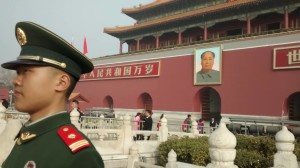
I’ve seen photos of China in the 60s and 70s with Chairman Mao’s picture everywhere, providing a Big Brother is Watching motif. We saw exactly two pictures of Mao, other than on the 1 yuan bill: a giant portrait on Tiananmen Gate into Forbidden City,

A guard stands near the Gate of Heavenly Peace and its giant picture of Mao. Photo by D. Dina Friedman.

and a modest poster in a random store window. We did not knowingly see a single picture of current Chairman Xi. Our tour director told us that the Cultural Revolution is definitely considered a mistake, and that the current government rates Mao “70 percent good and 30 percent bad.” He confirmed my suspicion that the prosecution of the “Gang of Four” (Mao’s widow and three comrades) a few years after Mao’s death was as much about repudiating Mao as anything else.

I noted only these very minor incidents:

  1. An officer on Tiananmen spun rapidly in an about-face when a tourist tried to take his picture; the cop Dina managed to catch in the picture shown here suspected he’d been photographed and glared at her, but made no attempt to engage.
  2. An annoying beggar outside the Shanghai Museum was told firmly to go elsewhere and leave our group alone.
  3. I was told to put my camera away after taking a photo of an ad inside a subway station—but I was not asked to delete the photo.

Street crime seemed to be nonexistent. The only threats I felt to my safety had to do with driving patterns, and particularly the very challenging lane-by-lane crawl across a completely uncontrolled eight-lane rotary to get between our hotel in Xian and the subway entrance one block away. Wasn’t too thrilled about silent electric mopeds sneaking up on both sides of what I’d thought was a one-way bike lane either.

Quite frankly, St. Petersburg, Russia, in 2002 (long after  the collapse of the Soviet Union) as well as New York and Washington post-9/11 have felt far more invasive. It is, however, the first country I’ve ever visited that routinely x-rays all bags belonging to subway passengers before allowing them to board.

Our tour director, who had been at the Tiananmen demonstrations in 1989, even told us that when someone steps out of line on social media, all that happens is eventually the dissident’s account is closed. However, in the aftermath of 1989, friends of his were jailed.

Still, every resident of China we discussed it (a limited number) with felt oppressed by the government. One family we met with is actually arranging to relocate to Canada. So obviously, there’s more repression than meets the eye.

Shel Horowitz’s latest book, Guerrilla Marketing to Heal the World, shows how to turn hunger and poverty into sufficiency, war into peace, and catastrophic climate change into planetary balance—using the power of the profit motive.Facebooktwitterpinterestlinkedinmail

If you search on Google for the word Google plus the exact phrase “Don’t Be Evil”, you get 366,000 hits. The company’s motto has been used at least since 2001, according to Wikipedia.

As someone who has been writing and speaking about business ethics for seven years, I applaud this motto. But I question its authenticity as it applies to some of Google’s actions. In other words, I see Google occasionally violating the motto with at least three sets of policies that–intentionally or not–certainly do evil.Read more »Facebooktwitterpinterestlinkedinmail