Every year, bestselling author and social media visionary Chris Brogan challenges his huge reader base to come up with three words to provide focus for the coming year. This year, I decided to take the challenge for the first time since 2016. My three words are:

  1. Clarity (click to read Part 1, where I discuss this word)
  2. Justice
  3. Healing

Justice

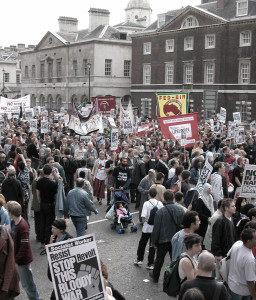
Nonviolent peace demonstration in Britain

Today’s installment is about Justice, and how it shapes both my career and my activism.

My career has evolved quite a bit from its founding (as a term-paper typing service!) in 1981. For the past several years, I’ve focused my writing, speaking, and consulting on helping business turn hunger and poverty into abundance, war into peace, and catastrophic climate change into planetary balance. By showing companies how to make a profit doing this, I hope to leverage far greater change than I would if I tried to motivate them through guilt, shame, and fear.

Lets make this concrete: I listed several benefits for each of five different examples in this blog post.

Ready to know more?  In the very early phases of this shift in my business, I did a TEDx talk, “Impossible is a Dare.” (you have to click on “Event Videos”, and then on my talk). It’s a nice 15-minute introduction to this idea as it existed in 2014; I’ve refined it quite a bit since then. A much deeper introduction is my 10th book, Guerrilla Marketing to Heal the World, endorsed by Chris, Seth Godin, Chicken Soup;’s Jack Canfield, Joel Makower (Executive Director of GreenBiz.com) and many other business and environmental leaders. And of course, I’m happy to talk to you about how I can be a “Sherpa” on this journey for your organization. 

But now, let’s go back to the activist side. In order to talk about Justice, I also have to talk about Injustice: what we’re trying to change.

And from there, how I personally am working to change injustice into justice through community-based activism: the work I do in my non-career time. There have been a few times in my life where that work dominated my day and pushed the career part off to the side. This is one of those times.

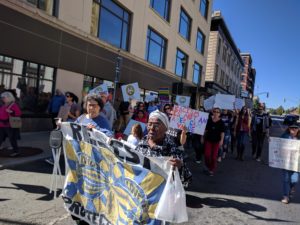
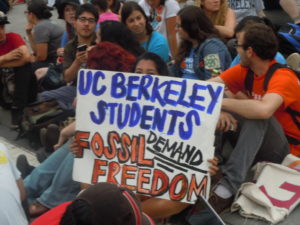
Marchers at a rally for racial justice and immigrant rights, Holyoke, MA. Photo by Shel Horowitz.

As a citizen of the US, I’m deeply concerned about the attack on our planet and its people (and other living beings) by the current federal government. This government and its most visible spokesperson have viciously attacked immigrants, people of color, people without a Y chromosome (not male, in other words) or who don’t identify with the gender of their birth or any gender, people who are not Christian or even Christians who condemn him, people with disabilities, people suffering in poverty who face attacks on safety-net programs such as SNAP benefits (formerly known as food stamps) as well as authoritarian responses to homelessness, people who’ve survived crimes this government doesn’t view as important (such as sexual harassment), and even 16-year-old climate activist Greta Thunberg–as well as people who might be likely to vote for someone other than that very visible spokesperson.

Humans, at least, can defend themselves. Forests, oceans, the air we breathe, the water we drink, the plants and animals that we share our planet with–they need human beings to defend them against the brutal attack by this administration. Since January 2017, this government has rolled back dozens of environmental protections, stripped government websites of information about issues from the human impact on climate change to toxic pollution databases, barred government scientists from speaking out, and of course, pulled the US out of the Paris climate accord.

As of October, 2019, that same visible spokesperson had lied at least 13,435 times while in office. He has violated his Oath of Office every single day since he was sworn in, because he refused to divest himself of emolument-laden business interests and thus undermines the Constitution; he illegally uses his position for personal enrichment. He even went so far as to order the next G7 Summit held at his own golf resort (public pressure forced him to walk this one back; even Fox raised an eyebrow). And of course, there were the two violations so egregious that they led to his impeachment. I would have preferred a much fuller bill of criminal activity (this link lists nine potential counts as far back as July, 2018).

But the problem goes far deeper than one corrupt and mean-spirited individual in a position of great power. 

As a citizen not just of the US but also of the world, I worry to see similar patterns repeating in many other countries, among them Brazil, Hungary, India, and Bolivia–and less intense versions attempting to rear their heads in places like France and UK.

I’ve been an environmental and social justice activist since October, 1969. That’s just over 50 years. Since that time, I’ve done much to improve the lives of my fellow residents of Earth, whether human, other animal, plant, fungus, or other lifeforms. I’ve been involved in numerous campaigns, and was glad to play a role in winning some of them. But there’s so much more to be done!

Each of these situations involves many cases of justice denied. I will do what I can to turn that around; I will continue to write and speak and act and organize and demonstrate and lobby from a place that says we are better than this, that we don’t accept this as normal, and that we are not willing to turn the clock all the way back to 1930s Germany. And I will continue to take comfort in the small victories we win, and the many friends I have made in the Resistance who prove to me that we are, indeed, better than this.

And each of us has an impact, often far greater than we realize at the time. Never accept that you cannot make a difference as an individual! But recognize that it’s easier to make that difference if you work with others.

I can take direct credit for victories ranging from a crosswalk at an intersection that desperately need one to starting the movement that saved a mountain when the “experts” thought our victory was impossible. And I’m far from done.

In May, 2019, my wife and I were accepted as sanctuary accompaniment volunteers, helping protect an upstanding immigrant who has to live in a church because he would be deported if caught outside the grounds. This is a hard-working man who just wants to provide for his family, including three children born in this country. He has lived in the US for nearly two decades, and in the church for more than two years.

A month later, we participated in an eight-person delegation to stand witness outside the prison holding up to 3000 migrant teenagers in Homestead, Florida. That prison, like the far worse one in Tornillio, Texas, was closed due to public outcry. The affinity group we went with is called Jewish Activists for Immigration Justice of Western Massachusetts. In February, we will be part of a ten-member JAIJ delegation doing relief work on the border at Brownsville, Texas and Mataoros, Mexico. Despite our tiny numbers, we’ve had a lot of influence, because we’ve been doing talkbacks, media interviews, and multiple public events since our return from Florida, and we’ve raised thousands of dollars to support the relief mission.

As in all my environmental and social work these 50 years, I hope to see my work become obsolete and unnecessary, because the problem has been fixed.

I dedicate my 2020 work for justice to the spirit of Frances Crowe, of Northampton, Massachusetts. She requested, for her 100th birthday, a demonstration with 100 signs representing 100 causes. She got 300 people marching in the streets, and I think she got her 100 causes, too. A few months later, she attended one of our public talks about the Homestead Detention Center just two weeks before she died. She was working on a climate scorecard for individuals to observe and improve their behavior at the time of her death.
I first met Frances at one of those actions that turned out later to have made a huge difference. She and I were both among the 1414 people arrested in 1977 while occupying the construction site of the Seabrook nuclear power plant, in New Hampshire. She was 58; I was 20, and I didn’t have a leadership role. When we got out, we discovered we’d birthed a nationwide safe-energy movement.

Part 3, on why I chose “Healing” for my third word, went live on January 20. Please leave your own three words (or any other appropriate comment) in the comments. Note that they are moderated, so don’t bother spamming.

Facebooktwitterpinterestlinkedinmail

Multicultural contingent at a climate march. Photo by Shel Horowitz.

You won’t normally see me starting a blog post with a bible quote, but…I’m quoting an article that quotes the Bible: 

In Genesis 1 God commands humanity: “Fill the earth and subdue it. Rule over the fish in the sea and the birds in the sky and over every living creature that moves on the ground” (1:28). “Subdue” and “rule” are verbs of dominance. In Genesis 2, however, the text uses two quite different verbs. God placed the first man in the Garden “to serve it [le’ovdah] and guard it [leshomrah]” (2:15). These belong to the language of responsibility. The first term, le’ovdah, tells us that humanity is not just the master but also the servant of nature. The second, leshomrah, is the term used in later biblical legislation to specify the responsibilities of one who undertakes to guard something that is not their own.

–Rabbi Lord Jonathan Sacks

The Jewish year divides the Old Testament into weekly portions that stay the same year after year.

My politically conservative, religiously Orthodox brother-in-law sent me the article I quoted, “The Ecological Imperative.” It turns out to be last week’s installment in a weekly series by a British rabbi on each week’s parshah, the Torah reading for the week. The readings assigned to each Hebrew-calendar week have stayed the same year after year, for centuries.

Joe knew I would like it. He didn’t know I’d be fascinated enough to write a whole blog post about it. I will share my takeaways from this article–but let me provide some personal background first.


My Back Story

I was a convert of the very first Earth Day, back in 1970, when I was 13. By 1971, I had joined my first two environmental advocacy organizations (one in my neighborhood, the other at my high school). That activism (and the lifestyle choices that support it) have been a strong part of my life ever since.

But my motivations back then were entirely secular. Three years earlier, my mom and dad had split up, and both parents had stopped being religious. I had moved from a yeshiva (religious school) with half the day in Hebrew to the regular public school. And as someone who’d not only been very frustrated with the many social and activity limits of Orthodox Judaism but who independently had questioned the existence of God by age 9, I welcomed those confusing changes in my life.

It was only many years later that I began to make space for a sense of faith. My image of God is very different from the classic image of the old man with a beard, throwing lightning. I don’t consider myself religious–but I can’t truthfully call myself an atheist.

In 2017, I began a process of reading major religious texts, starting with the Five Books of Moses, then continuing through the Four Gospels of the New Testament and now the Qur’an (Koran). So I’ve read Deuteronomy fairly recently. Of those nine books of the Old and New Testaments, I found Deuteronomy the most tiresome and challenging by far. It is largely a regurgitation in Moses’s voice of Leviticus and Numbers. As my secular side perceived it, it was a collection of random rules that made no sense in the modern world and maybe not much sense in the ancient world either.


Putting the Parsha in Context

But Rabbi Sacks reaches back from the week’s Deuteronomy 16:18-21:9 parsha (“Shoftim”) to the second chapter of Genesis, to show how the sages over these centuries have placed the commandment not to destroy your enemy‘s natural resources during a siege into a broader context of planetary stewardship, and even planetary healing.

The Sages, though, saw in this command something more than a detail in the laws of war. They saw it as a binyan av, a specific example of a more general principle. They called this the rule of bal tashchit, the prohibition against needless destruction of any kind. This is how Maimonides summarises it: “Not only does this apply to trees, but also whoever breaks vessels or tears garments, destroys a building, blocks a wellspring of water, or destructively wastes food, transgresses the command of bal tashchit.”[1] This is the halachic basis of an ethic of ecological responsibility.


Lessons and Takeaways

  1. Specifics in the Torah (and by extrapolation, other holy texts from other traditions) can be extrapolated to determine sweeping codes of social behavior/social responsibility.
  2. The texts support an earth-friendly interpretation that provides defense against the argument that the Bible commands us to subdue the earth and its other inhabitants.
  3. More than that, if we take these texts as the word of God, we are commanded to treat the earth as God’s creation, to treat it with great respect, and to maintain its abundance and its health for future generations.
  4. Given this imperative and the rapidly-closing window to solve the climate crisis, if we agree with #3, we have to support a political and business structure that encourages action. Presently, we face not only a global climate crisis (which I believe is still solvable through a combination of innovation and regulation), but a bunch of governments around the world, from the US to Brazil to the Philippines, that are actively attacking measures to preserve the environment (and, not coincidentally, attacking human rights at the same time). Just as Pope Francis’s climate encyclical provided impetus within the Catholic community, Rabbi Sachs’s interpretation can perhaps light a nonpolluting, non-carbon fire among religious Jews and even among Evangelicals (who of course see the Old Testament as part of the Word of God).
  5. The planet can’t speak up in front of a legislature or at the UN. So let’s get some movement going to get leaders who will speak on its behalf!

Facebooktwitterpinterestlinkedinmail

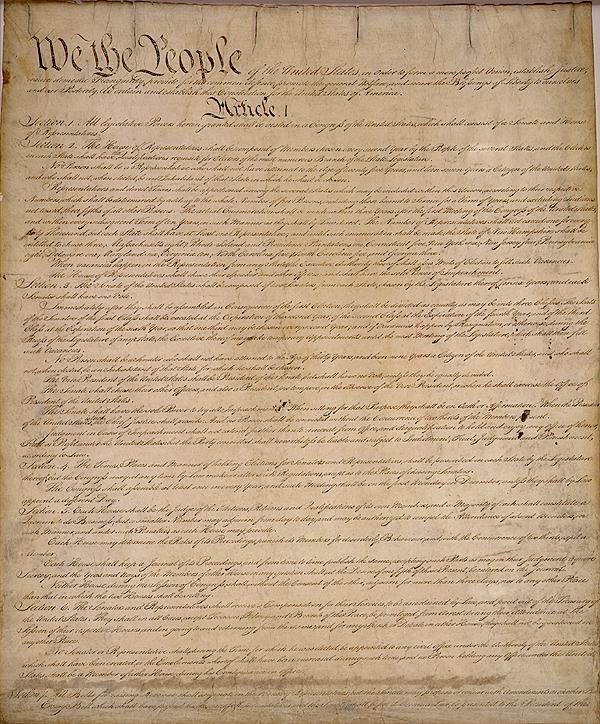
So many times, I’ve seen smart people saying we should not impeach or invoke Section 4 of the 25th Amendment (the Constitution’s presidential removal clause). Here’s why I think we should.

The United States Constitution

It’s true that Pence has both worse ideology and better political skills—and a Pence presidency could be extremely scary. I hope Mueller takes him down too, and that’s a real possibility.

But if he is sworn in after impeachment, he will be very, very careful. He will have to be seen as the unifier, and he will have to walk very carefully to avoid falling into the pit he created by his own actions, his own complicity. I think he will be quite cautious. And if he is not sworn in, the next in line is the very competent and moderately liberal Nancy Pelosi.

There’s also the issue of precedent. It says something very disturbing about our “democracy” that we have allowed this man to um, “serve” while continuing to break law after law, while telling 8158 lies in his first two years in office—6000 of them in 2018, while lining his own pockets, etc.

The possibility of a maniac like DT in office is why we HAVE the impeachment, emoluments, and removal-for-incompetence/incapacity clauses. We damned well better use them if they are anything other than ink on paper. Not using them forfeits our rights as citizens and makes it harder to challenge the next incompetent narcissist. I wonder: would this presidency have even been possible if GWB had been impeached for his incompetence, the actions of his competent but evil henchmen like Cheney and Rumsfeld, or for the fraudulent justifications for the Iraq war—or if the Democrats had fought hard enough in 2000 to prove that the election was fraudulent and should be overturned, thus preventing the GWB presidency in the first place?

Interestingly, the 25th Amendment requires the Vice President’s active cooperation. Here’s the full text of Section 4:

Whenever the Vice President and a majority of either the principal officers of the executive departments or of such other body as Congress may by law provide, transmit to the President pro tempore of the Senate and the Speaker of the House of Representatives their written declaration that the President is unable to discharge the powers and duties of his office, the Vice President shall immediately assume the powers and duties of the office as Acting President.

Thereafter, when the President transmits to the President pro tempore of the Senate and the Speaker of the House of Representatives his written declaration that no inability exists, he shall resume the powers and duties of his office unless the Vice President and a majority of either the principal officers of the executive department or of such other body as Congress may by law provide, transmit within four days to the President pro tempore of the Senate and the Speaker of the House of Representatives their written declaration that the President is unable to discharge the powers and duties of his office. Thereupon Congress shall decide the issue, assembling within forty-eight hours for that purpose if not in session. If the Congress, within twenty-one days after receipt of the latter written declaration, or, if Congress is not in session, within twenty-one days after Congress is required to assemble, determines by two-thirds vote of both Houses that the President is unable to discharge the powers and duties of his office, the Vice President shall continue to discharge the same as Acting President; otherwise, the President shall resume the powers and duties of his office.

Of course, Pence has made no secret that he’d love to be President. And any sane person would avoid overmuch loyalty to DT, who has shown over and over again that while he values loyalty in others, he has seemingly none of his own to distribute other than to Vladimir Putin and Russia—an alliance that goes back decades. If DT thinks you’re crossing him, he throws you under the bus with no hesitation. Even if you were his personal lawyer, fixer, and close confidante for many years. Thus, it wouldn’t be a shock if Pence cooperated with—or even initiated—a 25th-Amendment removal proceeding—IF he thought he could get away with it without repercussions from DT or his base.

In short, a legal maneuver to get DT out of office (and perhaps behind bars) is well justified, even though it will only succeed if several Senate Republicans desert him. Because they will, if a people’s movement demands it and they’d rather not lose their own jobs.

In other words, just because the GOP made a bad strategic decision to embrace the devil doesn’t mean we’re stuck with him. If they see the public swinging strongly against DT, they’ll abandon the sinking ship—but they need to hear from their constituents, loudly and often. They could have reined DT in early and firmly but they didn’t want to annoy his “base”—which as a result thinks those members of Congress are weak and don’t care much, and therefore continue to push the envelope on making very bad behavior acceptable. It’s time to push back and demand accountability for letting an incompetent maniac sack our democracy, burn bridges with our allies, collude with our enemies, and lash out at those who can’t defend themselves.

The faster the Republicans move, the easier it will be to re-cage the monster.

Facebooktwitterpinterestlinkedinmail

Marchers at a rally for racial justice and immigrant rights, Holyoke, MA. Photo by Shel Horowitz.

For more than a year and a half, the current administration has been mired in constant scandals of corruption/self-dealing, incompetence, vindictiveness, attacks on his opponents and on minorities, attacks on the environment, bullying, broken promises, well more than 2000 lies from the man himself, and even broken treaties…the list, unfortunately, goes on and on and on. The sorry chronicle started well before his inauguration and continues through the present.

Perhaps you didn’t think it could get worse But in the past six weeks, this vile administration has reached a new low. The decision to wrench 1995 helpless children from the arms of their loving parents and put them in cages is not only inexcusable on moral and humanitarian grounds, it’s also a long-term disaster for the safety and security of the United States. Yes, it puts every American at risk.

Here’s a quick description of the legal issues and a good list of organizations fighting this outrage that need our help.

Let’s look at both the moral and practical reasons why this must stop.


The Moral Issues

Many figures in this administration have been long-time champions of self-described “family values.” In other words, they say they are in favor of keeping families together, as long as those families are heterosexual. They talk earnestly about the importance of having a child grow up in a home with both parents. Yet, when mothers take their children and flee gang violence, domestic abuse, and other genuine evils, the US incarcerates them at the border and takes their children away. The parents treated like violent criminals. Their children put in cages.

Attorney General Sessions quotes one verse in the Bible to justify this barbarism: a verse that was used in the 19th century to justify the worst aspects of slavery.

Last I checked, the Attorney General is one of the people charged to protect the separation of church and state (as well as freedom of speech AND assembly) enshrined in the First Amendment. But even granting that the Bible can be a moral compass for a sitting Attorney General, Mr. Sessions’s interpretation is highly selective. Consider a few of the other things the Bible says. I’ve posted a whole bunch of them at the end of this blog post—but first, let’s talk about the practical impact.


The Practical Case

As taxpayers and citizens, we should be deeply concerned about what’s being done in our names. The consequences to the US could be deep, severe, and very negative. A few examples:

This policy creates an entire class of enemies—creates potential terrorists

Deliberately adding trauma creates maladjusted human beings: PTSD and other diseases. Any child ripped away from his or her family and put in a cage is going to be hostile to the government that did this. Family members will also be hostile. Taken to the extreme, you create something that looks entirely too much like the Israeli-Palestinian conflict, where hurts lead to rage, rage leads to violence, and violence leads to even more abrogation of rights. Once this cycle of violence gets established, it’s really hard to break (though, of course, lots of people are trying, including my colleague Andrea Ayvazian. Do we really want to create a whole new class of enemies who will feel justified in attacking US-related sites around the world? Hasn’t the US been fighting terrorism as its major foreign policy stance since 2001? This policy could create a whole new generation of terrorists.

Also, do we really want to attempt to repair avoidable psychological damage that prevents people from functioning effectively and finding gainful employment? Many of these folks will end up in the US eventually. By making it harder to function, we turn them into social burdens. Our tax dollars will have to cover the survival mechanisms for those not resilient enough to recover on their own.

It’s fiscally unsound and wrecking the economy

Jailing immigrants seeking asylum is expensive, with taxpayer costs of up to $585 per family per night. It is far cheaper to provide humane living conditions, assist in finding job and housing, and create a new and grateful productive class of future citizens.

Also, the many industries that rely on immigrant labor are at risk. Agriculture has been particularly hard hit, with crops rotting in the fields because workers are not available to harvest them. If we want food to eat, we have to stop terrorizing immigrant farmworkers.

It puts the US in violation of international law as well as our own constitution

The path the US is taking is in gross violation of various human rights charters, UN regulations, and our own constitutional requirements for due process. Imagine the consequences to business, for instance, if organizations in other firms because the US is guilty of crimes against humanity. It has happened to other countries and it could happen to us. There should be a massive outcry from business about the risks of this policy.

It positions the US as an unworthy partner for joint projects with other governments and businesses

The US has become a rogue state, blowing away trust on a host of issues, from the Paris Accord to the G7 Agreement. Now, other governments may face pressure from their own constituents not to do business with abusive governments, just as economically and organizationally isolating South Africa forced that country to get rid of apartheid.

A Few More Bible Quotes Mr. Sessions May Want to Study

On the importance of family:

8 Anyone who does not provide for their relatives, and especially for their own household, has denied the faith and is worse than an unbeliever.
1 Timothy 5:8
3 Children are a heritage from the LORD, offspring a reward from him. 
4 Like arrows in the hands of a warrior are children born in one’s youth. 
5 Blessed is the man whose quiver is full of them. They will not be put to shame when they contend with their opponents in court.
Psalm 127:3-5
15 She gets up while it is still night; she provides food for her family and portions for her female servants. 
16 She considers a field and buys it; out of her earnings she plants a vineyard. 
17 She sets about her work vigorously; her arms are strong for her tasks.
Proverbs 31:15-17

On immigrants’ place in society

21 “Do not mistreat or oppress a foreigner, for you were foreigners in Egypt.
Exodus 22:21
35 For I was hungry and you gave me something to eat, I was thirsty and you gave me something to drink, I was a stranger and you invited me in,
Matthew 25:35
32 but no stranger had to spend the night in the street, for my door was always open to the traveler
Job 31:32
35 “ ‘If any of your fellow Israelites become poor and are unable to support themselves among you, help them as you would a foreigner and stranger, so they can continue to live among you.
Leviticus 25:35

On human dignity

Numerous quotes at https://www.openbible.info/topics/human_dignity

Facebooktwitterpinterestlinkedinmail

A remarkable document came out of the G7 summit. It’s a blueprint for creating a just, fair, and environmentally viable world. Leaders of the world’s most powerful industrial economies are coming together in unity and releasing a document that I agree with almost all of. Among other things, the G7 Charlevoix  Declaration:

  • Affirms the rights of minorities (including indigenous people) and women
  • Positively addresses the conflict between Israel and Palestine, tension around Korea and Iran, Russian power grabs, and even the misery inflicted by Daesh (a/k/a the Islamic State)
  • Calls for worker protections
  • Promotes sustainable and democratic health care, economic growth, and even tax structures that benefit all
  • Has strong language urging protection of the earth and its resources

Really, the only place where I have concerns is in the endorsement of “WTO-consistent” trade policies. My understanding is that some of the World Trade Organization’s policies abrogate citizens’ and countries’ rights, including the right to enforce strict environmental and labor laws, allowing companies to sue if they find these laws burdensome. However, the citation above is almost 20 years old, and more recent documents from the WTO itself deny that claim.

With nearly 50 years as an activist, I find it utterly amazing that the “Leaders of the Free World” can agree on a document of such scope. We could actually call it revolutionary. The leaders of nations–and, in other forums, many leaders of major corporations–are agreeing to a manifesto of people’s and planetary rights. I’m not really used to having them on my side.

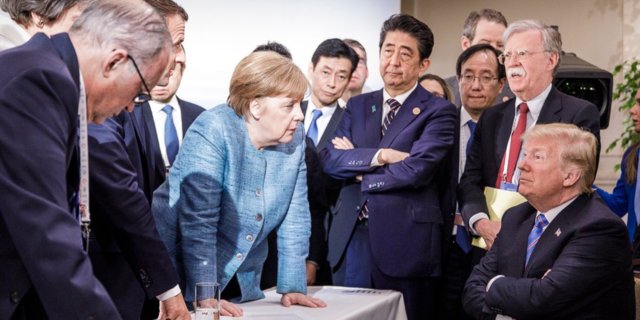
This photo released by the German government sums up the US president's attitude.
This photo released by the German government sums up the US president’s attitude.

And of course, the fly in the ointment was the disgraceful behavior of the “world leader” who happens to be in charge of my own country right now. The barrage of in-person pouts and Twitter nastygrams including repudiating the statement he signed make me embarrassed once again that this cruel, mean-spirited, and incompetent person supposedly represents me. Sigh!Facebooktwitterpinterestlinkedinmail

On Monday, the US Electoral College will be officially deciding whether Donald Trump will be president of the United States.

Caricature of Donald Trump by DonkeyHotey, Creative Commons License: https://www.flickr.com/photos/donkeyhotey/5471912349/sizes/m/in/photostream/

Alexander Hamilton had several reasons for proposing this convoluted structure. Some of them were not so noble, like giving more power to slave states. But one is worth noting: providing a check against the office going to someone unfit to hold it.

And just because that body has never found a winner unfit doesn’t mean it can’t. This time, there are a whole bunch of reasons why it might want to exercise that power. Some of them are about his complex financial empire, some about his personal actions—and some about the questionable integrity of this year’s voting process. Any one of these should be enough to say, “Hey, wait a minute, this is not OK.” Here are ten among many.

  1. Refusal to divest of investments that could influence policy
  2. Unlike every major party presidential candidate in decades, refusal to disclose his taxes
  3. Probable intervention by a foreign government (Russia), according to the CIA (Central Intelligence Agency)—and the request by some Electors for a briefing on this
  4. His opponent winning the popular vote by an astounding 2,833,224 votes
  5. Trump has been named in at least 169 separate lawsuits—for fraud, antitrust violations, discrimination, and sexual harassment (among other issues). One is especially worth highlighting: A consolidated fraud case (including two class action suits plus one filed by New York State’s Attorney General that Trump settled for $25 million alleged that his Trump University was a scam
  6. Interference in legitimate recount efforts in three states where exit polls showed a Democratic victory but the state was called for Trump
  7. Refusal to accept intelligence briefings, a daily part of every president’s morning since forever
  8. Threats to the First Amendment guarantees of freedom of speech, press, and assembly
  9. Threats and incitements to violence against a vast range of people, from Hillary Clinton to an 18-year-old college student
  10. Insults both to whole classes of Americans and to individuals who disagreed with him

This, unfortunately, isn’t even the whole story. I haven’t discussed the ludicrous lack of government experience among his Cabinet picks…his own inexperience in any government position…the consistent lying…the well-documented cheating of vendors…the lease he has with the federal government for his new Washington, DC hotel which bars any government employee…his insistence on remaining Executive Producer of Apprentice, as if running the country were a side hustle…the extremist agenda he has embraced…his refusal to meaningfully condemn the hundreds of hate crimes in the aftermath of the election…and on and on it goes.

I hope the Electors in the Electoral College do their patriotic duty, and (in the words made famous by Nancy Reagan) “just say no.”

Note: dozens of petitions to the Electoral College are circulating. Here’s one I like. It allows you to write your own letter (be polite!)Facebooktwitterpinterestlinkedinmail

The US presidential race is full of outsiders this year. Trump gets lots of attention in the media–but Sanders seems to be having more of an impact on policy questions, and on bringing disenfranchised-feeling voters in from outside the electoral process.

There are many parallels between Sanders on the left and Trump on the right–both of them attracting attention for being firmly OUTSIDE the mainstream, and both waging far more successful campaigns than the pundits predicted. And they both look and sound like the New Yorkers they are.

But in many other ways other ways, of course, they’re completely different: Unlike Trump, Sanders is…

1. Seriously concerned about making things better for those who are not wealthy, and basing this on a 50-year record of activism (vs. concern only about making things better for Trump and a few others of enormous class privilege).
2. Thoughtful, willing to engage on issues, analyzes more deeply than most candidates with charisma.
3. A populist fundraising champion who does not fund his campaign with–and thus is not beholden to–corporate money or party money, but from millions of ordinary people. I don’t think this has been done before on this scale (vs. Trump self-funding out of his personal fortune and claiming that this makes him honest because he’s the one doing the buying of politicians instead of being bought by them)
4. Someone who tells the truth (Trump has been caught in more lies than any of the others).
5. A successful coalition builder who has a track record of working well with people who think differently

But even Cruz and Rubio (and certainly dropouts Carson and Fiorina) are outliers too. It is scary to see the Republican Party start to coalesce around the very scary Ted Cruz, who only looks rational because Trump is so far in right field that he moves the public perception of what’s mainstream. When Speaker of the House Paul Ryan (a slasher of the safety net) is considered a centrist, we have a serious distortion in perception vs. reality.

So the big lesson I take away is this: when four out of the five most popular candidates this year are outside the mainstream, the mainstream had better look at why, and what they can do about it. With the exception of Clinton, all the mainstream candidates are out of the race–even presumptive GOP nominee (as of last summer) Jeb Bush.

Me? I agree with at least 80% of what Sanders says, and was happy to vote for him in our March 1 Massachusetts primary.

Oh yes, and let’s not forget the role of the media in king/queen making and unmaking. One of Sanders’ other strengths is in engaging millennials who are good at creating their OWN (social) media–while defeating the myth that a self-declared socialist can’t run a serious campaign for national office in the US.Facebooktwitterpinterestlinkedinmail

Guest post by Paul Loeb

Remember the World Trade Organization, which slipped into the shadows after massive Seattle protests in 1999? The same day last week that Congress initially blocked the possibility of fast track approval for the TPP trade agreement, the House voted to overturn rules requiring country-of-origin labeling for meat. Those supporting the vote said they were responding to a World Trade Organization ruling, judging US country-of-origin labeling unfair competition with meat coming from foreign countries like Canada and Mexico, and therefore a violation. They said they had no choice for fear of triggering sanctions or lawsuits from countries exporting meat across our borders.

I don’t know about you, but I like knowing whether my meat comes from Iowa or Uzbekistan, Montana or Mexico, Kentucky or Kenya. So do 93% of Americans, according to a Consumer’s Union survey. People like supporting US farmers, cutting down distance travelled, knowing there will be at least minimal inspection standards, even if the delights of e coli occasionally slip through. It seems commonsensical that we’d want at least the chance to become informed consumers, whether with the origins of our meat, GMO-derived crops, or the amount of sugar and calories in our baked goods.

Maybe the House members are wrong in insisting that the international tribunals that adjudicate trade disputes would deem this a violation. But if this particular House bill passes the Senate and gets signed by Obama, even the mere possibility of a lawsuit will have struck down a wholly reasonable law that protects our health and supports our local economies. And if TPP passes the Senate, other attempts to regulate commerce for the common good will be potentially gutted as well, from attempts at financial regulation to limits on the prices charged for drugs, to environmental rules and seemingly innocuous actions like requiring accurate labeling. Some of this could occur through legal action, and some through the mere fear that such action could occur.

Now maybe TPP won’t contain rules on meat. Maybe it will simply limit other ways we might try to exert our sovereignty over critical choices that affect us. But we do know that this agreement—involving countries constituting 40% of the global economy—through what’s called the Investor-State Dispute Settlement process, will establish unaccountable tribunals with the power to let corporations collect damages for loss of profits. We don’t know the precise reach of the agreement because ordinary citizens haven’t seen it. Even Congressional opponents were prohibited from taking notes when they looked at it, and “cleared advisors” who’ve seen it have been legally prohibited from talking specifics. Yet we’re told it represents an inevitable future, that the benefits will trickle down to ordinary citizens, and that those who ask reasonable questions about its profound implications are merely obstructionist whiners.

So do we demand full transparency before moving ahead? Or do we trust that the corporations that negotiated these rules have our interests at heart, and would never, in the slightest, harm our democracy? Whether or not the country-of-origin labeling on meat survives or is ended by the House bill and WTO ruling, TPP plays for far larger stakes, the ground rules that affect our very potential to take common action. The meat bill is one more warning that there are some rules and agreements where we should be careful to eagerly swallow.

Paul Loeb is the author of Soul of a Citizen and The Impossible Will Take a Little While

Facebooktwitterpinterestlinkedinmail

This may be a new level of stupidity. Murdoch-owned publishing behomoth HarperCollins actually prepared and started to sell an atlas that does not show Israel. At all. Lebanon, Jordan, Gaza, and the West Bank are there.

No big surprise, there was lots of pushback when word got out, and HC removed the atlas from circulation and said it would pulp any remaining copies. Even the UK Bishops’ Conference Department of International Affairs condemned the publication as a blow against peace in the region.

The company sheepishly withdrew, saying,

HarperCollins sincerely apologises for this omission and for any offence caused.

But the company is talking out of two sides of its mouth. Earlier, as reported in the Washington Post, it tried to justify the omission:

Collins Bartholomew, a subsidiary of HarperCollins that specializes in maps, told the Tablet that it would have been “unacceptable” to include Israel in atlases intended for the Middle East. They had deleted Israel to satisfy “local preferences.”

HarperCollins has quickly found out that it’s also unacceptable to abandon truth in a volume that claims to offer

“in-depth coverage of the region and its issues.” Its stated goals include helping kids understand the “relationship between the social and physical environment, the region’s challenges [and] its socio-economic development.”

Ummm, hello, and just how do you intend to put the region in context if you ignore the most conflicted issue it faces? Do you really think students in Arab countries haven’t heard of it? Did you really think this would stay a safe little conspiratorial secret just for the cognoscenti?

HarperCollins would have been totally justified in marking the West Bank and Gaza as disputed territory held by Israel, following conquest. But there’s no dispute about Israel being a nation.

This is a time when we all have social media at our disposal. That means it not only should have been totally obvious that this would backfire, but HarperCollins had the tools at its disposal to make the governments demanding this absurdity to be the ones looking ridiculous. If any governments insisted on refusing entry to accurate atlases, the company could have had a skilled social media manager explain why HC would no longer sell atlases into these countries, and create a pressure movement both from outside the country and from those inside who recognize that not knowing geography is a handicap in the global economic arena, and the Gulf states would have lifted the restriction.

Instead, what HarperCollins has done is to eliminate its own credibility. It’s hard to imagine anyone in the future trusting any reference materials from this publisher. Blatant and deliberate repudiation of truth is not a recipe for success in the world of reference books—especially reference books about the world.Facebooktwitterpinterestlinkedinmail

I can think of no better way to celebrate July 4th this year than to acknowledge the huge honor my hero and friend Dean Cycon, CEO of Dean’s Beans in Orange, MA recently received.

Dean Cycon, CEO, Dean's Beans, jamming with musicians in Rwanda
Dean Cycon making music in Rwanda

Dean Cycon is the most ethical business owner I know, and the only person to be a guest twice on the business ethics radio show I hosted and produced for four years, from 2005 to 2009. Dean has done 100% organic and fair trade coffee and cocoa since the day he opened his company, which he located in a depressed area where jobs are scarce. Dean not just funds but also actively partners with people in the villages that supply his coffee to do “people-centered development” projects, led by the folks who live and work in those villages. He also partners with local charities in western Massachusetts to create private label coffee they can sell as fundraisers. Oh yes, and he’s also the author of one of my favorite travel books: Ippy Award gold winner Javatrekker: Dispatches from the World of Fair Trade Coffee (Chelsea Green, 2007). And he’s a fun guy who hasn’t let success interfere with his playful spirit.

And now, OMG, Dean Cycon has been awarded one of the most prestigious honors in the world: the Oslo Business for Peace Award, also known as the alternative Nobel Prize for business. The award judges are actual Nobel Laureates, including microlending pioneer Prof. Muhammad Yunus, winner of the Nobel prize in Economics in 2006, and Prof. A. Michael Spence, winner of the Nobel prize in economics in 2001. Dean is one of five honorees, and the only American. All I can say is, he richly deserves it.Facebooktwitterpinterestlinkedinmail