An AP story on the Republican Convention in today’s paper puts it this way:

Mitt Romney conceded Sunday that fresh controversy over rape and abortion is harming his party and he accused Democrats of trying to exploit it for political gain.

“It really is sad, isn’t it, with all the issues that America faces, for the Obama campaign to continue to stoop to such a low level,” said Romney, struggling to sharpen the presidential election focus instead on a weak economy and 8.3 percent national unemployment.

Let me see if I get this straight:

  1. Mitt Romney has spent the entire campaign trying to distance himself from the moderate stances on social issues he embraced as recently as 2008, embracing a hard-right radical ideology that would attack women and gays, increase economic disparity, and stack the Supreme Court with more radical-right ideologues.
  2. Mitt Romney chose as his running mate Paul Ryan, whose budget proposals are akin to a hit-man attack on the poor, and whose environmental record makes me worry a great deal about the future of the planet (Paul Ryan gets a miserable 3% rating from the League of Conservation Voters)—and who co-authored extreme anti-choice legislation with none other than the notorious Missouri Congressman Todd Akin, yes, the same one who made the ridiculous remark about pregnancy being nearly impossible in cases of “legitimate rape.”
  3. Mitt Romney is content to stand behind a Republican party platform that contains a full-blown assault on women’s reproductive rights.
  4. As an example of taking the high road, I suppose, Romney made a joke that essentially endorsed the discredited birther movement that claims Obama was not born in the US, just last week. Talk about focusing on the important issues!

And please, finally, let’s not forget that the Republicans have no legitimate claim to run on economic issues. Not only did George W. Bush turn the largest surplus in history—that he inherited from Bill Clinton, who built a remarkable ecnomic recovery after the disaster of the Reagan-Bush years—into a raging deficit, not only did the economy crumple under years of deregulation and defanging the watchdogs, but the Republicans have sabotaged Obama’s recovery efforts over and over again, with the expressly stated goal of making him a one-term president. Even so, housing starts are up, private-sector jobs are up, and the stock market is waaaay up.

And let’s not forget Romney has made it quite clear he will be the president of the 1%. Those of us in the 99% will not find a friend in Romney-Ryanomics.

Joseph Welch asked Senator Joe McCarthy, “Have you no sense of decency, sir?” He’s often misquoted as asking “have you no shame, sir?” That second question is the one I pose today to Mitt Romney.

Facebooktwitterpinterestlinkedinmail

A government is finally taking action against Monsanto, which has a long history of abusive practices involving genetically modified crops.

In this instance, the company stands accused of stealing brinjal (a kind of eggplant) and developing GM varieties in an attempt first of all to extract biodiversity riches from the local populace without compensation, and second, to mislead others about whether they were engaging in GM once they had it. In the past, Monsanto has had a particularly disgusting habit of letting its GM crops contaminate other farmers’ fields, including organic growers, and then suing the victims for using its seed without permission. I am glad to see a government finally going after this corporate bully that plays fast and loose with our food safety.

Lots of bloggers have picked up this story, but it doesn’t seem like the mainstream media have paid attention. I finally located a mainstream media report: an English-language public affairs show on French TV covering India’s lawsuit against Monsanto.

Let’s hope this action is the first of many similar actions of governments protecting their people against these outrages.

Facebooktwitterpinterestlinkedinmail

Never, ever think that war solves problems. It multiplies them.

Before the illegal and immoral US invasion, Iraq was a garden-variety dictatorship, similar to at least 30 other countries around the world, where dissent was suppressed but society was basically functional.

Now, it’s a wreck. And of course, US mainstream media only talk about the impact on Americans: the US soldiers (and their mercenaries) who died or were wounded or who suffered post-traumatic stress, and their families who are impacted by the hurt to these brave men and women. The impact of the war on the people of Iraq is rarely talked about.

An article by John tirman in the November 15 Washington Spectator (not yet posted on the newsletter’s website) lays out some of the litany of chaos and devastation. A few “highlights”:

  • Somewhere between 400,000 and a million deaths, many of them civilian
  • 3.5 million to 5 million displaced refugees
  • Massive, widespread infrastructure and support failures including health care, education, clean water, sanitation, and electricity
  • Thousands of desperate Iraqi women and girls turning to prostitution
  • 750,000 impoverished widows
  • A legacy of corruption that diverted millions of dollars from the US economy into the hands of a few well-placed privileged Iraqis, while the services being paid for either went undelivered or were so shoddy as to be useless
  • And of course, widespread hatred and fanaticism directed against the West in general, and the US in particular, and a huge rise around the world in the worst kinds of extreme Islamic fundamentalism—it’s a lot easier to recruit a teenage suicide bomber or terrorist when that person is furious that you killed a close friend or relative

The first five bullets come directly from the article, “How Will We Remember Operation Iraqi Freedom?” The last two points are my own analysis. The stats that follow come from another article in the same issue, “Left Behind,” by editor Lou Dubose.

While the war was entirely a creation of George W. Bush and his advisors (particularly Donald Rumsfeld and Dick Cheney), it hasn’t really gotten better under Obama. His withdrawal process has been slow and incomplete, and he’s leaving behind a “diplomatic” apparatus big enough to run a small country: 17,000 people including 650 American diplomats, in the largest embassy in the world (not counting several satellites around Iraq), with a $6 billion budget and another $13 billion in private contracts.

And why has Obama steadfastly refused to even consider war crimes trials?

Facebooktwitterpinterestlinkedinmail

According to the New York Times, it seems the Chinese want to have their cake and eat it too when it comes to electric cars. With only a minuscule budget for R&D, the Chinese want to coerce their way into access to expensively developed technologies for electric cars by making that access a precondition for foreign manufacturers who want to sell electric vehicles in China, if they want the same subsidies that Chinese-made electric cars enjoy. (This happens to be a violation of the World Trade Organization’s rules, and China is a WTO member)

Here’s how I think that would play out:

  • At least some foreign automakers, wanting access to the vast and rapidly growing Chinese market, make the devil’s bargain and share their technology secrets
  • China begins a crash program in its state-owned car companies to bring cars to market using this technology
  • After one to three years, the foreign automakers find themselves closed out—and sitting on a big useless pile of expensive infrastructure—as the Chinese rush cheap and shoddily built EVs to market using American, European, or Japanese technology

General Motors is actively resisting and protesting; Nissan doesn’t even want to go into the market under these conditions; yet Ford apparently plans to cave.

This is one time I find myself agreeing with General Motors. This is a bad idea!

Facebooktwitterpinterestlinkedinmail

Early this month, I got an e-mail from a Professor Robert Brain, inviting me to speak at my full fee plus expenses for a rapidly upcoming conference in England. The topic he proposed was a bit off my usual topic, but one that I could handle.

Follow-up mails from a Professor Woodman Walker included a letter of agreement to sign and requested more information from me. I wanted to find out more about the parameters of the speech, so I asked for some phone time. Our interview was scheduled for 8 a.m. my time this morning.

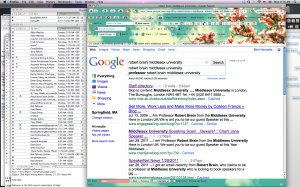
In the meantime, I had asked my good friend Google to tell me what it new about these two “gentlemen.”

The results were not encouraging:

One of the links on that page led me to a full account of how the scam works. I also checked the Middlesex University staff directory. Oddly enough, the phrase “Robert Brain” brought back a listing of the staff directory, as you can see in the screen shot–but when I clicked through the directory itself, neither Robert Brain nor Woodman Walker showed up.

Now, I’ve had a few speaking requests that seemed pretty flaky at first, and turned out to be real. So I was willing to give him the benefit of the doubt. Here’s an approximation of how the conversation went:

Me: “Good morning, this is Shel. How may I make your day special?”

Him: “This is professor Woodman Walker of Middlesex University, UK.”

Me (big, hearty): “Good morning, Professor. The first thing I need from you is the names, off the top of your head and you can give me contact information later, of three people who’ve spoken for you in the last year. There are some rumors about you on Google.”

Him: hangs up.

Speakers—be suspicious of any e-mail that asks for banking information in order to get a work permit (I didn’t get that far with him)—and don’t be surprised if a similar scheme shows up allegedly from a different school and different professors.

You’ve been warned!

Facebooktwitterpinterestlinkedinmail

Two stories in today’s paper about high consequences for corporate greed—and both of them have significant environmental as well as business ethics interest.

First, a local company here in Massachusetts, Stevens Urethane, faces a five-year ban on manufacturing a technology used in making solar panels, as well as more than $8.6 million in assorted fines, penalties, and other costs. The company was found guilty of stealing the secrets of a competitor, and the judge’s ruing not only impounded more than a million dollars worth of revenue, but forbade the company from using a $2 million assembly line it had built to make the product. Punitive damages, attorneys’ fees, and reimbursement of the other side’s legal and expert witness fees combined to create the $8.6 million total.

But the cost of this business ethics failure is only 1/1000th of the costs slapped onto oil giant Chevron by the government of Ecuador. While the $8.6 billion amount was less than 1/3 of the court-appointed expert’s recommendation, it is still the largest damage award ere in an environmental damage lawsuit (and probably the first of many more around the world against oil companies, which have been sued for habitat destruction in Nigeria and elsewhere).

Ironically, this suit had originally been filed in US courts against Texaco (now owned by Chevron), and the company’s attorneys successfully argued that the case should be heard in Ecuador.

Facebooktwitterpinterestlinkedinmail

If you search on Google for the word Google plus the exact phrase “Don’t Be Evil”, you get 366,000 hits. The company’s motto has been used at least since 2001, according to Wikipedia.

As someone who has been writing and speaking about business ethics for seven years, I applaud this motto. But I question its authenticity as it applies to some of Google’s actions. In other words, I see Google occasionally violating the motto with at least three sets of policies that–intentionally or not–certainly do evil.Read more »

Facebooktwitterpinterestlinkedinmail

Exactly how did Bernie Madoff steal his billions? Why are Halliburton’s hands so dirty? What happened with corruption cases in the rebuilding of Iraq? Following a link from EthicsWorld’s e-newsletter, I came to a single URL that has multiple stories on corruption: https://www.ethicsworld.org/publicsectorgovernance/corruptioninvestigations.php#sec.

This is what we’re up against, those of us who believe in ethics.

Facebooktwitterpinterestlinkedinmail

Pope Benedict XVI’s third encyclical is a sweeping, 144-page document addressing and interlocking a wide range of social issues. He calls on the financial industry to tame its greed and turn to ethics, asks the United Nations and individual governments to address deep-rooted poverty issues–not only from economic development perspectives but also making sure these countries have a voice and a seat at the table of power–a political shift, in other words.

Good coverage in the Washington Post (see above link). And a shoutout to Allan Holender of the World Wide Association of Zentrepreneurs, for bringing this important document to my attention.

Facebooktwitterpinterestlinkedinmail

Like many others, I am appalled both by the apparently stolen election in Iran and by the repressive, violent response of the government to the mass protests.

And like many bloggers today who want to be cheerleaders for democracy and (to use Martin Luther King’s wonderful phrase) “drum majors for justice,” I’m joining in a worldwide campaign today to call attention to the problems with the Iran vote and its bloody aftermath. Click the link to see a long list of grievances and solidarity actions.

Thanks to @engagejoe on Twitter for calling this solidarity action to my attention.

Relevant Twitter tags: #FreeIran #IranElection #bloggersunite

Facebooktwitterpinterestlinkedinmail