“We have built the safest civilisation in human history while convincing ourselves that we live in the most dangerous. Billions of people experienced measurable improvements in health, safety, and material conditions in 2025. That progress didn’t make the news. But it happened anyway, one vaccine, one school meal, one kilowatt-hour at a time.”
—Angus Hervey, Fix the News

From Fix the News, one of several good-news publications I receive—and one that skews toward science-based progress. This one does start with a depressing summary of the news we’ve all heard—but then moves into a long series of victories that most of us didn’t even now about. It pauses to excoriate mass media for amplifying the negative and superficial (e.g., celebrities) while ignoring unsexy but vital stories such as the amazing ocean treaties and the actual elimination of rampant fatal diseases, country by country. And then it finishes with another long list of victories for humanity and the other creatures we share this amazing planet with.

You won’t be sorry to spend ten minutes with this. https://fixthenews.com/p/the-telemetry?utm_source=post-email-title&publication_id=4861955&post_id=182468358&utm_campaign=email-post-title&isFreemail=true&r=sl4r&triedRedirect=true&utm_medium=email

Facebooktwitterpinterestlinkedinmail

I admire your constant calls for peace, Donald. I just wish I could believe them. You see, there’s this little problem: saying you want peace isn’t enough. You have to actually BE a peacemaker. And you haven’t been one.

You’ve claimed to end eight wars. Independent fact checking shows that you did in fact have a role in bringing several of those countries to the table, and I commend you for that. However, your grand, sweeping claims that peace wouldn’t have happened without your aggressive diplomacy are highly exaggerated. And several of the peace agreements aren’t exactly working out. For example, the United Nations reports that 339 Palestinians were killed by Israel in the six weeks following the ceasefire. We’ll give you a B-.

You renamed the US Institute of Peace after yourself.  You spent months telling Oslo you deserved the Nobel Peace Prize. Yes, it’s true that some recipients didn’t deserve it either: Barack Obama was new in office and hadn’t done anything significant toward peace at that point. Henry Kissinger was a war criminal responsible for much harm during the Vietnam War, the Chilean Pinochet dictatorship that followed the US-aided coup, and many other foreign policy debacles. But still, if you have to nominate yourself for the peace price and name an institution that is supposed to be independent after yourself, it doesn’t scream “qualified.” It actually says “laughably insecure and demanding.” Grade: D-.

Then there’s Ukraine. You’ve been so inconsistent that nobody knows where you stand. You berate the Ukrainian president in person on national TV. Next, you tell Putin to negotiate. Then you bring forward a proposal so lopsidedly Russia-centric that even Mitch McConnell dismissed the plan and said Putin had made a fool of you. One key principle of peacemaking: It has to include all the sides and let all of them at least claim some small victory, which this plan utterly fails to do. Grade: F.

How about relations with our near neighbors? You’ve killed at least 87 people in 22 separate attacks on vessels in the Caribbean, claiming that they were smuggling drugs. You’ve provided no evidence that this is true (and your long record as a massive serial liar doesn’t boost our confidence). And even if it were true, the proper procedure is to interdict and seize the boat, arrest the crew, and hold the cargo as evidence—not to blow it out of the water without warning. Both Colombia and Venezuela have accused you of extrajudicial murder. At least two of those were killed while clinging to the wreckage after you destroyed their boat, in clear violation of international law.  And it’s hard to believe that you really care about keeping drugs out of this country when you just granted a full pardon to the former president of Honduras, who had just started serving more than 40 years for a huge cocaine smuggling operation. There’s widespread speculation that this is really about setting your sights on Venezuela’s oil, and that you’re willing to start a war against them. Grade: F.

And then there’s your “peacemaking” right here in the  good old United States of America.

  • You send armed, masked goons to snatch honest, hard-working non-criminal immigrants away from jobs, loved ones, and decent places to live,  without a shred of due process. Sometimes, your goons snatch up people who have citizenship or permanent residence. Other times, you target people who are going through all the proper steps of being able to stay legally. This creates terror, not peace. It serves no useful function, disrupts families and the economy, and makes the whole country unsafe. Grade: F.
  • You rip the safety net apart, causing economic dislocation of the kind that encourages crime, making our streets less safe and less peaceful.
  • Your energy policies, pushing the most destructive, resource-intensive, and economically unworkable energy options, will lead to resource conflicts, which will lead to more wars. Grade: F.
  • Finally, your public language is the opposite of a peacemaker’s. You issue all sorts of smears against people of color, non-Christians, people with disabilities, even those who happen to belong to a different political party, as well as people you have specifically named and declared they are your enemies. You are an attack dog with a remarkably thin skin who insults others but has zero tolerance for dissent. To paraphrase Three Dog Night, “That ain’t the way to make peace, please.” Grade: F.

So if you want to be seen as a peacemaker, you have to become one. That’s going to take major restructuring of your whole way of being president. Are you up to the challenge? I’d love to see you succeed at embracing peace and would cheer you on publicly if you’re sincere. I’m not optimistic that you’re up to it—but I’d love to be proven wrong.

 Facebooktwitterpinterestlinkedinmail

Read. This. Article. It’s one of the most important articles I have read about climate change. Yes, the writing is a bit denser than most of what I share. But it’s still pretty readable. And it’s pretty short. If it feels like a struggle, take a couple of breaths and try again. The author’s points are marginalized in mainstream media and you won’t typically find them.
And along with that critique of Bill Gates’s climate theories, I would point out that the cooling centers he advocates are a Band-Aid on a gushing wound. Far better to prevent the need for cooling centers by switching immediately to REAL renewables (NOT nuclear fission power plants, which he has advocated elsewhere)–and mitigating not just the temperature but the social conditions of injustice that will be much much worse as the planet heats. One example in the article is setting up cooling centers for those on the margins—in other words, people who have no dwelling, who are homeless. That homelessness will in many cases be a direct result of climate change, which creates refugees directly (through crop failures and natural disasters and indirectly (through crime and resource wars).

Facebooktwitterpinterestlinkedinmail

Most of these are singable songs that can be used at rallies, though I snuck in a few harder to learn ones that tell really inspiring stories, marked with *, as well as some in other languages. Vaguely sorted but many of these songs could be in multiple categories. Authors’ names included where I have them. These are living songs. You will find versions with different lyrics, verses in different order as they evolve—adapted for new causes or new definitions or new sensibilities. You’ll also find some older works that don’t reflect the nth degree of what’s currently considered politically correct. They were important songs in their time, and part of what I’m trying to do is provide a sense of movement history. You’ll also find some musings about what a particular song means to me, sometimes with a memory thrown in. Enjoy!


The Strength of Ordinary People who “Activize” and Resist

Tyrants Always Fall (Nerissa Nields). When I got depressed during the first DT term, I often turned to this song for comfort. Western Mass folks will recognize the Northampton scenery, as The Nields are local and filmed their video downtown.

Something Inside So Strong (Labi Siffre). The Black Gay British man who wrote it was shocked by a video of South African police shooting into a crowd of anti-apartheid demonstrators—and also drew on his own background growing up gay and marginalized. It’s been widely adapted in the movements both to end apartheid and to gain LGBTQ rights. The couplet “The more you refuse to hear my voice/ The louder I will sing” is the earworm that’s been in my head a lot lately—and what inspired me to compile this resource.

*Denmark, 1943 (Fred Small) documents the incredible night when the people of Denmark rose up to smuggle almost the country’s entire Jewish population to safety in Sweden, just before the Nazis planned to swoop in to arrest and deport them. It has a singable chorus but I wouldn’t try to teach it to crowd that’s never heard it.

Never Turning Back (Pat Humphries). A great zipper song, easy to teach and lead.

Power to the People: We Rise (Laurie Woodward Garcia). Released in June, 2025, this song draws lyrics, energy, and photos from many struggles, including many from 2020 to the present.

If I Had a Hammer (Pete Seeger and Lee Hays). The original lyrics had “All of my brothers.” Decades ago, activist Libby Frank asked Pete at one of his concerts, “Why only brothers?” So Pete discussed it with Lee and they came back with “my brothers and my sisters.” In this version, Emma’s Revolution changed it to the more gender-inclusive “all of the resisters.” We still need to come up with something that has love not just for the resisters but for everyone, without reintroducing the gender binary. Got an idea?

Song of the Soul (Cris Williamson). An anthem of the women’s and lesbian movements, but I put it here because it’s also applicable generally.

Swimming to the Other Side (Pat Humphries). Like Song of the Soul, a song of spiritual renewal.

How Could Anyone Ever Tell You (Libby Roderick). I always thought of this as an LGBTQ community song. Turns out it’s been used in dozens of social movements. You’ll find a long list at the link, as well as several different recordings.

Rebecca Jones (Bob Blue). An ordinary mom steps into her greatness and gives a speech that inspires peace workers. I don’t know if this is based on one real person and one real incident, but I’ve met dozens and there have been tens of thousands of ordinary people who created massive social change, from 11-year-old Malala Yousafzai and 15-year-old Greta Thunberg (ages at the times they became activists) to Doris “Granny D” Haddock and Frances Crowe, both still activists on their hundredth birthdays. Despite dying at age 57, Bob was a prolific songwriter who left behind dozens of great songs. He’s probably best known for the feminist song “The Ballad of Erica Levine,” sung here by Kim Wallach. I’ve heard that one at several feminist weddings.

We’re Still Here (Holly Near). An upbeat, almost vaudevillian celebration of the resistance’s resilience and power.

What’s Going On (Marvin Gaye). That link is to an “official” video, released in 2019 (35 years after Gaye’s death) that includes images and sounds of protests and repression. If you would rather have it straight up, visit https://www.youtube.com/watch?v=H-kA3UtBj4M


LGBTQ

Singing For Our Lives (Holly Near). I love this video because not only do we have Holly’s beautiful rendition as it had evolved by 2004, but hugely inspiring footage of the massive march for women’s reproductive rights where she performed it. And some new lyrics put up at the end of the video. Holly literally wrote this song while carpooling to San Francisco to protest the murder of San Francisco Board of Supervisors member Harvey Milk—one of the first openly gay politicians in the US—and Mayor George Moscone by a right-wing homophobe. The driver, Holly herself, and a few others discuss the song’s origins and power in this short video.

*Scott and Jamie (Fred Small). Another true-story ballad from I Will Stand Fast (the same album as Denmark, 1943). How, in the 1980s, a gay male couple provided a loving, nonjudgmental home for two abused brothers only to have them ripped away by a homophobic government. Glad we have made big progress on this issue, at least.

*My Name is Joanna (Flight or Visibility). Misgendered once too often, my nonbinary younger child, a professional musician and music educator who also runs a school for social justice, wrote this after an encounter with a particularly clueless server in a cafe. Language warning: One f-bomb in the last line.

*When I Was a Boy (Dar Williams). A gender-bending song from the early 1980s that amazingly enough, I discovered because my local commercial FM rock station played it regularly! I very much identify with this song, especially the ending.

Thank You Anita (Charlie King). Released back in 1979, King counters Florida orange juice spokesperson Anita Bryant’s very public homophobia by saying she united people who hadn’t worked together before but now were joining forces to oppose her bigotry.


Peace

Oh What a Grand and Glorious Feeling (I think this is traditional, but it could have been written by Earl Robinson, who I learned it from at a house concert around 1978. Since then, I’ve taught it at many sing-alongs and rallies. I didn’t find a recording, just the lyrics, but the tune is the same as Oh How Lovely Is the Evening.)

Last Night I Had the Strangest Dream (Ed McCurdy). My folk-music-loving 4th grade teacher taught us this song and many other great ones!

*The Hammer Has to Fall (Charlie King). This song actually changed the way I felt about property-destruction civil disobedience that resulted in long prison terms. I used to resent the Ploughshare 8 for removing themselves from activism for decades. This song humanized them for me and touched my soul deeply.

Imagine (John Lennon). I could have put this in the general resilience category, or made a new section on visioning. But I’m putting it here because of the second verse that contains both “Nothing to kill or die for” and “Living life in peace.”


Safe Energy/No Nukes

Acres of Clams (Charlie King). Theme song of the Clamshell Alliance’s 1977 Seabrook occupation (one of my proudest moments in 55 years of activism).

We Almost Lost Detroit (Gil Scott-Heron). You may have never heard of the 1966 accident at the Enrico Fermi nuclear plant in Michigan, or the one at Browns Ferry in Alabama in 1975—or dozens of other near-calamities. Gill Scott-Heron helps us remember Fermi. By the way, I am convinced that the reason we DID hear about Three Mile Island, Chernobyl, and Fukushima while most of us have not heard of more than 100 other serious nuclear accidents was because of the safe energy movement, which inspired the movie, The China Syndrome, that came out right before the TMI accident. Lyrics.


US Civil Rights Movement

Oh, Freedom (traditional). I love Odetta’s version but could only find it as part of her Freedom Trilogy, so I went with Harry Belafonte’s.

I Ain’t Scared of Your Jail ‘Cause I Want My Freedom. From Pete Seeger’s 1963 Carnegie Hall concert, one of my favorite albums ever. More of this is telling the story than singing the very short song. But only Pete’s own recording turned up in a search.

We Shall Overcome (many authors over multiple generations). The anthem of the Civil Rights movement, carried over to many struggles since—in part, because it’s a “zipper song” where it’s easy to add new verses. Great article on the history of the song from Encyclopedia Britanica.

Ain’t Gonna Let Nobody Turn Me Around (adaptation of a traditional Black gospel song). This performance by civil rights activists the Freedom Singers doesn’t have a date, but according to this university curriculum citation, it can’t be older than 1962 or newer than 1980. My guess is sometime between 1962-65. I think I first heard it at a community rally in Atlanta when I lived there briefly in 1976, during a college internship at a socialist community newspaper.


Immigration and Immigration Justice

Yes I Am (American) (Malini D. Sur, MD). This 2010 song joins Brown, Black, Yellow, and Red people through the common experience of coming from someplace else—even if it was 10,000 years ago across the Bering Strait.

Mexican Chef (Xenia Rubinos) celebrates the jobs immigrants, especially Latines, do for people in the US and how our society would grind to a halt without them. I could do without the fake-sexy dance moves, though.

Where You Go (I Will Go) (Shoshana Jedwab). Based on the Old Testament Book of Ruth, one of the earliest voluntary migration stories we have. The Old Testament contains many migration stories across many centuries: Adam and Eve leaving the Garden, Abraham leaving Iraq and later experiencing several temporary migrations, Hagar and Ishmael forced into the desert, climate refugees Jacob and his adult children seeing refuge in Egypt, where he reunites with Joseph, the son he’d been told had been killed, Moses and later Joshua leading the Israelites out of slavery…I’d say these migration stories contain a lot of the power in those texts.

Deportee (Woody Guthrie, words; Martin Hoffman. music). The ugliness of US immigration policy is nothing new; this song was written following the death of a plane full of migrants in 1948. Judy Collins’ voice is achingly beautiful.

Using the same melody and parallelling the lyrics, Yosl Kurland ties together the tragedy of the Ashkenazi (Northern European) Jews aboard the St. Louis—which was refused entry by several countries including the US, and most of whose passengers were killed in the Holocaust after being sent back to the country they’d sailed from—and the modern tragedies of refuges from the Middle East, Afghanistan, and Latin America still being turned away or imprisoned or abandoned, in a powerful 2017 update called Refugee.

Leaving Mother Russia (Robbie Solomon). A song written for Natan Sharansky in the 1970s, when he was imprisoned for Jewish rights activism by the USSR.

*Revelación (Genie Santiago). Bilingual English/Spanish rap with lots of images of protests and of people trying to cross the border. Like so many immigration songs, this could also go easily into the Class section.

*Immigrants (We Get The Job Done) (Lin-Manuel Miranda). A remix with pieces from various songs in his musical, Hamilton. Lyrics here.

Running (Refugee Song) (Keyon Harrold, Andrea Pizziconi, and Jasson Harrold) describes the hard life in refugee camps—and why they had to flee in the first place.

American Land (Bruce Springsteen). With a rollicking Irish melody, Springsteen contrasts the dreams of wealth and ease shared by so many immigrants in the 19th and early 20th centuries with the harsh realities they found here. This version, appropriately, was filmed live in Dublin. Also of note are the words Springsteen speaks at a 2025 concert in Manchester, UK before singing Land of Hopes and Dreams (another song from the same album).

Kilkelly, Ireland (Peter Jones). A 19th-century Irish farmer dictates letters to his son living in the US across several decades. This hauntingly beautiful song reminds us that until quite recently, people who emigrated left behind loved ones and had only very slow postal mail to keep in touch. And despite the magic of video calls and emails, what’s still true today is that for many, there is no going back.


Class, Labor, and Economic Justice

This Land is Your Land (Woody Guthrie). In 1975, I found myself co-leading a march of several thousand people through the streets of Washington, DC, playing this song on harmonica along with a violinist, a kazoo player, and I think a guitarist. Not only didn’t we rehearse, I had no idea I was going to be drafted into this impromptu marching band. The two string players were also singing. That day was memorable both because it remains the only time I’ve ever performed music for an audience (other than teaching “Oh What a Grand and Glorious Feeling”)—because it was the first time I heard the long-suppressed politically progressive “secret” verses. I used to own an LP where you could actually hear the needle scratch as it was pulled away to cut those verses out of the master. Guthrie wrote hundreds of lyrics but to the best of my knowledge, never wrote a tune.

This particularly moving performance is led by Pete Seeger, less than four months before he turned 90, with some help from his grandson Tao Rodríguez Seeger, Bruce Springsteen, and a mostly Black chorus—recorded at the Lincoln memorial during Obama’s inauguration concert.

Talkin’ About A Revolution (Tracy Chapman). Chart-topping class-based anthem about those who are “…standing in the welfare lines/
Crying at the doorsteps of those armies of salvation”

Is This the World We Created? (Freddie Mercury and Brian May of Queen). A British comparison of desperate hunger in the Global South with “a wealthy man…sitting on his throne.”

Step By Step (Words from a 19th-century union rulebook; music by Pete Seeger). We are strongest when we work together.

Brother, Can You Spare a Dime? (Yip Harburg and Jay Gorney). Written in 1932 during the Great Depression and a hit for both Bing Crosby and Rudy Vallee, it starkly illuminates the way corporate greed casts aside those who built that wealth. This much more recent version, soulful if a bit overblown, is by George Michael. Good backgrounder on the Kennedy Center website. In case the MAGAs have taken it down, this is the most recent version (April 12, 2025) on Archive.org. BTW, Harburg is a major Broadway songwriter probably best known for songs like “Somewhere, over the Rainbow” and “It’s Only a Paper Moon.”

I’m Changing My Name to Chrysler (Tom Paxton). A scathing response to the bailout of US automakers during the Carter years (not to be confused with the similar bailout under Bush II). Arlo Guthrie recorded the song when it was new, then recorded it with Tom’s updated lyrics for this 2008 Farm Aid benefit.

We Gotta Get Out of This Place (Barry Mann and Cynthia Weil). Hard-rocking ‘60’s hit about love amidst terrible working conditions.


Liberation Struggles Around the World

*Would You Harbor Me? (Ysaye Barnwell, USA, of Sweet Honey in the Rock). A beautiful song asking the title question about a wide range of people who are part of oppressed groups.

Woyaya (Sol Amarfio, Ghana, of Osibisa). You may know versions by Art Garfunkel or the Fifth Dimension. This is the composer’s band, Osibisa, from 1971.

Si se calla el cantor (Horacio Guarany, Argentina). “What will become of life if the Singer/Does not raise his voice in the stands/For those who suffer, for those for whom there is/No reason that condemns him to walk without a blanket.” Full lyrics and translation here.

Mbube (Solomon Linda, South Africa). Americanized as Wimoweh/The Lion Sleeps Tonight, this was a huge hit for the Weavers in 1951 and again 11 years later for the Tokens. This version by Ladysmith Black Mambazo is closer to the original but with lots of unique LBM touches. And this is very much what a local Black chorus sounded like when we heard them play this song on the streets of Cape Town. There is an upsetting chronicle about the way Mr. Linda was defrauded of proper compensation on Wikipedia.

Falasteen Biladi (Hamood Alkuder). A Palestinian cries out for justice in Gaza. Arabic with English subtitles.

Zahrat al-Mada’en (Assi Rahbani, Mansour Rahbani). The Palestinian narrator mourns the isolation from Jerusalem (whose name literally translates as “city of peace”), beloved by both Palestinians and Jews. Performed here by Fairuz. Translated lyrics here. For a Jewish perspective, listen to Ben Snof singing “If I forget thee, O Jerusalem” from Psalm 137 (many translations into English here). Interestingly, the same Biblical psalm also contains “By the Waters of Babylon,” another song of exiles longing for their homeland.


Resources

This list of 50 songs is a drop in a roaring river of great social change music. Find more in the songbooks Rise Up Signing and its second volume, Rise Again, compiled by Peter Blood and Annie Patterson, in We Rise: A Movement Songbook available for no-cost download, at the websites of Peoples Music Network and Sing Out magazine, at this Spotify playlist, and on the websites of many of the authors and performers.


Thank-yous to the many people (alphabetically) who suggested songs:

Janet Beatrice

Stephanie L.H. Calahan

Donna Cooney

Lisa Diaz

Raf Horowitz Friedman

Luis-Orlando Isaza Villegas

Riqi Kosovske

Yosl Kurland

Lauchlan Mackinnon

Oscar Martinez

Marcia Miller

Amanda Risi

Andrea Rudnik

Phil Stone

Sandy Sulsky

Melody Tilton

Dianne Turausky

Debbie Ward

Cat YurakaFacebooktwitterpinterestlinkedinmail

About fifteen years ago, reports began to show up that Monsanto was suing farmers if the ag giant’s GMO seeds showed up in neighboring fields due to wind-borne seed drift. I wondered why organic farmers weren’t banding together in class-action countersuits claiming that Monsanto was ruining their organic certification. That certification isn’t easy or cheap, and I immediately understood that GMO contamination put that certification at risk.

Some did, although I hadn’t heard. A suit by an organic farming association was dismissed because the court didn’t find any evidence of farmers being sued in this situation.

Monsanto denied doing this and claimed to be happy to support a mixed organic-chemiculture-GMO farming culture. But according to the watchdog group Center for Food Safety, the multinational corporation “Monsanto had a department of 75 employees with a budget of $10 million for the sole purpose of pursuing farmers for patent infringement,” at least as far back as 2003.

It turned out that some chemiculture (conventional-ag) wheat farmers also filed suits over non-approved GMO crops being released into the market, rather than threat to organic certification. Those suits were settled.

All this is prelude to a news story in yesterday’s Daily Hampshire Gazette (my local paper) describing a lawsuit by a local pot farmer over pesticide contamination from an adjoining chemiculture berry farm. Apparently, because Massachusetts state law prohibits any pesticide residue in pot, the farmer lost one year’s crop to contamination and at least two more years because their storage freezers were filled with the contaminated crop, which the state is requiring them to keep as evidence—leaving them no room for current crops.

First, the obvious question: if these pesticides shouldn’t be ingested by adults eating or smoking cannabis products, why are we allowing kids to eat them unwashed as they accompany their parents in the u-pick fields? Why should pesticides be allowed on fruits whose sprayed surfaces are directly consumed? While an especially thorny issue (pun intended) for berries, it’s also an issue for apples, pears, plums, cherries, etc. And frankly, even rind fruit is not necessarily uncontaminated.

Second, could this admittedly extreme case finally set legal precedent allowing farmers to sue successfully over threats to their organic status?Facebooktwitterpinterestlinkedinmail

Welcome to 2025, a year that’s only two weeks old and already fraught. This is a
challenging time. Business leaders who believe business can make the world better for
the planet and its residents will face intense scrutiny and pressure to fold our tents. But
if we stand firm, if we continue to act on our sense of ethics, our decency, and our
knowledge that environmental and social responsibility is a business success strategy,
we will eventually prevail!

My heart goes out to readers and their loved ones who have been directly impacted by
the dozens of recent massive climate events such as the floods in the US Southeast,
Libya, and Uganda, earthquakes in China and Vanuatu, fires in California, cyclones in
Mozambique and Sri Lanka, volcanic eruption in the Philippines…and by human-caused
disasters, including the brutal wars in Ukraine and Gaza, the massive migrations from
areas that are no longer safe, and more.

Speaking of human-caused disasters—here in the US, starting on January 20, we face
an openly authoritarian, openly bigoted, and openly corrupt administration that brags
about how it will undo our progress on environmental and social issues and attacks
personal freedom. This new government plans to act not as a force for the greater good,
but to enrich kleptocrats and make life miserable for “enemies” within.

And many senior executives are pushing hard to enable that undercutting within their
own organizations. Companies are shredding DEI programs, universities are struggling
to come up with something equitable to replace welcoming admissions policies deemed
illegal by a partisan Supreme Court, and both social and mainstream media are
adopting policies that kowtow to authoritarians, from eliminating fact-checks and
enabling hate speech to suppressing criticism of the new regime. And alas, similar
governments already exist in Hungary, North Korea, Russia, and elsewhere.

But there’s plenty of good news, too:

  • Several countries, including Brazil, Chile, and
    Columbia, have tossed out right-wing dictators.
  • Others including Germany and France turned back far-right candidates and slates.
  • In the US, many left-of-center candidates and ballot initiatives won even in states that went for Trump.
  • Under-the-radar organizing by progressive grassroots organizations is massive.
    And these groups are finally working together. I went to one national Zoom meeting that
    had 140,000 registrants, 100,000 attenders, and the active participation of at least five
    national grassroots groups. Individually and collectively, they’re crafting and launching
    to best create nonviolent strategies to resist Trump policies and nominees.
  • These organizing efforts marked its first victory in November with the almost immediate collapse of Matt Gaetz’s nomination for Attorney General, which culminated in the release of the US House ethics report on his long list of transgressions.

And that’s just the beginning. Visit this page from Nonviolence News for a torrent of more good news, most of which I hadn’t even known about until their newsletter crossed my desk. I don’t see
everything on their list as good news, but the vast majority certainly is.

So instead of drowning in doom and gloom, get active, get involved, get excited. Remember, as Nerissa Nields put it in her song, “Tyrants Always Fall” (written during the earlier Trump administration), “There are more of us than there are of them.” And become an even more effective agent of change!Facebooktwitterpinterestlinkedinmail

As I was waking up this morning at 5:47 a.m. Eastern Standard Time, the New York Times was calling the election for Donald Trump. And when I checked a few minutes later, I literally burst into tears. I am not much of a crier but I feel upset, betrayed, a stranger in my own country.

It is going to be the worst presidency in the history of our country. This lying, thieving, predatory thug is going to do his worst to reverse all our hard-fought progress. Expect devastating attacks on:

  • The environment and the movement to reverse catastrophic climate change
  • The rights of immigrants, LGBTQ folks, people with disabilities, people of color, people who do not identify as Christian
  • Women’s reproductive freedom, and potentially even women’s place in modern society
  • Independent media featuring honest reporting
  • Low-income wage workers
  • Labor unions
  • And of course, democracy and personal freedom

But we can’t give up!

We have 2 months to organize a nationwide nonviolent resistance movement. We have four years to do what we can to clog up the evil work this man will try to do. We have been here before, in the 1850s, in the 1960s, and in the 1980s, to name three. We have resisted and we have survived. Never underestimate our collective power but never take it for granted either. Some of us may find ourselves organizing from  prison or exile. But we can still organize.
Study and train in non-violent resistance. Follow people like Stephen Zunes, Erica Chenoweth, George Lakey, the long list of people who organized Standing Rock, the shrinking list of people who were active in the many-headed nonviolent revolution that brought us the civil rights, get out of Vietnam, modern feminist, and environmental movements, and whose (figurative as well as literal) children and grandchildren have been active in stopping carnage in Palestine and elsewhere. That is our future, that is our hope, and that is our call to action. We do not give up and we are not going back! Even if our government is.
You may thing that nonviolent resistance doesn’t work. But you would be mistaken. Nonviolent struggles are slow but they do work. Historicallty, they’ve worked better than violent revolutions. On multiple occasions, they’ve brought down govenments.
One lesson I take away from this is it proves that yes, the perfect is the enemy of the good. I am totally shocked that 15 million fewer people voted for Kamala Harris then for Biden 4 years ago. It was about people staying home or voting third-party. That is the only way I can understand the huge drop between Biden’s 81 million 4 years ago and Harris’s 66 million. That’s where the election went.

Facebooktwitterpinterestlinkedinmail

Democracy itself is at stake in this election. If you choose not to vote, or you cast a vote for a 3rd-party candidate, you may never have the right to vote again. You’ve probably heard about the Heritage Foundation’s Project 2025—but have you looked at the details? Fasten your seatbelts—this one’s scary! Heritage’s president, Kevin Roberts, actually said it out loud: he’s attempting to conduct “the second American Revolution, which will remain bloodless if the left allows it to be…There are parts of the plan that we will not share with the Left: the executive orders, the rules and regulations.

But what they did commit to paper is bad enough: an approximately 900-page blueprint for a fascist takeover of the US including an agency-by-agency roadmap for the first six months of a second Trump administration. Project 2025, written with input from somewhere between 85 and 100 senior Trump advisors and endorsed by J.D. Vance in his foreword to the main author’s book, will attack our freedom in many directions. Here are five of the awful things they are planning to do:

  1. Viciously attack immigrants with massive deportations and detentions that would be far, far worse than the criminal cruelty of Trump’s first administration (this link outlines all the immigration points I summarize below)
  2. Attack women’s reproductive rights, LGBTQ rights, and women’s equality—starting with banning abortion in all 50 states.
  3. Act as if the climate crisis doesn’t exist: wildly ramp up dirty energy sources like oil, coal and nuclear while destroying green energy programs. According to the Sierra Club, “Project 2025 is essentially a death sentence for federal climate and environmental protections.
  4. Eliminate DEI (Diversity, Equity, and Inclusion) programs—and further enable Trump’s long history of open and blatant racism, from the 1970s right up to his recent race-based attacks on Kamala Harris, to be just the outward face of seriously cruel policies..
  5. Eliminate the right to vote for millions of people, through obscenely difficult registration procedures, reduction of polling places in areas that vote Democratic, and even bringing armed thugs to polling places to discourage voters of color—and, from all appearances, try to maintain power indefinitely. Trump even publicly told a so-called Christian Nationalist audience (if you look at what Christ said, they’re not Christians), “You got to get out and vote. In four years, you don’t have to vote again. We’ll have it fixed so good you’re not going to have to vote.

Because this article is a project of Jewish Activists for Immigration Justice, let’s look more closely at the horror of Project 2025’s immigration proposals. You can find equally horrifying parts attacking civil rights, social equity, women’s reproductive freedom, the environment, and even education itself. According to the Niskanen Center, a centrist think-tank, Project 2025 would demolish legal immigration and make the US less safe while inflicting significant damage to the US economy

Specific policies within Project 2025 are a fascist’s dream and a progressive’s nightmare. To list just some proposals, it would:

  •       Choke off many types of legal immigration (even for survivors of crimes)
  •       Cut off federally funded student loans from up to 10.7 million US students at schools that grant in-state tuition to DACA recipients and undocumented students
  •       Ban most immigration from 13 countries that refuse to receive deported nationals
  •       Repeal ALL Temporary Protected Status (TPS) designations (putting about 700,000 long-term US residents at risk of deportation)
  •       Stop processing refugee immigration applications
  •       Eliminate work permits for many immigrants, denying them jobs and creating a burden on taxpayers
  •       Require immediate expulsion if Customs and Immigration Service denies an application, even for simple paperwork errors, and even for people with valid Green Cards
  •       Force state and local governments to provide driver’s license and other data to the feds—pretty much ending Sanctuary communities around the country
  •       Eliminate ALL privacy protection for those without documents, leading to risk of harassment by private vigilantes and deportation or incarceration by federal agencies
  •       Evict from public housing mixed-status families that include citizens or green card holders and people without documents

Immigration justice activists will also be badly hurt by non-immigration-related parts of both Project 2025 and Trump’s own hate-filled speeches such as how to handle dissent and dissenters.

“We pledge to you that we will root out the communists, Marxists, fascists and the radical left thugs that live like vermin within the confines of our country that lie and steal and cheat on elections…They’ll do anything, whether legally or illegally, to destroy America and to destroy the American Dream…the threat from outside forces is far less sinister, dangerous and grave than the threat from within. Our threat is from within…” 
Donald Trump, speaking at a rally in Claremont, NH, November 11, 2023

Note that the “vermin” wording is one of several times Trump has plagiarized from Adolf Hitler. That’s not a coincidence.

If Trump gets back into the White House, many progressives might have to organize from inside the walls of prisons and detention centers. Proposals to stop dissent from those who lean Democrat and other supposed “enemies” include:

Another deeply worrisome batch of proposals would centralize government power in the White House and eliminate even the weak protections against corporate greed that now exist: Project 2025 aims to:

  •       Move control of the Federal Communications Commission (which regulates TV, radio, telephone, etc.) and other public protection agencies directly under the White House while eliminating the Departments of Education and Commerce entirely
  •       Permanently eliminate career managers and replace them with political appointees loyal to Trump

Coupled with the recent Supreme Court Trump v. United States decision giving presidents they like unlimited powers to quash dissent, including even assassinating their enemies, we need to take these threats—and all the other threats wrapped up in Project 2025 and in Trump’s own words—VERY seriously.

And to those who voted “uncommitted” in the Democratic primary to protest Biden’s way-too-enabling response to Netanyahu’s massive crime in Gaza, let’s not forget that Trump has not only called for detaining/deporting Pro-Palestinian students and their allies but has told Israel to “finish the problem,” encouraging the Israelis to continue on the path toward genocide.

Sitting out this election or voting 3rd-party is not an option if you want to protect democracy and prevent fascism. Without ranked-choice voting, any vote other than for the Democratic nominee is a vote for Trump and his brand of fascism.  Is Harris perfect? Certainly not. But elections in a two-party, winner-take-all election are not about getting the perfect candidate. They are about who we’d rather be organizing against or trying to impact!

Although on a number of key issues–especially immigration justice and the war in Gaza–Harris is far from where we want her to be, we activists across the country will have a much better chance to extract concessions from a Harris-Walz administration than from the fascist alternative. As Abraham Josephine Riesman wrote in Slate, progressives do influence the Biden administration: “They have, at times, responded to pressure from their left wing in Congress (the so-called Squad and others), as well as pressure from unions and advocacy campaigns…”

National partners in the immigration justice movement (led by those most directly impacted) confirm that progressive organizing campaigns have led to recent wins (e.g. TPS for Haitian asylum seekers, legal paths and freedom from deportation for undocumented spouses and children of US citizens).  Currently the ACLU and immigration justice groups are suing the Biden administration for their new anti-asylum executive orders.  Under a Biden-Harris or a Harris-Walz administration, these suits and advocacy efforts can move forward.  We don’t know what repressive steps would be taken if MAGA were to win.

As we continue to fight to save lives in Gaza and on the US/Mexico border, we must be assured of the best environment possible to continue to influence legislators and the administration, speak up and speak out, and push the news media to take stands in favor of peace and justice.   With Biden and Harris, we have been able to push for better policies and we have had some wins.  We need to elect Harris and Walz so that radicals will not be hunted down as they were during the McCarthy era and so we can build our movements to be as large and inclusive as possible.  This is a long-term fight, and electing Harris and Walz is just the first step.

In fact, we urge you to vote for Democrats for every contested office this time so that Harris and Walz can get things done without getting blocked by Congress, state legislatures, governors, and judges at every turn.  The choice this time is clearer than it’s ever been.


Lifelong activist Shel Horowitz wrote this on behalf of Jewish Activists for Immigration Justice, which unanimously endorses it and ran an abridged version in its newsletter. An author, international speaker, TEDx Talker, and expert in turning business into a force for social justice and environmental healing, his award-winning 10th book is Guerrilla Marketing to Heal the World. Download excerpts from the book at http://goingbeyondsustainability.com Shel acknowledges Holly Bishop and D. Dina Friedman, whose significant edits made this piece stronger.Facebooktwitterpinterestlinkedinmail

We are at the dawn of a new era in ESG (Environmental/Social/Governance, often rolled together as “sustainability). Following a long Model T Ford stage of kludged-together bandaid fixes, we are finally evolving into a much more holistic, much more regenerative approach. This incorporates several deeper methodologies like biomimicry, lifecycle costing, product take-backs, and multiple functions from single innovations, as well as massively scaled climate solutions that can actually reverse atmospheric carbon.

A lot of this progress is happening because the increasingly extreme weather of the last few years makes it obvious that we have no choice; we either learn how to be good neighbors to other species, ecosystems, and the planet—or the planet will drive us out. It’s going to be exciting.

We will see:
• Much deeper understanding of what the actual problem is. As one example: rather than focusing on building a better car, design ways to move people and freight across distances without requiring new roads, clogging existing ones, or pollution: something that would eventually make the private personal vehicle obsolete. It might look like modular mass transit bubbles that link together to move great distances at high speeds, then separate for last-mile door-to-door delivery—or it might look like “Beam me up, Scotty”—or, much more technologically and financially achievable, a group-conference immersion platform that simulates in-person contact through holography, smell receptors, and other techniques.
• Nature-based solutions that are far simpler, less expensive, and more effective than present approaches: emulating desert beetles for pure water supplies, bacterial fermentation to turn waste plastic into something useful, adhesives that replicate geckos, etc.
• Far more attention to the S in ESG, and integrating it with the E. For instance, green agriculture could create whole new industries that provide jobs and economic power to marginalized inner-city neighborhoods and depressed rural areas (or entire countries). And they could use open hiring procedures like the one that’s been so successful for Greyston Bakery to provide ladders out of poverty to ex-addicts, ex-felons, and ex-mental patients who have very little hope of finding a job through more standard approaches. Greyston is now consulting to other companies on how to implement a successful open hiring program.

Within a few years, these will be moving into the mainstream—providing significant competitive advantage over the companies that don’t embrace them: in energy and materials efficiency, reduced labor costs, and other direct operational benefits—and ALSO in marketing. These major steps forward will attract and retain customers, perhaps even turn customers into unpaid brand ambassadors.

We’ve been shown the path by visionaries like Amory Lovins, Janine Benyus, and Gunter Pauli for more than 20 years. We already know many of the solutions. Now we have to implement all these great ideas.Facebooktwitterpinterestlinkedinmail

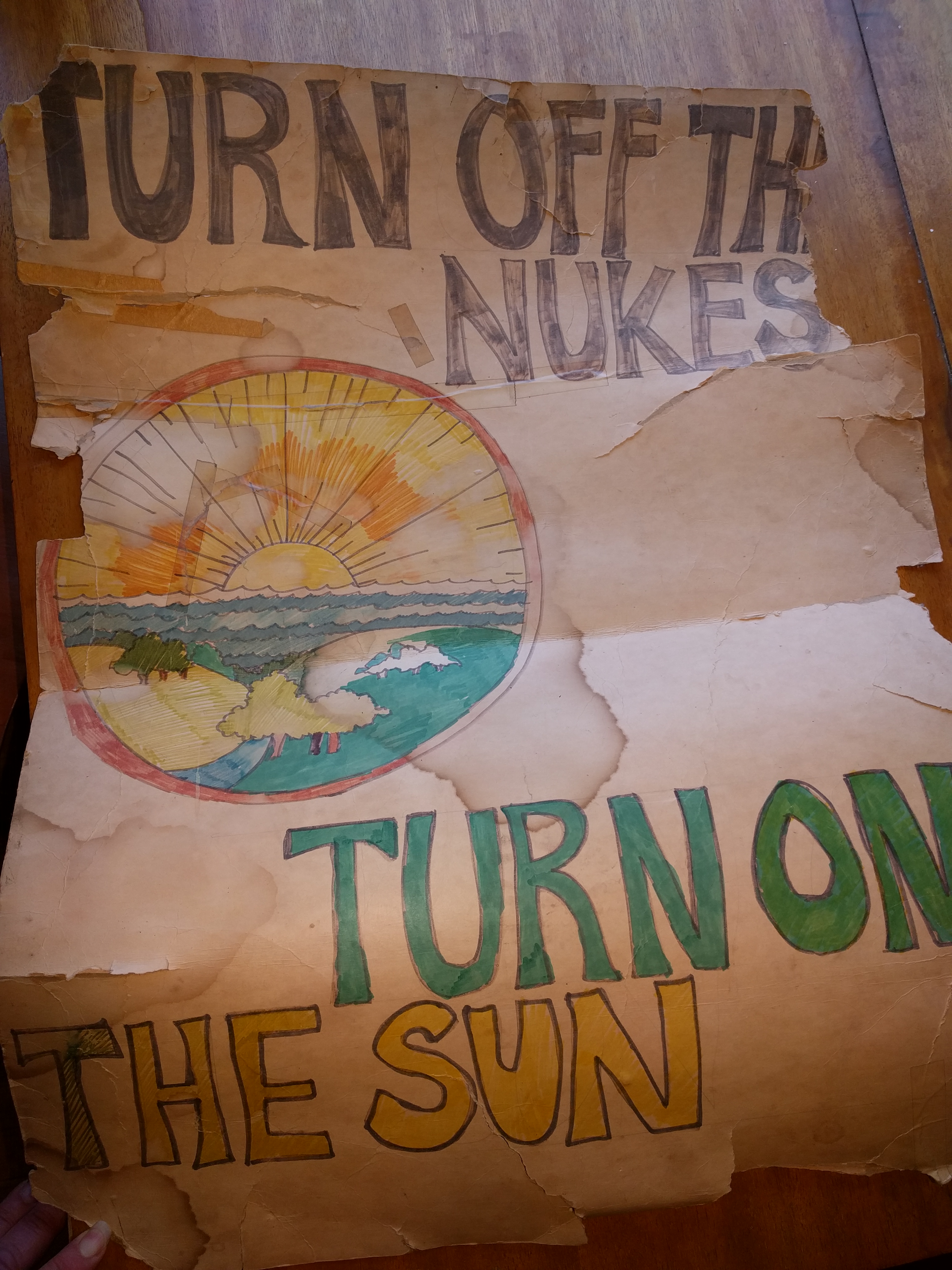
Sign by Nancy Hodge Green, used at Seabrook by Shel Horowitz, 1977. Photo by Shel Horowitz

Of all the eamples of greenwashing I know, none is more insidious than the way the nuclear power industry pretends to be green. In reality, it’s super-dangerous, with at least a dozen serious issues that threaten our liberty,our property, and our very lives. Nuclear power is unsafe, uneconomical, and is not a solution to the climate crisis. My first book was about this, and when I updated it after Fukushima for a Japanese publlisher, I saw that it was still unviable, and still a threat.

If you live in the US, the Senate and House will be going to conference committee to workout their different versions. And this is our chance to stop this horrible bill from becoming law. Below is the letter I’m sending to my Senators, which contains a lot of information about the issue. If you are moved to take action, please copy or modify it and send it it to your own Senators and Representive. You can reach them easily by clicking the Senators button at http://senate.gov and then selecting your state. You also have my permission to share it widely, including with groups you’re involved with and with the media. Don’t forget to change the blankline to the recipient’s name. I usedthe subject line, “Please STOP the Price-Anderson Act renewal–our lives depend on it”

Here it is (note that I have removed the fronts of web addresses because at least some Senators block a submission that has many hyperlinks):


Dear Senator ________:

As your constituent, I urge you in the strongest possible terms to REMOVE the giveaways to the nuclear industry from the reconciliation package. If we examine the package closely, we discover that:

1. It RENEWS the grossly inadequate and highly taxpayer-subsidized insurance “protection” of the Price-Anderson Act for 40 (House version) or 20 (Senate version) years, leaving the public almost completely unprotected from financial loss in the event of an accident. This is one of the worst bills ever signed into law, capping insurance payouts for nuclear accidents at absurdly low levels. Price-Anderson originally capped the federal share at just $500 million per accident plus another $60 million from the utilities, according to the 1969 book Perils fo the Peaceful Atom by Richard Curtis and Elizabeth Hogan, pp. 194-195. The private utility coverage has since expanded through secondary coverage, with nuclear utilities retroactively assessed to cover up to $16.097 billion per accident, according to a January 2024 report to Congress by the Congressional Research Service, crsreports.congress.gov/product/pdf/IF/IF10821. By contrast, actual dollar losses from the single 2011 disaster at Fukushima are estimated at $20 trillion—more than 1000 times as much (see ncbi.nlm.nih.gov/books/NBK253929/#:~:text=The%20total%20cost%20of%20the,Bottom%20nuclear%20plant%20in%20Pennsylvania ). Property owners and taxpayers are expected to make up the difference. And this doesn’t even count non-dollar or indirect costs such as injury and death, loss of land for generations, forced relocations, loss of agricultural revenue, and more. According to this Newsweek report, 14,000 people were forced to relocate after the Chernobyl accident closed a 1040 square-mile area back in 1986 (38 years ago)—and scientists don’t expect that area to be safe again for at least 3000 years. See newsweek.com/chernobyl-aftermath-how-long-will-exclusion-zone-uninhabitable-1751834
2. It REMOVES much of the licensing oversight from new nuclear power plants. These are crucial protections for civilians. The nuclear power industry has had a long history of not factoring in things like earthquake faults when siting n-plants.

It is also important to note that well beyond the three catastrophic accidents (Fukushima, Chernobyl, and Three Mile Island) we all know about, there have been at least 133 potentially serious accidents just in the brief span since the birth of the industry in the 1950s. See en.wikipedia.org/wiki/List_of_nuclear_power_accidents_by_country. We have been extremely lucky that only three wreaked significant damage.

Finally, the claim that nuclear is necessary as a tool to fight climate change is false on three counts:

• Clean, renewable energy can do the job better, more reliably, and MUCH faster (see sciencealert.com/here-s-why-nuclear-won-t-cut-it-if-we-want-to-drop-carbon-as-quickly-as-possible , sciencedirect.com/science/article/abs/pii/S2214629618300598 , and https://clamshellalliance.com/statements/statement/ )
• Many parts of the nuclear power cycle other than feeding radioactive materials through a reactor have a big carbon cost (see nrc.gov/docs/ML1014/ML101400441.pdf , especially Page 2)
• When something goes wrong, as noted above, the detriments far outweigh any potential benefit.

It is long past time to end the subsidies for this dangerous, economically unworkable, and poorly performing technology and turn our attention to the real solutions such as solar, wind, and geothermal—and energy conservation/efficiency, which are the low-hanging fruit (see eia.gov/energyexplained/use-of-energy/efficiency-and-conservation.php ). I urge you to not only support true green energy but to convince your colleagues to block this terrible initiative.

Facebooktwitterpinterestlinkedinmail