The LGBT Pride March in Northampton, Massachusetts has happened every May since 1982. Northampton, an artsy college town on the Connecticut River with a population under 30,000, has mostly been a haven for lesbians and gays (and more recently, for trans, bisexual, and gender-queer folks) for decades–but there were some major bumps along the road, such as the arrest of several gay male Smith College professors in 1960. Another bump occurred in 1983, as you’ll read below. And at one point someone tried to shut down the event because it was too big and the person tried to claim that the town was overwhelmed. But the March marches on.
I marched in the first Northampton Pride March, served on the organizing committee for the following three years (1983-85), and have marched every year I’ve not been traveling except for one year when a friend’s daughter was becoming Bat Mitzvah. I haven’t counted but it’s probably at least 32 of the 38 years.
The first year, there were about 500 of us, many covering their heads with paper bags for fear of retribution—and many others did their best to avoid cameras. We were met with a couple of thousand curious gawkers and maybe 100 very loud, very hostile counterprotestors from the local Baptist church. We considered it an enormous success. The next year, I think we had about 1000, and about 20 counterprotestors.
But later that year, a sitting at-large City Councilor ran for re-election, and won, on a platform of “I will stop the gay rights march.” Also around that same time, lesbian activists started receiving anonymous death threats over the phone. We demanded and received a mass meeting with the then-mayor and county District Attorney, where we demanded a statement condemning the violence. The mayor shilly-shallied around for an hour, until the DA, a quiet guy named Mike Ryan from an old Northampton family and someone with a strong passion for social justice, finally blurted out, “I’ll give you a statement.” Once he had cover from Mike, the mayor agreed as well. Eventually, someone was convicted for the harassing phone calls.
Pride Day kept growing from there, and after a few years, there were no more counterprotestors. In the 1990s, 10-12,000 was fairly typical, if I remember right. Then in the past few years it started to grow much larger.
The first several marches started at Bridge Street School and marched up Main Street to Pulaski Park. Later, as the crowds got too big for that little park, the direction was reversed. For many years now, it starts at a staging area in a big parking lot behind Main Street and heads down Main and Bridge to the 3-County Fairgrounds, which are enormous.
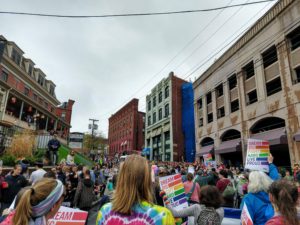
Part of the Elizabeth Warren contingent marches past the Northampton parking garage #Nohopride2019. Photo by Shel Horowitz.
This year, it didn’t even fit into the staging area and spread into several surrounding streets. By the time it reached the Fairgrounds, gathering up so many of the bystanders along the way, it took over an hour and a half for the whole march to pass by.
The Springfield paper estimated 35,000, but I think they were counting the march as it left the staging area. At least 10,000 waited for us along the whole length of Main Street, watched the parade go by, and then joined in. The Gazette said 30-40,000, and I think that higher number is more accurate.
Back in the early 1980s, we were considered curiosities, even in liberal Northampton. Even as recently as 1991, the first publication in the Gazette of a same-sex wedding announcement sparked an outrageous article in the National Enquirer headlined “Lesbianville, USA.”
But for a decade now, the contingents have included dozens of school groups from kindergarten through college, the occasional daycare center, banks, churches and synagogues, real estate agencies, hospitals…every type of business you can think of. People come with their kids, same- or different-sex partners (as usual, I was there with my wife, D. Dina Friedman), grandparents, pets…and homemade or store-bought rainbow apparel.
The first person I saw that I knew this year was Northampton Mayor David Narkewicz, who was officiating a wedding on stage at the rally that followed the march. He didn’t just show up to do his bit, but marched with the rest of us. He posed for a picture but my camera didn’t cooperate. But I snapped this unposed one while he was talking to someone (possibly State Senator Jo Comerford—I couldn’t tell from the back). Holyoke Mayor Alex Morse was also in attendance, as was former Northampton Mayor Mary Clare Higgins. Holyoke City Councilor and staffer for Elizabeth Warren’s presidential run Jossie Valentín organized the Warren contingent.
Those first years were about anger, vulnerability, and claiming our right to be part of the community. Now, it’s a celebration. Much less activism and much more a great big day-long party with the march, the rally, and various dances and cultural events in the evening. The hotels, restaurants, and retail businesses downtown are packed.
This is how far we’ve come! From fringe to totally normal. The legalization of same-sex marriage was certainly a factor in normalizing the LGBT community, but acceptance was permeating through the local culture long before that. I’m convinced that when someone from a conservative culture sits on e.g. a PTA committee with a same-sex parent, and they both realize they want basically the same things for their kids and their community, those barriers break down.
I’m proud that Northampton has been in the vanguard of this movement (a movement I first got involved with in 1973, before I ever heard of Northampton). While I haven’t lived within city borders since 1998 when I moved across the river to Hadley, it’s still my community, I’m there several times a week, and I can see it from the hill behind my house.
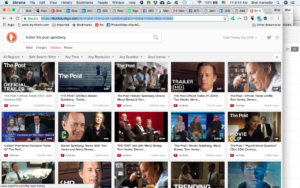
“The Post” lives up to the hype. It takes a very cerebral story and builds it into high drama, spurred by strong performances from Meryl Streep as publisher Katharine Graham) and Tom Hanks (editor Ben Bradlee).
The overall message, about the power of the free press, and the need for the press to defend its Fist Amendment freedom, despite the whims of a paranoid and dictatorial president (Nixon, in this case—a different example today).
It tracks Daniel Ellsberg’s smuggling out massive quantities of classified documents from the Rand Corporation, where he worked, and releasing them first to the New York Times, and then to the Washington Post. The movie also dramatizes the frenetic effort throughout the newsroom to absorb the information and turn it into stories on very tight deadlines, not even knowing if the presses would run, while the Times suffered under the first pre-publication censorship of journalism in the history of the United States. Known as “The Pentagon Papers,” these documents proved that US high officials knew by the early 1960s that the war was unwinnable, and that presidents Eisenhower, Kennedy, Johnson, and Nixon all lied to the American people about it.
And it covers the legal battle: the government’s attempt to shut them down and the papers going all the way to the Supreme Court to secure their rights. The timing of these events happened to threaten The Post’s long-awaited IPO, which adds to the drama and the sense of what’s at stake for Graham, Bradlee, and their journalists.
BTW, just as the movie gives lessons on how to survive a paranoid, media-hating president facing serious doubts about his honesty, the Nixon link above focuses on some very interesting parallels between his presidency and that of the current occupant of 1600 Pennsylvania Avenue, Washington, DC. However, let’s remember the differences. Nixon had a very impressive record on the environment—I describe him as the president with America’s second-most environmentalist track record (behind Obama but ahead of both Jimmy Carter and Teddy Roosevelt) also, despite the Vietnam war, did much to break down the barriers between the US and both the Soviet Union and China.
Thank you, Commissioners Mignon Clyburn and Jessica Rosenworcel for speaking truth to power. Since this is published on the FCC website, Clyburn’s is an official federal document, and thus automatically in the public domain. Please reprint widely. Rosenworcel’s may be as well, but I found it on CNET so am linking, not reprinting.
Note: I met Commissioner Clyburn several years ago when she addressed a National Conference on Media Reform. I was impressed with her as a speaker Now I am impressed with her as a writer, too.
DISSENTING STATEMENT OF COMMISSIONER MIGNON CLYBURN Re: Destroying Internet Freedom, WC Docket No. 17-108
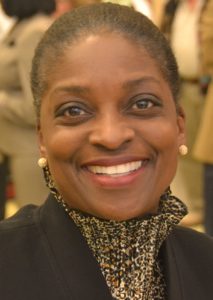
Dissenting FCC Commissioner Mignon Clyburn in 2014 (courtesy Wikipedia)
“I dissent. I dissent from this fiercely spun, legally lightweight, consumer-harming, corporate-enabling Destroying Internet Freedom Order.
“I dissent, because I am among the millions who is outraged. Outraged, because the FCC pulls its own teeth, abdicating responsibility to protect the nation’s broadband consumers. Why are we witnessing such an unprecedented groundswell of public support, for keeping the 2015 net neutrality protections in place? Because the public can plainly see, that a soon-to-be-toothless FCC is handing the keys to the internet — the internet, one of the most remarkable, empowering, enabling inventions of our lifetime — over to a handful of multibillion dollar corporations. And if past is prologue, those very same broadband internet service providers, that the majority says you should trust to do right by you, will put profits and shareholder returns above what is best for you.
“Each of us raised our right hands when we were sworn in as FCC Commissioners, took an oath and promised to uphold our duties and responsibilities ‘to make available, so far as possible, to all the people of the United States, without discrimination… a rapid, efficient, nationwide and worldwide wire and radio communication service with adequate facilities at reasonable charges.’ Today the FCC majority officially abandons that pledge and millions have taken note.
“I do not believe that there are any FCC or Congressional offices immune to the deluge of consumer outcry. We are even hearing about state and local offices fielding calls and what is always newsworthy is that at last count, five Republican Members of Congress went on the record in calling for a halt of today’s vote. Why such a bipartisan outcry? Because the large majority of Americans are in favor of keeping strong net neutrality rules in place. The sad thing about this commentary, it pains me to say, is what I can only describe as the new norm at the FCC: a majority that is ignoring the will of the people. A majority that will stand idly by while the people they serve lose.
“We have heard story after story of what net neutrality means to consumers and small businesses from places as diverse as Los Angeles’ Skid Row and Marietta, Ohio. I hold in my hand letters that plead with the FCC to keep our net neutrality rules in place but what is striking and in keeping with the new norm, despite the millions of comments, letters and calls received, this Order cites not even one. That speaks volumes about the direction the FCC is heading. That speaks volumes about just who is being heard.
“Sole proprietors, whose entire business model, depends on an open internet, are worried that the absence of clear and enforceable net neutrality protections will result in higher costs and fewer benefits because you see: they are not able to pay tolls for premium access. Even large online businesses have weighed in, expressing concern about being subject to added charges as they simply try to reach their own customers. Engineers have submitted comments including many of the internet’s pioneers, sharing with the FCC majority, the fundamentals of how the internet works because from where they sit, there is no way that an item like this would ever see the light of day, if the majority understood the platform some of them helped to create.
“I have heard from innovators, worried that we are standing up a mother-may-I regime, where the broadband provider becomes arbiter of acceptable online business models. And yes, I have heard from consumers, who are worried given that their broadband provider has already shown that they will charge inscrutable below-the-line fees, raise prices unexpectedly and put consumers on hold for hours at a time. Who will have their best interests at heart in a world without clear and enforceable rules overseen by an agency with clear enforcement authority? A toothless FCC?
“There has been a darker side to all of this over the past few weeks. Threats and intimidation. Personal attacks. Nazis cheering. Russian influence. Fake comments. Those are unacceptable. Some are illegal. They all are to be rejected. But what is also not acceptable is the FCC’s refusal to cooperate with state attorney general investigations, or allow evidence in the record that would undercut a preordained outcome.
“Many have asked, what happens next? How will all of this — net neutrality, my internet experience — look after today? My answer is simple. When the current protections are abandoned, and the rules that have been officially in place since 2015 are repealed, we will have a Cheshire cat version of net neutrality. We will be in a world where regulatory substance fades to black, and all that is left is a broadband provider’s toothy grin and those oh so comforting words: We have every incentive to do the right thing. What they will soon have is every incentive to do their own thing.
“Now the results of throwing out your net neutrality protections may not be felt right away. Most of us will get up tomorrow morning and over the next week wade through hundreds of headlines, turn away from those endless prognosticators and submerge ourselves in a sea of holiday bliss. But what we have wrought will one day be apparent and by then, when you really see what has changed, I fear, it may not only be too late to do anything about it, because there will be no agency empowered to address your concerns. This item insidiously ensures the FCC will never be able to fully grasp the harm it may have unleashed on the internet ecosystem. And that inability might lead decision-makers to conclude, that the next internet startup that failed to flourish and attempted to seek relief, simply had a bad business plan, when in fact what was missing was a level playing field online.
“Particularly damning is what today’s repeal will mean for marginalized groups, like communities of color, that rely on platforms like the internet to communicate, because traditional outlets do not consider their issues or concerns worthy of any coverage. It was through social media that the world first heard about Ferguson, Missouri, because legacy news outlets did not consider it important until the hashtag started trending. It has been through online video services that targeted entertainment has thrived, where stories are finally being told because those same programming were repeatedly rejected by mainstream distribution and media outlets. And it has been through secure messaging platforms, where activists have communicated and organized for justice without gatekeepers with differing opinions blocking them.
“Where will the next significant attack on internet freedom come from? Maybe from a broadband provider allowing its network to congest, making a high-traffic video provider ask what more can it pay to make the pain stop. That will never happen you say? Well it already has. The difference now, is the open question of what is stopping them? The difference after today’s vote, is that no one will be able to stop them.
“Maybe several providers will quietly roll out paid prioritization packages that enable deep-pocketed players to cut the queue. Maybe a vertically integrated broadband provider decides that it will favor its own apps and services. Or some high-value internet-of-things traffic will be subject to an additional fee. Maybe some of these actions will be cloaked under nondisclosure agreements and wrapped up in mandatory arbitration clauses so that it will be a breach of contract to disclose these publicly or take the provider to court over any wrongdoing. Some may say ‘Of Course this will never happen?” After today’s vote, what will be in place to stop them?
“What we do know, is that broadband providers did not even wait for the ink to dry on this Order before making their moves. One broadband provider, who had in the past promised to not engage in paid prioritization, has now quietly dropped that promise from its list of commitments on its website. What’s next? Blocking or throttling? That will never happen? After today’s vote, exactly who is the cop of the beat that can or will stop them?
“And just who will be impacted the most? Consumers and small businesses, that’s who. The internet continues to evolve and has become ever more critical for every participant in our 21st century ecosystem: Government services have migrated online, as have educational opportunities and job notices and applications, but at the same time, broadband providers have continued to consolidate, becoming bigger. They own their own content, they own media companies and they own or have an interest in other types of services.
“Why are millions so alarmed? Because they understand the risks this all poses and even those who may not know what Title II authority is, know that they will be at risk without it.
“I have been asking myself repeatedly, why the majority is so singularly focused on overturning these wildly popular rules? Is it simply because they felt that the 2015 net neutrality order, which threw out over 700 rules and dispensed with more than 25 provisions, was too heavy-handed? Is this a ploy to create a ‘need’ for legislation where there was none before? Or is it to establish uncertainty where little previously existed?
“Is it a tactic to undermine the net neutrality protections adopted in 2015 that are currently parked at the Supreme Court? You know, the same rules that were resoundingly upheld by the DC Circuit last year? No doubt, we will see a rush to the courthouse, asking the Supreme Court to vacate and remand the substantive rules we fought so hard for over the past few years, because today, the FCC uses legally suspect means to clear the decks of substantive protections for consumers and competition.
“It is abundantly clear why we see so much bad process with this item: because the fix was already in. There is no real mention of the thousands of net neutrality complaints filed by consumers. Why? The majority has refused to put them in the record while maintaining the rhetoric that there have been no real violations. Record evidence of the massive incentives and abilities of broadband providers to act in anti-competitive ways are missing from the docket? Why? Because they have refused to use the data and knowledge the agency does have, and has relied upon in the past to inform our merger reviews. As the majority has shown again and again, the views of individuals do not matter, including the views of those who care deeply about the substance, but are not Washington insiders.
“There is a basic fallacy underlying the majority’s actions and rhetoric today: the assumption of what is best for broadband providers is best for America. Breathless claims about unshackling broadband services from unnecessary regulation are only about ensuring that broadband providers have the keys to the internet. Assertions that this is merely a return to some imaginary status quo ante, cannot hide the fact, that this is the very first time that the FCC has disavowed substantive protections for consumers online.
“And when the current, 2015 net neutrality rules are laid to waste, we may be left with no single authority with the power to protect consumers. Now this Order loudly crows about handing over authority of broadband to the FTC, but what is absent from the Order and glossed over in that haphazardly issued afterthought of a Memorandum of Understanding or MOU, is that the FTC is an agency, with no technical expertise in telecommunications; the FTC is an agency that may not even have authority over broadband providers in the first instance; the FTC is an agency that if you can even reach that high bar of proving unfair or deceptive practices and that there is substantialconsumer injury, it will take years upon years to remedy. But don’t just take my word for it: even one of the FTC’s own Commissioners has articulated these very concerns. And if you’re wondering why the FCC is preempting state consumer protection laws in this item without notice, let me help you with a simple jingle that you can easily commit to memory: If it benefits industry, preemption is good; if it benefits consumers, preemption is bad.
“Reclassification of broadband will do more than wreak havoc on net neutrality. It will also undermine our universal service construct for years to come, something which the Order implicitly acknowledges. It will undermine the Lifeline program. It will weaken our ability to support robust broadband infrastructure deployment. And what we will soon find out, is what a broadband market unencumbered by robust consumer protections will look like. I suspect the result will not be pretty.
“I know there are many questions on the mind of Americans right now, including what the repeal of net neutrality will mean for them. To help answer outstanding questions I will host a town hall through Twitter next Tuesday at 2 p.m. ET. What saddens me is that the agency that is supposed to protect you is abandoning you, but what I am pleased to be able to say is the fight to save net neutrality does not end today. This agency does not have, the final word. Thank goodness.
“As I close my eulogy of our 2015 net neutrality rules, carefully crafted rules that struck an appropriate balance in providing consumer protections and enabling opportunities and investment, I take ironic comfort in the words of then Commissioner Pai from 2015, because I believe this will ring true about this Destroying Internet Freedom Order:
I am optimistic, that we will look back on today’s vote as an aberration, a temporary deviation from the bipartisan path, that has served us so well. I don’t know whether this plan will be vacated by a court, reversed by Congress, or overturned by a future Commission. But I do believe that its days are numbered.
Have you seen the infamous Pepsi ad that’s been called “tone-deaf” by progressives, and which Pepsi pulled quickly? Before you read the rest of this post, please write your impression of it in the comments.
And I agree with Whoopi: the message is about inclusion.
Yes, it is co-opting the movement. Advertisements have always co-opted cultural memes. If you wear $60 torn jeans, you can thank the hippies and grunge-punks who wore their clothes to rattiness. For that matter, Bud commercials and Wheaties cereal boxes have been co-opting sports culture for decades (it feels like millennia).
I’m old enough to remember when hijab-wearing women and people of color and same-sex couples would not have been allowed anywhere near a commercial. What I see most of all is a message to DT that we are united in our diversity (and that includes the cops, who are actually our allies most of the time–and which the movement made a big mistake in automatically trashing in the 1960s).
I also agree with Whoopi that water is my preferred drink over any kind of soda.
That Pepsi was attacked to the point where they pulled the ad is much more shocking to me than the ad itself.
But I guess I shouldn’t be shocked. Here in the Blue Bubble, behind the “Tofu Curtain” (not a phrase I invented) in Massachusetts’ Hampshire/Franklin Counties—one of the bluest parts of a very liberal state—those accusations of “tone deaf” are all-too-familiar. Two among many examples:
A program in which cops in the schools did something sociable with the kids was kiboshed and the very progressive police chief (an out lesbian who was seen at Pride Day marches long before she became chief) was trashed as tone-deaf
Two towns over, several years ago, a production of “West Side Story” was canceled because some people thought the whole idea of the play was racist. I don’t know if they read the script or saw the movie, but to me, that movie makes a statement against racism, just like Twain’s Huckleberry Finn (which has also been criticized for racism, because it uses the N-word—even though it was written in the 19th century when that was the term used and the whole premise of the story is to show the absurdity and cruelty of racism)
It reminds me of the days when the left (my teenage self included) would practically canonize any extreme statement that happened to be made by a person of color or one who identified as any shade of LGBTQ, even if that statement incited violence against innocent people who happened to be white and straight. I should have spoken out against those outrages 45 years ago, but I was just as hoodwinked.
I’m not talk about any false unity of sweeping real grievances under the rug. But I am objecting to the shrill side of political correctness that demonizes the Other without even listening, even when the Other is mere steps away on the political spectrum, dividing instead of uniting and leaving us all at risk when the real forces of repression sweep in.
NOTE: You’ll find several action steps at the bottom of this post. If you don’t want to read the whole thing, please scroll down to that section and take action before leaving this page.
Watch this video made by Standing Rock Water Protector Candida Rodriguez Kingbird on November 14.
Read a transcript by clicking this link. She claims that a crop duster was spraying the encampment, and only the encampment. Kingbird’s video, or commentary on it, has appeared on many progressive sites and social media profiles.
We know the level of repression against Standing Rock Water Protectors has been consistently shockingly high. There are numerous reports of the authorities using water cannons, tear gas, and even rubber bullets against this peaceful group of Native people fighting nonviolently to protect their water—from a project that was originally to go very close to Bismark, but was rerouted because of worries about what it would do to the water supply.
The link in the paragraph above is to a Christian Science Monitor story with video. The Monitor is a respected mainstream news outlet known for its good journalism over many decades.
Although a search for “chemical weapons standing rock” didn’t turn up any video of the spraying or any reportage based on a claim by someone else—or coverage in mainstream media, I find Kingbird’s testimony thoroughly believable. I found her a credible witness, someone clearly not used to being a public figure. I didn’t feel she was acting, just reporting—and speaking from the heart.
There is the (faint, IMHO) hope that Obama will protect the area either by revoking the DAP permit or protecting the land as a National Monument in his final weeks, but I am personally not optimistic that either will happen, or that it will survive a near-certain overturn attempt form the new administration.
Actions You Can Take
Petitions (click the marked text to sign, then share them widely):
All my life, I’ve heard about the authoritarian Chinese government micromanaging every aspect of everyone’s lives, the government’s total control over career options, and of course, the “reeducation” of intellectuals and destruction of cultural resources during the Cultural Revolution.Getting a visa was a major and expensive hassle that had to be set up weeks ahead, and there was no way to get a business visa without an invitation from someone.
The other obvious difference was the way China blocks many key Internet sites, including all Google sites, Facebook, and Twitter. LinkedIn, Yahoo, and Bing do work, however.
And yet, during our brief visit, the society felt very open. While there are plenty of cops and security guards (including community volunteers who have almost identical uniforms to the police but with the addition of bright red armbands), most whom we saw were not obviously armed and seemed for the most part to be a force for peace, not repression. We’d often see cops joking around with passers-by or chatting amicably with each other. And mobility was almost totally unrestricted, other than at paid attractions. As visitors, we felt no police presence singling us out, had no “minders,” and we were unrestricted even when we went to meet a young couple that a friend of ours had met through Couchsurfing.
Even when our entire group of 26 struck up a conversation with a red-robed Tibetan monk (in the government’s eyes, a potential dissident) who happened to walk through Tiananmen Square with a stylish female companion, there was no feeling of being watched. Since I briefly had a Tibetan housemate and know how to say hello in Tibetan, I even greeted him in his own language. His face lit up—but he got frustrated and disappointed when he tried to answer back and realized that was the only Tibetan I knew. (China claims Tibet and has often consideredorganized Tibetan Buddhism a hostile force; the Tibetans see themselves as an occupied nation, and govern the religious aspects from exile in India.) He spoke fluent Chinese, so our tour director interpreted for us. He posed for selfies with all those in our group who wanted one and was with us for about ten minutes. Plenty of cops were on the plaza, and none took the least interest in this interchange.
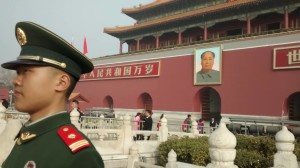
I’ve seen photos of China in the 60s and 70s with Chairman Mao’s picture everywhere, providing a Big Brother is Watching motif. We saw exactly two pictures of Mao, other than on the 1 yuan bill: a giant portrait on Tiananmen Gate into Forbidden City,
A guard stands near the Gate of Heavenly Peace and its giant picture of Mao. Photo by D. Dina Friedman.
and a modest poster in a random store window. We did not knowingly see a single picture of current Chairman Xi. Our tour director told us that the Cultural Revolution is definitely considered a mistake, and that the current government rates Mao “70 percent good and 30 percent bad.” He confirmed my suspicion that the prosecution of the “Gang of Four” (Mao’s widow and three comrades) a few years after Mao’s death was as much about repudiating Mao as anything else.
I noted only these very minor incidents:
An officer on Tiananmen spun rapidly in an about-face when a tourist tried to take his picture; the cop Dina managed to catch in the picture shown here suspected he’d been photographed and glared at her, but made no attempt to engage.
An annoying beggar outside the Shanghai Museum was told firmly to go elsewhere and leave our group alone.
I was told to put my camera away after taking a photo of an ad inside a subway station—but I was not asked to delete the photo.
Street crime seemed to be nonexistent. The only threats I felt to my safety had to do with driving patterns, and particularly the very challenging lane-by-lane crawl across a completely uncontrolled eight-lane rotary to get between our hotel in Xian and the subway entrance one block away. Wasn’t too thrilled about silent electric mopeds sneaking up on both sides of what I’d thought was a one-way bike lane either.
Quite frankly, St. Petersburg, Russia, in 2002 (long afterthe collapse of the Soviet Union) as well as New York and Washington post-9/11 have felt far more invasive. It is, however, the first country I’ve ever visited that routinely x-rays all bags belonging to subway passengers before allowing them to board.
Our tour director, who had been at the Tiananmen demonstrations in 1989, even told us that when someone steps out of line on social media, all that happens is eventually the dissident’s account is closed. However, in the aftermath of 1989, friends of his were jailed.
Still, every resident of China we discussed it (a limited number) with felt oppressed by the government. One family we met with is actually arranging to relocate to Canada. So obviously, there’s more repression than meets the eye.
Shel Horowitz’s latest book, Guerrilla Marketing to Heal the World, shows how to turn hunger and poverty into sufficiency, war into peace, and catastrophic climate change into planetary balance—using the power of the profit motive.
The last hundred years have also seen a similar ratchet (amplified, I’d argue, by the technology of media and of the economy) in civil rights. It’s unlikely (with the exception of despotic edicts) that women will ever lose the vote, that discrimination on race will return to apartheid-like levels, that marriage will return to being an exclusionary practice… once a social justice is embraced by a culture, it’s rarely abandoned.
Unfortunately, those “despotic edicts” are all-too-common. While the general trend is not to reverse progress, there are far too many exceptions:
Women’s rights in Iran under the Shah or Kabul pre-Taliban versus today
Rights of Jews, Gypsies, and LGB folks in prewar Germany vs. the Nazi years
The collapse of Sarajevo’s much-vaunted multiculturalism into massive racism and “ethnic cleansing” in the 1990s
Although this is a pessimistic post, I am ultimately an optimist. I think Godin is basically right–but there are many, many exceptions. Let’s work together for a world in which those exceptions are no longer tolerated–we can do this!
Freedom to exercise one’s own religion is NOT the same as freedom to stuff that religion down others’ throats. This is what the right-wing Christians have not understood about the Supreme Court decision on gay marriage. No one is forcing them to marry each other–and they do not have the right to keep others from marrying the ones they love, just because their religion doesn’t agree.
When my family was kosher, I went to private Jewish schools (yeshivas). It may have been that part of my parents’ reasons was to keep me away from the “corrupting” influence of non-kosher food.
This post is inspired by a report of a Canadian mayor telling Muslim parents the schools would not stop serving pork–a report that was a hoax (which took about seven seconds to determine). But just because the report was false (and probably motivated by someone seeking to stir up religious divisions) doesn’t mean we shouldn’t talk about the underlying issue: when does one person’s freedom stop and another’s start?
I am a vegetarian and I would never say to a school system, “don’t serve meat because it is offensive to me.” On the contrary, it is offensive to me when someone tells me I can’t eat the food I want because that food offends them, and I wouldn’t presume to make those choices for others. Sure, I wish more people would turn vegetarian, and I can list a dozen reasons why vegetarianism is good for the planet and good for our bodies.
I will say (and have said), “please don’t bring meat into a potluck at my vegetarian house.” A parent offended that foods he/she doesn’t eat are served in the cafeteria has other choices. There are schools where no pork is served–in fact, I know for certain that pork is not served at any Orthodox yeshiva or Islamic or Seventh Day Adventist school. It would be offensive if the Muslim kids and Orthodox Jewish kids and vegetarian kids attending public school were *forced* to eat pork. But it should not be offensive to sit in a cafeteria where others are eating it.
A friend shared a meme on Facebook this morning: photo of an Assembly of God church marquee with this message on its movable sign: “A free thinker is Satan’s slave.”
But apparently even this is too high a barrier. All they can find are Abraham’s nephew Lot and his family—and they are not exactly models of terrific human behavior. They are taken to safety and the cities are destroyed.
Though I’m not particularly religious, I was raised in an Orthodox Jewish household. People obeyed the commandments as they understood them, but spent lots of time debating their merits—and, for that matter, dissecting the world’s news. And of course, much of the commentary on the Torah came from the sages of old, who would spend hours discussing the intricacies and shades of meaning of some obscure passage. In today’s world, the Jewish Renewal movement (which I do consider myself a part of) has again, actively engaged, reinvented traditions, and provided lots of commentary.
And this is certainly not an exclusively Jewish trait. From the Catholic Worker, Vatican II, and Liberation Theology movements to the preachings of Pope Francis, we see active engagement permeating Catholicism. And we find similar movements in the Islamic, Protestant, and Buddhist worlds (think about the Dalai Lama, for example). And, I’m guessing, in every other significant religion.
The miracle of religion, in my mind, is that people do question, grapple, argue, test out theories—and continue to come back to their own personal version of God.
I feel sorry for the person who crafted the message on the sign.
Today, I encountered a post from an Internet friend who lives in Israel, urging Israeli Prime Minister Benjamin “Bibi” Netenyahu to bomb Iranian nuclear facilities.
The post made me feel queasy. My original response was a desire to scream and yell that this was racist. Fortunately, I had enough self-control not to give into that stupid and unproductive urge. I also didn’t want to start a firestorm of negative attacks on me because I had the temerity to disagree with a view that I felt was both racist and extremist. And yet I wanted to confront this way of thinking and not let it go unchallenged.
So instead, I thought for a couple of minutes about what type of response would actually be heard and not blocked out—what could actually advance a dialog. (I will confess that I haven’t always been skilled in that type of response, but I think I’ve gotten much better in the past several years.
And this is what I finally wrote—knowing that my friend is deeply religious, and that an appeal to his religious convictions might actually get through.
Even as poor a student of the Torah as I am knows that God does not want to see innocent blood shed. Your recipe for Bibi would leave hundreds of thousands dead and the Middle East–including Israel–in flames. Possibly the entire world. I urge you to think carefully about unintended consequences.
And amazingly enough, this actually did open a door for some mild and thoughtful dialog. Not a perfect outcome but one I could feel reasonably good about. I had used the marketing principles I teach, and given the right message for the audience.