I keep waiting for one of these Great Defenders of Property Rights—you know, people like Limbaugh, Hannity, Coulter, and O’Reilly—to step forward and make some noise about the way the police wantonly destroyed property of individual occupiers and resources belonging to the community as a whole during the evictions last week. Among other things, a 5000-volume library was destroyed. I can’t see any reason for this.

Of course, I don’t expect the right-wing pundits to make any noise about the shameful treatment by police of some of the occupiers, such as the outrageous incident on the UC-Davis campus, where police used pepper spray in the faces of peaceful, sitting protestors—something that has one professor calling for the chancellor to resign. But since protecting private property has been so near and dear to their hearts over the years, I hold them to the same standard when the property being destroyed is that of their opponents.

Facebooktwitterpinterestlinkedinmail

Political advisors spew so much crap about the need to tear down your opponent. Here’s a refreshing case study that proves the opposite is possible.

Congratulations to the newly-elected mayor of Northampton, Massachusetts, David Narkewicz. While his opponent went negative to the point of craziness (even going so far as to attack him for riding a bicycle, with an ad that talked about training wheels as a metaphor for inexperience), Narkewicz stayed positive, focusing on community-building, achieving widely held goals, and his own civic history. He was also deeply issue-focused and very articulate during the numerous debates (more than I can remember for any previous local election, in my 30 years in the area).

As a marketing consultant who has occasionally advised politicians, I have long held the opinion that such a positive campaign could be quite popular. I used this positive focus writing the press releases for the successful first mayoral campaign of a different mayor, who won in 1989 and went on to serve four two-year terms.

And while I predicted that his opponent’s strategy (using the considerable talents of a very good local ad agency), would fail, even I was pleasantly shocked at the margin of victory. Narkewicz took 70 percent of the vote, sweeping every ward, even the traditionally conservative western parts of the city. And he had coattails for progressives in every other contested race, as well as a ballot initiative to keep a land-preservation bill that the right had attacked.

Bravo.

Facebooktwitterpinterestlinkedinmail

Ten years ago, 19 criminal thugs seized control of four planes—and the world as we knew it was shed like the skin of a snake, replaced with a new and very unpleasant reality.

On this anniversary, I want to publicly thank the hundreds of brave men and women who unselfishly, courageously faced death and yet still went back into the flaming buildings…wrested control of Flight 93 back from its hijackers and crashed it in an empty field, instead of a major government building…poured into New York and Washington to see how they could help, knowing they were risking their own health, their own lives. Also, the thousands of brave soldiers from the US and elsewhere who have put their lives on the line every day. It is not their fault that we shouldn’t have even been in those wars.

But I also want to remember what might have been. In the vast emotional outpouring following the attacks, we were, for almost the only time in our history other than Pearl Harbor, united as a people. And also, for perhaps the first time ever, we had the sympathy and compassion of the whole world.

It was the first President George Bush who had called, ten years earlier, for “A New World Order, where the rule of law, not the rule of the jungle, governs the conduct of nations.” His son had a chance to make that happen.

What was needed was a powerful, emotional speech recognizing that the old, imperialist model of conduct among nations didn’t work anymore…and seizing this terrible moment as a bridge to world peace, a chance for the world to re-invent itself as something new—as a collaborative body determined to achieve greatness as a place where war is an archaic and never-again-used way to settle disputes, no one starves, everyone can get an education and decent health care, the environment is given a chance to heal, and the enemies of industrialized societies cannot get any traction. I thought at the time that this is what Bush should have done and I still think so.

Not that the perpetrators would get off, though. Bush could have called for an international criminal manhunt to bring Bin Laden and his gang of thugs to justice for mass murder, and the world would have supported it. Especially as the US, coming off the Clinton period of prosperity and massive surpluses, had the resources to fund that manhunt.

What an outpouring of support that would have caused! People of all nations would have embraced Bush as a hero, and more importantly, would have striven to put those magnificent words into practice. The United States would have been seen as giving a precious and lasting gift to the entire world. And Bin Laden probably would have been captured early on, with no negative impact on the people unlucky enough to live in Afghanistan or Iraq.

Instead, Bush told us to go shopping…squandered the surplus in two illegal, immoral, unjust—and extremely expensive—wars (not counting the domestic war on Muslims, Arabs, and poor people)…initiated dozens of repressive practices at home…blew up our credibility in the world of nations by acting as a “rogue state” (turning us into either a hated enemy or a laughingstock, in various parts of the world)…and completely failed in his pursuit of Bin Laden (Obama had to come in and finish that one). And his actions caused so much resentment against the US that it turned Al Qaeda from a tiny cell into a massive terrorist organization spanning many countries. He made the enemy much bigger.

I have always perceived George W. Bush as a small-minded bully surrounded by smart and evil advisors, and I was not surprised that he could not step into greatness. But I’d have loved to have been proven wrong. And how much safer I’d feel today if he had somehow risen to the task. He could have been our greatest President. Instead, in my opinion, he was the worst.

On this 10th anniversary of 9/11, let us think how we can still achieve that world of peace. It will be much harder now—but it is not impossible.

Facebooktwitterpinterestlinkedinmail

The word “greenwashing” is only a few years old; the practice, unfortunately, goes back much longer.

This morning, for some reason, I woke up thinking about a loaf of bread I saw in the supermarket some time in the early 1980s. This line of bakery products was very clearly marketed to the customer who wanted natural foods, and even back then, that included me. The packaging copy was all about wholesome whole grains, natural growing practices, and such–until I got to the ingredients list.

And there I saw the deal-killer: “calcium propionate added to discourage mold.” Back it went from my hands to the shelf!

I was so deeply offended to see this very common bread additive in a bread marketed as wholesome and natural that I can still recall the exact wording. In fact, I remember telling several friends how corny and false this company was, trying to disguise its use of chemicals by saying “discourage” instead of the more typical, and harsher sounding, “retard mold.”

And that got me thinking about another early greenwashing offender: nuclear power. As a child in the 1960s, and one who was impressed by the promise of technology, I was enchanted by the idea of clean energy that would be “too cheap to meter,” as one prominent nuclear bureaucrat famously put it.

This enchantment didn’t stop me from getting involved in a local group that was questioning the wisdom of a proposed nuke two miles from New York City, but back then, all we knew about was thermal pollution. Thank goodness the utility abandoned that plan!

Two years later, I chose as a college research topic the pros and cons of nuclear power, and started reading in depth. Turns out, thermal pollution is the least of nuclear’s problems. Factor in these:

  • Potential for catastrophic accidents that could make Fukushima, Chernobyl, and Three Mile Island look like a romp in the park
  • Deeply subsidized limited-liability insurance that means if there is a catastrophe, private citizens aren’t going to collect on their losses without a massive infusion of billions of dollars of government money (this is a US law, the Price-Anderson Act, but many other countries have similar provisions)
  • A long and sordid history of literally hundreds of small accidents that could have become big very easily–this link with pictures and descriptions of the nine worst shows that five of the nine were AFTER Chernobyl
  • A 250,000-year pollution problem in the need to isolate extremely deadly wastes from the environment for a quarter of a million years (think about how few artifacts remain from even 5000 years ago, and almost nothing of human origin exists from even 30,000 years ago)
  • Huge inefficiencies that lead one analyst, John Berger, to conclude that nuclear–counting the entire fuel cycle–had actually consumed five times as much energy as it produced, so all this risk is for NO benefit (I have the full citation in my book, Nuclear Lessons)

And you wonder how any environmentalist (and several very prominent ones have) can endorse this terrible, deeply flawed, and very UN-green technology.

Facebooktwitterpinterestlinkedinmail

For more than 30 years, one of the arguments I’ve made against nuclear power is the chilling effect on our freedom.

Now, it seems that Japan may have passed a law heading down that slippery slope. Or not—I am not so far convinced that the claims are accurate.

A blogger for the UK Progressive put up a rambling, jumbled article claiming that Japan has passed a law giving sweeping powers to shut down bloggers, people who post videos on Youtube, etc. when they’re critical of the government and/or TEPCO.

I did a bit of Googling and found dozens of other blogs basing their story on that same article, which I consider unreliable. But I did find this in the Tokyo Times, which seems to be a genuine news organization that fact-checks and posts corrections. The Tokyo Times article says the Computer Network Monitoring Law was passed on June 17.

It also says that during March and April, even before the law was passed, government agents sent 41

“letters of request” to internet providers, telecom companies, cable TV stations and others to take measures in order to respond to illegal information, including erasing any information from the Internet that can be seen as harmful to morality and public order.

However, this article links back to coverage in the Examiner which again ties back to the original, untrustworthy blog post. I certainly am not going to pore over all 6000 citations to see whether this story is legitimate. But it’s certainly worth keeping an eye on.

Facebooktwitterpinterestlinkedinmail

David Vossbrink, APR, a PR guy who happens to be the president of PRSA’s Silicon Valley chapter, wrote in regarding my recent article on a PR site, “Seeing Past the “Spin”: Debunking Five Dangerous Myths About Nuclear Power.”

Vossbrink called my attention to a speech by the late safe energy activist David Comey, of Friends of the Earth. Comey, addressing the nuclear industry’s own Atomic Industrial Forum, told them they have a major credibility problem, and that he wasn’t afraid to tell them about it because he knew they would never follow his advice to tell the truth, and therefore remain easy targets.

Comey referenced a British spymaster, Richard Crossman, who was in charge of “alien psychological warfare” during World War II. He outlined 7 key principles that Crossman put forth in a 1953 lecture:

  1. The Basis for All Successful Propaganda is the Truth
  2. The Key to Successful Propaganda Is Accurate Information
  3. The Most Successful Propagandist Is the Person Who Cares About Education
  4. To Do Propaganda Well, One Must Not Fall in Love with It
  5. A Successful Propagandist Cannot Afford to Make Mistakes
  6. The Propaganda Must Be Credible to the Other Side, Not Your Own [empahsis mine]
  7. Understatement Succeeds Best [the Brits used understatement to make the Nazis think they were only bringing a portion of what they could, and that they could inflict far more damage on their enemy]

An aside: Interestingly, while trying to find his speech online (which was critiqued in a journal published February 1975, and thus must be no later than mid-1974), I came across Comey’s description of the fire at the Browns Ferry, Alabama nuke in 1975 (which could have been utterly catastrophic, but once again, we were lucky). The Browns Ferry reactors, among 23 US nuclear plants using essentially the same design as the failed Dai’ichi reactors in Japan, had to be shut down this week because of tornados. At least they didn’t wait until the tornado created a disaster, as the tsunami did in Japan.

Unfortunatley, Comey was right: the nuclear industry still can’t seem to tell the truth. And fortunately, I believe that Comey was also right about what that means;  it should be easy to undermine the nuclear industry’s credibility and overcome the juggernaut, to make it clear that we as a society will not tolerate the construction of a single new n-plant or license extension of an existing one, and that we need to take active steps to decommission the ones already in use.

Let’s prove Comey right—get out there and organize!

Note: I will be glad to send the PDF of Comey’s full speech–write me at shel (at) principledprofit.com, subject line Send David Come Nuke Speech. I was not able to locate it online.

Facebooktwitterpinterestlinkedinmail

The latest news from Daichi makes it clear: Nothing these officials say can be trusted:

Highly toxic plutonium has seeped into the soil outside the troubled Fukushima Dai-ichi nuclear power complex in northeastern Japan, officials say. The amounts detected in five different soil samples taken from the facility did not pose a risk to humans, safety officials say.

Yes, I am calling that last sentence an outright lie—a disgusting, damnable, and definitely dangerous dissembling.

Want to know the safe level of inhaled plutonium? Zero. The risks are lower if it’s eaten or drank. Breathing the stuff has a very high deadliness factor because it settles in the lungs.

Facebooktwitterpinterestlinkedinmail

Ever see a 76-year-old-man up on stilts—and not just ordinary stilts but giant ones that elevated him 15 or 20 feet above everyone else?

I saw Peter Schumann, the tireless founder of Bread & Puppet Theater, do just that yesterday, at a performance in Boston.

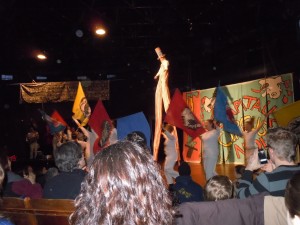
Bread & Puppet Theater founder Peter Schumann, age 76, walking high above other performers on giant stilts.
76-year-old Peter Schumann, on giant stilts

Schumann founded the well-known political theater troupe back in 1963. Known for its giant puppets and unflinching anarchist-socialist politics (not to mention Schumann’s visual art and breadbaking, the collective nature of its living and working, and incorporating audience members including kids into its performance), Bread & Puppet has been fighting the good fight for decades.

Puppet-headed actors on stage: Bread & Puppet Theater

I first encountered them in the early 1970s, when I used to attend demonstrations against the Vietnam war as a teenager. Walking the line between art and propaganda, the large troupe, based on a  beautiful farm in Glover, Vermont, is always entertaining, and always committed to the arts as tools of personal empowerment, affordable to all.

Peter Schumann talks with the cast just before the show
Not yet in costume, Peter Schumann huddles with the cast at the end of the dress rehearsal

I’m glad they’re still out there pushing the envelope, and was particularly glad to see a large number of kids, both in the audience and among the volunteers who got there early to rehears and join the cast for the day.

Facebooktwitterpinterestlinkedinmail

Heretic that I am, I’m going to take an unpopular position: that the Democrats lost not because they were too bold, but because they weren’t bold enough. As all the “pundits” tell the Democrats (as they always do) to move ever-more-rightward, I’ll say, yet again, that moving rightward and wimp-ward is why they keep losing!

The strength of the Tea Party vote is more than a repudiation of Obama. It’s also a repudiation of the “mainstream” GOP (which was already so far to the right that people like Nelson Rockefeller or Lowell Weicker would have found it very uncomfortable).

The massive switch of independent voters, in particular, was, in short, a continuation of the 2008 Obama call for “change”: a loud cry that people didn’t feel they actually received the change they had voted for in 2008.

And this can be pinned squarely on the Democrats’ failure to make bold policy, and to be willing to tell the story of their success boldly. On health care, on climate change, on the economy…the Democrats whittled themselves down to half-measures. Where was the single-payer health care program that almost every other country in the world has adopted in some form (and why didn’t they position that as the boon to the business community that it is)? Where was the Marshall Plan-scale effort to get us off fossil and nuclear and into job-creating, carbon-slashing clean renewable energy? Where were the measures to hold Wall Street and the GW Bush administration accountable for the mess they made? And where were the visionary leaders who should have populated Obama’s Cabinet?

Despite a huge mandate for change, and a majority in both House and Senate, the Democrats refused to even listen to calls for massive structural reform, and then forgot all the marketing lessons they learned in the campaign and let the other side not just control but completely dominate the discourse—leaving the impression that they are a weak and ineffectual party of favors to special interests who can’t fix the economy or anything else. And failing on three crucial aspects of marketing: to remind people firstly of who got us into this mess, second, of the steps they did take to pull us out, and third, of the policy initiatives where change was actually achieved in the last two years.

As I wrote two years ago,

Don’t apologize for your beliefs. Three out of the four most recent prior Democratic nominees–Dukakis, Gore, and Kerry–all crawled on their bellies with messages that basically said, “umm, I’m not really a liberal, I didn’t mean it, I’m soooo sorry!” And all three lost because doing that took the wind right out of their sails. Bill Clinton, who is not a liberal, didn’t play that game. Not surprisingly, he won. Obama never apologized, ignored the L-word, and didn’t even flinch when in the closing days, McCain revved it up and actually called him a socialist (traditionally, the kiss of death in US politics).

Monday evening, Rachel Maddow released a video highlighting Obama’s accomplishments. It’s a great video. The Democratic Party itself should have made something like it, six months ago, and worked to get it viral. Released by an outside journalist, twelve hours before the polls opened, it had no time to gather momentum.

Here in Massachusetts, Governor Deval Patrick wasn’t given much chance a year ago. But he ran a positive campaign focused on the slogan, “Optimism and Effort.” He highlighted his accomplishments over and over again, made a case that the work wasn’t done, and inspired audiences with a message of hope, economic recovery, and the rights of ordinary people. In other words, he used the exact strategies I’ve been advocating for decades that the Democrats use. Despite his somewhat centrist record, he was able to position himself as a change agent. I went to one of his rallies and went up to him afterward to thank him for being a sitting governor bold and hopeful enough to go out and make that kind of speech.

He did benefit from a third-party candidate who clearly drew votes from the colorless, bland GOP candidate. But still, he won, and by a larger margin than many pundits had predicted.

Facebooktwitterpinterestlinkedinmail

Stupid idea of the Week award to (drumroll, please)…Terry Jones, pastor of the Dove World Outreach Center, an evangelical church in Gainesville, Florida. Jones and his 50 members want to commemorate 9/11 by burning a Koran.

Here’s what General David Petraeus had to say about this idiotic idea:

It is precisely the kind of action the Taliban uses and could cause significant problems, not just here, but everywhere in the world we are engaged with the Islamic community…Images of the burning of a Koran would undoubtedly be used by extremists in Afghanistan – and around the world – to inflame public opinion and incite violence. Such images could, in fact, be used as were the photos from [Abu Ghraib]. And this would, again, put our troopers and civilians in jeopardy and undermine our efforts to accomplish the critical mission here in Afghanistan.

The same Washington Post article quotes a statement from the U.S. Embassy:

Americans from all religious and ethnic backgrounds reject the offensive initiative by this small group in Florida. A great number of American voices are protesting the hurtful statements made by this organization. Numerous interfaith and religious groups in America are actively working to counter this kind of ignorance and misinformation that is offensive to so many people in the U.S. and around the world.

To these 50 extremists who falsely call themselves Christian, I’ve got a few other things to say:

  • Christ’s message was one of tolerance of differences, acceptance of diversity. Consider as one among many examples the story of the Good Samaritan. Samaritans were a despised ethnic group in Christ’s day, as this post on Bible.org makes clear.
  • What makes the US different from (and better than) totalitarian governments with official state religion is that we were founded on the bedrock principles of justice and equality, even for those who are different from us. While it’s true that as a country, we certainly haven’t always lived up to these principles, they are part of our founding heritage and part of why I am proud to be an American. Bigotry is anti-American, and this is an act of bigotry.
  • As General Petraeus points out, your action inflames the passions of the zealot/terrorist faction within Islam–and while they are a tiny minority, they can do tremendous damage, especially with you doing their recruiting for them. You are putting the lives of every American soldier in Iraq (still 50,000 left, in so-called non-combat deployments) and Afghanistan at risk!, not to mention the lives of all of us on the home front. Are you willing to have the blood of these brave soldiers on your hands?

    Advice to the better selves hiding behind that racist front: don’t do it. You want to do something constructive to commemorate 9/11? How about an interfaith Christian/Muslim/Jewish dialog group?

  • Facebooktwitterpinterestlinkedinmail