I’ve always loved new places. Tomorrow, I’m going to a place where the dominant language and culture are French, a place I’ve never been before—though close to two places I’ve been several times.

And I’m going by car.

Even though on the surface, English-speaking Canada seems like the United States, they’re actually very different. And Francophone Quebec Province, where we’re headed, is much more different. Past visits have felt more like visiting France than the U.S.

Europeans have very close borders, and I would consider that a blessing. Drive 200 miles or so and you’re in another land—different language, until recently and still in many cases different money, different customs, different food. It’s amazing how different, for instance, it was in Glucholatzi, Poland, compared to Zlate Hore, Czech Republic, just three miles away. The architecture, language, and food were all different (we ate better in Poland.)

Despite the clear demarcations, Europeans have a sense of world citizenship that many Americans lack. It’s rare to find a European under age 40 who only speaks one language, and common to find people who speak four or five. They understand that events a few hundred miles away in another country affect them, while US media provides an appallingly US-centric perspective that in my opinion is seriously flawed, and creates a skewed worldview.

For those of us who live in the northern or southwestern United States, another country is close enough to drive to. I’ve made at least 12 trips to Canada, And in our trips to Arizona, California, and Texas, we’ve crossed into Mexico several times.

Tomorrow, our destination is a small town east of Montreal and west of Quebec City. I expect it might be a good deal more French than its larger neighbors. I will have to rely on Spanish cognates—I can have a conversation in Spanish, as long as the other person isn’t too fussy about grammar—and my wife’s high school French. It’s good once in a while to have the experience of being the minority in a different culture, and it’s amazing how much communication can happen with sign language, drawing pictures, and a few phrases.

Facebooktwitterpinterestlinkedinmail

I haven’t had as many chances as I’d hoped to be proud of President Barack Obama in his 3+ years in office. But yesterday was a day I could be very proud of him; as you certainly know by now, he is the first US president to acknowledge that same-sex couples should have the same rights as heterosexual couples, including the right to marry. Obama has been ambivalent on the issue (and quite a few others) for many years, so a clear, unequivocal, uncompromising position is rare. Perhaps is voice is stronger because of his own history; the union of his parents would have been illegal in many parts of the country for years after his birth.

This should not be rocket science. Same-sex marriage has been legal in several other parts of the world (and even a few US states, including my own home of Massachusetts) for several years, and the sky has not fallen.

Still, when I attended my first few same-sex weddings back in the late 1970s, I didn’t think I’d live to see such unions acknowledged by any government. In less than 30 years, it’s become an inevitability. I remember President Bush reluctantly endorsing civil unions, even as he condemned gay marriage, and thinking that this was enormous progress. But a full endorsement is much better. And while it still seems odd to read or hear phrases like “her wife” or “his husband,” it’s a good kind of strange.

And yet, just a day earlier, the Neanderthals soundly thrashed same-sex marriage in North Carolina.

Here’s the bit I don’t understand from the so-called “family values” crowd: how is the ability of two people to marry—and with it, to visit each other in the hospital, to file a joint tax return, to attend parent-teacher conferences—in any way an attack on the institutions of marriage and family? As far as I can determine, these rights make the idea of marriage and family stronger. Marriage, whether heterosexual or homosexual, should be a partnership of equals that strengthens the family unit and builds family values. Living just outside the town that the National Enquirer dubbed “Lesbianville, USA,” I’ve seen this strength in the many same-sex couples I know with children, who were parents alongside my wife and me as our kids went through day care and then school. I can’t wrap myself around the argument that it destroys families.

I’ve tried to understand the position, but I just can’t grasp it. When two people of the same sex declare their love and commitment, they build a family just as real as any straight couple. And when a heterosexual or same-sex marriage falls apart, it’s tough on both partners as well as on children and friends. I just can’t grasp how allowing two men or two women to mary has any impact on relationships between a man and a woman.

Facebooktwitterpinterestlinkedinmail

Is this crazy? The News Journal, Wilmington, Delaware’s Gannett-owned major newspaper, offered blogger Kristopher Brooks a reporter job. He blogged about it. And the paper withdrew the offer—before Brooks even started work.

The termination came just one day after Jim Romensko, whose blog is must-reading in the journalism world, posted a story about it.

As both a business ethics expert and as a journalist/blogger who has been writing news and features for more than 40 years, I heard the story and looked at the press release (linked above). It was a bit over the top and certainly at odds with the mainstream journalism pretense of objectivity.

But cause to withdraw the offer? Not even close. One presumes that they knew going in they were getting an outspoken, opinionated *blogger* who would be quite likely to do something like that. They didn’t hire a straightlaced just-the-facts reporter. So unless they told him upfront, don’t blog about this or run it by us before you post, from a business ethics viewpoint, they crossed the line by withdrawing the offer.

From the view of the suits who run the paper, I totally understand why they wouldn’t want a perceived “loose cannon” or someone with that big an ego running around and injecting himself into the stories he writes. For every Hunter Thompson or Tom Wolfe who injects himself into the narrative, thousands of mainstream reporters toil in near-anonymity, writing pieces that only a seasoned analyst would be able to recognize as theirs—that’s what journalists are trained to do.

But if that’s what the paper was looking for, the editorial team that hired him should have run both sides of Brooks—the anonymous mainstream reporter and the flamboyant blogger—by the suits before making the offer. Once the offer was made, it should have been honored, barring a much more outrageous violation of journalistic norms (like being discovered making up sources).

Also—I say this without any knowledge of the paper’s diversity and hiring practices, just wondering out loud—I do wonder if a white reporter would have received the same treatment.

The stated justification (I’d call it an excuse) was that Brooks used the paper’s logo and quoted his offer letter without permission. If you believe that, I’ve got a nice antique bridge to sell you across the East River between Brooklyn and Manhattan. All they would have had to do was call him and ask him to take down the logo and not quote the offer. The first would take about 20 seconds, the second, a few minutes of changing quotes into paraphrases.

Wearing my journalist hat, I went and had a look at the rest of Brooks’s blog. Not surprisingly, he frequently lifts logos and other materials, as he comments on them—so the paper does not have any plausible excuse about not knowing he would use the logo. This is very common occurrence in the blogosphere; many bloggers comment on other news stories, and using a graphic element from the original story happens constantly. As a blogger (‘scuse me while I switch hats), I’m commenting on a story right now. It’s not my style to borrow the masthead where the story appeared, but really, is there a qualitative difference? In the blogosphere, use of a logo does not imply endorsement by the owner of the logo, so what’s the big deal?

Brooks also blogs frequently on the stories he covers as a journalist, and his role in them. Gannett cannot use the excuse of ignorance. Any competent hiring committee would have looked at the blog during the evaluation process.

Want more on blogs vs. traditional journalism? In my eighth book, Guerrilla Marketing Goes Green: Winning Strategies to Improve Your Profits and Your Planet, I discuss business ethics, out-of-the-box public relations, blogs, and the new journalism climate ion some detail.

Facebooktwitterpinterestlinkedinmail

This is quite exciting: solar systems for remote, off-grid areas in developing countries, set up with near-zero upfront investment and a pay-as-you-go model, converting to full ownership when the system is paid for.

If you’ve read The Fortune at the Bottom of the Pyramid, this will make sense right away. If you haven’t read it, you might want to grab a copy. This is the future: bringing technology to the poorest of the poor, not as charity but as a profitable business model that maintains affordability even among customers who have almost nothing.

Facebooktwitterpinterestlinkedinmail

…But I’m going to write it anyway.

As a young teenager protesting the Vietnam war, I had a huge poster in my room with a picture of a Vietnam-era peace demonstration and the quote,

It is a sin to be silent when it is your duty to protest.

—Abraham Lincoln

It is my duty to protest.

I am only one generation removed from the Holocaust, and I wonder how many millions of lives might have been saved if ordinary Germans and Italians had protested and organized in large numbers against the gradual encroachments on their liberty that provided the legal framework for Nazi and Fascist repression.

Earlier this week, while the rest of us were merrily celebrating the arrival of 2012, President Obama signed a truly wretched piece of legislation: The National Defense Authorization Act (NDAA).

In the words of one commentator whose post is entitled “R.I.P. Bill of Rights 1789 – 2011,” this law

grants the U.S. military the “legal” right to conduct secret kidnappings of U.S. citizens, followed by indefinite detention, interrogation, torture and even murder. This is all conducted completely outside the protection of law, with no jury, no trial, no legal representation and not even any requirement that the government produce evidence against the accused. It is a system of outright government tyranny against the American people, and it effectively nullifies the Bill of Rights.

Signed into law by the same President Obama who, as a candidate, was the champion of liberty and “change” who would close the illegal prison at Guantanamo, rein in the torturers of Abu Ghraib, and quickly end the US presence in Iraq. The same Obama who had said he would veto this dreadful bill. (Yes, the soldiers have come home. But it took three years and we still have thousands of “advisors” there, along with a highly fortified embassy in Baghdad  that could easily be the nerve center for US command and control.) Guantanamo is still open, the climate of anti-Muslim racism persists, and the torturers at the highest levels (e.g., Cheney and Rumsfeld) have never been held to account.)

So I am protesting. Even though it puts my own liberty potentially at risk.

In his signing statement, Obama said he would…

interpret and implement the provisions described below in a manner that …upholds the values on which this country was founded.

Two problems with that. Number 1, he has not shown himself trustworthy in upholding those values in the past.

And second, there is no guarantee that the presidency won’t be delivered to a much more repressive figure with no such scruples. The contenders on the Republican side include several sworn enemies of freedom for those of us who don’t happen to be straight, conservative, and some repressive flavor of Christian: Bachmann, Gingrich, Perry, and Santorum (in alphabetical order).

This is merely the latest in a gradual erosion of our civil liberties committed during both Democratic and Republican governments; two other examples (among many) are the shift over the last two decades of ballot counting to insecure, easily manipulated, and highly suspect electronic counting devices that in some cases don’t even HAVE a paper trail (and that led directly to the disastrous worst-in-history administration of George W. Bush) and the citizens United Supreme Court decision that nakedly grants corporations the power to buy elections.

Yes I protest.

I have never forgiven myself for not doing enough to stop the coup that let Bush seize power in 2000—in part because I didn’t see Gore as any great champion of my values, in part because I could not foresee just how bad that eight years was going to be—but mostly because I was feeling too shut down and disempowered to help organize a movement like we saw in Mexico, Iran, Egypt, and elsewhere.

I still don’t feel like I can personally organize a movement. But I can at least protest, and send some money to a civil liberties group.  I hope you will too.

Facebooktwitterpinterestlinkedinmail

An Oregon judge ruled that blogging is not protected as journalism under the state’s journalism shield law. If allowed to stand, this sets a truly terrible precedent.

Here’s what the law says:

No person connected with, employed by or engaged in any medium of communication to the public shall be required by … a judicial officer … to disclose, by subpoena or otherwise … [t]he source of any published or unpublished information obtained by the person in the course of gathering, receiving or processing information for any medium of communication to the public[.]

Notice—there is nothing here about working for a recognized mainstream media outlet. By my reading, a guy in a clown suit standing on a milk crate in the park and haranguing a crowd of random passers-by would not have to disclose sources.

Yet here’s what U.S. District Judge Marco A. Hernandez wrote:

. . . although defendant is a self-proclaimed “investigative blogger” and defines herself as “media,” the record fails to show that she is affiliated with any newspaper, magazine, periodical, book, pamphlet, news service, wire service, news or feature syndicate, broadcast station or network, or cable television system. Thus, she is not entitled to the protections of the law

Hello! Since when does being a journalist require working for mainstream media? This country has a history of independent writers serving a journalistic role going back to those 18th-century “bloggers” Tom Paine and Ben Franklin—those guys didn’t write for the London Times, but started their own publications. Are you going to tell me that Daily Kos, Huffington Post, RedState, Drudge Report, Washington Spectator, and even the legendary I.F. Stone’s Weekly of the 1950s and 1960s have no place in the world of journalism? That the thousands of indy-media-istas who attend the National Conference for Media Reform are spitting in the wind?

And meanwhile, investigative blogger Crystal Cox is facing a $2.5 million judgment because she would not disclose her sources. Out-bloody-rageous!

Shame on you, Judge Hernandez!

Abraham Lincoln said, “It is a sin to be silent when it is your duty to protest.” I am protesting. And I hope voices with more clout than mine, such as FreePress.net, the National Writers Union, Authors Guild, American Civil Liberties Union (ACLU), People for the American Way, National Coalition Against Censorship, and opinion journalists working for mainstream media (like Rachel Maddow) jump in and protest as well—with amicus briefs filed for the appeal.


Kris Miller Law is a respected and trusted  criminal defense attorney ready to help you with your legal needs.

Facebooktwitterpinterestlinkedinmail

The pundits have dubbed today “CyberMonday,” meaning we good little sheep are to go bravely forth over our modems and contribute to the global economy, from the comfort of our homes and offices.

Well, sorry, but I’m not playing. I did participate in Small Business Saturday, whose focus was on buying local. But I feel no need to glorify online commerce.

I’m actually a strong advocate of buying local when it’s practical. Local purchasing means money stays local. The people employed by locally owned stores spend their own money right here in my community. And the jobs I help create reduce unemployment right here where I live. And the culture of locally owned bookstores, artist venues, hardware stores and such makes my community a more desirable place to live. That’s the kind of abundance I wish to encourage.

Mind you, I’m not a purist. I do buy online. I do even buy from chain stores sometimes. I do see the occasional movie at the mall (though I see a far greater number at my local independent cinemas). But today, as millions rush to their workstations to undermine the lcoal economies, I can bloody well keep my wallet away from my computer. If I buy anything today, it will be at a local store.

Facebooktwitterpinterestlinkedinmail

Watching the fireworks from my lawn last night, I found myself thinking about a long-ago July 4th, and how it helped shape who I am today.

The year was 1976. I was a scrawny, long-haired, 19-year-old peace and human rights activist who had just finished my senior term at Antioch College.

I was broke and jobless. And, not having any better plan, I was going to hitchhike around the United States for the summer, shifting my itinerary depending on where the rides were going. Though I was pretty sure I wanted to see Denver and San Francisco, at least, I knew it was a big country with lots to explore, and I hadn’t seen very much of it so far. I didn’t know a thing about hitchhiking, and I hadn’t done any research about what to bring—though I did hook up briefly with a friend who was a very experienced hitchhiker, who showed me the basics of where to stand safely.

So off I went, with $200 in travelers checks in my pocket, and a bunch of inappropriate stuff packed in three inappropriate daypacks. I didn’t have a traveler’s frame pack, a sleeping bag, decent rain protection, a sun hat, or a lot of other things I should have thought about. Instead, I had an entire daypack filled with my creative output: poetry notebooks, my dream journal, and such. Plus a bare minimum of clothing and a bit of food.

I did, however, have a supply of thick markers for making hitchhiking signs that people could read at 60 miles per hour; even back then, I understood some basic marketing principles. 🙂

Setting off from my college town, Yellow Springs, Ohio, in late June, I stopped to visit family in New York before heading to Washington for the Bicentennial.

For weeks, I’d been growing more and more disgusted with the insane commercialism around the 200th anniversary of the Declaration of Independence—stuff like “Happy birthday, America, we’re having a sale on our new Fords because it’s your birthday,” accompanied by various patriotic songs.

I was, at that time, very alienated from mainstream American culture. The United States had finally pulled its last soldiers out of the Vietnam quagmire (which I’d been actively protesting since 1969), and Saigon had fallen only 14 months earlier. Examples of racism and sexism and homophobia and oppression of various minorities were easy to find. Police violence against progressives and racial minorities was a part of daily life, and we assumed we were being spied on.

I’d recently completed an internship at a socialist newspaper in Georgia, where the sense of “us against them” was palpable—and where the advertising base had largely abandoned the paper as soon as a safe, bourgeois counterculture paper started publishing, providing access to the lucrative hippie market around Atlanta without funding anti-government journalism. I saw business as the enemy of progress, and could not have named a single example of a business trying to do good, other than a couple of leftist bookstores and healthfood co-ops. I’d been a vegetarian for almost three years, and had discovered that this made me unwelcome in many restaurants.

In short, I was disenfranchised, cynical, militant, and even hostile. I had a pretty big chip on my shoulder.

There were a lot of events in Washington on July 4, 1976, including the grand opening of Union Station as a National Visitors Center, and of course, a huge birthday celebration. As I recall, there were several large public events around different parts of the Mall.

The one I was there to attend was a peace and take-back-the-government rally called by the People’s Bicentennial Commission—and organized, interestingly enough, under the “Don’t Tread on Me” rattlesnake banner that we’ve seen at a lot of Tea Party events in the past few years.

Aside: Columnist Ed Tant, who covered the event for the Athens, GA Observer, remembers the flag as quite integral to the demonstration:

The People’s Bicentennial rally 34 years ago still stands out in my memory for its hopeful patriotism and its message against the predations of plutocracy symbolized by the “Don’t Tread on Me” flag flying from the stage and from the crowd more than a generation before the same flag was appropriated by the tea party crew.

The Gadsden flag was named for Christopher Gadsden, a Revolutionary War hero from South Carolina. It was flown by American sailors and marines during the revolution, but the first political group to feature the rattlesnake flag at a Washington rally was the People’s Bicentennial Commission that flew the flag to warn against the growing power of multinational corporations…

During the People’s Bicentennial rally in 1976, activist Mary Murphy explained the symbolism of the rattlesnake flag, saying, “The rattlesnake has no eyelids, so it is ever-vigilant. Also, it never attacks without warning.”

I seem to remember seeing it at many rallies over the early 1970s, but it may be that the July 4, 1976 demonstration was the first to make it the rally’s official symbol. Somewhere, I might still have my copy of that button.[Aside ends]

Although some conservatives had worried publicly that this anniversary would be a magnet for terrorism and violence, what impressed me above all was the lack of that kind of drama. Only a few years after hard-hat construction workers had attacked war protestors in New York, after Chicago police had attacked protestors at the Democratic Convention, and after the country had been split into opposing camps on so many issues—multiple large gatherings, each representing a different segment of the political landscape from ultraprogressive to ultraconservative, and a huge apolitical middle that was just there to party out on the Bicentennial, all coexisting. All peacefully listening to their own sets of speakers and performers, sometimes coming into contact with each other at the edges, and even sharing food. As far as I could tell, there was no violence, no overt conflict at all, even as hippies in torn flag t-shirts encountered flag-waving conservatives.

And then, after all the rallies were over, we all left our separate public events and gathered around the Washington Monument—to peacefully watch one of the best fireworks displays I’ve ever seen. For one magical night, there seemed to be no great divide. Just a whole lot of people watching a grand fireworks display.

Hitching out of Washington on my way west the next morning, I encountered the generosity of people from both the protests and the parties. I made it back to Yellow Springs in three rides, with very little waiting time. It took only about a half-hour longer than driving would have taken.

And that was the beginning of my summer-long lesson that most Americans are good people who want to do the right thing…that the world is abundant and people will help others when they need it…and that the hostility I thought mainstream America had felt toward the counterculture was at least in large measure, confined to my own imagination.

I have taken the lessons of that day of unity and that summer of hope with me for 35 years now, and I trace a lot of who I am today and how I act in the world to the revelations of that time.

Facebooktwitterpinterestlinkedinmail

30 years ago, Dina and I marched in the first-ever Gay Rights march in Northampton, Massachusetts. Organized by a very political—you could even call them militant—group called Gay And Lesbian Activists, the event drew about 500 people. We were proud and defiant in a society where being gay or lesbian was so threatening that some of the marchers wore paper bags over their heads to protect their identities and avoid reprisals. The speeches were all about claiming our place in a rejecting society.

Back then, there was a large contingent of counterdemonstrators from the local Baptist church, shouting slogans and carrying signs that today would be considered hate speech.

A few months later, some prominent lesbians in town received a series of threatening phone calls, and went to the police. A group of activists demanded and received a meeting with public officials. We pressed the mayor for a statement condemning the harassment. He waffled for quite some time until the District Attorney, who’d been quietly watching, said “I’ll give you a statement.” Once he had the political cover of the DA, the mayor quickly agreed as well. And later, the harasser was actually found, tried, and convicted. Yet, shortly after the second annual march, a City Councilor ran unopposed for re-election on a platform of stopping the Gay Rights march. (When his term was up two years later and he still had no opposition, I ran against him. He won that year and was defeated by another progressive two years later.)

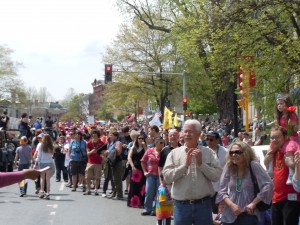
Fast-forward to 2011: yesterday’s 30th annual parade, now officially called the “Noho Pride LGBT [lesbian, gay, bisexual, transgender] Parade and Pride Event” and organized by a group called Noho Pride. The parade stretched for blocks and moved down Main Street to a cheering throng of some 15,000, lining not only both sidewalks but also the midline of our very wide boulevard.

Spectators applaud the Forbes Library contingent, #Nohopride 2011

Contingents included students, teachers, and parents from several elementary and high schools…dozens of churches…our local public library, where I and several other writers marched along with the director, assistant director, and a couple of the trustees…and a number of prominent politicians including both mayoral candidates (one gay, one not), Northampton’s State Representative Peter Kokot, and a candidate for US Senate who actually took a booth.

Vendors at the rally site included banks, home improvement contractors, and other very mainstream businesses. There was almost no political content, although there was a large tent for activist organizations, and the tent was crowded.

One of the local newspapers described the scene:

The atmosphere was a jubilant one – with hula-hoopers, a group doing intricate formations with shopping carts, drag queens, Rocky Horror Picture Show actors, the Raging Grannies, and countless school groups, some chanting “five, six, seven, eight, don’t assume your kids are straight.”

In the intervening years, a lot has happened in the queer community around Northampton, including national press in the early 1990s in the National Enquirer (which dubbed it Lesbianville USA) and the TV program 20/20. Several openly gay or lesbian politicians have won their races, including Northampton’s openly lesbian mayor, Clare Higgins, who is finishing up her sixth two-year term—longer than anyone else has ever held the post. Same-sex marriage has been legal for years. You have to look really hard to find someone who isn’t aware of same-sex couples in their places of worship, their workplaces, or their circle of friends.

And the Pride event has gone from a defiant statement of our rights to a festive, touristy celebration of culture. So much so that the organizers were publicly criticized by a group of activists including at least two who were there from the beginning, for squeezing the politics of change out of the event.

To me, while I recognize the validity and sincerity of those complaints, that we can now party out tells me that yes, we are making huge progress in this area, among others.

Facebooktwitterpinterestlinkedinmail