Being political can be a very good thing for a business—look what it’s done for Ben & Jerry’s. I believe that social/environmental responsibility is what made B&Js a player with 40% or more of the superpremium ice cream market. Without it, it would be just another among the hundreds of minor players with slivers of market share. Many other companies have also benefitted by their strong stands, including Patagonia, The Body Shop, Interface (flooring company), and many others.
But there has to be a good match between audience and messages.
Which is what makes Budweiser’s “Born the Hard Way” Superbowl ad so surprising, almost shocking.
The football-adoring working-class male Bud drinker (a big part of their audience) is one of the demographics most likely to have voted for DT. Many voters in that demographic had enough comfort with the anti-immigrant rhetoric and action that they cast that vote, even if their motivations were on other issues (such as believing that DT would create more jobs). In other words, this ad could anger a large segment of Bud’s core market. Taking that risk is an act of courage.
Budweiser bottle (photo credit Paul Fris)
Those out in the streets for immigrant rights who are not themselves immigrants or the children of immigrants probably skew rather heavily toward craft beer. I don’t think as great a percentage of them will be going for Bud, Coors (BTW, heavily associated in the 1970s with right-wing causes, before it merged with Molson), or any other industrial beer. It’s also worth pointing out that Islam is a no-alcohol religion (though that commandment is not always followed). So Anheuser-Busch is being quite courageous. If right wing elements (or DT himself) call a boycott, it’s going to be hard to get those who support their position to also support their beer.
I speak out of my own tastes here. I am delighted that Bud took this stand. The company says this ad was prepared in October, before the anti-immigrant candidate eked out his Electoral College victory. That may be. But that also left them two months following the election to decide not to run it. Going forward raises my respect for A-B. But until an American Bud tastes as good as the incredible Czech Budwar (originated by the same family), I still won’t want to drink it. I might talk about them in my speeches or even invest in the company, but I’m not likely to be a customer, let alone a brand loyalist.
Wouldn’t you love to be a fly on the wall when A-B discusses this commercial at its next high-level strategic marketing meetings?
If you like to study Superbowl ads, BTW, here’s a reel of someone’s choices for the top 10 of this year. (My comments are underneath the video.)
https://www.youtube.com/watch?v=XF3wOrWBKjc
The “Born the Hard Way” Bud ad didn’t make the cut, though another Bud ad did. I don’t know who curated this, but I don’t share that person’s sensibility. As a group, I found them disjointed, way too violent, and for the most part not focused on selling (other than the McDonald’s “Big Mac for That”). Why does Mercedes spend 3/4 of their ad on a play fight among motorcyclists in a bar? Why was it such a struggle to even make the connection between the Humpty Dumpty ad and the product that less than half an hour after watching, I can’t even remember what the ad was for? Considering how many millions of dollars go into producing and airing each of these ads, it just makes me scratch my head. Is this really a successful marketing strategy?
I’m starting this post at 2:30 a.m. on January 21, as I prepare to board a bus to Washington, joining the Women’s March for human rights that will greet the newly sworn in US president on his first full day of office. Hundreds of thousands are expected in Washington, New York, Los Angeles, and many smaller communities. Post-event note: at least 3.3 million to 4.6 million demonstrators came out around the US, plus hundreds of thousands more elsewhere in the world in more than 600 events. I’m finishing it the next day.
Several people have asked me, “Why don’t you give him a chance?” And my father-in-law, a liberal, shocked me with a different question: “He won. Why are you still marching?” Later, someone else asked me the same question on Facebook.
Marching at the Women’s March on Washington with my wife and children (from left: son-in-law Bobby, daughter Alana, wife Dina, me, son Rafael)
The Chances DT Has Failed to Take
I have given him not one chance but many, and he has failed to take them. I feel it is my patriotic duty to speak out against his agenda, to remind him that he not only has no sweeping mandate—he lost the popular vote “bigly”—and to remind my fellow Americans that his election was not clean and his behavior has not met any legitimacy tests.
This was already abundantly clear during the campaign. Back in August, I wrote an open letter to DT that called him out for his racism, misogyny, and bullying.
Despite my harsh language, when he eked out his narrow victory, I was still willing to give him lots of chances. But here’s what happened, just to name a few:
I gave him a chance to appoint experts in their fields to run the massive government departments, Most of those he has appointed are business people with no experience managing such a large bureaucracy and in many cases have stated opposition to the missions of their departments. The few who do have relevant experience are scary: for Attorney General, a man rejected by his own Senate for a judgeship because of racism; for Homeland Security, a Guantanamo torturer; for Secretary of State, the head of our largest oil company—a company that has foreign entanglements in Russia and elsewhere and created possibly the most effective corporate disinformation campaign ever, attacking the thoroughly documented science of climate change (which even Energy Secretary nominee Rick Perry, a former climate denier, now admits is real).
I gave him a chance to start telling the truth. Yet just as during the campaign, I’ve seen one outrageous lie after another. Examples: the ridiculous claim that he really won the popular vote and the above-mentioned false kvetching about the media distorting his inauguration’s attendance figures.
I don’t want to make this blog into a book, so I will stop there. I would love to have been wrong on this. I would have deeply delighted in the emergence of a new and different DT, one who really was trying to “make America great.”
My Patriotic Duty One final reason why I marched: the most important one of all! As a patriotic American who believes this country is already great and that DT’s and/or his surrogates’ policies on the environment, women’s rights, minority rights, education, freedom of the press and other freedoms in the Bill of Rights, and a whole host of other issues are not just the wrong path, but take us down the ugly (and utterly unacceptable) road that Germany and Russia took in the 1930s. I not only refuse to be part of that takedown, I feel it is my duty as someone who cares about my country to stand up and say NO. When my as-yet-unborn grandchildren ask me, decades from now, what I did to protect our country and planet at this critical time, I will be able to stand proudly, as my mother did about her role in the Civil Rights movement in the 1960s, and say that I was there. I stood up for what’s right.
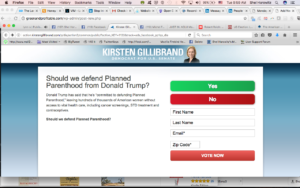
I have been a fan of your since you took office. However, after following your Facebook link to the Planned Parenthood funding survey, I have to say I felt tricked, deceived, and betrayed.
I’ve used this blog to call out unethical marketing from various companies over the years. And even though you and I share many political views (including a strong commitment to women’s rights)—I have to call you out on this.
The initial question that led to the dead end
I had no problem with the initial one-question survey. But then I opted in to the follow-up questions.
First, as a survey instrument, the questions were useless. Each had only a yes or no option, written in language that showed a clear bias toward one answer. Yes, you’ll be able to prepare a press release that could cite a number like 95 percent of respondents—but it’s meaningless. You’d be laughed off the page, or worse, publicly shamed, by journalists who bother to look at the source data.
Second, after I checked off my answers and tried to submit, my phone took me to a page demanding money. I say demanding rather than asking, because there was no way out except by giving money. My submit button was refused when I left the field blank and refused again when I put in a zero. And when I exited the page without contributing, it tried to post to my Facebook page that I had just contributed to you. I have no way of knowing if my responses were actually counted—but I can tell you I did not appreciate being trapped and manipulated like this.
I don’t have a problem being asked for money at the end of a survey, when it’s my choice whether to give or not. But this felt like a shakedown, quite frankly. It left a very bad taste.
I would find this unacceptable from any politician and any charity. But since you were “the very first member of Congress to put her official daily schedule, personal financial disclosure and federal earmark requests online” and cited by The New York Times for your commitment to transparency, I find this an especially bitter pill.
As a marketer, I am saddened to see you resorting to Trumpian tactics based in dishonesty and lack of transparency. You’re better than this. In Michelle Obama’s famous line, “When they go low, we go high.”
Sincerely,
Shel Horowitz, marketing strategist and copywriter
On Monday, the US Electoral College will be officially deciding whether Donald Trump will be president of the United States.
Caricature of Donald Trump by DonkeyHotey, Creative Commons License: https://www.flickr.com/photos/donkeyhotey/5471912349/sizes/m/in/photostream/
Alexander Hamilton had several reasons for proposing this convoluted structure. Some of them were not so noble, like giving more power to slave states. But one is worth noting: providing a check against the office going to someone unfit to hold it.
And just because that body has never found a winner unfit doesn’t mean it can’t. This time, there are a whole bunch of reasons why it might want to exercise that power. Some of them are about his complex financial empire, some about his personal actions—and some about the questionable integrity of this year’s voting process. Any one of these should be enough to say, “Hey, wait a minute, this is not OK.” Here are ten among many.
His opponent winning the popular vote by an astounding 2,833,224 votes
Trump has been named in at least 169 separate lawsuits—for fraud, antitrust violations, discrimination, and sexual harassment (among other issues). One is especially worth highlighting: A consolidated fraud case (including two class action suits plus one filed by New York State’s Attorney General that Trump settled for $25 million alleged that his Trump University was a scam
This, unfortunately, isn’t even the whole story. I haven’t discussed the ludicrous lack of government experience among his Cabinet picks…his own inexperience in any government position…the consistent lying…the well-documented cheating of vendors…the lease he has with the federal government for his new Washington, DC hotel which bars any government employee…his insistence on remaining Executive Producer of Apprentice, as if running the country were a side hustle…the extremist agenda he has embraced…his refusal to meaningfully condemn the hundreds of hate crimes in the aftermath of the election…and on and on it goes.
I hope the Electors in the Electoral College do their patriotic duty, and (in the words made famous by Nancy Reagan) “just say no.”
As someone who is decidedly NOT a fan of the annual Black Friday shopping orgy—and who participates instead in celebrating Buy Nothing Day (like Black Friday, always on the day after US Thanksgiving), I just love this!
Patagonia had pledged to donate all of its worldwide online and offline revenues on Black Friday to environmental causes.
The outdoor clothing maker previously announced it would donate 100 percent of its global retail and online sales on Black Friday. It says it expected to reach $2 million in sales, but instead generated five times more. Patagonia says the fundraiser “attracted thousands who have never purchased anything from Patagonia before.”
Mind you, that’s not the profits from its $10 million in sales. It’s the whole amount, the gross revenue. Nothing set aside for product costs, operating costs, or anything else. I hope this generates many loyal new customers and lifelong fans. May the company’s generosity be a source of continued abundance, and maybe next year they can repeat and do even better.
All I can say is BRAVO and WOW!
Personally, I’ve been a fan of Patagonia for decades. I even profile the company in my latest book, Guerrilla Marketing to Heal the World. I didn’t happen to hear about this ahead, but might have actually moved from participating in Buy Nothing Day to making an online Black Friday purchase to support the environment. That would not have felt like the crass commercialism that seems to fill every moment of airspace in November and December, and feels especially extreme on Black Friday.
During last night’s debate, Donald Trump kept taking any accusation or criticism and attempting to pivot it around to his opponent. He also interrupted constantly, shouted belligerently, told numerous documentable lies,* and bragged about his bad behavior. It was a performance worthy of an elementary school bully, not a candidate for President of the United States. It was ugly. And quite frankly, it got in the way of the few good points he honestly made about areas where Clinton should do better.
Donald Trump and Hillary Clinton
Clinton chose to be cool, calm, and collected, to smile patronizingly with an “isn’t this little boy adorable?” look over her shoulder—while quickly and scathingly rebutting him when she got the floor. It may not have been the perfect approach—but with the need to do a delicate dance of expectations, as a very public liberal woman in a culture that doesn’t like powerful liberal women in politics, it may have been her best option–even if it did seem a trifle over-rehearsed. Trump mostly glowered and scowled, looking for moments to interrupt.
But let’s not focus on style over substance. On policy specifics, Clinton noted her earlier accomplishments and referenced her specific proposals. Trump was hard to pin down, used empty adjectives like “beautiful” and “tremendous” (example: “I’m really calling for major jobs because the wealthy are going to create tremendous jobs.”). He resorted to ridiculous claims, defense of procedures that have been declared unconstitutional, and as already noted, flat-out falsehoods.
Perhaps most telling are the “accomplishments” he did brag about. Here’s his response when he was asked about his pattern of cheating people who’ve worked for him:
I take advantage of the laws of the nation because I am running the company. My obligation right now is to do well for myself, my family, my employees, for my companies.
Here’s what he said when Clinton speculated that the reason he doesn’t release his taxes is that he doesn’t pay any:
That makes me smart.
Near the end, Trump made this ballsy claim:
I think my strongest asset, maybe by far, is my temperament. I have a winning temperament.I know how to win. She does not know how to win. The AFL-CIO – the other day behind the blue screen, I don’t know who you’re talking to, Secretary Clinton, but you were totally out of control. I said, there is a person with a temperament that’s got a problem.
In Yiddish, the word for this is chutzpah. The closest English translation would be unmitigated gall. The man who has run his campaign on temper tantrums, slander, innuendo, inappropriate sexual references, and racist/sexist belittling of others, who could not even make it through a 90-minute debate without interrupting and shouting, claims that his temperament is his best asset.
Let’s take him at his word—and give a landslide vote in November that repudiates that temperament and doesn’t expose us to the dangers of his other, presumably worse attributes.
I have noticed that many successful startups are advertising that they donate x% of their profit to someone in need or they help someone have a better life,etc. What do you think is the importance of such messages to gain initial traction and how does it help grow the company?
By the time I saw the post, several other people had jumped in to tell him that social entrepreneurship isn’t just a marketing trick. It must be genuine.
How some people view the world—Opportunity for businesses that genuinely care
I agree, but there’s more. Here’s what I wrote:
Yes, social giving has to be genuine–motivated not by marketing but by sincerely helping the world–but if you’re doing that, you gain huge marketing advantage if you handle it right.
Keep in mind: charitable give-backs are NOT the only model. I’m rather a fan of creating products, services, and business cultures that directly *and profitably* turn hunger and poverty into sufficiency, war into peace, and catastrophic climate change into planetary balance. In fact, in my latest book, Guerrilla Marketing to Heal the World–which is focused on this aspect–charity givebacks account for part of one chapter out of 22 chapters. In my speaking and consulting, I help companies actually develop these kinds of approaches. You can get a very quick early-stage introduction by spending 15 minutes with my TEDx talk, “Impossible is a Dare” https://www.ted.com/tedx/events/11809 (click on “event videos”)–but recognize that this was 2 years ago and the work has evolved a lot since then.
All other things (such as price, quality, convenience) being comparable, consumers “vote with their feet” to support ethical, green, socially conscious companies. So you, as a startup, have the chance to look at the skills, interests, and wider goals within your company…create products and services that match these skills, interests, and goals with wider goals like the Big Four I mentioned at the beginning…and market them effectively to both green and nongreen markets (which has to be done differently, as I discuss in the book). But please, do it with good intentions! (I can help, BTW.)
Here in Massachusetts, we get to vote on some interesting referenda.
Lifting the Charter School Cap
UPDATE, OCTOBER 6, 2016: I’ve been convinced in the intervening weeks that this particular charter school vote is not one I can support. I am not convinced of the motives of this bill’s supporters, and I see a greater threat to the public schools in the way this measure is structured. Below is what I’d written on September 18, before I was really aware of the issues with how this referendum is structured. All my other points about the other issue and candidate remain accurate.
One is on lifting the current cap on charter schools. These schools are publicly funded and privately run, funded primarily by a state per-pupil allotment. They range from liberal experiments in educational democracy to corporate-sponsored throwbacks to long-abandoned educational models promoting rote learning and obedience. At the moment, 32,000 Massachusetts students are on waiting lists for charter schools.
Preschool girl with a creative project. Photo by Anissa Thompson.
It’s important to separate whether the charter school experiment is a good thing from the funding formula. Bias disclosure: both of my kids attended charter schools for elementary through high school, so I’m a quadruple alumni parent. It’s also worth pointing out that my wife and I both attended the same New York City high school for gifted children. This was a public school, but in many ways the experience was closer to an academic-achievement-oriented charter school in today’s world.
The switch came for us when the public school second grade teacher insisted on teaching reading by lowest common denominator. Our daughter, who had always loved school through preschool, kindergarten, and first grade, very quickly started hating it. She didn’t want to sit through whole-class reading lessons using a book with two words on each page, paced to the slowest kids in the class–and the school administration was not responsive. We moved her to Hilltown Cooperative Charter Public School, an arts-based school that emphasizes love of learning through multiple modalities–and she thrived there.
We worried that my son, five years younger than my daughter, could have been a bullying victim in the traditional public school, as I was. He was a sensitive, feminine, non-sports-playing classical musician, avid reader, and a member of a tiny ethnic minority in our town. And our town’s school culture is heavily focused on sports. But he did well in the zero-bullying-allowed culture at Hilltown. Both of my kids went on to thrive in the performing arts charter high school they attended afterward (which was, incidentally, much more ethnically and racially diverse than our town public school). My son drew on that training to attend a major music conservatory for both his undergrad and graduate studies.
Hilltown also did its best to follow its mission and be a lab school for new educational methods, which it was eager to share with other area schools. However, the school’s outreach efforts were rebuffed over and over again. My wife was on the board for a while, and she told me how almost every outreach gesture was brushed away by the local traditional public schools.
I vote an enthusiastic yes for the idea of charter schools–but the funding formula borders on criminal IMHO. Removing resources from the traditional public schools just adds to the spiral of despair, increases bureaucracy, denies resources to kids who are in many cases already begging for more, and cuts off real learning.
Yet I will vote for more charter schools–because they were there for my kids when traditional public schools failed them–but reluctantly, because I think the funding formula strikes a blow against public schools with every student who leaves. And whether or not the vote passes, I think we charter school supporters have to be part of fixing that rotten funding formula. And as a vote to give a few of those 32,000 waitlisted students the same opportunities my children enjoyed.
Recreational Marijuana
I will also vote, reluctantly, for pot legalization, though I don’t like the way the industry is moving. I see it becoming another outpost that extracts money from the poor, uses questionable marketing tactics, and encourages people to detach from reality rather than step up to the plate and work for change. It’s also likely to concentrate clout in the hands of a few big players, squeezing out any mom-and-pop businesses. And I worry about fostering a culture of chemical dependence, and of course I worry about problems when people drive while stoned.
However, we already have all of that, with alcohol. And pot is actually a much more socially benign form of blocking the real world than alcohol. Pot smokers don’t get aggressive or violent, and don’t drive nearly as dangerously, as drunks. And criminalizing this behavior causes deep and lasting damage. It:
Ruins the lives of people who are using a much milder drug than many legal ones
Diverts scarce law enforcement and criminal justice resources away from crimes that actually hurt people
Causes a tremendous financial burden to taxpayers (it’s not cheap to keep someone in jail for several years) and contributes to prison overcrowding
Jacks up prices to levels that may lead to property crime
Once again, I’m voting for the lesser of evils. Criminalization is a failed solution.
The Presidential Race
And yes, dammit, I will vote reluctantly for a deeply flawed Democratic presidential candidate who in many other years might not get my vote, even though I live in a “safe” state where I could vote third-party, and have voted for independent candidates in the past.
I want such an overwhelming margin of defeat for Trump’s agenda of racism bullying, misogyny, lying, cheating his suppliers, suppression of the media, egomania, etc. that he never shows his face in politics again. Let’s compare Clinton and Trump:
She is far too likely to get us into another war. He would make us a puppet of Russia’s Vladimir Putin.
Her support of Israel’s ultra-right government is troubling. His support of anti-Arab and anti-black and anti-Latino positions is equally troubling. And his consistent egging his supporters on toward physical violence against dissenters is straight out of the Nazi playbook.
She has a history of standing up for the rights of women and children. He embraces racial stereotyping and stands up only for the rights of his own various business enterprises—including the “right” to cheat vendors and lenders out of legitimate payment.
She’s uncomfortable with the press. He actually bans reporters from media outlets he doesn’t like.
She embraces secrecy in ways that make me deeply uncomfortable. He says the first thing that comes into his mind, regardless of the implications–but is the first major party candidate in decades to refuse to release his tax returns, which makes me wonder what he’s hiding.
I could go on and on. If you want more, start with longtime political observer Adolph Reed’s article, Vote for the Lying Neoliberal Warmonger: It’s Important. And to those on the Left who say a Trump presidency would revitalize the opposition, I would respond that repression doesn’t often create a climate of change. For every success like the freedom struggles in South Africa and India, there are many more like Prague Spring being crushed by the Russians–where the hopes and reams of the people are squashed like bugs. We didn’t see a popular uprising during Reagan’s or even George W. Bush’s presidency; why would we suddenly see one under Trump and his suppression of the press?
In other words, I find myself facing the lesser-of-evils in three different votes on my November ballot. And while I can’t say I’m OK with it, I find voting for the lesser evil better than the non-action that triggers the greater evil. Better still: taking action to get voting reforms so we no longer need to vote lesser-evil.
Last night, I signed a petition created by Rep. Joe Kennedy about gun control. The page gave me the option to share on Facebook, and I did. Then I went to bed.
I was pretty horrified to check my page this morning and see my share that said “Stand With Rep. Joe Kennedy” and had a huge picture of him. Not a word about gun control showed up in the Facebook preview.
So I took it down and posted this note:
To those who might have wondered why there was a huge campaign ad for Rep. Joe Kennedy on my page last night. I had just signed a petition he originated on gun control, and wanted to share it. I didn’t check how it posted on FB. I felt tricked and betrayed enough to take the entire post down. Let him get signatures some other way.
This was a classic bait-and-switch. In fairness, Kennedy probably delegated this to some social media intern and most likely wasn’t personally involved. But if I lived in his district, this would make me look for someone else to vote for, because I don’t like being manipulated and cheated.
Only after I took it down did I think about blogging about this feeling of betrayal. If I’d decided to blog before I instinctively took it down, I would have grabbed a screenshot to post here. Instead, you get the logo of the ultimate-bait-and-switcher: Volkswagen.
Aging Volkswagen showing VW logo. Photo by Daria Schulte.
VW, of course, preyed upon environmentalist car owners to sell them a low-emission vehicle—but fudged the test results and was really selling highly polluting cars. This is costing the company billions, and it isn’t over yet. The state of Vermont just filed suit against VW two days ago. Vermont, tiny as it is, has the second-highest per-capita concentration of VWs in the country (after Oregon)—precisely because environmental consciousness is extremely high among its residents. In fact, a year ago, a group of those Vermont residents already filed a class-action suit against Volkswagen.
I used to think my parents and in-laws were overreacting with their continuing pledge never to buy Volkswagen s because of the company’s involvement with the Holocaust. After all, the people who made those brutal decisions are long dead or in nursing homes. But after this scandal, I can’t think of any reason why I would ever trust the company again.
Bottom line: in business and in politics, bait-and-switch has no place in ethical marketing.
Someone asked me today what advice I’d give to someone just starting out. If someone had given me these four bits of advice in 1981 when I was just starting out, I’d have been on the success track a lot faster.
Be green and ethical—and willing to proclaim this to the world
Delegate early, especially those things you’re not good at–but keep checks and balances in place
Don’t reinvent the wheel. An off-the-shelf solution may be better and cheaper than reverse-engineering something
Recognize the REAL opportunities that provide first-mover advantage–and walk away from those that aren’t there yet