Today is Election Day in the United States. And something like the 7th week of the Occupy Wall Street/Occupy Everywhere movement that sprung up in September.

A good day to reflect on different social change strategies—as someone who’s done both grassroots and electoral politics.

I began to get involved in grassroots movements in the fall of 1969, shortly before my 13th birthday. I marched to end the war in Vietnam, was arrested at the 1977 Seabrook occupation trying to shift society away from nuclear power and toward safe energy, and organized on a whole raft of social justice, environmental, and human rights issues over the decades. I even founded the grassroots community group that saved a mountain. This activism led directly to my career as a marketing consultant; much of my early work in marketing drew on my experience doing publicity for the grassroots groups, and my move toward green marketing in the last 12 years or so is a natural outgrowth of my need to braid together these two stands of my life: the activist and the entrepreneur.

On the electoral side, I’ve been an active volunteer on numerous campaigns, managed a successful City Council campaign, wrote press releases for a successful mayoral candidate—and ran three times for local office.

Nonviolent Action Brings Down Governments

This year, we’ve once again seen massive evidence of the power of grassroots nonviolent activism to bring down governments. In Tunisia and then Egypt, deeply entrenched autocratic governments were forced out. (Libya, which was more of a civil war, lots of violence on both sides, is a different case.) Historically, this pattern has shown itself countless times, though often taking much longer to achieve victory. A few worth mentioning: India, 1930s-40s; South Africa, 1976-94; Poland, Czech Republic, and much of the former Soviet bloc, 1968-1990. And yes, we have to put the 1979 revolution in Iran in this category, showing that active nonviolence can be used toward authoritarian as well as democratic ends.

And this is important to note: activists have to have a plan for victory, and for safeguarding the democracies we fight so hard to establish. I’m very concerned right now that Egypt’s new government will prove just as authoritarian as Mubarak’s.

Also, we have to note that nonviolent organizing doesn’t always work. American protestors opposing World War I accomplished very little (though the feminists of the same period accomplished quite a bit). Tibet is still deeply repressed by China, more than 50 years into the occupation.

The Occupy Movement and the Broader World of US Social Protest

While the Occupy protests owe much to this long heritage of nonviolent action, the demands on Wall Street are different than the demands of Arab Spring. The 99 percenters are not looking to toss out the Obama government. They are simply calling for economic justice. They’ve been criticized in mainstream media for a lack of a cohesive vision, but in this situation, a simple cry for justice may be enough.

While inspired by Arab Spring, Occupy’s real roots are in the issue campaigns in the US going back at least into the 19th century: labor, civil rights, peace, feminism, LGBT, safe energy, and so forth—and decision-making structures, especially, owe much to Clamshell Alliance and other players in the 1970s safe energy movement. All of these movements can point to massive victories—to cultural changes. The kinds of oppressive behavior that were considered normal a few decades back are no longer socially acceptable.

Yet many other movements like these also failed to make a difference. The more people in the Occupy movement who can take the time to study what worked and didn’t work in social movements, the more likely they are to achieve their goals.

Electoral Politics

If the process of organizing in the streets seems slow, the process of moving change forward by electing progressives seems glacial. For every Franklin Roosevelt or Ronald Reagan who is able to accomplish enormous structural change while in office, there are dozens of Jimmy Carters and Bill Clintons, hamstrung by budgetary constraints, partisan warfare, and their own desire to please everyone (pleasing no one in the process).

I’m not just talking about presidents. Most people enter Congress, or even local political bodies, out of a desire to do good in the world, and are quickly beaten down by the system (or corrupted by the platform it provides to enrich themselves, their financial backers, and their friends). For every fire-and-brimstone Bernie Sanders, there are dozens in office whose names we don’t even know unless we live in their districts—people who are not making much of a difference.

A charismatic figure like Barack Obama can galvanize support and get elected—but then has to either show real progress, fast, in a social structure that moves painfully slowly and is steered by forces outside the victor’s control, or show how the opposition’s intransigence is a roadblock to progress and press for a larger, stronger governing coalition. So far, Obama hasn’t risen to the challenge, though he’s showing signs of moving in that direction. He could still become one of our great presidents—but in failing to act, he risks becoming a one-term nonentity that dashed the hopes of those who voted for change and didn’t receive it.

Occupy Wall Street actually presents Obama a huge opportunity: to embrace the progressive agenda he was elected to advance, to use the anger of the people in the streets to “have his back” as he pushes for real change, and to negate the arguments of Tea Partiers and other right-wing extremists that his minor reforms are “going too fast.” I doubt he’ll seize the moment, but I’d love to be proven wrong.


Facebooktwitterpinterestlinkedinmail

This morning, a reporter posted a query on HARO (a free service that matches reporters with story sources) asking,

Were you a protester/activist back in the 1960s? If so, what's
your reaction to the current Wall Street protest and the
off-shoots around the country?

I thought my response was worth sharing with a wider audience:


Hi, Sondra, I went to my first demonstration about the Vietnam war in 1969 and was very active in protests all through the 1970s and beyond. I was arrested at Seabrook in 1977, committed civil disobedience but was not arrested at the Wall Street Acton in 1979, was a peacekeeper for the million-person march for peace in 1982. I probably still attend three to five demonstrations in a typical year, mostly local (Western Massachusetts) –but I did go to massive demos in Washington and NYC to try to keep us out of Iraq in 2002-03. Also, using other methods than street demonstrations, I have been an active organizer for decades. My biggest success was forming a group called Save the Mountain, which generated widespread community support and blocked a particularly horrible housing proposal next to a state park–after all the “experts” said there was nothing we could do.

As it happens, today I’m getting on a bus for an evening conference on sustainability in NYC, and staying over for the night. Tomorrow morning my plan is to go to Wall Street and see how things are going.

As a teenager, I had a poster in my room with a picture of a peace demonstration and the caption, “It is a sin to be silent when it is your duty to protest –Abraham Lincoln”–and I guess that pretty much sums up my feeling.

Obama has been a very weak president, falling short on issue after issue about bringing the “change” he was elected to create. He has given us a slower–and in some cases faster (like drone killings)–version of the “new normal” that developed under the illegal government of George W. Bush. No one has even been indicted for the crimes against the people by the Bush government or by the looters in suits in the financial industry. I believe strongly in the power of nonviolent protest, and am thrilled to see a new generation stepping forward, willing as we were to disrupt their lives in order to make a difference. Street protest is certainly not the only approach, and I believe we need multiple simultaneous nonviolent approaches. The country has gotten so topsy turvy and out of balance that I don’t think Richard Nixon would be tolerated by the Republican Party anymore (he’s probably to the left of Obama, if you watch both men’s actions rather than their words), and even their ‘sainted’ Reagan would be too far left to be nominated today. We desperately need an effective Left in this country, and the Occupy movement is stepping up, even if it has not figured out yet how to articulate its mission and goals.

Facebooktwitterpinterestlinkedinmail

Ten years ago, 19 criminal thugs seized control of four planes—and the world as we knew it was shed like the skin of a snake, replaced with a new and very unpleasant reality.

On this anniversary, I want to publicly thank the hundreds of brave men and women who unselfishly, courageously faced death and yet still went back into the flaming buildings…wrested control of Flight 93 back from its hijackers and crashed it in an empty field, instead of a major government building…poured into New York and Washington to see how they could help, knowing they were risking their own health, their own lives. Also, the thousands of brave soldiers from the US and elsewhere who have put their lives on the line every day. It is not their fault that we shouldn’t have even been in those wars.

But I also want to remember what might have been. In the vast emotional outpouring following the attacks, we were, for almost the only time in our history other than Pearl Harbor, united as a people. And also, for perhaps the first time ever, we had the sympathy and compassion of the whole world.

It was the first President George Bush who had called, ten years earlier, for “A New World Order, where the rule of law, not the rule of the jungle, governs the conduct of nations.” His son had a chance to make that happen.

What was needed was a powerful, emotional speech recognizing that the old, imperialist model of conduct among nations didn’t work anymore…and seizing this terrible moment as a bridge to world peace, a chance for the world to re-invent itself as something new—as a collaborative body determined to achieve greatness as a place where war is an archaic and never-again-used way to settle disputes, no one starves, everyone can get an education and decent health care, the environment is given a chance to heal, and the enemies of industrialized societies cannot get any traction. I thought at the time that this is what Bush should have done and I still think so.

Not that the perpetrators would get off, though. Bush could have called for an international criminal manhunt to bring Bin Laden and his gang of thugs to justice for mass murder, and the world would have supported it. Especially as the US, coming off the Clinton period of prosperity and massive surpluses, had the resources to fund that manhunt.

What an outpouring of support that would have caused! People of all nations would have embraced Bush as a hero, and more importantly, would have striven to put those magnificent words into practice. The United States would have been seen as giving a precious and lasting gift to the entire world. And Bin Laden probably would have been captured early on, with no negative impact on the people unlucky enough to live in Afghanistan or Iraq.

Instead, Bush told us to go shopping…squandered the surplus in two illegal, immoral, unjust—and extremely expensive—wars (not counting the domestic war on Muslims, Arabs, and poor people)…initiated dozens of repressive practices at home…blew up our credibility in the world of nations by acting as a “rogue state” (turning us into either a hated enemy or a laughingstock, in various parts of the world)…and completely failed in his pursuit of Bin Laden (Obama had to come in and finish that one). And his actions caused so much resentment against the US that it turned Al Qaeda from a tiny cell into a massive terrorist organization spanning many countries. He made the enemy much bigger.

I have always perceived George W. Bush as a small-minded bully surrounded by smart and evil advisors, and I was not surprised that he could not step into greatness. But I’d have loved to have been proven wrong. And how much safer I’d feel today if he had somehow risen to the task. He could have been our greatest President. Instead, in my opinion, he was the worst.

On this 10th anniversary of 9/11, let us think how we can still achieve that world of peace. It will be much harder now—but it is not impossible.

Facebooktwitterpinterestlinkedinmail

Watching the fireworks from my lawn last night, I found myself thinking about a long-ago July 4th, and how it helped shape who I am today.

The year was 1976. I was a scrawny, long-haired, 19-year-old peace and human rights activist who had just finished my senior term at Antioch College.

I was broke and jobless. And, not having any better plan, I was going to hitchhike around the United States for the summer, shifting my itinerary depending on where the rides were going. Though I was pretty sure I wanted to see Denver and San Francisco, at least, I knew it was a big country with lots to explore, and I hadn’t seen very much of it so far. I didn’t know a thing about hitchhiking, and I hadn’t done any research about what to bring—though I did hook up briefly with a friend who was a very experienced hitchhiker, who showed me the basics of where to stand safely.

So off I went, with $200 in travelers checks in my pocket, and a bunch of inappropriate stuff packed in three inappropriate daypacks. I didn’t have a traveler’s frame pack, a sleeping bag, decent rain protection, a sun hat, or a lot of other things I should have thought about. Instead, I had an entire daypack filled with my creative output: poetry notebooks, my dream journal, and such. Plus a bare minimum of clothing and a bit of food.

I did, however, have a supply of thick markers for making hitchhiking signs that people could read at 60 miles per hour; even back then, I understood some basic marketing principles. 🙂

Setting off from my college town, Yellow Springs, Ohio, in late June, I stopped to visit family in New York before heading to Washington for the Bicentennial.

For weeks, I’d been growing more and more disgusted with the insane commercialism around the 200th anniversary of the Declaration of Independence—stuff like “Happy birthday, America, we’re having a sale on our new Fords because it’s your birthday,” accompanied by various patriotic songs.

I was, at that time, very alienated from mainstream American culture. The United States had finally pulled its last soldiers out of the Vietnam quagmire (which I’d been actively protesting since 1969), and Saigon had fallen only 14 months earlier. Examples of racism and sexism and homophobia and oppression of various minorities were easy to find. Police violence against progressives and racial minorities was a part of daily life, and we assumed we were being spied on.

I’d recently completed an internship at a socialist newspaper in Georgia, where the sense of “us against them” was palpable—and where the advertising base had largely abandoned the paper as soon as a safe, bourgeois counterculture paper started publishing, providing access to the lucrative hippie market around Atlanta without funding anti-government journalism. I saw business as the enemy of progress, and could not have named a single example of a business trying to do good, other than a couple of leftist bookstores and healthfood co-ops. I’d been a vegetarian for almost three years, and had discovered that this made me unwelcome in many restaurants.

In short, I was disenfranchised, cynical, militant, and even hostile. I had a pretty big chip on my shoulder.

There were a lot of events in Washington on July 4, 1976, including the grand opening of Union Station as a National Visitors Center, and of course, a huge birthday celebration. As I recall, there were several large public events around different parts of the Mall.

The one I was there to attend was a peace and take-back-the-government rally called by the People’s Bicentennial Commission—and organized, interestingly enough, under the “Don’t Tread on Me” rattlesnake banner that we’ve seen at a lot of Tea Party events in the past few years.

Aside: Columnist Ed Tant, who covered the event for the Athens, GA Observer, remembers the flag as quite integral to the demonstration:

The People’s Bicentennial rally 34 years ago still stands out in my memory for its hopeful patriotism and its message against the predations of plutocracy symbolized by the “Don’t Tread on Me” flag flying from the stage and from the crowd more than a generation before the same flag was appropriated by the tea party crew.

The Gadsden flag was named for Christopher Gadsden, a Revolutionary War hero from South Carolina. It was flown by American sailors and marines during the revolution, but the first political group to feature the rattlesnake flag at a Washington rally was the People’s Bicentennial Commission that flew the flag to warn against the growing power of multinational corporations…

During the People’s Bicentennial rally in 1976, activist Mary Murphy explained the symbolism of the rattlesnake flag, saying, “The rattlesnake has no eyelids, so it is ever-vigilant. Also, it never attacks without warning.”

I seem to remember seeing it at many rallies over the early 1970s, but it may be that the July 4, 1976 demonstration was the first to make it the rally’s official symbol. Somewhere, I might still have my copy of that button.[Aside ends]

Although some conservatives had worried publicly that this anniversary would be a magnet for terrorism and violence, what impressed me above all was the lack of that kind of drama. Only a few years after hard-hat construction workers had attacked war protestors in New York, after Chicago police had attacked protestors at the Democratic Convention, and after the country had been split into opposing camps on so many issues—multiple large gatherings, each representing a different segment of the political landscape from ultraprogressive to ultraconservative, and a huge apolitical middle that was just there to party out on the Bicentennial, all coexisting. All peacefully listening to their own sets of speakers and performers, sometimes coming into contact with each other at the edges, and even sharing food. As far as I could tell, there was no violence, no overt conflict at all, even as hippies in torn flag t-shirts encountered flag-waving conservatives.

And then, after all the rallies were over, we all left our separate public events and gathered around the Washington Monument—to peacefully watch one of the best fireworks displays I’ve ever seen. For one magical night, there seemed to be no great divide. Just a whole lot of people watching a grand fireworks display.

Hitching out of Washington on my way west the next morning, I encountered the generosity of people from both the protests and the parties. I made it back to Yellow Springs in three rides, with very little waiting time. It took only about a half-hour longer than driving would have taken.

And that was the beginning of my summer-long lesson that most Americans are good people who want to do the right thing…that the world is abundant and people will help others when they need it…and that the hostility I thought mainstream America had felt toward the counterculture was at least in large measure, confined to my own imagination.

I have taken the lessons of that day of unity and that summer of hope with me for 35 years now, and I trace a lot of who I am today and how I act in the world to the revelations of that time.

Facebooktwitterpinterestlinkedinmail

I’m not used to this: John Boehner said something I agreed with. Which is that Obama’s action in Libya needs approval under the War Powers Act. While I’m glad he’s holding Obama up to this very important law, I do wonder where he was when the handful of peaceniks in Congress were criticizing George W. Bush’s two far more extensive illegal wars. Mr. Boehner, I hope in the future that you hold Republican presidents as well as Democrats to the standard.

It’s less surprising that I occasionally agree with Ron Paul (not that I’d ever vote for him, as I think many of his domestic policies are a disaster). Here’s something brilliant Ron Paul said at the GOP debate the other day:

I served five years in the military. I’ve had a little experience. I’ve spent a little bit of time over in the Pakistan-Afghanistan area, as well as in Iran. But I wouldn’t wait for my generals. I’m the commander-in-chief. I make the decisions. I tell the generals what to do. And I’d bring them home as quickly as possible. And I would get them out of Iraq, as well. And I wouldn’t start a war in Libya. I’d quit bombing Yemen. And I’d quit bombing Pakistan. I’d start taking care of people here at home, because we could save hundreds of billions of dollars. Our national security is not enhanced by our presence over there. We have no purpose there. We should learn the lessons of history. And the longer we’re there, the worse things are, and the more danger we’re in, as well, because our presence there is not making friends, let me tell you.

Facebooktwitterpinterestlinkedinmail

While the GOP lines up to see who can be more crazy and out-of-touch and unintelligent than their competitors, the Left is strangely quiet. Haven’t even heard rumblings of candidacy from Congressman Dennis Kucinich, who has set the bar for leftist challenges in the past two presidential elections.

And this is odd, because Obama has failed the Left, despite being elected on a platform—dare I say a mantra—of “change.”

Yes, he can claim a number of significant accomplishments—one blogger found Obama’s legislative accomplishment rate was an astonishing 96 percent—but on most of the issues that really matter, his record does not inspire:

WAR:

We’re still in Iraq, where five US soldiers lost their lives this week. And we’re way deeper in Afghanistan than we were, with about 100,000 troops on the ground. And we’ve deployed in Pakistan and Libya. The only real move toward peace was Obama’s recent speech on the Israel-Palestine conflict

HEALTHCARE:

All that energy into the pathetic and complicated Obamacare compromise! Not only was single-payer not “on the table,” but even the wimpy public option was taken off the table. What was left?  A gift to the insurance industry and not much else. I want a candidate who will propose a one-sentence health reform bill: “All US citizens and legal residents are eligible for Medicare from birth.” If we need to phase it in, start by moving eligibility to age 55, then 40, then 20, then zero over a period of years.

ENERGY/ECONOMY/ENVIRONMENT

I lump these three together because the solution integrates across the disciplines: A massive, Marshall-plan-style initiative to get OFF fossil and nuclear energy sources in ten to twenty years, replacing them with sources that are both clean and renewable (with special attention to deep conservation that reduces the need for energy by 50 percent or more). We’d use government loans to jumpstart the effort, bring the price of conversions down, and front the money for homeowners, tenants, farmers,  and business owners to get systems in place—with the loans repaid out of the energy savings. This would boost the economy, create hundreds of thousands, maybe even millions of jobs, get people out of poverty, put them back to work, remove our biggest reason for starting wars—and drastically reduce our carbon footprint, all at once!

The candidate who can articulate this vision, who can claim the unfinished mandate that Obama promised and didn’t deliver, has a pretty good shot at galvanizing the American people—if they can be convinced that these changes are actually possible.

Facebooktwitterpinterestlinkedinmail

Ever see a 76-year-old-man up on stilts—and not just ordinary stilts but giant ones that elevated him 15 or 20 feet above everyone else?

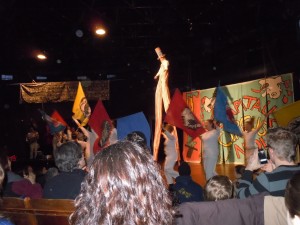
I saw Peter Schumann, the tireless founder of Bread & Puppet Theater, do just that yesterday, at a performance in Boston.

Bread & Puppet Theater founder Peter Schumann, age 76, walking high above other performers on giant stilts.
76-year-old Peter Schumann, on giant stilts

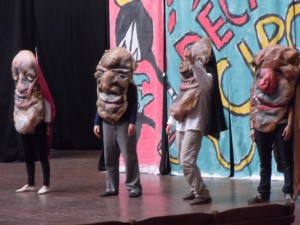
Schumann founded the well-known political theater troupe back in 1963. Known for its giant puppets and unflinching anarchist-socialist politics (not to mention Schumann’s visual art and breadbaking, the collective nature of its living and working, and incorporating audience members including kids into its performance), Bread & Puppet has been fighting the good fight for decades.

Puppet-headed actors on stage: Bread & Puppet Theater

I first encountered them in the early 1970s, when I used to attend demonstrations against the Vietnam war as a teenager. Walking the line between art and propaganda, the large troupe, based on a  beautiful farm in Glover, Vermont, is always entertaining, and always committed to the arts as tools of personal empowerment, affordable to all.

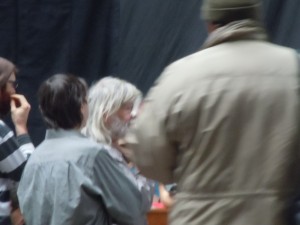
Peter Schumann talks with the cast just before the show
Not yet in costume, Peter Schumann huddles with the cast at the end of the dress rehearsal

I’m glad they’re still out there pushing the envelope, and was particularly glad to see a large number of kids, both in the audience and among the volunteers who got there early to rehears and join the cast for the day.

Facebooktwitterpinterestlinkedinmail

I received a notice today about a photo exhibit of Albanian Muslim rescuers of Jews during the Holocaust—taken by a Jewish photographer, Norman H. Gershman. This rescue took place while the country was under Nazi occupation:

When Hitler’s troops began invading the Balkan States in the early 1940s, Muslims across Albania took an estimated 2,000 Jewish refugees into their homes en masse and welcomed them not as refugees, but as guests.  They disguised these Jews as Muslims, took them to mosque, called them Muslim names, gave them Muslim passports, hid them when they needed to, and then ferried them to inaccessible mountain hamlets.  “In fact, Albania is the only Nazi-occupied country that sheltered Jews,” says Gershman.  The Jewish population in Albania grew by ten-fold during World War II, and it became the only country in occupied Europe to have more Jews at the end of the war than at the beginning.  Records from the International School for Holocaust Studies show that not one Albanian Jew or any of the other thousands of refugees were given up to the Nazis by Albanian Muslims.  “They did this in the name of their religion,” Gershman said.  “They absolutely had no prejudice what so ever.”

If I can manage to get to NYC before January 29, I am so there! I see two key takeaways in this story:

1. Even in the face of unspeakable evil, there will be people who do the right thing, even at great personal risk.

2. This is one of many pieces of historical evidence that Jews and Muslims can coexist, yet another reason to disbelieve the racists on both sides who say such a thing is impossible.

Facebooktwitterpinterestlinkedinmail

As it happens, my breakfast reading this morning was the latest Utne Reader, specifically an article called “The Big Green Machine.”

It describes a speaking tour featuring four veterans speaking on climate change and energy independence. The vets are one unit in Operation Free, sponsored by the Truman National Security Project, which has an all-star board fronted by former Secretary of State Madeleine Albright. Vets speaking as part of Operation Free have logged 25,000 miles in 21 states to make the case that switching off oil to renewable energy is crucial not only to our prosperity, but also to our national security. Speakers note that both the Department of Defense and the CIA have endorsed the energy transition and are taking major steps forward. “These are not organizations known for hugging polar bears,” points out Robin Eckstein, a former Army fuel truck driver in Iraq.

This might be the way we make change as a society: by moving people from sectors not typically involved in activism to convince others who don’t listen to activists.

Drew Sloan, who was badly inured in a grenade attack and went back for another duty tour in Iraq, says even if we don’t know everything, we have to make the shift:

When [people attack] the science of climate change, they ridicule the data as being uncertain. “Veterans know you can’t wait for 100 percent certainty. If you wait until everything is clear and laid out, you’re probably no longer alive. . . . Veterans know how to deal with ambiguity and still make decisions.

As Ms. Eckstein notes,

When certain individuals hear the words “climate change,” they shut down. For whatever reason, when they hear veterans speak on it, they actually listen.

Utne’s article was excerpted from a longer piece in On Earth, which ran under the title, “Patriots Act.”

Facebooktwitterpinterestlinkedinmail

Stupid idea of the Week award to (drumroll, please)…Terry Jones, pastor of the Dove World Outreach Center, an evangelical church in Gainesville, Florida. Jones and his 50 members want to commemorate 9/11 by burning a Koran.

Here’s what General David Petraeus had to say about this idiotic idea:

It is precisely the kind of action the Taliban uses and could cause significant problems, not just here, but everywhere in the world we are engaged with the Islamic community…Images of the burning of a Koran would undoubtedly be used by extremists in Afghanistan – and around the world – to inflame public opinion and incite violence. Such images could, in fact, be used as were the photos from [Abu Ghraib]. And this would, again, put our troopers and civilians in jeopardy and undermine our efforts to accomplish the critical mission here in Afghanistan.

The same Washington Post article quotes a statement from the U.S. Embassy:

Americans from all religious and ethnic backgrounds reject the offensive initiative by this small group in Florida. A great number of American voices are protesting the hurtful statements made by this organization. Numerous interfaith and religious groups in America are actively working to counter this kind of ignorance and misinformation that is offensive to so many people in the U.S. and around the world.

To these 50 extremists who falsely call themselves Christian, I’ve got a few other things to say:

  • Christ’s message was one of tolerance of differences, acceptance of diversity. Consider as one among many examples the story of the Good Samaritan. Samaritans were a despised ethnic group in Christ’s day, as this post on Bible.org makes clear.
  • What makes the US different from (and better than) totalitarian governments with official state religion is that we were founded on the bedrock principles of justice and equality, even for those who are different from us. While it’s true that as a country, we certainly haven’t always lived up to these principles, they are part of our founding heritage and part of why I am proud to be an American. Bigotry is anti-American, and this is an act of bigotry.
  • As General Petraeus points out, your action inflames the passions of the zealot/terrorist faction within Islam–and while they are a tiny minority, they can do tremendous damage, especially with you doing their recruiting for them. You are putting the lives of every American soldier in Iraq (still 50,000 left, in so-called non-combat deployments) and Afghanistan at risk!, not to mention the lives of all of us on the home front. Are you willing to have the blood of these brave soldiers on your hands?

    Advice to the better selves hiding behind that racist front: don’t do it. You want to do something constructive to commemorate 9/11? How about an interfaith Christian/Muslim/Jewish dialog group?

  • Facebooktwitterpinterestlinkedinmail