As a supporter of Elizabeth Warren’s presidential campaign (and a resident of Massachusetts who’s seen the positive impact she has had on the state she represents), I got asked to do a survey of what issues I felt were most important.
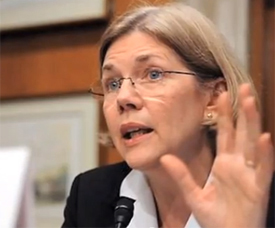
Senator Elizabeth Warren of Massachusetts
While it was tempting to check every choice, I limited myself to 12 of the 32 options.
And then there was an open question: “Is there anything else you’d like to share about why you’re in this fight?” This is what I wrote:
I see the two biggest challenges as peace and climate change. The US has a major role to play in both, starting with STOPPING our support for repressive governments around the world. To get there, we have to have meaningful electoral reform to secure our own democracy, meaningful gun policies that make it at least as hard to get a gun as it is to get a license to cut hair, and policies/tax codes that eliminate all subsidies for fossil and nuclear while encouraging a rapid transition to solar, wind, hydro, and other true clean renewable technologies–including a deep conservation retrofit program. I’ve been a supporter of yours since your first run in Massachusetts (where I live) and an activist for 50 years starting at age 12.
Surely, we can build a better future with technology instead of focusing on autonomous drone delivery of a latte 9 blocks away in San Francisco.
—Seth Godin, December 31, 2018
On New Year’s Eve, Seth Godin riffed on an ambitious list of 23 problems we can focus on solving. A few of my favorites:
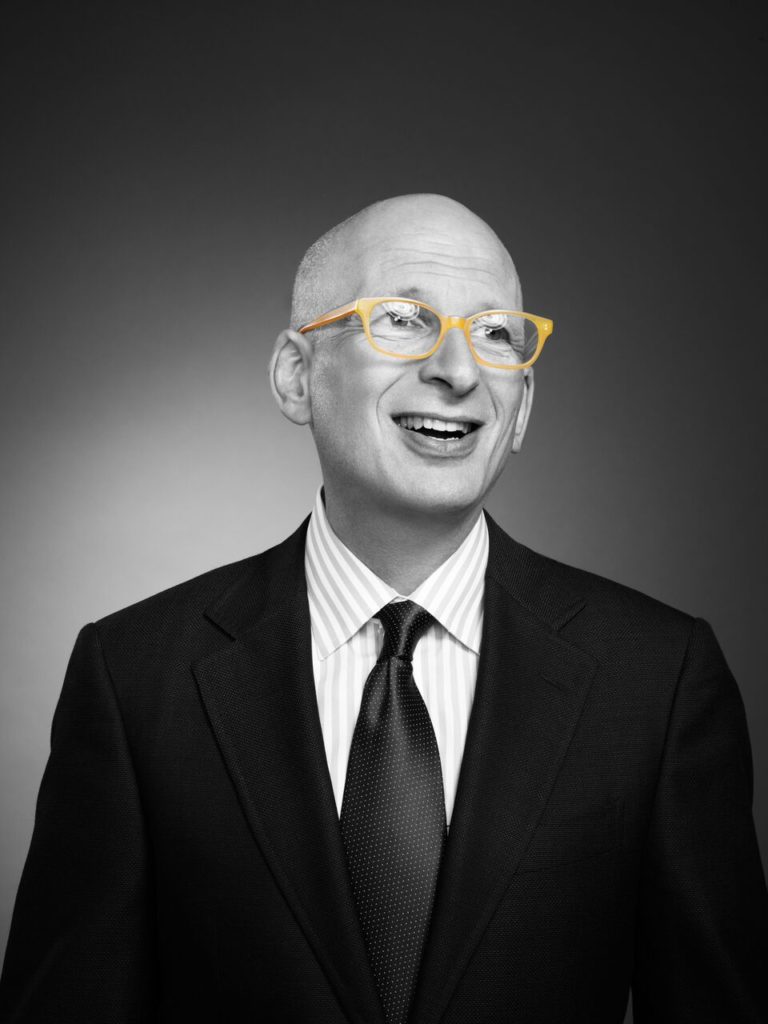
Seth Godin. Photo by Jill Greenberg. Courtesy of Seth Godin.
1. High efficiency, sustainable method for growing sufficient food, including market-shifting replacements for animals as food 2. High efficiency, renewable energy sources and useful batteries (cost, weight, efficiency) 8. Useful methods for enhancing, scaling or replacing primary education, particularly literacy 12. Gene therapies for obesity, cancer and chronic degenerative diseases 13. Dramatic leaps of AI interactions with humans 14. Alternatives to paid labor for most humans 15. Successful interactions with intelligent species off Earth 17. Cultural and nation-state conflict resolution and de-escalation 18. Dramatically new artistic methods for expression
Seth’s list fascinates me because it uses technology as a jumping-off point to solve social problems. Most of us don’t think of technology that way; too often, we think of technology only in terms of lifestyle issues (I don’t even want to label them as problems). Go back to the quote at the very top of this post to see what Seth says about that!
I’m one who does think of technology this way. I’ve written frequently about using technology to turn hunger and poverty, war, and catastrophic climate change into abundance, peace, and planetary balance.
And like Seth, I think we actually can solve these huge problems. As he writes,
[This list seems ridiculous until you realize that in the last few generations, we created vaccines, antibiotics, smartphones, GPS and the Furby].
Not to mention viable solar power, conflict resolution based on deep listening, the ability to access the world’s entire written or pictorial knowledge base from devices the size of a watch, a vast increase in the quantity and quality of organic food…
So I let Seth’s list percolate in the back of my brain for a week.
Here are a few I’d add:
Peace: no more armed conflict as a way to settle grievances, anywhere—and this means diplomats must be trained deeply in nonviolence theory and practice, using not just academic but also empirical hands-on problem-solving and creative thinking
Nonviolent, respectful conflict resolution taught from preschool through college as a required subject, and reinforced through adulthood in the media, the court system, and government—among other things, that means no longer glorifying actual or threatened violence or presenting it as a way to solve problems in film, TV, or literature
New tools for genuine democracy: governments at all levels from village to planet that work for the benefit of their entire population while minimizing any restrictions on personal freedom to act in any ways that don’t harm others, that are based not in who pays the candidates the most but in how each government unit can benefit its population (including the non-humans) and the ecosystem (macro and micro)—this also means ensuring that votes are free and fair, honestly and accurately counted, and allow all citizens to participate
Two-way or multiple-way communication with many plant as well as animal species—maybe even with bacteria—not just by a few outliers, but as other languages people could study
At least 50 percent urban community food self-sufficiency: even our most paved-over spaces, like New York City, should be able to supply 50 percent or more of their own food, using rooftops, windowsills, traffic islands, public green spaces, etc. (This will require cleaning up pollution using plant-based filtration, first—and ending sources of ongoing pollution from fossil-fuel-powered vehicles, buildings, and powerplants)
Complete conversion to clean, renewable, non-fossil, non-nuclear power sources within five years for new construction or manufacture, and fifteen years to phase in the conversion of existing buildings and vehicles
Elimination of all forms of slavery, including not just sex trafficking (Seth’s #3), but also sweatshops, child slaves picking cocoa beans in Africa, prison labor at far below minimum wage…
Speaking of prison—isn’t it time we had more humane ways of dealing with criminals and sociopaths?
Exploration of space in ways that honor the ecosystems, not to rape and plunder their resources but to expand our knowledge, develop laboratories for alternative ways to design a society, and perhaps find other intelligent life forms we can communicate with and learn from, as Seth notes in his #15 and #23
And because not everything has to be so ambitious and grandiose, making email useful again. Figuring out a way to eliminate spam while letting legitimate messages through, even if people write about subjects like marketing or cancer of a the mammary system using the b-word, but keeping the real junk out. That’s actually pretty ambitious, because the only way it’s likely to get done is with a huge leap in artificial intelligence technology—in other words, this is one application of Seth’s #13.
Like Seth, I’ll ask, “What’s on your list?” Please leave a comment whether it’s your top few or a longer list. If comments are closed (which they do automatically after a certain time), write to me at my contact form, https://greenandprofitable.com/contact/, and use the subject, Blog Comment: Seth’s List. I’ll get them posted here.
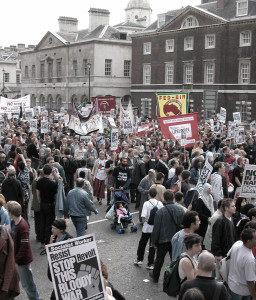
I am one who thinks Donald Trump is the worst thing to happen to the United States of America in my lifetime, maybe in history. He has wrapped his presidency in–and pushed the country’s culture toward–bullying, bigotry, broken promises, and baksheesh (money corruption). He has no grasp of policy and seems to be governed (and governing) by whim. He takes a scary number of memes from the Nazis. He appoints people who are ruthless, openly corrupt, and bent on sabotaging all the progress of the past 80+ years. I’ve marched in the streets opposing his policies dozens of times since he was elected.
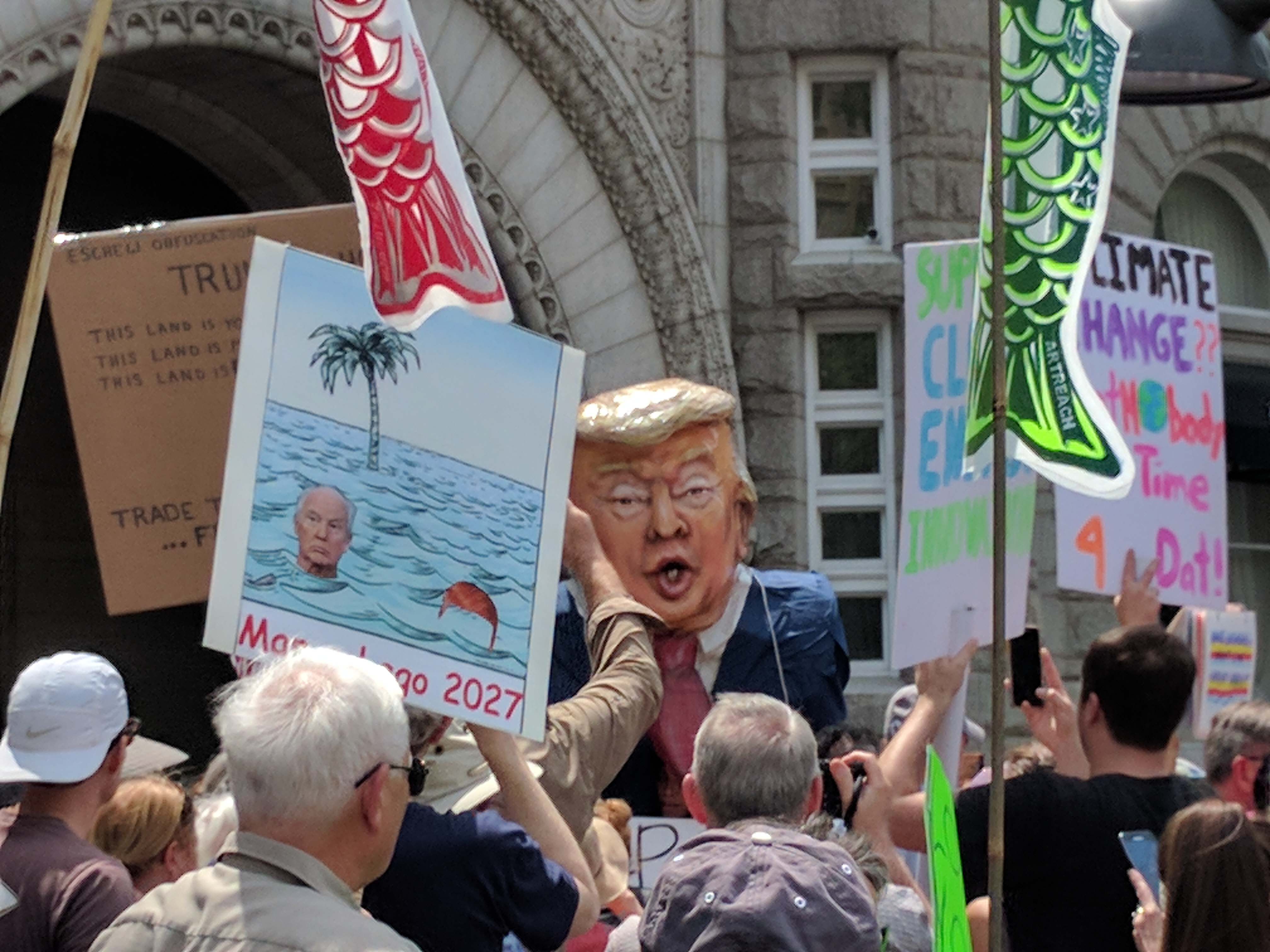
Climate marchers in front of Trump Hotel, Washington DC 4-29-17 (Clamshell Alliance’s spiritual heirs)
Yet, unlike some Democrats–it’s not just Republicans who can put building their party ahead of building their country and their planet–I publicly congratulate him for agreeing to the summit with Kim Jong Un, and I pledge to publicly congratulate him if some genuine good comes out of it. We have to talk with our enemies to make peace with them. I’d like to see a similar summit with the Iranians.
Much as I’d be thrilled if it happens, my expectations of something great occurring at this meeting are low. I’m expecting these two dangerous madmen to shout and grandstand and at best not accomplish anything, at worst, push us closer to nuclear war. Go ahead, Donald, make my day: prove me wrong!
[Postscript, June 12, 2018]. I have just seen the declaration issued by the US and North Korea following the summit. While the accord is very weak on specifics, I think it’s a strong first step. It might even be the first actual good thing of the DT presidency. As a statement of intent, it is eloquent. Now of course we have to see how it’s implemented and whether it’s more than hollow rhetoric. Anyway, I am keeping my promise and praising this agreement. It’s more than any other president has accomplished on North Korea. But it’s only the first step in a long process.
There are hundreds more I could honor. These 10 are all people I knew personally. I chose them somewhat randomly, basically who came top of mind first. I am grateful to all of them even if the interaction was painful when it happened.
My mom, whose commitment to racial justice extended to desegregating the apartment building we lived in. She was also a tester for the Urban League, making sure that when a black family was told an apartment was already rented that it was really rented—by applying to live there.
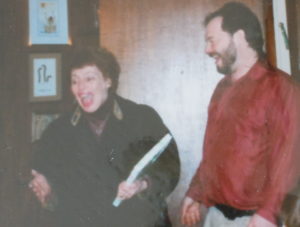
Walking my mother, Gloria Yoshida, into her 65th-birthday surprise party, 1998
The speaker I heard when I 12, at my first peace demonstration, who told me the Vietnam war was undeclared—and brought my false reality crashing down around me.
The idiot who made me sit in the children’s section of a movie theater with my full-price adult ticket (also age 12) and gave me my first experience of discrimination-based injustice (for being part of a class of people). I started a boycott of that cinema that has now continued for 48 years, and thus had the first experience of recognizing that I had power to change things.
Mrs. Ehrlich of the Bronx High School of Science English Department in the 1970s, who believed the lie I’d told that I had turned in an assignment. Horrified, she said she’d never lost a student paper before. I felt intense guilt and realized that my action had hurt someone innocent. I’ve done my best not to repeat that and to take responsibility for my actions even when I don’t like the consequences.
My first grade teacher, Mrs. Gross of Westchester Day School in the 1960s, who recognized that I was already a good reader and sat me in the back of the room with a 4th grade geography text while she inflicted Sally-Dick-and-Jane on the rest of the class. I still love reading, still love maps, and that was probably the first time I recognized how fascinating the world is, how people lived so differently in different parts of it.
The college classmate who yelled at me that I was extremely and consistently selfish. It hurt like hell at the time, but on reflection, I realized he was right. And I changed my behavior! (Years later, I went up to him at a reunion and thanked him. He didn’t even remember the incident.)
Dr. Jeffrey Lant, who was the first person to help me discover you-centered, benefit-focused marketing.
Dean Cycon, CEO of Dean’s Beans, who combined the strongest moral compass and the best sense of humor of any business owner I know. (I never got to meet the late Ray Anderson; he might have topped Dean in his commitment).
Maggie Kuhn, founder of the Gray Panthers, who started a whole social movement after mandatory retirement forced her out of a quiet job within the Presbyterian Church.
Pete Seeger, who was probably the first to show me that the arts could change people’s minds and create action for social and environmental justice.
My wife and I were both deeply moved watching a filmed performance of George Takei’s Broadway musical, “Allegiance,” set primarily in an isolated internment camp holding Japanese-Americans during World War II.
“Allegiance” musical-logo
While according to Wikipedia, the play exaggerates the anti-Japanese racism and conditions at the camps in pursuit of the salable story, it has a whole lot to say about ethics, families whose values conflict, and prejudice—98 percent of which still applies even if that is true. Each major character pursues his or her own truth, and acts in the way s/he feels is best for both the person and the wider Japanese-American community. But those ways are in such conflict that a family is torn asunder for 60 years.
Even if the story hadn’t been so engaging, the quality of singing is amazingly high, especially from Lea Salonga (Keiko) and Christopheren Nomura (Tatsuo).
Takei (who is absolutely brilliant as the grandfather and also plays the very emotional role of the male lead as an old man) says he worked on this project for 10 years. But the show ran only several months. Fortunately, it was preserved on film.
It is worth remembering that the Japanese-Americans, many of them citizens, were rounded up during the administration of FDR, a liberal Democrat. That their property was confiscated, their freedom taken away, and the conditions in the camps were often miserable. And that once they were allowed to enlist, Japanese-American men were put in situations where massive numbers would die.
Now, under a right-wing Republican president Takei could not have anticipated when he and his colleagues started work, other ethnic and religious groups are being targeted. We who are not part of those groups must ensure that what happened to the Japanese in America and their Japanese-American US citizen children must never happen again to any ethnic or religious group.
Someone posed this question on a discussion group, with a particular emphasis on which candidate would be better for innovation. This was my response:
One of the few promises Trump is likely to keep is to withdraw federal government support for innovation in the energy sector–the place that’s likely to be among the most job-creating new industries in the next two decades. Trump will deliberately choke off innovation in this very innovative sector. That will be bad for business.
Offshore oil platform. Photo by Freddie Hinajosa
Trump will be seen as untrustable by all other countries. That will be bad for business.
Trump has a record of skipping out on what he owes small businesses, then bragging about how he cheated them. That will be bad for business. I’ve been speaking and writing about business ethics as a key to success since 2002, and he is completely devoid of ethics.
Trump has made it abundantly clear that his policies will favor billionaires over others. That will help a few at the top, but overall, be bad for business.
Trumps bullying/name calling, thin skin, bad temper, open racism, mocking of those he perceives as enemies, etc. are the opposite of good management. Having that as a role model in the top management job in the country will not only be bad for business but could easily start wars.
I’m not real happy with Hillary Clinton as a candidate, but I’m in general agreement with the direction she would take the country–other than my worry that she will lead us into unnecessary wars. She at least is smart, stable, and caring. Her ethics are shaky and her tendency toward nontransparency worries me. But at least she HAS a moral compass even if it doesn’t point true north–and (I believe) a genuine desire to make the world better.
In other years, I might vote third-party. I’ve done it before. But this year, I want Trump’s margin of defeat to be so enormous that he never shows his face in politics again. A Trump presidency would be a disaster, not just for business, but for everyone who loves democracy, innovation, morality, or merit-based success. Trump represents the worst of American society: a racist, sexist, authoritarian bully. A liar and a cheat. A man who is only about himself and has no higher calling. A man who thinks his material wealth gives him the right to stomp on others. A man who panders to fear and has no vision. A man who doesn’t “play well with others.”
Caricature of Donald Trump by DonkeyHotey, Creative Commons License: https://www.flickr.com/photos/donkeyhotey/5471912349/sizes/m/in/photostream/
Although I’m a strong Bernie supporter, I disagree with the article’s sanctimonious tone. Sometimes, you do have to suck it up and vote the lesser evil. I personally think this is one of those times. After California, Bernie has to accept that he made a really good run, but it’s over. He got farther than pretty much anyone thought he would, and I’m glad.
I’ve voted third-party before, and might do so again. But not this time. Yes, even though we’re faced with two secretive people, each with a history of serious ethics breaches, I will vote for the Democrat this time.
Clinton will be reasonably good on domestic policy (and will recognize that the Left brought her to power) if elected. As a consistent war hawk who can’t see any fault in Israel’s ultra-right-wing government, she’ll be horrible on foreign policy, which ought to be her strong suit–and especially bad on the Middle East. I predict another war during her term. She’ll be middling-poor on energy policy. These are issues that mean a great deal to me.
But she will appoint decent people, including to the Supreme Court. She’ll be socially liberal on a number of issues, and will likely do some good for poor people as long as it doesn’t bother her bankster friends. Ordinary people’s lives are likely to get better under her administration, as they did under Obama.
And most of all, voting for Hillary is the best thing we can do to prevent President Trump.
Trump and his very scary supporters smell like fascism to me. A Trump presidency will very quickly displace GWB (who I used to refer to as His Imperial Delusional Majesty) as the worst president in history. Trump will be far worse on energy, on poverty, on international relations (where he really doesn’t have a clue), on immigration, on minority rights, women’s rights, and almost every other issue you could name. He might be slightly less willing to go to war than Hillary, but when he does, it will be much uglier. And his response to international incidents will be belligerent enough that other people will start wars with us and he won’t have a choice.
And his thugs will roam the streets, enforcing their brand of nativism, attacking people who don’t look or think like them.
If the US had proportional representation, instant runoff voting, or any of the other reforms we’ve been working for over the decades, we’d have a choice. But in a faceoff between a no-ethics/me-first bullying fascist and an ethically challenged secrecy-loving corporate neolib, to not recognize the very real difference is slitting our own throats.
I want Trump’s margin of defeat to be so crushing that his movement goes away for 20 or 30 years. For that, I’m willing to hold my nose and vote for Hillary. This time.
Bernie Sanders said two things worth noting the other day, at the same event. When asked at a Town Hall meeting how to convince Bernie supporters to vote for Hillary if she’s the nominee, he responded, “it is “incumbent on her” to win over his supporters. Specifically, he pointed out that he doesn’t exercise control over his supporters and nor should he, and that many have a deep suspicion of a candidate with such close ties to Wall Street. He even gave her a road map: endorse his Medicare-for-ALL healthcare plan.
At the same event, he announced that he would do “everything in my power to keep the Republicans out of the White House.”
She still does not get that Bernie is not a politician in charge of a machine in the old style of politics. He finds himself at the forefront of a people’s movement that he does not control. Bernie can endorse and I’m sure will endorse Hillary if she is a nominee, but that doesn’t mean he is able to overcome his supporters’ massive and justified skepticism of her belief systems and her actions. Once again, he has spoken the truth; she does have to win them over.
And Hillary needs these people. Independents and left-leaning Democrats will be major factors in November. If they stay home, we get whichever monster emerges from the Republican convention. If they show up, we get a Democrat.
I have serious issues with Hillary Clinton, and particularly her foreign policy. I worry that she’s too much of a war-hawk and way too comfortable with the worst excesses of Israel’s ultra-right government. I don’t love her cluelessness about people’s movements and her coziness with Wall Street. And while she’s obviously extremely smart, she’s done some really dumb things over and over again. I don’t expect any significant progressive shift under a Hillary Clinton administration.
In the past, including in 2000, I’ve voted 3rd party. Of course, I have the luxury of living in a state where my vote doesn’t count anyway. Knowing that Massachusetts was safely Democratic made it easy to vote my conscience and cast my vote for Nader.
Yet, if she’s the nominee, I will hold my nose and vote for her. The prospect of either a Trump or Cruz presidency is so distasteful that I want the margins of victory to be enormous; this year, I want to be counted in that victory margin, and not pushed off to the side with a Green Party vote that nobody pays any attention to. Under Clinton, I would expect some attention to economic policies that help poor people—as a sop to Sanders supporters, if nothing else—and some good stuff on women’s issues. I would expect excellent Supreme Court nominees.
And, unfortunately, I would expect once again to be out in the streets with thousands of others, doing my best to keep us from being sucked into whatever war HRC would get us into.
I deeply resent Hillary Clinton’s message that we can’t go for what we really want. Barack Obama beat her in ’08 because his message was “hope” and “yes we can.” He made some of that a reality in spite of tremendous resistance–more than I’ve ever seen for ANY president’s policies. But he would have gotten much more accomplished if he’d continued organizing: bringing the same coalition that led him to victory into supporting his agenda and pressuring that reluctant Congress. As a former community organizer, he should have known this.
Bill Clinton’s presidency shows the dangers of the HRC approach. By dismissing any effort at real change right from the start, he allowed himself, over and over again, to back away from meaningful change and turn what should have been the post-negotiation fallback position into the starting gate, and then allow that to be whittled down further until the change was so small that Grover Norquist actually could drown it in a bathtub.
Obama made the same mistake. “Single payer isn’t on the table but we have a public option” turned into. “no public option.” And the ACA as finally passed was a giveaway to insurance companies. Yes, it made people’s live’s better and I’m glad it passed. But Obama squandered the potential for much deeper reform.
Isn’t it so much better to aim for what you really want and get only three-quarters of the way than to aim for what you think is “achievable”—and still get only three-quarters of the way? It’s a very rare football play that gets a touchdown from the kick-off point. Much more commonly, the team advances the ball, play by play, and starts again from the end point of the last play. Then they get the touchdown.
It took 100 years to eliminate slavery in the US. It took another 100 to pass meaningful civil rights legislation, and it may be another 100 before the cancer of racism is nothing but a memory. It has already taken about 80 years to get even the wimpy ACA; that doesn’t mean we say we don’t need to make more progress. And it certainly doesn’t mean you have to tear down the ACA before you have something better in place.
Henry Ford said, “Whether you think you can do a thing or think you can’t do a thing, you’re right.”
Muhammad Ali put it this way:
Impossible is just a big word thrown around by small men who find it easier to live in the world they’ve been given than to explore the power they have to change it. Impossible is not a fact. It’s an opinion. Impossible is not a declaration. It’s a dare. Impossible is potential. Impossible is temporary. Impossible is nothing.
And I personally have taken on the “impossible” goal of showing the business community how to turn hunger and poverty into sufficiency, war into peace, and catastrophic climate change into planetary balance—at a profit. Taking my cue from Ali, when I speak on this, my talk is called “Impossible is a Dare!” I’ve also written a book, Guerrilla Marketing to Heal the World, that demonstrates how these future victories are actually quite possible. I’ve done “impossible” things before. Why restrict ourselves by thinking small?
I have other issues with Hillary besides her willingness to settle for less even before the negotiations start. HRC’s ties to Wall Street make me nervous. Her hawkish rhetoric, even more so. And her Middle East policy is just plain shameful. As an American Jew, I stand up and say “Israel right or wrong” is as misguided as “America right or wrong” was in the Vietnam era—and I further say that we progressives knew that going into Iraq as we did was a terrible mistake. I was out there in the streets with millions of other Americans, saying “don’t do this, it will be a disaster.” There is zero justification for her vote to support the worst foreign policy disaster in history.
I will proudly—excitedly—vote for Bernie in the primary. Nonetheless, if Hillary is the nominee—and she probably will, due in part to Party rules that allocate delegates to high-status mainstream Democrats over and above those allocated in elections—I would support her unequivocally over any of the Republicans running. I think she has a good heart, I’d much rather see her in charge of picking the next members of the Supreme Court than any of that bunch, and I would see her election—as I saw Obama’s—as getting us closer on the path from the kick-off to the goal.
Here’s what they mean to me, and why I picked them:
Transform
First, there’s the social transformation I want to bring about by transforming the business world. I want to end the biggest crises of our time, and I see the business community as the best lever. Appealing to enlightened self-interest—the profit motive—I want to make the bottom-line business case that just as going green saved costs and increased revenue, so too can addressing big picture issues like how to turn hunger and poverty into sufficiency, war into peace, and catastrophic climate change into planetary balance. When I first started talking a great deal about going green as a profit booster, around 2002, people looked at me funny. Now, it’s common business wisdom. I think the same will be true eventually for creating profitable products, services, and a company DNA that address these issues at their roots.
Second, the transformation in my own business. I see consulting, speaking, and writing on how business can bring about that transformation (and how any particular business can develop and market the right social change products and services for its own culture and markets) as a major part of my business in the coming year, and for the rest of my working life. While I’ve been thinking about these things for many years, have written books and given talks about it, I still have to find the markets that are willing to pay for what I know I can do for them. I go into the year with two possible markets that are quite different: small entrepreneurial and startup companies, and large, established corporations. I’ve developed two different websites for these audiences, because the agenda, methodology, timetable, and price structure will be very different.
All of this is a natural outgrowth of the green business profitability work I’ve done the past several years—but while it builds on the past work, it is different. I’m confident that I can make it work, but am still a bit fuzzy on the how. Which brings us to the second word:
Win
My original choice was “succeed,” but then I went to Chris’s post. He chose “win” as one of his words, and I think it’s like success, but stronger. It can also work as both a noun and a verb, as can my third word.
Also, I feel that on many levels other than the material, my life IS a success. I made a conscious decision about 30 years ago to have a happy life, and I’ve made good on that: I love the marriage I’m in, the house and community where I live, the places I visit, the local organic fresh food I eat, the books I read, the performances I watch, and so on. That decision rippled through all areas of my life. As early as 1985, it was the difference between feeling angry and frustrated and cheated when I had to spend an entire day of precious vacation mailing packages back to myself, as the old me would have—and thinking, even before I was married, about the wonderful story I’d have to tell my grandchildren.
But there are two areas where I need to replace that general feeling of success with a clear, strong victory: the economic underpinning of my business (which has now had two low-producing years in a row while I retooled for the transformation)…and the deeper impact of my work on the world.
The problem with having many interests and multiple skill areas is that it’s really hard to focus. When everything is fascinating, how do you choose? Yet, to succeed—to win—you have to close some doors so you can pass through the doors that remain open.
This is the lens: I’m using to help me choose what to focus on:
Over the past few years, I’ve worked hard to overcome a case of what my friend Noah St. John calls “success anorexia.” I’ve looked at my money/success blocks, and overcome a number of them. But, watching my own failures doing things that have worked really well for others, I realize there’s still some hidden piece, deep in my subconscious, that courts failure. I need to find that piece, hold it up to the light, make an alliance with—and redirect—the parts of it that act out of love, excise the parts that are rooted in self-hatred, and have a clear win. This will be difficult, because I don’t even know what it is that’s holding me back. But it’s essential.
Once that hurdle is overcome, I want to look at how to broaden my impact. I have a great message and great examples of how we can solve these big problems. But for that to really change the world, I need to find tens of thousands, maybe millions of people who are open to that transformational message. None of my books have ever sold more than a few thousand copies. My blog and social media audiences are limited. The number of people who hear me speak in a year is much too small. The second big win I need is to get myself in front of a far larger number of people. That this will help with selling more books, doing more paid speaking to larger audiences, and getting more consulting gigs—in other words, contributing to the win I’m looking for in my own blocks—is an extra benefit. At age 59, I have a limited time to make a big impact on the world. I want to leave a legacy of creating deep transformational change, because I love this planet. And that’s a nice transition to the third word.
Love
Love of others and of self, love of the ecosystem and the planet. In my youth, I was a very angry, loud activist who felt utterly betrayed by governments and corporations and wasn’t good at finding common ground or seeking alliances with those who thought or felt differently from me. Over the years, I’ve learned how mistaken I was—starting all the way back in the 1970s. Some might say I’ve softened but I don’t see that way. I’ve learned to approach with love, respect, and an understanding that almost all of us want a better world; we just have different ways of understanding how to bring it about.
Love is often about deep listening. It’s also about seeking a higher good for a greater number of people, without sacrificing the needs and desires of others. It’s about building the communication skills to allow environmentalists and Tea Partiers to discover their common ground (something I talk about very specifically in my 10th book, Guerrilla Marketing to Heal the World).
Going deeper, this is what allows even the most hate-filled opponents to go past the hurt and build a better world for everyone. Nelson Mandela was a master of this. So were the people who formed the various Arab-Israeli joint projects such as the magnificent Wahat al-Salam/Neve Shalom community in Israel, where Jews and Arabs study and work together—the name, in both languages, translates as “Oasis of Peace”—or Combatants for Peace, which pairs Arab and Israeli former combatants to travel around and speak about cooperation.
It’s easy to love those who agree with you. It’s much harder to love those you might blame for the death of a loved one or the loss of your land. I have tremendous admiration for those involved in these sorts of cooperative efforts and I want to be more like them.