Along with every other decent human being, I deplore political violence. And as much as I despise his politics AND his character, I wish Donald Trump a speedy recovery from the wound inflicted by a would-be assassin with an assault rifle.

BUT that doesn’t mean we need to stop campaigning. It doesn’t mean we should fail to make the most of the opportunity that this criminal’s attack on another criminal creates. And it certainly doesn’t mean we should slink off with our tails between our legs because the MAGAs tell us “this is not the time!” It’s never the time, according to them.

And it absolutely doesn’t mean we should roll over play dead, and abandon hope just because Biden had a bad night in the recent debate or just because Trump may get sympathy votes for getting shot. Trump (who is only 3-1/2 years younger, by the way) had a bad night too, if you filter against fact-checking. He spewed blustery nonsense for 90 minutes, nearly all of it either blatantly false or totalitarian fantasy.

Here’s what we should be saying at every possible chance:

It’s time for the United States of America to stand behind the value of not getting shot by a random psycho at a school, a movie theater, a supermarket, a religious service, a concert, or anywhere else. And Trump cannot lead that effort. After all, he:

By contrast, President Biden issued a powerful Executive Order promoting gun safety and managed against the odds to gain passage of the Bipartisan Safer Communities Act, which he calls “the most significant bipartisan gun safety legislation in nearly 30 years.  The Act provides communities with new tools to combat gun violence, including enhanced gun background checks for individuals under age 21, funding for extreme risk protection orders and other crisis interventions, and increased mental health resources to help children impacted by gun violence heal from the resulting grief and trauma.” If Biden chooses to step down, the Democrat who will challenge Trump in November is also likely to favor sensible gun laws. The Democratic Party as a whole has been advocating common-sense gun safety for many years.

Finally, let’s remember three very important things:

First, just because the MAGA crazies have taken over the Republican Party doesn’t mean they’ve taken over the minds of mainstream Republicans. We see this in the typical 20 percent that Nikki Haley continued to draw even after she suspended her campaign! And I’ve also seen it in my conversations with many Republicans who tell me they don’t like Trump’s character, his lack of understanding of the issues, his massive narcissism, his open racism, his lack of a moral compass, etc. His support is weak even in his own party, in other words. Many could easily defect—as more than 100 prominent Republican have publicly pledged—to RFK, Jr., to the Democrats, to a Republican write-in, to to the Libertarians, or simply leave that space blank on their ballots.

Second, the Republican positions on many issues are wildly out of step with mainstream views. They oppose women’s reproductive freedom, LGBT rights, immigration (even legal immigration), voting rights, rights to protest against repressive governments, environmental protection, labor rights, and more. Both the Republican platform and the truly sinister Project 2025 (written largely by people who worked in Trump’s administration) embrace these extremist proposals—as do, apparently, a majority of the Supreme Court, which recently gutted environmental protection, declared Trump immune from prosecution for “official” acts, and of course, a year ago, overturned Rowe v. Wade—becoming the first Supreme Court to remove a constitutional right. And if that weren’t enough, Trump himself has alienated and insulted many large constituencies—veterans, people with disabilities, women, Palestinians, Muslims, Latin Americans, to name a few—and, starting January 6, 2021, thrown even some of his most loyal supporters like former Attorney General William Barr and former Vice President Mike Pence under the bus.

And third, Trump is not an attractive candidate to swing voters. He is now a 34-count convicted criminal and was found in civil court to have committed sex crimes. His rambling, off-topic speeches and compulsive lying could be evidence of serious mental decline. And of course, both men have a track record. Trump got little done besides his economy-crushing tax cut, while Biden, for all his flaws, has made huge progress on the economy, on recovering from the pandemic, on the environment, and on the US’s position as a world leader. On every issue where Biden has been bad (especially Gaza), Trump is demonstrably worse for progressives.

So let’s get out there and mobilize people to vote Democratic—including spreading the word about the huge negative impact of Trump’s proposals to people who don’t always vote for Democrats. Despite its problems, we still have a democracy worth saving!


Facebooktwitterpinterestlinkedinmail

Today, the United States of America marks the 248th anniversary of its founding. But this, year, I can’t celebrate.

But Monday, on its last day of the term, a bizarre Supreme Court decision essentially returned the country to monarchy. They put one person—the President—above the law, immune from prosecution even for extreme corruption and extreme violence, as long as they were acting in an official capacity.

In a stinging dissent joined by Brown and Kagan, Justice Sotomayor examined the consequences:

Orders the Navy’s Seal Team 6 to assassinate a political rival? Immune. Organizes a military coup to hold onto power? Immune. Takes a bribe in exchange for a pardon? Immune. Immune, immune, immune.

As Heather Cox Richardson noted, this case is legally known as Trump. v. United States. How apt.

It’s worth reading the original accusations in Thomas Jefferson’s Declaration of Independence that we mark today; many sound amazingly relevant, especially if Trump manages to gain power again.

Like our forbears of 1776, we are once again called to resist tyranny. But today, we know that nonviolent resistance is more effective and longer lasting than armed struggle. And we know more than 200 ways to be nonviolent activists. In the pre-Internet, pre-pandemic era. Gene Sharp identified 198 ways. Many more have been found in recent years. The challenges are figuring out what makes strategic sense against a corrupt Supreme Court, how to organize to prevent a Trump victory, and what to do if he does take power again.

Facebooktwitterpinterestlinkedinmail

We are at the dawn of a new era in ESG (Environmental/Social/Governance, often rolled together as “sustainability). Following a long Model T Ford stage of kludged-together bandaid fixes, we are finally evolving into a much more holistic, much more regenerative approach. This incorporates several deeper methodologies like biomimicry, lifecycle costing, product take-backs, and multiple functions from single innovations, as well as massively scaled climate solutions that can actually reverse atmospheric carbon.

A lot of this progress is happening because the increasingly extreme weather of the last few years makes it obvious that we have no choice; we either learn how to be good neighbors to other species, ecosystems, and the planet—or the planet will drive us out. It’s going to be exciting.

We will see:
• Much deeper understanding of what the actual problem is. As one example: rather than focusing on building a better car, design ways to move people and freight across distances without requiring new roads, clogging existing ones, or pollution: something that would eventually make the private personal vehicle obsolete. It might look like modular mass transit bubbles that link together to move great distances at high speeds, then separate for last-mile door-to-door delivery—or it might look like “Beam me up, Scotty”—or, much more technologically and financially achievable, a group-conference immersion platform that simulates in-person contact through holography, smell receptors, and other techniques.
• Nature-based solutions that are far simpler, less expensive, and more effective than present approaches: emulating desert beetles for pure water supplies, bacterial fermentation to turn waste plastic into something useful, adhesives that replicate geckos, etc.
• Far more attention to the S in ESG, and integrating it with the E. For instance, green agriculture could create whole new industries that provide jobs and economic power to marginalized inner-city neighborhoods and depressed rural areas (or entire countries). And they could use open hiring procedures like the one that’s been so successful for Greyston Bakery to provide ladders out of poverty to ex-addicts, ex-felons, and ex-mental patients who have very little hope of finding a job through more standard approaches. Greyston is now consulting to other companies on how to implement a successful open hiring program.

Within a few years, these will be moving into the mainstream—providing significant competitive advantage over the companies that don’t embrace them: in energy and materials efficiency, reduced labor costs, and other direct operational benefits—and ALSO in marketing. These major steps forward will attract and retain customers, perhaps even turn customers into unpaid brand ambassadors.

We’ve been shown the path by visionaries like Amory Lovins, Janine Benyus, and Gunter Pauli for more than 20 years. We already know many of the solutions. Now we have to implement all these great ideas.

Facebooktwitterpinterestlinkedinmail

Bob Burg devoted his Daily Impact newsletter this morning to endorsing a concept he found in Robert Greene’s book, The Daily Laws: 366 Meditations on Power, Seduction, Mastery, Strategy, and Human Nature: “Always stick to what makes you weird, odd, strange, different. That’s your source of power.”

I love the idea of embracing your weirdness—and I’ve basically lived it since my teen years. But I want to add three corollaries:

  1. Present your weirdness in ways that foster, rather than cut off, communication. So, in my case, living in a socially conservative farm community, I’ve chosen not to wear skirts even though I find them very comfortable—because I want my neighbors to understand that while I’m different from them in many ways, we still inhabit the same neighborhood and have more in common than they might think. I made different, more outrageous, choices in other places I lived in. Marrying and having kids, recognizing that my decisions impact other people, was another encouragement to dial it back. But I still publicly label myself as a “marketing heretic,” still post unpopular views in public places, still invite people of all viewpoints to engage with me (as long as they do so civilly). And I can proudly point to many examples where my activism has made the world a better place, both within the business community and in the wider world.
  2. Listen and engage when your weirdness starts to set up barriers. Let people express their discomfort. Strive to uncover their deeper feelings. Find points of agreement and build the discussion out from there.
  3. Bring your weirdness to the table but BE at the table! Participate actively in your community. I spent 9 years on my town’s Long-Range Plan Implementation Committee and have attended almost every Town Meeting for more than 25 years. In the 17 years before that, I was actively involved in the government and social infrastructure of the small city where I was living, both through board service and community organizing and through electoral work. I believe that service de-demonized the way several members of our town Planning Board perceived me. I went from newcomer/troublemaker who had organized the movement that blocked a big, totally inappropriate mountainside housing development to a person whose input was valued and seen as vested in keeping the character of the town.

How do you bring your nonconformity into your work, how do you make it a strength, and how do you engage with people who might feel threatened by it?

Facebooktwitterpinterestlinkedinmail

  • If you have a socially or environmentally conscious business…
  • If you are an activist on any issue…
  • If you work in any way to better the lives of disempowered people—whether the disempowerment is social, cultural, medical, geographical, or any other cause…

Please read this next paragraph VERY carefully. It’s from today’s Letters from an American by Heather Cox Richardson (emphasis added):

How religion and authoritarianism have come together in modern America was on display Thursday, when right-wing activist Jack Posobiec opened this weekend’s conference of the Conservative Political Action Conference (CPAC) outside Washington, D.C., with the words: “Welcome to the end of democracy. We are here to overthrow it completely. We didn’t get all the way there on January 6, but we will endeavor to get rid of it and replace it with this right here.” He held up a cross necklace and continued: “After we burn that swamp to the ground, we will establish the new American republic on its ashes, and our first order of business will be righteous retribution for those who betrayed America.”

This is a major Washington conference of influencers. Take it seriously! That is one of many ways fascism rears its ugly and dangerous head. Trump actually quoting Hitler, repeatedly, without attributing him is another. A series of Supreme Court decisions and new repressive state laws add more heads to this horrible Hydra.

The good news is they can’t do this without our help. Staying home on Election Day helps the wannabe fascists. And since most parts of the US don’t have ranked-choice voting yet, so does voting for a third-party candidate in the general election. Oh, and showing up helps our cause and hurts theirs. Show up to lobby your Members of Congress and your state and local elected officials. Show up in the streets to participate in protests against harmful policies or support demonstrations for those you favor. And show up to vote!

If, as I do, you disagree enough with Biden’s policies that you have a hard time voting for him, show that in the primary. Show up to vote and don’t vote for him. Either leave the president line blank or vote for an alternate candidate. My Primary is March 4 and I will either vote for Dean Phillips, who is slightly left of Biden, or write in Green Party candidate Cornell West.

But I recognize that Biden, barring some major development like a major health crisis, will be the nominee. And even though I live in a reliably Blue state, I recognize that his likely opponent will contest the results if they are anything less than an overwhelming victory for Biden.

And let’s not forget that Trump has promised to be even worse on immigration—and on many issues—than he was during his time as President.

I want that margin to be as big as possible, so come November, I will cast my vote for democracy and against fascism, despite Biden’s betrayal of his campaign promises on issues that include unnecessarily harsh positions on immigration and his relentless support of the brutal regime in Israel and its devastation of Gaza, despite his energy policy that doesn’t do nearly enough to curb fossil fuel and embraces the false narrative that nuclear power is part of the climate solution (I’ve written a book on this; nuclear is a problem, not a solution), and despite many other reservations.

Remember the prophetic words of anti-Nazi Pastor Martin Niemöller

First they came for the socialists, and I did not speak out—because I was not a socialist.

Then they came for the trade unionists, and I did not speak out—because I was not a trade unionist.

Then they came for the Jews, and I did not speak out—because I was not a Jew.

Then they came for me—and there was no one left to speak for me.

And speak out! Speak out for the socialists, the trade unionists, and the Jews. Speak out for Arabs and Muslims, for immigrants from anywhere, for people in the LGBTQ community, for those with disabilities, for those who Trump has threatened with retribution that includes rounding up and detaining opponents.

Speak out. For democracy. For decency. Speak out, ultimately, for yourself.

Facebooktwitterpinterestlinkedinmail

I finally got around to watching Jon Stewart’s return monologue. Yuck! I was a fan of Jon Stewart but this is ageist crap! Yes, Biden is old. So is Trump, as Stewart admits. While I have plenty of bones to pick with Biden (and I’ve been in the streets protesting some of his policies, especially around immigration and the Gaza war), we don’t have ranked choice voting in US presidential elections. And that means that absent some deep and unpredicted shift in the political landscape, either Biden or Trump will be elected in November.

There are many reasons to vote for Biden over Trump. While flawed (as we all are), he’s a basically decent person who has mostly used his time in office to better the lives of ordinary USArians and to improve the condition of the world. And despite a completely dysfunctional Congress, he has still managed to:

Now, about his opponent:


Bias Against Biden

Biden is not an existential threat to democracy. Biden was handed a government in complete chaos that had burned bridges with many of its allies and built back a functional government that honors its promises. Biden is about the good of the country, while Trump appears to be mostly concerned with leveraging his position for profit and inflating his already overweight ego. And Biden’s record of accomplishment after three years in office far outstrips Trump’s four years. 

So please tell me why the media is constantly dissing Biden because of his age and a perceived lack of mental acuity that by any reasonable standard is in better shape than Trump’s. How is it, for example, that the Washington Post (a liberal newspaper that prides itself on good journalism) actually ran a chart comparing how old Biden would be at the END of a second term with Trump’s age at the BEGINNING of a second term. 

I have that chart in an email dated February 9, 2024 entitled “The 5-Minute Fix: How should Democrats address Biden’s unpopularity?”; I can’t find it on washingtonpost.com and therefore can’t link to it. Because it’s copyrighted material, I can’t reproduce it here, but I’d be glad to forward that newsletter to anyone who requests it through the contact form. I can also link to the February 10th Today’s Edition Substack  newsletter by Robert Hubbell that mentions this chart along with five front-page New York Times stories about Biden’s age. And these are the liberals! WTF?


Proof that Age Doesn’t Matter

Finally, let’s look at five among thousands of models for aging with power:

  • Grandma Moses had a 25-year career as a painter, BEGINNING AT AGE 76
  • Pete Seeger was still writing and recording songs well into his 90s
  • Nelson Mandela became President of South Africa at age 76
  • My friends Frances Crowe and Arky Markham were both still activists on their 100th birthdays
  • Gray Panthers founder Maggie Kuhn and sexologist Dr. Ruth Westheimer were working on the sexuality of old people into their 80s (disclosure: I was a VISTA organizer for the Gray Panthers in 1979-80 and met Maggie once when she was 75)

You are never too old—or too young—to make a difference. Jon Stewart should know better, and so should we. Work to get ranked-choice voting and other reforms such as those outlined at https://www.americanprogress.org/article/its-time-to-talk-about-electoral-reform/ (scroll down to the section entitled “A range of possible electoral reforms”).

Facebooktwitterpinterestlinkedinmail

This could be quite the game-changer: a new technology that turns gas piping from a useless and expensive “stranded asset” to a powerful lever to green entire business and residential districts. And New York State just passed a law to encourage it.

The article is called This Emerging Green Technology Could Decarbonize Buildings and Provide Good Union Jobs. It’s a pretty quick read, and a remarkable one.

On a quick look, I don’t see any obvious flaws. Do you? Please leave it in a comment. I’ll be taking a more in-depth look at this in my March newsletter. If you’re not a subscriber yet, please visit any page at my main website, https://goingbeyondsustainability.com/ You’ll get some nice gifts for subscribing, too.

Facebooktwitterpinterestlinkedinmail

I often find myself disagreeing with, disappointed in, and even demonstrating against President Biden’s policies.

And yet, assuming he’s the candidate in November, he will get my vote. I admit he might not if the US had adopted ranked-choice voting. But until it does, a vote for any third-party candidate is a vote for the main opponent of your preferred candidate. More importantly, I believe that the bad things Biden has done have been part of his own effort—sometimes accurate and sometimes off-base—to leave the world  better than he found it. He is, fundamentally, a good person, And despite never having a majority in both houses of Congress, he’s done quite a bit of good as president:

  • Shepherding a phenomenal economic turnaround, the best post-COVID economy in the world, and creating or recovering hundreds of thousands more jobs
  • Replacing skepticism with science on topics ranging from global climate change to the safety of COVID vaccines
  • Restoring US leadership on the world stage after it was torn to shreds by his predecessor
  • Supporting labor, the middle class, the poor, and the disenfranchised—and doing his best to hold big corporations and the super-rich accountable for dong their part
  • Championing the right to vote—and the right to have that vote properly counted

As I write this BEFORE the first primaries and caucuses, that opponent is likely to be the orange-haired former president. Yeah, the guy who is facing more than 90 felony counts, who has bragged about a history of sexual abuse (and been accused of many others and found liable in one he didn’t admit to). The serial liar who was caught in 30,000 false statements just during his four-year presidency. The narcissist who thinks rules and laws don’t apply to him. The person who stacked the Supreme Court with people who have undermined the values shared by most US citizens, overturned longstanding legal precedents, and for the first time in modern history, stripped away the rights of whole classes of people.

And, let’s not forget, the man who has promised that if he is elected, he will focus not on governance, not on the economy, not on human rights—but on revenge against his perceived enemies, active harassment of people who might be a different color, ethnicity, political philosophy or religion, and who repeatedly uses language straight out of Hitler.

Yesterday, Christmas 2023, both men issued Christmas messages. Robert Hubbell devoted his daily newsletter to these messages—and their contrasts couldn’t be more stark. Biden spoke of unity, teamwork, kindness, and hope. But DT used his bully pulpit to wish that those he perceives as “EVIL and SICK…THUGS” (which includes the military and those who favor electric cars) “ROT IN HELL” (capitalization is his).

Please make sure you’re registered to vote. That your friends know why you will vote for Biden. And that the records of these two men while in office leave no choice.Facebooktwitterpinterestlinkedinmail

Today, I spent two hours with my heartstrings tugged at a concert of the Jerusalem Youth Chorus—where Palestinian teens and 20-somethings from East Jerusalem sing—and compose—together with their Israeli Jewish counterparts from West Jerusalem. In June 2014 (a time of relative peace), I attended an equally moving concert in the Galilee (northern Israel) by Diwan Saz, a modern combo whose performers that night included a 10-year-old Bedouin boy (with a gorgeous voice) and a Chassidic rabbi, among others.
Those hopeful events seem far away an out of reach as we mourn the tragic and avoidable loss of over 4000 lives on both sides this month.
We have to somehow prevent even greater losses of life—and to reset!

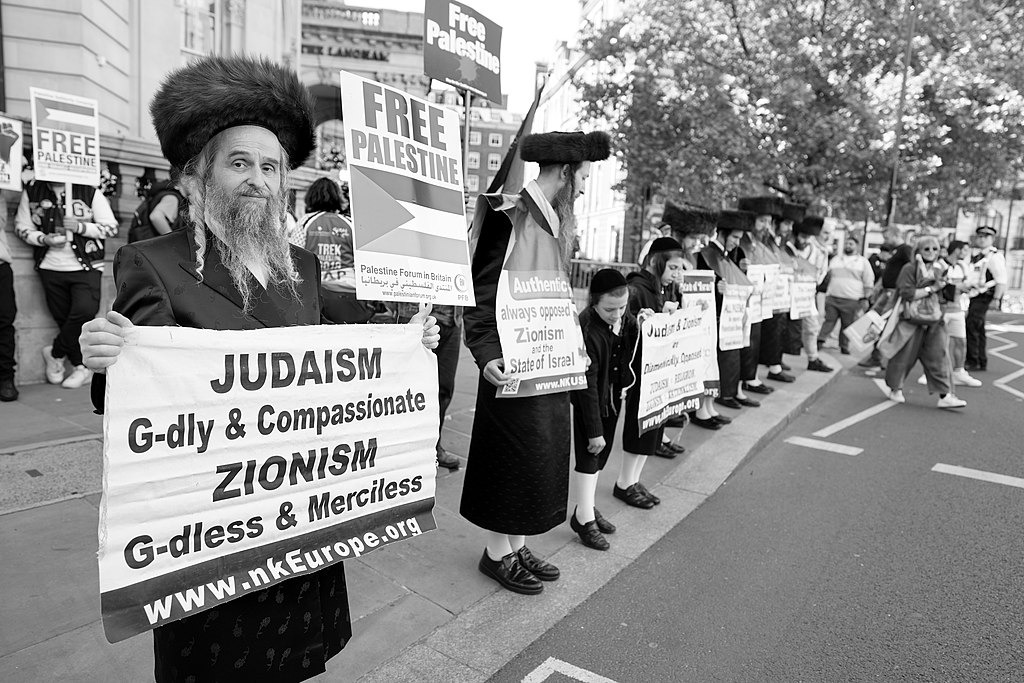
Ultraorthodox Jews protest in London for Palestinian rights. Photo by Alisdare Hickson from Woolwich, United Kingdom, CC BY-SA 2.0, via Wikimedia Commons

Let’s start with some points I hope everyone can agree on:
  1. Innocent people have been killed and hurt for decades, and nothing will bring them back
  2. The violence has not worked, no matter who commits it
  3. Both Arabs and Jews have claims on the land going back thousands of years
  4. They also claim common ancestry with both honoring a heritage that started with Abraham. They eat very similar foods, speak languages with many cognates, and have both had to adapt to the harsh desert that surrounds them.
  5. It is long past time to find a workable solution
From that very rudimentary framework, could we perhaps evolve to:
  1. We all are carrying deep hurts. An eye for an eye doesn’t just leave everyone blind, because it will eventually leap from eyes to other things. So an eye for an eye, ultimately, leaves no one standing. Can we accept not only that the past is filled with violence, cruelty, and the spewing of hatred/dehumanization—but that all sides would benefit from moving past this?
  2. Can we look to the world for other examples of long-standing hostility and violence transforming into something better—such as the Truth and Reconciliation process in South Africa and Sierra Leone and the peace process in Northern Ireland?
  3. Can we finally break the cycles of fear, hatred, and grief that seem to lock everyone into ever-deeper and more destructive cycles of violence?
  4. Can the barriers—both physical and psychological—between the two cultures be removed so that Israelis and Palestinians who are kept apart by laws and physical barricades learn to work, play, and live together; there already are several small projects that are a great start, such as:
  • Neve Shalom/Wahat as-Salam, a cooperative multicultural village;
  • Numerous other musical collaborations, including  Daniel Barenboim and Edward Said’s West-Eastern Divan Orchestra and many lesser-known ensembles;
  • Combatants for Peace, which presents touring programs featuring one person who fought in the Israeli army and another who was involved in the Palestinian resistance, now working together for peace despite some of them experiencing injuries, imprisonment, and all of them mourning the loss of friends and family members in the conflict

It takes great courage to organize for peace when the leaders of both communities feed their population an unending diet of hatred for the other side. In the Middle East and around the world, many people have been killed for trying to make peace.

I have visited Israel and Palestine twice and have family and friends (both Palestinian and Israeli) in both  Israel and Palestine (in the West Bank). I’ve stayed in the homes and hotels of Palestinians, with a Chassidic family, in a Druze village, a Transcendental Meditation village, a kibbutz, and an Israeli settler community on the West Bank. I’ve met with a blogger in Ramallah and with leaders of several Israeli peace organizations. I’ve also participated in Middle East peace groups in the US going back to the early 1980s. The vast majority I’ve talked to over the years, no matter what their ethnic or religious heritage, just want peace. The governments are not giving it to them. Surely there are better ways to solve things than yet another war in a long and brutal series of wars!
Perhaps we can take our cue from songwriter Nerissa Nields, who answers the old labor union song “Which Side Are You On? with “The world says ‘you can figure it out. Haven’t you noticed I’m round?‘”

Facebooktwitterpinterestlinkedinmail

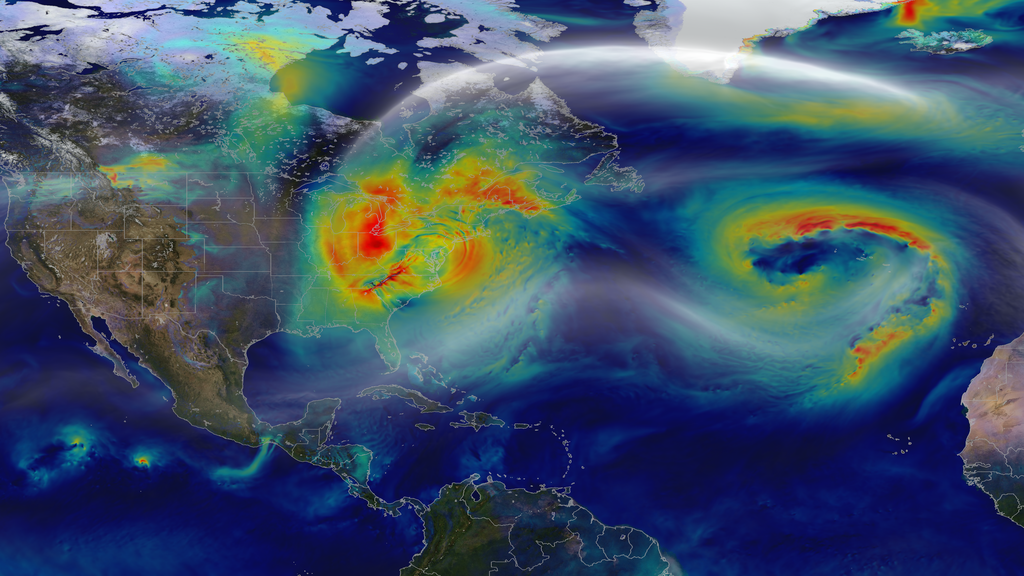
NASA photo tracking 2011 Superstorm Sandy
NASA photo tracking 2011 Superstorm Sandy. Attribution: NASA Goddard Space Flight Center from Greenbelt, MD, USA, CC BY 2.0, via Wikimedia Commons. Tracking_a_Superstorm_(8970258657).png

A friend posted her fears that the extreme weather we’ve pretty much all been experiencing is only going to get worse…that coastal cities (which includes most of the world’s great centers) are going to be hammered by storms that will make Hurricane Sandy—which wreaked havoc in NYC and elsewhere—feel like a gentle rain…wildfires that consume vast acreage, depleted aquifers that cannot regenerate and can no longer supply our farming needs…

I agree with her that the current path will lead to multiple calamities. But I remain optimistic that the rapidly closing window to fix it is still open for now; we can still reverse the destruction. We know how: innovation has reached astounding levels in the last 20 or 30 years, and we humans have developed and piloted hundreds of cool technologies and processes that accomplish multiple good outcomes with zero-to-minimal harm.

But we are 50 years late in making meaningful progress and we can’t be wasting time debating whether human-caused climate change is real. Nearly unanimously, scientists who are not funded by polluters agree that humans have accelerated climate change significantly. And even if the climate change is nothing more than the earth making course corrections, we still need to address/reverse/prevent the effects if human civilization is going to continue in anything like the way we know it.

With light editing for context and to mask the identities of others who posted in the thread, this is my response:

My Response to the Gloom-and-Doom Post

One thing we can all do—homeowners, tenants, farmers, business owners—is STOP SQUANDERING CLEAN WATER! We waste far more than we actually consume, and this has serious consequences as aquifers dry up. I just read this morning in a book called The Sustainabiity Scorecard that certain prescription drug manufacturing processes generate up to 7700x the product weight in waste, most of it water. I’ve said for more than 20 years that while our descendants might forgive us for squandering oil (which has substitutes), they will NOT forgive us for squandering water, which is essential to life.

Like most pieces of climate change, we’ve known how to fix the problems for decades—but we can’t find the political will. We should be living in a circular economy by now, where waste is transformed into input. We should be powering that economy with clean and renewable power sources including not only the common ones like solar and wind but more advanced, less well-known technologies like harnessing light and natural electrochemical reactions (see Gunter Pauli, The Blue Economy 3.0). We have known how to do this since at least 2001, and we’ve known we need to do it since at least 1970. This is our last chance to get it done before the scenarios [the original poster] is worried about become everyday reality—and lead to constant civil unrest, widespread famine, and various other calamities that dwarf anything we’ve experienced. Science fiction writers like John Brunner have been describing that awful world for generations, because they could see the logical consequences of hiding our heads in the sand and pretending everything can go on as it has. 

BTW *I* am actually an optimist on this. I believe we can still fix it, but we damn well better hurry up and commit society to solving these interrelated problems just as we committed ourselves globally to de-fanging COVID (with amazing success in a very short time)—but the longer we wait, the harder the task. The window is closing while we squander the 50-60 years we’ve had to get it done.

And thus I AGREE with [another commenter]’s paragraph about mitigation. Yes, engineers and designers can fix a lot of stuff—especially if they come in not attached to particular solutions but look holistically at how integrated solutions can not only address multiple problems at once (e.g., climate, waste disposal, water and food insufficiency, human comfort) but provide lots of jobs and community revitalization at the same time. But too many engineers have been trained in the existing, failing ways of thinking. We need to think circular and lifecycle impacts (including end-of-product-life disposal or repurposing), with closed loops, zero waste, net energy consumption, or pollution, etc.—and not linear thinking that only acknowledges processes production cost. Engineering as usually practiced has a tendency to externalize things like disposal costs onto the backs of us taxpayers and our progeny.

I also agree that we need to look at pollution, waste disposal, etc. in other industries including chemicals and battery manufacturing, and I don’t see electric cars or solar panels as panaceas.

But I totally disagree with most of his other points. The overwhelming scientific consensus, at least of scientists not funded by fossil companies or others who would have to drastically alter their processes (and temporarily lower their profitability) to fix the mess they helped create, is that human-caused climate change is real, and extremely dangerous.

[Original poster] brings up fusion, as she often does. Fusion sounds great in theory, but I’ve been hearing for my whole life that it’s just around the corner, and yet we never turn that corner. We can’t sit around waiting for fusion. The most optimistic predictions still put it pretty far down the pipe as a mainstream energy source. Yes, let’s keep the research going, but meanwhile, dig ourselves out of this deep hole of our own making.

I know [the original poster] is also a fan of small-scale nuclear fission, but I am not. [In her response to my comment, she corrected me and said she is not either.] If you want to know why, visit https://clamshellalliance.com/statements/statement/ (disclosure: I provided some minor help in writing this, particularly the section on accidents). I have some expertise here: my first of ten books was on why nuclear fission is a big mistake. It was written in the aftermath of Three Mile Island (as a revision/update of a much older book by my co-authors) and I updated it again—for a Japanese publisher—after Fukushima.

Several years ago, I brainstormed a list of 111 things the average person can do to reduce carbon and water footprints. It’s not comprehensive, it’s not necessarily the most important—it’s just one person’s brainstorm from around 2009. It retails for $9.95 but I’m giving it away. Just visit https://goingbeyondsustainability.com/#Freebies and click “Painless Green” (yes, you will need to provide your email and subscribe to my monthly newsletter—but you can unsub if you don’t like it).

Facebooktwitterpinterestlinkedinmail