Regardless of where they fall on the liberal-conservative spectrum, many of my friends face a choice between a candidate they find deeply flawed and one they find completely unacceptable. They differ on which candidate they will vote for with gritted teeth and a hope for a better future vs. the one they see must be stopped at all costs—but fundamentally, it’s the same question. And I know plenty who find neither candidate acceptable and will either vote third-party or skip that line on the ballot.

The US presidential election has become a shambles. As a country, we deserve better.

And we can get better!  Proof is as close as this coming Tuesday’s primary election in my own Hampshire County, Massachusetts.

One district over from me, much-loved State Representative Ellen Story is giving up the seat she was first elected to in 1992. Six candidates are on the ballot to replace her, and all six bring impressive credentials, endorsements, and a track record of community service. Ellen herself has no major enemies—pretty remarkable in 24 years in state politics, especially in a fractious town where even Town Meeting takes two weeks. In my town, we do Town Meeting in one night, twice a year.

I’ve listed a few simple reforms in bold, below. Adopting them throughout the US would go a long way toward reclaiming our democracy.

Reform #1: IRV
The state rep election is a perfect case study of why we need ranked voting (a/k/a Instant Runoff voting). You name your first choice, and if your candidate is eliminated, your vote goes to your second choice. If that candidate is eliminated, the vote goes to your third choice, and so on down the line until there’s a clear victor. We need this locally, and we need it nationally. Several other countries use it, as do a few cities in the US. For the first time in a US national election, people would be able to vote their consciences without feeling they were throwing their support to the worst candidate if they picked someone unlikely to win.

I don’t vote in that election, but I’ll be happy with whoever wins. And I do get to vote in two county-wide races. I consider two of the three candidates for Sheriff highly qualified, as are both of the candidates for Governor’s Council (an obscure Massachusetts office that helps select judges). I’m voting for Melissa Perry and Jeff Morneau, but I don’t think I’ll be badly served as a voter if my first choices don’t win.

The Key Difference Between Local and National Elections

Reform #2: Undo Citizens United and Change the Way We Finance Campaigns
Why did these races draw so many strong candidates while at the national level, we have to scratch our heads and hold our noses?

I believe we can sum up the answer in just two words: CAMPAIGN FINANCE. These local campaigns are cheap to run and use little paid advertising. So the candidates are not beholden to any special interest.

On the national level, campaigns cost billions and special interests hold major sway over the candidates they fund. It’s not a coincidence that the only candidate who was able to galvanize progressives was also the only candidate to fund his candidacy through direct populist appeal to small individual donors. Nobody thought a year ago that Bernie Sanders would be any kind of serious candidate. Yet he won numerous primaries and—for the first time in decades—proved that you can run a national campaign without becoming a puppet of your funders. As the devastating effects of the Citizens United Supreme Court decision allowing essentially unlimited corporate money to flow to campaigns become palpable, this is key for the future direction of American politics.

It’s also not a coincidence that Trump originally garnered support by claiming he was too rich to be influenced by those special interests and he would self-fund his campaign. That turned out to be just another Trump lie, but it was the public line through most of the primary season. However, in this ABC News link, it’s obvious that this was a sham even as far back as January.
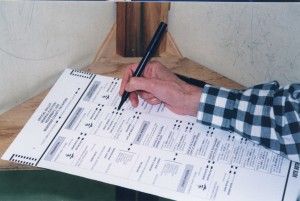
A voter marks a ballot. Photo by Kristen Price.

Reform #3: Hand-Countable Paper Ballots
We will never know who really won the US presidential elections of 2000 and 2004. In both cases, the decision hung on a single state, and in both states, the outcome was highly suspect. These are only the most dramatic among many elections that were very close. In far too many, the use of electronic voting machines without paper ballots means there’s no way to tell if the votes were counted accurately. This is simply unacceptable. Electronic voting machines and regional tabulation machines are far too easy for a hacker to flip—or to simply go out of alignment and count votes for people the voter didn’t vote for. The law should mandate that an electronic total is preliminary, and that election officials will hand-count within the week if the margin of victory is narrow or if there are any reports of irregularities. And those ballots should be properly archived so they can be checked later if accusations surface on the basis of new information.

Reform #4: Parliamentary Allocation
Most of the world uses a parliamentary system in the legislature. If a party gets enough votes to pass a threshold (many countries use 5%), it gets a share of the seats in the legislature. This is another way to make sure minority viewpoints are represented.

Reform #5: Eliminate Winner-Take-All Electoral College
Nebraska and Maine have been apportioning electoral votes by who wins each Congressional District. Why are the other 48 states still using the weird 18th-century throwback of giving all electoral votes to the person with the most? This disenfranchises any of us who live in a “safe” state. Our vote doesn’t really count unless we live in a swing state. Isn’t that crazy?

Left and Right can agree on these and a few other reforms. Let’s join forces and get this done.

Facebooktwitterpinterestlinkedinmail

Someone posed this question on a discussion group, with a particular emphasis on which candidate would be better for innovation. This was my response:

One of the few promises Trump is likely to keep is to withdraw federal government support for innovation in the energy sector–the place that’s likely to be among the most job-creating new industries in the next two decades. Trump will deliberately choke off innovation in this very innovative sector. That will be bad for business.

Offshore oil platform. Photo by Freddie Hinajosa
Trump will be seen as untrustable by all other countries. That will be bad for business.
Trump has a record of skipping out on what he owes small businesses, then bragging about how he cheated them. That will be bad for business. I’ve been speaking and writing about business ethics as a key to success since 2002, and he is completely devoid of ethics.
Trump has made it abundantly clear that his policies will favor billionaires over others. That will help a few at the top, but overall, be bad for business.
Trumps bullying/name calling, thin skin, bad temper, open racism, mocking of those he perceives as enemies, etc. are the opposite of good management. Having that as a role model in the top management job in the country will not only be bad for business but could easily start wars.
I’m not real happy with Hillary Clinton as a candidate, but I’m in general agreement with the direction she would take the country–other than my worry that she will lead us into unnecessary wars. She at least is smart, stable, and caring. Her ethics are shaky and her tendency toward nontransparency worries me. But at least she HAS a moral compass even if it doesn’t point true north–and (I believe) a genuine desire to make the world better.
In other years, I might vote third-party. I’ve done it before. But this year, I want Trump’s margin of defeat to be so enormous that he never shows his face in politics again. A Trump presidency would be a disaster, not just for business, but for everyone who loves democracy, innovation, morality, or merit-based success. Trump represents the worst of American society: a racist, sexist, authoritarian bully. A liar and a cheat. A man who is only about himself and has no higher calling. A man who thinks his material wealth gives him the right to stomp on others. A man who panders to fear and has no vision. A man who doesn’t “play well with others.”
A man who must not be elected President.
Facebooktwitterpinterestlinkedinmail

Dear Donald Trump,

Now that it’s abundantly clear that you ain’t gonna win, you’re already making claims that the election will be rigged.

Mind you, I share your distrust of electronic voting machines without paper backup. Yes, they can be manipulated. They likely were in 2000 and 2004.

Caricature of Donald Trump by DonkeyHotey, Creative Commons License: https://www.flickr.com/photos/donkeyhotey/5471912349/sizes/m/in/photostream/

But you will lose because you underestimate the decency of the American people. Your views AND your tactics are so repugnant that you even got ME to vote for Hillary Clinton—not because I’m so in love with her (actually, I have lots of issues with her), but because I want your margin of defeat to be so “yuge” that it dwarfs the margins of even Goldwater in 1964 and McGovern in 1972. I’ve voted third-party before, and there’s a third-party candidate this year that I could feel somewhat comfortable voting for.

You will lose because of your racism…your misogyny…your constant bullying and name calling…your attempts to shame people for being disabled, losing a son who defended our country, surviving years of torture and horrible conditions as a POW who stood true to his beliefs…your untrustable temper…your veiled threats of violence…your refusal to disclose your finances, which the New York Times called “a maze of debts and opaque ties…your 40-year history of cheating small business owners, lying, and showing your contempt for others.

You will lose, by a landslide, because you do not speak for the American people. The American people are better than you—and we deserve better leadership than you offer.

Facebooktwitterpinterestlinkedinmail

In other years, I would probably vote for Green Party candidate Jill Stein. I voted for Nader twice. I love what Stein says. And I live in Massachusetts, where my electoral votes will go to Clinton no matter what I do—which is why I was able to vote for Nader.

But not this year. I feel in my heart that every vote for Green is one more invitation for Trump or someone similar to come back and try again. I want the margin of victory to be so large that we never have this breed of politics in a national election in our lifetimes–an utter and total repudiation. I also utterly dread the idea that Trump could appoint perhaps three more Clarence Thomases. And I note that the country just barely survived the wreck of the far more moderate George W. Bush’s eight stolen years in office. This one must be too definitive to steal.
Not that I’m calling George W. Bush a moderate. He and his henchmen (should I say puppeteers?) were extremists as we understood the term, until Palin and Cruz and Huckabee et al. came along and redefined it. But even they did not wallow in blatant racism. Even they did not have the chutzpah to openly cheat people in numerous business ventures. Even they knew better to openly make denigrating comments about women while bringing forward their misogynist laws. Even they refrained from attacking John McCain because he was taken captive in Vietnam.
I was just in Canada. Everyone wanted to talk about Trump and how scared they were of him. Literally, strangers would hear our American accents and come up to talk with us. If this country turns fascist, I want to say that I at least voted to block it. I can’t find motivation to work on Hillary’s campaign, but that much I can do.
I feel that Hillary Clinton, underneath it all, has a good heart. She actually does care about people. Yes, she is a flawed candidate. She will be a militarist, pro-Wall Street president, ’tis true. She has shown poor judgment on several occasions. She lacks the charisma and outsider status of both Bernie and Trump. Her ethics are sketchy. But Trump has no ethics at all. And a President Trump would be a living reminder that Hitler came to power originally in an election.
It is very disturbing to me that a thin-skinned bully who has made it abundantly clear he cares only about himself and his own money and power could secure the nomination, even among a group of looney-birds so extreme that Jeb Bush seemed like the moderate (he’s not). If Trump wins, it really raises a deeper question for me than how will we survive his presidency and what do we do if he refuses to step down when his term is over. It raises this: do I want to live in an America that would elect this monster?
I watched three inspiring hours of the convention last night, including Bernie’s speech as well as those of Michelle Obama, Elizabeth Warren, and various members of Congress, Latinos, blacks, people with disabilities, and a gay NBA star, usually right after they played a clip of Trump bashing that constituency. It brought home a point that Trump seems to utterly miss and Hillary really gets: that our diversity is a key part of our strength as a nation. It was very effective in showing the vast contrast between Hillary and Trump and made many of the right noises about a progressive agenda, noting over and over again that this year’s platform embraces much of the Sanders agenda.
It made me feel much better about my decision months ago that I would vote for her if she is the nominee, and sparked my decision today to publicly endorse Hillary Clinton.
Facebooktwitterpinterestlinkedinmail

Donald Trump and the late Muhammad Ali had at least three things in common: personal wealth, a love of bragging and a willingness to speak their mind even if others were offended. But there’s a big difference: Ali actually had something to brag about. He really was the greatest at what he did, racking up an amazing 55 victories over 61 fights in his career, and going undefeated in his first 30 bouts.

Muhammad Ai probably wore gloves like these. Photo by Wojciech Ner.
Muhammad Ai probably wore boxing gloves like these. Photo by Wojciech Ner.

He was also a man of deep principle, foregoing his career for three years after refusing to fight in Vietnam.

This is what he said about that choice:

Why should they ask me to put on a uniform and go 10,000 miles from home and drop bombs and bullets on Brown people in Vietnam while so-called Negro people in Louisville are treated like dogs and denied simple human rights? No I’m not going 10,000 miles from home to help murder and burn another poor nation simply to continue the domination of white slave masters of the darker people the world over. This is the day when such evils must come to an end. I have been warned that to take such a stand would cost me millions of dollars. But I have said it once and I will say it again. The real enemy of my people is here. I will not disgrace my religion, my people or myself by becoming a tool to enslave those who are fighting for their own justice, freedom and equality. If I thought the war was going to bring freedom and equality to 22 million of my people they wouldn’t have to draft me, I’d join tomorrow. I have nothing to lose by standing up for my beliefs. So I’ll go to jail, so what? We’ve been in jail for 400 years.

Agree or disagree with him , you knew where he stood.

Ali was also a humanitarian and philanthropist, using his fortune—a fortune amassed not through inherited wealth and speculative business ventures, but by coming up out of poverty and putting himself in the ring to be slugged again and again by some of the strongest people in the world—for social good.

By contrast, Trump brags about screwing people over, is very quick to unleash insults on others, and yet is very thin-skinned when anyone criticizes him. He even revoked the Washington Post’s media credentials to cover the Trump campaign because he didn’t like the things he said about them.

Let’s listen to Trump in his own words:

“The beauty of me is that I’m very rich.” –Donald Trump

Of course, it helps that he inherited a fortune from his father, a large-scale NYC landlord whose racist policies were so bad that Woody Guthrie (his tenant, briefly) wrote scathing songs about him. Trump’s own record includes lots of failure—including four bankruptcies. It’s hard to imagine him getting rich if he hadn’t had the springboard of his father’s wealth. And he brags about using bankruptcy as a tool to screw the public to further his personal fortune. This quote is on the same 2011 ABC news report on the bankruptcies:

I’ve used the laws of this country to pare debt. … We’ll have the company. We’ll throw it into a chapter. We’ll negotiate with the banks. We’ll make a fantastic deal. You know, it’s like on ‘The Apprentice.’ It’s not personal. It’s just business.

Two more very telling quotes from The Donald:

“If you can’t get rich dealing with politicians, there’s something wrong with you.

“I rented him a piece of land. He paid me more for one night than the land was worth for two years, and then I didn’t let him use the land. That’s what we should be doing. I don’t want to use the word ‘screwed’, but I screwed him.”–Donald Trump

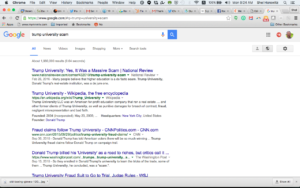
Has he reformed? No. Just look at the recent flurry of news stories quoting everyone from the conservative National Review to the New York State Attorney General calling his Trump University “a scam.”

Results for search for "trump university scam" from Washington Post, CNN, Wikipedia, and National Review
Results for search for “trump university scam” from Washington Post, CNN, Wikipedia, and National Review

This is the continuation of a long history of unethical business dealings, as this story in US News and World Report notes.

As it happens, I’ve heard both Muhammad Ali and Donald Trump speak in person—Ali at an Aretha Franklin concert in Harlem, in 1971, and Trump delivering the keynote for a conference where I was also speaking, in 2004. Ali’s speech left me feeling empowered. Trump’s left me feeling I’d been slimed by an exhibitionist in a public place.

This bullying, thin-skinned, name-calling racist and sexist who brags about how he gets rich on the backs of others has no grasp of the issues, and apparently no ethics. He  doesn’t belong in the White House.

Facebooktwitterpinterestlinkedinmail

Found an article this morning excoriating Senator Elizabeth Warren for her endorsement of Hillary Clinton.

Caricature of Donald Trump by DonkeyHotey, Creative Commons License: https://www.flickr.com/photos/donkeyhotey/5471912349/sizes/m/in/photostream/

Although I’m a strong Bernie supporter, I disagree with the article’s sanctimonious tone. Sometimes, you do have to suck it up and vote the lesser evil. I personally think this is one of those times. After California, Bernie has to accept that he made a really good run, but it’s over. He got farther than pretty much anyone thought he would, and I’m glad.

I’ve voted third-party before, and might do so again. But not this time. Yes, even though we’re faced with two secretive people, each with a history of serious ethics breaches, I will vote for the Democrat this time.

Clinton will be reasonably good on domestic policy (and will recognize that the Left brought her to power) if elected. As a consistent war hawk who can’t see any fault in Israel’s ultra-right-wing government, she’ll be horrible on foreign policy, which ought to be her strong suit–and especially bad on the Middle East. I predict another war during her term. She’ll be middling-poor on energy policy. These are issues that mean a great deal to me.

But she will appoint decent people, including to the Supreme Court. She’ll be socially liberal on a number of issues, and will likely do some good for poor people as long as it doesn’t bother her bankster friends. Ordinary people’s lives are likely to get better under her administration, as they did under Obama.

And most of all, voting for Hillary is the best thing we can do to prevent President Trump.

Trump and his very scary supporters smell like fascism to me. A Trump presidency will very quickly displace GWB (who I used to refer to as His Imperial Delusional Majesty) as the worst president in history. Trump will be far worse on energy, on poverty, on international relations (where he really doesn’t have a clue), on immigration, on minority rights, women’s rights,  and almost every other issue you could name. He might be slightly less willing to go to war than Hillary, but when he does, it will be much uglier. And his response to international incidents will be belligerent enough that other people will start wars with us and he won’t have a choice.

And his thugs will roam the streets, enforcing their brand of nativism, attacking people who don’t look or think like them.

Hitler took power in an election. “Those who cannot remember the past are condemned to repeat it.

If the US had proportional representation, instant runoff voting, or any of the other reforms we’ve been working for over the decades, we’d have a choice. But in a faceoff between a no-ethics/me-first bullying fascist and an ethically challenged secrecy-loving corporate neolib, to not recognize the very real difference is slitting our own throats.

I want Trump’s margin of defeat to be so crushing that his movement goes away for 20 or 30 years. For that, I’m willing to hold my nose and vote for Hillary. This time.

Facebooktwitterpinterestlinkedinmail

Here’s the opening paragraph from the Associated Press report on yesterday’s Wisconsin primaries:

(AP) — Republican Ted Cruz stormed to a commanding victory in Wisconsin Tuesday, denting front-runner Donald Trump’s chances of capturing the GOP nomination before the party’s convention. Democrat Bernie Sanders triumphed over Hillary Clinton but still faces a mathematically difficult path to the White House.

This is entirely too consistent with a long-running pattern in the mainstream media: anything that gets in the way of a Donald Trump nomination is heralded, even though the mainstream Republican Party loathes Ted Cruz—and I and many other progressives find his brand of religious extremism as much of a threat as Trump’s racism and misogyny. I’m sure they would rally much more happily around Kasich, if he could only get non-Ohioans to vote for him.

A voter marks a ballot. Photo by Kristen Price.

Yet the mainstream media continue to trivialize Sanders’ victories—in 7 of the last 8 contests—and talk about how difficult it will be for him to overcome Clinton’s delegate lead.

A more honest reportage would note that Trump and Cruz have swung wildly back and forth, neither emerging as a clear victor, and both wildly unpopular with mainstream voters.

It would also note these key differences in the Democratic race:

  • Sanders has been remarkably consistent on issues for his entire adult life, going back to his days marching for civil rights with Martin Luther King; Clinton has changed positions frequently (moving left under pressure from Sanders in her rejection of the TPP trade partnership, embrace of same-sex marriage, and energy issues—even outflanking him from the left on guns
  • Much of Clinton’s delegate strength is in “superdelegates” pledged to her, but not bound to her; this same group switched to Obama in ’08 and will switch again if Sanders enters the convention with a commanding lead among elected delegates, because they don’t want to give away the presidency to the scary and fractious Republicans
  • The mainstream media continually says that Clinton does better with black voters and urban areas. Yet, some of the most highly urbanized and ethnically diverse states have gone for Sanders, especially Michigan, where a “close race” turned out to be huge for Sanders—and my own diverse, urbanized state of Massachusetts was a virtual tie (as were Iowa and several others)
  • Clinton has consistently benefited from early voting, gaining tallied votes while Sanders gets his campaign warmed up, while same-day voters in several states have overwhelmingly supported Sanders; Daily Kos calls this “Hillary’s Surge Protector.”
  • Clinton’s greatest strength has been in the conservative South—but those states aren’t likely to go blue in November; in likely Democratic states, Sanders has an enormous edge

So hey, AP, hey, New York Times [“Mr. Sanders’s win is so surprising that it’s hard to know what to make of it. Are we learning, for the first time, of a big latent advantage in the Rust Belt? Was it a fluke?”], hey, Washington Post [“Bernie Sanders may be drawing thousands of people to his rallies and raising millions of dollars online, but increasingly he’s also having to make the case that his campaign isn’t a lost cause.”], and hey, CNN [“Trump remains the Republican presidential front-runner, but he didn’t clean up on Saturday…Sanders still a thorn in Clinton’s side”]

—how about if you use the same standards to judge Sanders’ rapid ascent against Clinton as you to for the anyone-but-Trump pushback that has given legs to the Cruz campaign?

Facebooktwitterpinterestlinkedinmail

The 21016 US presidential race shows that branding repels as well as attracts.

Three of the five remaining candidates have very strong brands. Trump has the strongest, clearest brand: “it’s all about me; the issues don’t matter.” I found him repugnant 11 years ago when he keynoted a conference where I was speaking, and find him even more so today. What part of his brand that is not based in Donaldism is rooted in misogyny and racism. His cult of personality is far too reminiscent of dictators in other countries, other centuries. His cluelessness on the issues, tolerance of violence at his rallies and in his campaign leadership, and his blatant disregard for truth create a strong brand indeed—but it’s strong like the odor of raw sewage, a push-away. This is not who I want governing the country!

Next strongest is Sanders, who is all about integrity, consistency, and giving a leg up to those who’ve been squeezed out by the 1%. And who got my vote in the primary. While just as much an outsider, Sanders is the opposite of Trump. I think ultimately Sanders’ “we” will trump Trump’s “me.” Win or lose, he is out there to build a movement, and is universally respected for it.

Interestingly, both of these two have built brands on their outsider-ness. Not a good year for the mainstream candidates, even those who are the son/brother—or wife—of former presidents.

The third brand-builder is Clinton. She is very much a mainstream candidate and has built her brand around “isn’t it time for a smart, powerful woman to be in power?” Like Trump, she’s a “me” candidate, but with more appeal to constituencies that vote. Unfortunately for her, it’s been wrapped up in a package of entitlement, incompetence, lack of transparency, and settling for crumbs.

That Sanders has even been a contender, let alone actually won so many contests and nearly tied several others, shows some of the flaws in Clinton’s strategy. Without resorting to attack ads, he has successfully pointed out that she is a Janey-come-lately on issues ranging from LGBT rights to the TPP trade agreement, where he has been forthright and consistent for decades. He is the first serious contender in decades to raise a viable campaign budget from a broad base of millions of supporters. Meanwhile, she tells the American people to be satisfied with what they have, while he talks about redistributing wealth from the 1%.

There is certainly some part of the Clinton brand that is wildly successful. She is perceived as greater a friend to people of color, while even though Bernie grew up in ultra-diverse New York City and marched with Martin Luther King while she was working for Barry Goldwater, he is perceived as trapped in whiteness. And she has successfully outflanked him from the left on one issue: guns. But the perception is that she doesn’t see the big picture, doesn’t understand the shift in the culture, will be at least as obstructed by the other side as Obama, and expects people to vote for her just because she’s been waiting so long.

Of course, two other candidates still remain on the Republican side: Cruz and Kasich. Neither has really built a brand. What Cruz stands for—a hard-right agenda fueled by religious conservatism (and, seemingly, some personal unlikability)—is not widely known around the country. If he becomes the nominee, the Democrats will build his brand for him, warning of the apocalypse to come (as they’re already doing regarding Trump).

As a relatively personable moderate with a reasonable track record, Kasich would actually be the Republicans’ best hope if he had any marketing traction. Of the three remaining, he’s the only one who could get independents and centrist Democrats aboard. Fortunately for the Democrats, he doesn’t. The GOP clearly wants an extremist this year, and Kasich has won only his own state of Ohio.

Facebooktwitterpinterestlinkedinmail

The US presidential race is full of outsiders this year. Trump gets lots of attention in the media–but Sanders seems to be having more of an impact on policy questions, and on bringing disenfranchised-feeling voters in from outside the electoral process.

There are many parallels between Sanders on the left and Trump on the right–both of them attracting attention for being firmly OUTSIDE the mainstream, and both waging far more successful campaigns than the pundits predicted. And they both look and sound like the New Yorkers they are.

But in many other ways other ways, of course, they’re completely different: Unlike Trump, Sanders is…

1. Seriously concerned about making things better for those who are not wealthy, and basing this on a 50-year record of activism (vs. concern only about making things better for Trump and a few others of enormous class privilege).
2. Thoughtful, willing to engage on issues, analyzes more deeply than most candidates with charisma.
3. A populist fundraising champion who does not fund his campaign with–and thus is not beholden to–corporate money or party money, but from millions of ordinary people. I don’t think this has been done before on this scale (vs. Trump self-funding out of his personal fortune and claiming that this makes him honest because he’s the one doing the buying of politicians instead of being bought by them)
4. Someone who tells the truth (Trump has been caught in more lies than any of the others).
5. A successful coalition builder who has a track record of working well with people who think differently

But even Cruz and Rubio (and certainly dropouts Carson and Fiorina) are outliers too. It is scary to see the Republican Party start to coalesce around the very scary Ted Cruz, who only looks rational because Trump is so far in right field that he moves the public perception of what’s mainstream. When Speaker of the House Paul Ryan (a slasher of the safety net) is considered a centrist, we have a serious distortion in perception vs. reality.

So the big lesson I take away is this: when four out of the five most popular candidates this year are outside the mainstream, the mainstream had better look at why, and what they can do about it. With the exception of Clinton, all the mainstream candidates are out of the race–even presumptive GOP nominee (as of last summer) Jeb Bush.

Me? I agree with at least 80% of what Sanders says, and was happy to vote for him in our March 1 Massachusetts primary.

Oh yes, and let’s not forget the role of the media in king/queen making and unmaking. One of Sanders’ other strengths is in engaging millennials who are good at creating their OWN (social) media–while defeating the myth that a self-declared socialist can’t run a serious campaign for national office in the US.

Facebooktwitterpinterestlinkedinmail

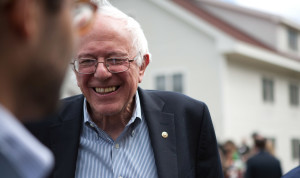
Senator Bernie Sanders, looking relaxed

A friend and I were discussing the presidential election, and he brought up the tired old shibboleth that the Democrats got so badly burned on George McGovern’s 1972 campaign that they don’t feel any progressive candidate is electable.

I will concede some surface similarities: both are/were genuine progressives who can ignite the youth vote, neither had the support of the party elite, both were critical of the war machine.

But if anything, I’d say McGovern is more accurately compared to the failed campaigns of Michael Dukakis, Al Gore, and John Kerry—and even John McCain.

Now—why is Bernie’s campaign different?

  1. Unlike the Dukakis disaster, the Republicans can’t make “liberal” sound like a curse word. Bernie is more than liberal. He’s progressive. He is an open socialist, so calling him a socialist has no traction; we all know that already, and it doesn’t seem to be hurting his performance.
  2. He has a track record of coalition building and getting things done both as an executive (as Mayor of Vermont’s largest city, where he served multiple terms and continues to be enormously popular) and as a legislator.
  3. His fundraising prowess is astounding, and has been outside the mainstream Democratic party channels. It’s new money coming into the party. While Trump can claim he’s not beholden because he’s funding his own campaign, he is closely allied with his fellow billionaires. Bernie is a candidate of the people and supported financially by the people.
  4. Bernie has enormous integrity—and that makes him unique in the current crop of candidates. Clinton, Trump, Cruz, and Rubio have all been accused of various shady dealings (as was Gore).
  5. Bernie’s strength on the left and Trump’s on the right shows clearly that the old style of politics-as-usual is out of favor. About the only thing they have in common (other than their NYC roots) is that their campaigns have been fueled by enormous voter disaffection with politics-as-usual.
  6. He uses social media better than anyone else in the race—and this is one of several reasons he polls so well with Millennials.
  7. Unlike McGovern, Dukakis, Kerry, or McCain, Sanders is a skilled orator who really knows how to work a crowd.
  8. He polls better than Clinton in match-ups against all the Republican candidates.
  9. Ambitious agendas are always more popular than treading water. Clinton urges us to tread water—to protect Obamacare, to accept the economic crumbs falling off the silk tablecloths of the 1%—to keep things as they are. Bernie urges us to think big. It’s the same message of hope and change that inspired millions of first-time voters to come out for Obama. But Obama was a centrist running as if he were a progressive, and he let a lot of those people down. Sanders has been putting his beliefs into action for decades. And he can show consistency over time, unlike the flip-flopping Clinton and Trump.
  10. His positions would actually help the majority of voters if they became policy.
  11. He’s attacking an enemy that is disliked (Wall Street). And he’s reaching out to all the constituencies Trump (and to a lesser extent the other GOP candidates) has attacked.
Facebooktwitterpinterestlinkedinmail