To lose Pete Seeger so soon after Nelson Mandela–two great champions of justice and democracy! If you want to know the true definition of an American Patriot, it’s spelled P-e-t-e  S-e-e-g-e-r. Not only was he an extremely talented musician and a devoted rabble-rouser on a host of social, labor, and especially environmental causes–for which he suffered greatly in the 1950s and ’60s–and not only can he claim a major role in cleaning up the Hudson River and co-founding the amazing Clearwater sloop and organization and folk festival…he was one of the most humble people I’ve ever met.

I used to see Pete Seeger at the Clearwater Revival, wearing a volunteer shirt and picking up trash. I got to bang a few nails with him once as he was building the Woody Guthrie (one of I think three small boats he built along with the Clearwater and the Sojourner Truth). And I interviewed at least once, saw him perform dozens of times live and numerous more on TV–growing up as a public television kid in New York City, where once the blacklist was lifted, he was frequently found on Channel 13–and hung out with him at some People’s Music Network conferences. He helped start PMN, started Sing Out! magazine, the Newport Folk Festival, a bunch of environmental and peace organizations, and many other ventures for the public good.

His 1963 Carnegie Hall concert is one of the 10 albums I’d absolutely insist on having if I were stranded on a desert island with one CD holder. Among other things, it contains the best of his dozen or so recordings of Wimoweh, long before that other group made it a top-40 hit. I own many other of his records, but that one is a standout.


And Pete walked his talk. Though he could certainly have afforded much grander housing, he lived for the last many decades in a small cabin outside Beacon, New York, on his beloved Hudson River, heating with wood he chopped himself. Though he could have gotten all wrapped up in ego, he spent his entire life championing newer musicians. He helped bring Bob Dylan and Tom Paxton to the world’s attention, as well as later songwriters like Dar Williams and many others.

Pete was one of three amazing lifelong activists born in the spring of 1919 who I knew personally. Miriam Leader (not much known outside of her various home communities) passed about a year ago. And Frances Crowe continues her active work for peace, justice, and the environment. The world is richer because these three people with giant hearts walked its ground. Goodbye, Pete, and thanks for all you’ve done to make my life richer. You’re probably already starting to organize amongst the angels ;-).


Facebooktwitterpinterestlinkedinmail

One of the books I’m currently reading is Charles Eisenstein’s Sacred Economics—which makes many fascinating points about the interplay of money, attitudes, and relationships. (I’ll be reviewing it in my March newsletter; if you don’t already subscribe, please do so in the upper-right corner of this page.)

Early in the book, he talks about the gift economy, and the difference between reciprocal giving and circular giving. Reciprocal giving is closer to barter than to a true gift economy: you give something to someone, and that person reciprocates either right then, or at some future time. Until the gift is “redeemed” by the second gift, it creates a sense of obligation—kind of like what the Millionaire Mindset types call the Law of Reciprocity.

But circular giving is a completely different framework. You give something to someone, either because that person needs something you have or simply because you want to give a gift. That person will make gifts to other people who they can help. You may or may not be among the recipients. But when you have a need, someone will step forward and enable it. It’s more Karmic.

I’d never really thought about the distinction before, but I realize I’ve lived the parts of my life that are in the gift economy on the circular model. A great example (among many) is homestays. We’ve been members of the international homestay network Servas for more than 30 years, and Couchsurfing since 2009 (Note: Servas link is to the United States site, as the International is down at the moment). People stay at our house. We stay in private homes when we travel. No money changes hands. When we travel, we usually bring a small gift: a bottle of wine, a loaf of good bread, a copy of one of our books—but this is something we choose to do and is not required by either organization. Some of our guests bring gifts, some don’t.

This is not just about saving money, though that’s certainly a factor. It’s about having a visit in a place where you didn’t know anybody. Having a human connection in a private home, instead of an impersonal hotel room interchangeable with others all over the world. It’s about going someplace as a traveler and a visitor, not as a tourist—experiencing a place, if just for a couple of days,  through the eyes of people who live there. Eating their food staying in their neighborhood, playing with their kids or pets, listening to their music.

It’s very rare that our homestays are reciprocal. I think there have been about five people in all these years where first one of us visited, and then the other return the visit—and the motivation in those cases was not “you owe me,” but “we enjoyed you so much, we’d like to see you again.” It’s actually very common for people who visit us to invite us to visit them,and vice versa. If we ever make it to Berlin, we already have half a dozen families who’d be delighted to host us and see us again.

And this goes back to Eisenstein; he makes the point that money not only commoditizes goods and services (and drives uniformity over craftsmanship)—but also commoditizes relationships. We build relationships with many of the people we meet through these homestay networks. We’re on each other’s Facebook friend lists or e-mail humor or political alert lists, we send copies of our annual letter, we stay in touch if we return to those locations. In short, we’re gaining friendships—not with everyone, but with the ones where the chemistry is good, and that’s most of them.

Even in the most hospitable Bed & Breakfast, with the most delightful innkeepers, this doesn’t happen; money creates a different dynamic.

And circular gift economies are only one facet of the evolving economy. I could do another whole post on paid shared-resource economies like Zipcar and Airbnb. And one thing all of you should consider is how much more eco-friendly these are than everyone buying their own car, their own lawnmower, etc.

I haven’t gotten to the part of Sacred Economics where Eisenstein lays out his ideas for money economies that don’t devalue and dehumanize. I’m looking forward to it, and might write again here when I see what he has to say about that.

Facebooktwitterpinterestlinkedinmail

The concept of cellular memory was made very real and personal to me today, in the woods.

Yesterday, it happened that I chose a very icy location for my daily hike, slipped several times, fell twice, and banged myself in a few places. I even iced one of the spots when I got home. Those areas were still a bit sore for a couple of hours but were OK by the evening.

Today, I went to different nearby woods, free of ice, just a thin and not-very-slippery coating of snow. And as soon as I got out of the car, two of the spots I banged yesterday—below my left knee and above my right wrist—started to hurt! They’d felt fine all day.

I am convinced they “remembered” that the snowy woods had caused pain the day before.

Even more remarkable: once they “realized” that the conditions were, in fact, different, the pain subsided quickly. Within about three minutes, my leg was no longer hurting. Another couple of minutes and my arm felt fine too.

If I’m reading the signals correctly, the implications are that any body part not only has a memory, but has emotions and even thought.

Since the mid-1970s, I’ve paid at least some attention to the way bodies react to stress. I’ve explored a number of modalities, from Re-evaluation Counseling (all about releasing rapped emotions that often manifest as tension) to rolfing to yoga to Network Chiropractic to Alexander Technique (and several others). And I’ve explored uncountable numbers of audios, books, and articles about our ability co influence our own fate and to manifest what we desire–often called the Law of Attraction (LoA). Many of these work on releasing stored tension in the body that stems at least in part from emotional distress.  Thus, my discovery today actually makes a good deal of sense to me. (And by the way, I have been enormously helped by the Alexander work, which I’ve done steadily since around 2005,  with a very skilled practitioner, Ruth Rootberg of Amherst, MA. Any Western Massachusetts people reading this might want to try her out.)

While I recognize that this may seem off-topic or too “woo-woo” for this blog, I’ll put out the idea that it’s actually very, very relevant. Changing oneself is key to changing the world. Understanding how much power we have to shape our own destiny helps us create the planet we’d like to live on—and looking at cellular memory might be a part of that. If we can have Prosperity Consciousness or an abundance mindset, can’t we also teach our bodies to de-stress?

Have you had any experience with this sort of cellular memory? Please share by posting a comment.


Facebooktwitterpinterestlinkedinmail

I choose not to participate in the always-crowded and frequently violent orgy of consumerism called Black Friday. I do my best to shop locally most of the time, I don’t like crowed craziness, and I know Black Friday is not really a help to local small businesses that can’t afford to deep-discount.

There’s an alternative celebration on the day after US Thanksgiving that resonates more with me: Buy Nothing Day: 24 hours without any purchasing activity. I can’t always do it; sometimes the gas tank is empty or I’m flying home from Thanksgiving in another part of the country. But this year, I see no reason to spend any money today.

Wikipedia has a nice page on the history of Buy Nothing Day and some creative incarnations of anti-consumerism.

Meanwhile, society at large is going in the opposite direction. I was really hoping that the big-box store openings would be a flop. Unfortunately, there were big crowds leaving their families to chase down bargains. This, I see as a blow against workers’ rights. I very much doubt that all the employees working yesterday were volunteering to work on a holiday. In fact, there are demonstrations at Walmarts all over the country today, protesting this encroachment on workers’ family time. In my area of Western Massachusetts, it’ll be 3 p.m. at the Walmart in Hadley.


Facebooktwitterpinterestlinkedinmail

When I get a good apple or pear, I eat it “right down to the bone.”

Apple core

This is an actual core from a wonderful Macoun apple that I picked myself. It was fresh, juicy, crunchy, and that wonderful combination of sweet and tart. An apple right from the tree is one of the great pleasures in life. When we go apple picking, I get home and immediately start drying them and making apple sauce, because even one day later, it won’t taste quite as good. And three weeks later, it’ll taste only a little bit better than a store-bought apple shipped from the other side of the country.

As a locavore, a green business profitability expert, and someone who attempts to live a very green, yet very comfortable life, I feel each of us has a responsibility to minimize waste. Eating every last bit of a tasty apple is one of the ways that minimizing waste can actually be fun. And of course, the few grams remaining go into the compost, to be recycled by Mother Nature into something else.

And those are the two principles of waste reduction: use things more efficiently so you generate less waste, and figure out what that waste can be turned into to create something else. Better than pollution, I’d say.

Please comment below about how you are—or how you could be—generating less waste or setting that waste up as raw material for something else.


Facebooktwitterpinterestlinkedinmail

It’s amazing how much you can see on foot, if you just open your eyes.

I just took an hour-plus walk in Springfield, Massachusetts, from Baystate Medical Center’s Chestnut Building in the North End to the Quadrangle downtown, inbound on Dwight and returning on Chestnut. And I saw all sorts of things that I found fascinating (your mileage may vary—but as I always say, I became a writer because I’m interested in almost everything). Unfortunately, I didn’t have my camera with me, so words will have to do. Here’s some of what I discovered:

  • A spectacular blue, green, and pink Victorian house, as fancy as any of San Francisco’s Painted Ladies.
  • Not one, but three churches with Star of David motifs. One of them was obviously and one probably built as synagogues, but the third, a massive stone Catholic edifice with a medieval-style tower and an ultra-modern series of metal sculptures on the roof—could only have been built as a church. The star was directly over the main entrance.
  • The most graceful windows I’ve ever seen on a residence: the dramatically tall and elegant rounded windows on the Kimball, built in 1911.
  • Several blocks that must have once held graceful if run-down Victorians and still has a few—but most have been replaced by a tactless mix of tiny 1950s ranch houses and ugly 1970s or 1980s small duplexes. What a shame!
  • The vibrant blue art panels and gold trim on the sides of the Deco-era Massachusetts State Office Building, across from the railroad station—which I never noticed in many trips passing it as I picked up or dropped off someone
  • A former school from the late 19th century, built to resemble a castle (now housing for the elderly).
  • An enormous strip club decked out to look like a commercial block in New Orleans
  • The sprawling ante-bellum-Southern-mansion-style institution that might be part of Mercy Hospital, tall columns and all—sealed off with a chain-link fence and no trespassing signs, seemingly deserted except for one cluster of rooms with lights on. This building was sandwiched between another once-grand institutional building that had burned and been partially demolished—and a modern glass, steel, and aluminum office complex that doesn’t even have its walls yet.
  • A beautiful green antique copper clock tower on Main Street, viewed from up the hill on Chestnut near State where I couldn’t tell what building it was attached to.
  • Three gilded onion domes atop a Russian Orthodox church.
  • A sculpture all by itself on the Chestnut Street side of Museum Quadrangle, obviously part of the Dr. Seuss Sculpture Garden but one I’d never noticed walking around the quad—and another sculpture across from the Mass Mutual Center that looked like broken pottery.
  • The Two Mattoon nightclub is now a law office. Mattoon is a beautiful historic block that would be at home in Washington DC’s Georgetown or Brooklyn’s Park Slope. I didn’t walk it today, but crossed the western edge of it.
  • Rehab projects everywhere.
  • How remarkably few people were out on the streets. In an hour’s walk, I probably saw just a couple of dozen pedestrians, even though I came close to Main Street and it was a beautiful sunny day.

Of course, it’s not enough to notice. We need to think about what these things mean. For instance, I see Springfield as a city that actively reuses its old buildings; the ugly urban renewal project was an exception. More typical are the synagogues that have become evangelical churches, the train station that’s being redeveloped into a modern transportation center and retail base, and the school that now provides living quarters.

The near-absence of pedestrians means something less positive: that the city still has a long way to go before it feels vibrant. I’ve seen pictures of Downtown Springfield in the 1940s, teeming with people. The city needs a more active commercial base with people-centered retail and attention to both visitors and residents, as it once had.

What do you see when you walk around a neighborhood that you usually drive through? Your comments, below, are welcome.

Facebooktwitterpinterestlinkedinmail

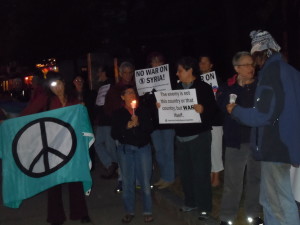
No War in Syria Candlelight Vigil, Northampton MA 9-9-13

Something magical happened at the peace demonstration in Northampton, Massachusetts tonight.

A young man crossed the street to read our signs, and then engaged in dialog with four of us. He told us that he was very ambivalent, because he didn’t want to be seen as supporting chemical weapons. I told him, “I don’t think you’ll find a single one of us [sweeping my hand to indicate the more than 200 demonstrators] in favor of chemical weapons. And it isn’t clear who it was that used the chemical weapons—but it is clear that war will not solve the problem, and will destabilize the region. It doesn’t have to be only two choices: war or no action. There are a lot of other options.”

Another demonstrator talked about the likelihood that Iran and Israel would be drawn into the conflict. And someone else noted, “200,000 people have died in this conflict. I don’t see that chemical weapons are so much worse than landmines as to be worth going to war.” To which the young man replied, “That’s a really good point. I hadn’t thought of it that way before.” No doubt reflecting on our questioner’s age, the fourth demonstrator talked about the likelihood that a new war could reinstate the draft.

I spoke again: “With the possible exception of the former Yugoslavia, I can’t think of a single war after World War II where war solved the problem, and I can think of many where it made it worse. I don’t understand how killing innocent people to protest the killing of innocent people makes any sense.”

At that point, the young man said he had to go meet his friend, but he thanked us for the dialogue and said we’d left him with a lot to think about.

To me, participating in this dialogue and watching a mind open in front of us (not necessarily change, but open) makes it all worthwhile. It is so rare to get immediate feedback that our actions make a difference—but tonight, I and three other people made a difference in thinking of one young man.

Never doubt that a small group of thoughtful, committed citizens can change the world; indeed, it’s the only thing that ever has.
—Margaret Mead

In 44 years of participating in political protest, I can count a dozen or so times where I could see instantly that my actions actually mattered. This was one of them. Another was the very first demonstration I ever went to, in 1969 when I was 12. That time, the person who was changed was me.

Facebooktwitterpinterestlinkedinmail

Yesterday, I wrote about how much fun I have cooking and eating local organic food—and how it’s not uncommon for 80 percent of our dinners to be grown within a few miles of our house.

Today, I want to talk about what local organic food means personally, and to the planet.

For me:

  • Food that’s fun to cook and delicious to eat
  • Super-fresh, and loaded with nutrition, vitamins, and minerals (instead of toxic chemicals)
  • Very frugal
  • Children who feel a direct connection to where their food comes from and how it grows—and who have carried their food awareness into their own lives in big cities, now that they’re grown
  • Community; we always see friends when we pick up our share at the CSA farm, and they have educational programs like herb walks or food preservation workshops, potlucks and concerts once in a while

As an example of the dollars and cents, consider the six-flat of tomato plants we bought. I think we paid $3—so 50 cents per plant. Let’s amortize the fixed costs of the garden across all the crops, and add another $3 to cover the tomatoes’ share. So we’re up to $6.

Fresh local organic tomatoes are usually around $3 per pound at the local farmers  markets—so we break even on the second pound. This is a slow year; we’re only getting about a dozen tomatoes a week, perhaps four pounds. Some years we get more like 40 pounds a week. But even with this year’s limited crop, that means we’re pulling in $120 worth over a ten-week harvest season, and in a good year, that number is more like $1200. And that’s just one crop; we’re also growing broccoli, green beans, kidney beans, eggplant, kale, onions, basil, rosemary, cucumbers, zucchini, raspberries, blackberries, blueberries, and peas (earlier in the year). The whole garden costs us less than $100 for the year.

We split the $600 CSA membership with another family, and we collect our share for about 23 weeks, typically getting 10-20 pounds of organic produce per week—or roughly 345 pounds for the year. If the stores averaged even $4 per pound (they’re often higher for organic), that means our $300 has turned into $1380—not bad!

Saving so much money on our local organic produce lets us justify the expense of the locally produced food craft items at the farmers markets; the cheeses and eggs are quite a bit more expensive than the industrial versions in supermarkets. But it’s worth it, because they taste so much better, feel so much better in our bodies, and help our local organic farmers stay in farming. And with those foods, a little goes a long way; $10 or $20 a week gives us all we need.

The Planet:

Now, let’s look at what my food lifestyle means to the economy and ecology of my town, and the whole country:

  • Very low carbon footprint. Instead of being shipped across the country, our food is hand-carried about 100 feet from our garden to our kitchen, or brought three miles (five kilometers) from the CSA farm either by car or bicycle. Instead of requiring huge inputs of petrochemicals and petrolabor, we work our garden by hand, except for the initial rototilling. And as vegetarians, our carbon footprint is much lower than if we ate meat (it would be lower still if we went vegan).
  • Chemical-free. No health effects from pesticides and herbicides—to me and those who share my table, or to the farmers who grow it. AND no harmful effects to the soil and the water.
  • Good for the local economy. Our farm membership fee and the dollars we spend on local dairy products, bread, and fruit stay in the community, instead of being siphoned off by a dozen middlemen and into the coffers of far-away corporations.
  • Good for farmland. Every farmer that sells food to us is a farmer who is keeping the land in agriculture instead of selling that land off for development—and every successful local organic farm is a living lesson to other farmers that they don’t need to douse the earth (and their customers’ bodies) with poisons.

Pretty cool!

Now it’s Your Turn:

Please leave a comment about how you’ve incorporated (or will start incorporating) local artisan foods into your lifestyle. How are local organic foods making a difference to you?

Still need ideas? Tomorrow’s blog will provide concrete steps you can take to green your food, even if you live in a city. I do have to warn you though: once you’ve tasted REAL food, you won’t ever be satisfied by the poor imitations that dominate the industrial food system.

Facebooktwitterpinterestlinkedinmail

Are you a locavore?

From June through October, the vast majority of or dinners are 60 percent or more sourced locally—and the majority of that, hyperlocally: either our own garden, or the Next Barn Over CSA farm 3 miles up the road, or the artisan cheeses and breads we buy from area farmers markets. (In a CSA farm, you pay a membership fee and then collect the harvest all season)

Last night’s dinner, about 80 percent locavore, was typical: Of the five different dishes I prepared, four used only local main ingredients (plus very small quantities of non-local flavorings, such as olive oil, salt, and balsamic vinegar):

  1. Cucumber-tomato-basil soup. All three main ingredients from our garden, plus a touch of hot pepper from the CSA .
  2. Grilled shitake mushrooms, grown by a friend of ours one town over, and seasoned with herbs from the CSA farm.
  3. Our own green beans and onions in a nonspicy peanut sauce (locally made one-ingredient natural peanut butter thinned with boiling water—yes, I know, the peanuts, were grown elsewhere, but I ground them myself a couple of days ago, using the store’s machine).
  4. Organic brown rice (the one nonlocal main ingredient) with our own tomatoes, our own oregano and lavender, the farm’s thyme, and local Greek yogurt.
  5. Salad with our own cucumbers, the farm’s salad greens and red bell pepper, and a local artisan goat cheese, garnished with non-local walnuts.

I was in a Mediterranean mood, so I used a lot of oregano, thyme, Greek yogurt, and salt. Some meals are more Indian,  Chinese, Italian, or Mexican themed, some are a mix—and some have no theme at all.

Eating like this has been remarkably easy, frugal, and infinitely rewarding—I’ll talk more about that tomorrow.

This time of year, our menu planning revolves around what’s in the crisper. I cooked what I cooked because we had two big bags of green beans in the fridge,and one of them was harvested three or four days ago and was not going to last too much longer, by our standards. I’d originally thought I’d make a mixed-veggie dish with our garden broccoli, zucchini, and eggplant—but when I saw the large number of beans that had to be used, I shifted the plan. The rice was left over from Dina’s cooking Thursday night, and we’re still inundated with cucumbers, so I built both the soup and salad around them (all-told, I used eight cukes and four tomatoes plus another seven or so for a batch of frozen sauce I made this morning).

Last night’s feast was a typical meal in the Horowitz/Friedman household. It’s how we eat in the summer and fall. In the winter, we often still manage to eat 30 to 50 percent locavore, drawing heavily on what we’ve frozen and dried during the harvest.

It’s still August, and our freezer is already crammed with corn, kale, green beans, three kinds of our own berries, tomato sauce, garlic scapes, basil pesto, and I forget what all else, and our pantry is lined with jars of dried zucchini and tomatoes—all of it local and organic, and processed while still very fresh.

Growing up in New York City apartment buildings in the 1960s and 70s, “locavore” was an unknown concept. The “fresh” vegetables  we ate were trucked from California and had been sitting for weeks and most of our my friends ate their veggies out of cans. So the way I eat is a radical departure from the way I ate as a child. I knew ONE family with a garden: friends of my mother who lived in suburban Westchester County.

Tomorrow, please check back—we’ll look at the impact of eating locally and organic—how being a locavore is good for you, your wallet, and the planet.

Facebooktwitterpinterestlinkedinmail

In Part 1, I looked at my own history as a bicultural who is at home in my native New York City as well as in the farm village of 200 people where I live now. Part 2 looked at the context of going no-impact in present-day NYC, and how in some ways it’s easier now, and outlined Colin Beavan’s choices in attempting to live a year with no net negative impact on the environment.

In this final part, I close the circle and direct my bicultural lens on Colin’s choices.

First, I have enormous respect for what he and his wife did. They telescoped into a matter of weeks lifestyle choices that took us decades to evolve, and with considerable personal sacrifice. No  movies, no eating out, no curling up with a great book long after the lights are out.

Second, I understand why they took it to the extreme they did. Their lives were so far out of balance that it took radical surgery to set it right, and it was clear at the end of the movie that as the cycle ended, they would reintroduce some of those comforts, starting with electricity.

But I don’t go quite that far. I’ve always had a goal of low negative environmental impact, rather than no environmental impact.

When I lived in Northampton, I walked or biked constantly—but I could get to town in three minutes by bike, or eight on foot. Now, I live in a place that is not served by public transit. And while I’ve been biking more frequently to Amherst or Northampton, I don’t always have the two hours to bike round-trip, versus 30 to 40 minutes by car.

On the other hand, I eat very locally. In the summer and fall, about 75% of our diet is hyperlocal, either from our own garden or from the CSA farm three miles away (and yes, we often pick up our veggies by bike). Another big chunk comes from local farmers markets eight miles away, whose vendors are mostly within 20 miles. But that still leaves us eating plenty of stuff that doesn’t grow around here.

And I’ve had a consciousness about local food for 30 years—something that’s very common here in the Valley even among the most mainstream people. Living here, I see the cycles of food in a way that’s difficult to experience in New York City.

I live in a single family home that could be better insulated, and now that the kids are grown, it’s a lot of space for two people. Certainly more than we absolutely need.

On the other hand, we’ve added solar hot water and photovoltaic, and the house, built in 1743, long ago amortized the carbon footprint of its construction.

Colin chose to give up toilet paper in favor of rewashable cloth, because he didn’t want to be responsible for cutting down trees. I am not sure that’s actually the most eco-friendly option. First of all, toilet paper NOT made from virgin wood is widely available. In New York City, at least four brands of recycled toilet paper are easily available, including Marcal, which actually uses New York City’s junk mail to manufacture its paper goods, and has for 63 years. So using that solution actually reduces landfill impact. And second, in order to avoid a BIG problem with germs, the water to wash those cloths has to be really, really hot. And hot water, unless it’s solar-heated, is an emormous draw-down of energy and user of fossil fuels.

If were to be eco-purist, I could find 100 little inconsistencies to carp about—but that’s not the point. The point is that this experiment transformed Colin and Michelle’s lives, and actually had a large impact on the way people think—particularly people in large cities.

And what do YOU think? Please leave your comment below.

Facebooktwitterpinterestlinkedinmail