This is very personal to me; my son’s college is about a mile from Copley Square.

He was fine, but he and a group of friends decided to walk home (several miles) rather than take the train as usual.

9/11 was also very personal. I was one connection removed from at least two people who were killed, and it took me two frantic weeks to find out that my ex-housemate from my Brooklyn days, who was at that time living just two blocks from the WTC, was all right.

But what made me want to write tonight was not those deep personal connections. It was a question by my friend @PeterShankman, founder of HARO, about how he can talk about this sort of random violence to his daughter, due to be born in a few days.

My answer, I admit, talked around his question rather than going straight for the center. I wrote:

We explained to our young kids (now 20 and 25) why we were bringing them to protest various wars and injustices and environmental atrocities, and to talk of the importance of NOT accepting evil, that we could always do SOMETHING and whether it worked or not was less important than that we did not turn a blind eye.

Interestingly enough, they both have been involved in social justice work quite a bit. My daughter defended a nerdy male classmate against bullies when she was six, and my son was also six when he organized a children’s fundraiser for Save the Mountain, the environmental group my wife and I started that actually did save our local mountain. I was and still am very proud of them.

I do feel that one of the things we did right as parents is to inculcate our kids both with a sense of social justice and with the knowledge that they can actually have an impact. These were lessons I got from my own mother, the late Gloria Yoshida; as a young mom in New York City, she was one of the white volunteers civil rights groups could call upon to find out if that “already rented” apartment was REALLY rented, or if it was only off the market if a black family came to look at it.

Facebooktwitterpinterestlinkedinmail

The organizers of a rally to protest Karl Rove’s appearance at the University of Massachusetts tonight opened the microphone to anyone who wanted to talk. I hadn’t planned to speak, but I felt I had something to share with this crowd of 150 or so, most of them in their 20s.

My remarks went something like this:

Back when I was a teenager protesting the Vietnam War, we had a president named Richard Nixon. We thought he was pretty conservative—but his record is to the left of Barack Obama.

Obama blows with the wind. He feels the breeze of the Tea Party—but he doesn’t feel us. We have to ‘have his back’ when he does the right thing—and make a lot of noise when he doesn’t.

Richard Nixon brought us the Clean Water Act, Clean Air Act, the Environmental Protection Agency, detente with the Soviet Union, a newly opened door with China…

Barack Obama took nearly three years to get us out of Iraq, failed to close Guantanamo (and hasn’t tried very hard), escalated drone strikes, backed away from his early rhetoric on climate change, and refused to provide the deep change he was elected to bring.

Even on his signature issue, health reform—one area where he was actually willing to act presidential–he wouldn’t even talk about the real reforms, like single-payer. Yes, I know he has done many good things, and I now he’s been battered by a hostile Congress. But he could have done much more, if he’d enlisted the support of progressives around the country.

And not only has he failed to undo most of the policies of the Rogue State Government of George W. Bush, he has let the treasonous, anti-moral crooks and liars of the George W. Bush administration, including Karl Rove, walk free.

Obama is weak and susceptible to public opinion. Yet, only the opinions of the right-wing fringe seem to sway him—because the left does not understand how to pressure politicians. We elected him twice, and we can get him to listen to us. But for that, we need different strategies and much much better framing.

Facebooktwitterpinterestlinkedinmail

I just got back from a Nigerian Highlife concert at Mount Holyoke College. The place was set up with a huge dance floor and folding chairs off on the sides. The audience was mostly female, mostly 20-something college students, and more racially mixed than the typical crowd in this mostly-white area.

And yet—for the first fifteen minutes or so, I was the ONLY one on the dance floor, even though the opening song was a very danceable number called “Shake Your Body,” and even though the bandleader kept imploring people to get out and dance! I’m a 56-year-old white guy with gray in my beard and a history of ankle and shoulder injuries, and I was dancing, by myself. Why weren’t those lithe 20-somethings out on the dance floor?

Finally, the bandleader pretty much ordered everyone on the floor. And what do you know—one they were out there, they liked dancing, some of them were quite good, and a lot of them stayed dancing (as did I) for the remaining hour and a half. A few even got up on stage and strutted their stuff with the band.

But in my day, we didn’t have to wait to be commanded to dance. We heard music, and we danced!

(Note: in case it’s not obvious, this post is an attempt at humor; I’m not actually upset, just surprised.)

Facebooktwitterpinterestlinkedinmail

Note to manufacturers: your green products (including recycled products) have to compete on quality. If someone buys a recycled product and discovers it’s crappy, not only are they a one-time customer who won’t repeat, but they’re also a negative talking machine, trashing not just your product but in many cases, green products or recycled products in general.

In other words, any time you put out crap in the name of selling recycled products, you hurt the prospects of every green business. Don’t rush to market; take the time to get the quality right first!

This rant was inspired by the cleanup after my daughter’s Passover Seder.  She had recycled aluminum foil. I was excited to see it, as I hadn’t known such a thing was  available in the consumer market. But my excitement quickly turned to frustration when I tried to use it, and discovered it was so brittle that I had to use about three times as much; it ripped wherever I touched it. It was as bad as the first generation of biodegradable diapers that we tried to use when she was a toddler, circa 1990. As bad as the solar cell-phone charger I bought a year or two ago that was so ineffectual I returned it for a refund.

Now, I’m a committed green, and I will give recycled aluminum foil another try in five years or so. But if this had been my first experience of a recycled product, it probably would have been my last.

Facebooktwitterpinterestlinkedinmail

Ten years ago, the United States began its illegal and immoral invasion of Iraq: an operation based on numerous lies, no real evidence, and a lot of testosterone.

Iraq, as we know now and strongly suspected then, had no connection with Al Quaida, nor did it have “Weapons of Mass Destruction.” It had a stable, if nasty, government. And it had the bad judgment to have a little war with the U.S. over Kuwait during the first Bush administration.

So George W. Bush and his minders decided to get even. And the United States became the “rouge state” that the Bush administration accused Iraq of being.

What did we accomplish with this shameful chapter in our history? Hundreds of thousands dead and injured and homeless, vicious acts by US troops and Blackwater mercenaries at Abu Ghraib and elsewhere, and widespread enmity throughout the Arab world. Oh yes, and the worst kinds of extremist terrorists established a beachhead in places where they had never had strength before, including Iraq itself. And Iraq’s economy shattered. And the US economy—let’s remember that GW Bush inherited a SURPLUS from Bill Clinton—badly damaged.

A weak President Obama has brought us back into the company of nations, and partially rebuilt the US economy but has failed to reverse so many of the wretched Bush policies and has allowed the right-wing extremist fringe to frame and control the discourse.

To commemorate these ten years, MoveOn.org asked people to share one memory. Rather than focus on the negative, I wrote:

I remember the amazing demonstration in NYC just before the invasion that filled at least four wide avenues on the east side of Midtown Manhattan. I am guessing there were about two million of us, and the police wouldn’t even let people down to the low-number avenue (I think it was 1st Ave, near the UN) where the “official” rally was—so we spilled over and filled up 2nd, 3rd, and Lexington. The media only counted people on the official avenue, but those of us who were there know it was enormous–possibly the largest US peace demonstration in history.

Of course, it should not be a surprise that the mainstream media severely undercounted us. After all, Judith Miller of the New York Times and many other supposedly skilled journalists were cheerleading the run up to the war, neglecting their journalistic due diligence, and even firing those among them who dared to speak out (including Bill Moyers and Phil Donahue).

No more illegal, immoral wars!

Facebooktwitterpinterestlinkedinmail

There was a note on my contact form today that I was 98% sure was junk mail…but it touted a legitimate product (NOT sex, drugs, or casinos), was hand-posted to my contact form, and had a gmail address—so in case it fell into the other two percent, this is what I wrote:

Are you asking for help with marketing this product, or simply spamming my contact form? If the latter, I strongly suggest you NEED help with your marketing, as spam makes enemies, not sales.

Let me know if you want information on my marketing services.
Not that I really expect to hear back from her (or necessarily even want her as a marketing client)—but it was an interesting exercise that took under 1 minute. Of course, now I’m spending ten minutes blogging about it–but I get new content out of the deal.
Yes, spammers are potentially a target audience for legitimate and ethical marketing consultants like me. But in most cases, they would be difficult clients to attract, totally clueless, not likely to pay real money, and not necessarily the best clients to work with. And I’ve got plenty of clients I enjoy working with.
So why did I bother? I don’t know; something about this particular note called out for a response. Maybe this is the one in ten million who is educatable? Anyway, it felt soooo good to write that second sentence.
Facebooktwitterpinterestlinkedinmail

I listened to a call with Debra Poneman, and she shared one of the most astonishing and moving stories I’ve ever heard.

During the Truth and Reconciliation hearings in South Africa following the fall of the apartheid government, an elderly South African woman listened to a soldier confess the brutal murder of her husband and son. The jude asked her what she wanted from this man, and she had three requests.

1. To take her to the murder site to gather some ashes and give it a proper burial

2. To “become her family”: to be her surrogate son and absorb some of the love she still had, by visiting her every two weeks

3. To accept her complete forgiveness for him, starting with the powerful hug she wanted to give him right then and there.

If this woman can find the strength of love in her heart to not just forgive her enemy but to make him a part of her family, is there anything the rest of us have experienced that could not be forgiven? I took this to heart—and when Debra led us on a forgiveness exercise after recounting this story, I took on a deep challenge: forgiving the stranger who had grabbed me off the streets of my West Bronx neighborhood and raped me when I was about 11 years old.

This was not easy for me. I don’t know if I fully succeeded. But I definitely got through at least some of my “stuff” about this man, who I never saw before or since. And quite frankly, I felt better afterward. I was reminded that forgiveness is not for the benefit of the person who transgressed; we forgive, and we heal ourselves.

Facebooktwitterpinterestlinkedinmail

Yesterday, I got into a heated discussion with a very conservative neighbor about the potential for clean energy in this country. He doesn’t think it’s practical to power the whole country through solar, wind, small hydro, etc. I do—but only if we first reduce our energy loads, and I argued that we can easily cut energy use in half or more with today’s technology.

So I appreciated the timing of these two articles on Triple Pundit that crossed my desk this morning.

First, deep conservation can save us 50 percent on existing buildings, 90% if incorporated into the design of new buildings. I know of a solar house built in 1983, long before solar and conservation  technology evolved to today’s sophistication, that was pretty darn close to net-zero energy. If we’d mandated this in the early 1980s, we wouldn’t be facing the climate crisis we have today. And second, the price of solar continues to fall.

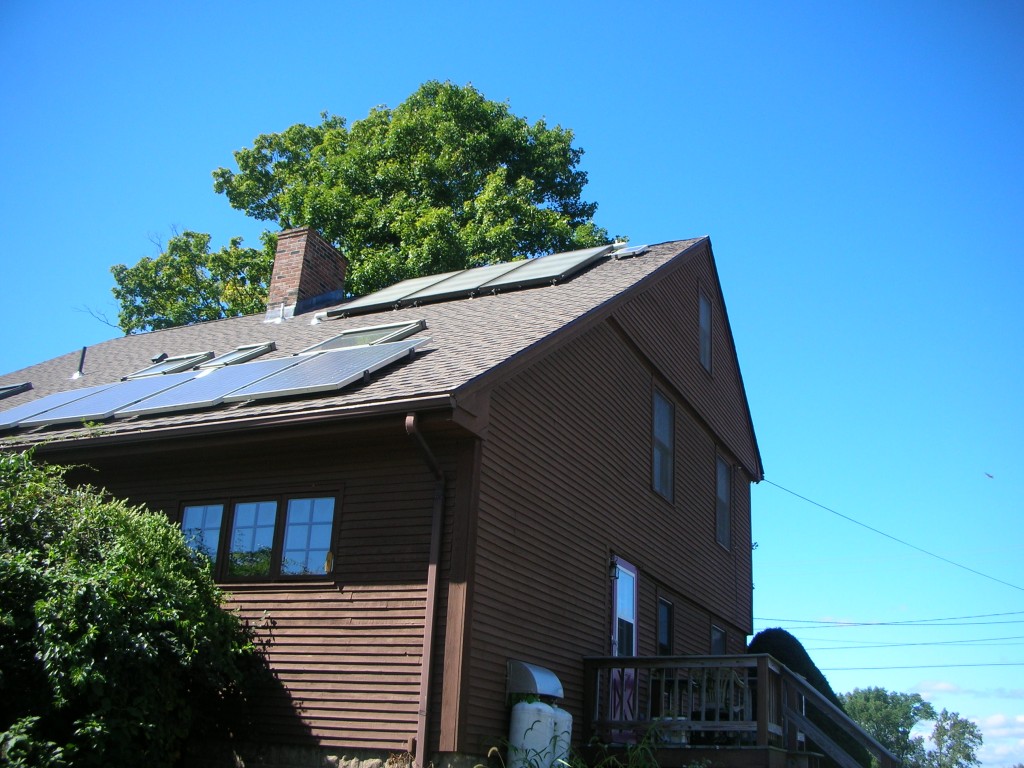
I live in a house built in 1743, which we solarized. It has both solar hot water and a small PV system–and we hope to tie in to the cow poop-powered methane generator that our farmer neighbors are building for their farm that was established in 1806. My neighbors across the street from the farm put geothermal in their 1747 home and use it for heating, cooling, and hot water.

My solarized 1743 Saltbox farmhouse. The three panels at the top are for hot water; the four at the bottom produce 1KW of electricity.

And we live in Massachusetts, a much cloudier and colder place than many other parts of the US, and the world. Similarly, cloudy, cold Germany is a world leader in solar. If we can do it—so can you.

Facebooktwitterpinterestlinkedinmail

Hands down, my favorite commercial of the Olympics so far–and in fact my favorite TV commercial of the last several years, in any context–is Nike’s “Find Your Greatness: Jogger” (The full transcript,and the one-minute video, are at that link.)

The entire video is an overweight kid running at the camera, starting quite some distance out. Working hard, but not being fazed.

When I saw it on TV, I thought it was an  60-something overweight man. Looking again, I see it’s a kid. But the message of empowerment is the same.

Especially when the voiceover says (in part),

Somehow we’ve come to believe that greatness is a gift reserved for a chosen few, for prodigies, for superstars, and the rest of us can only stand by watching.

You can forget that.

Greatness is not some rare DNA strand, not some precious thing. Greatness is no more unique to us than breathing.

As a somewhat overweight guy who will be 60 in five years–and who has lost 15 pounds since upping my daily exercise regime from 30 to 60 minutes, to 60 to 120 minutes. The ad resonates with me. And not a lot of ads do.


Facebooktwitterpinterestlinkedinmail

Nothing cloak-and-dagger, but I recently took a journey to a secret location.

This happened because a few weeks ago, I asked my wife what she’d like for her birthday. “Take me on a trip,” she said. So I took her on a mystery trip. She knew the dates and vaguely where we were going, but not the exact city, and not what we were doing (a ten-day world music and dance festival in Drummondville, Quebec, three days of which we got to attend).

This is fun! And we have a history of things like this. For my last birthday, I asked to be blindfolded and taken to a restaurant I’d never been to. Without her asking, I’d done that for my wife several years earlier.

Keeping some mysteries and secrets is a very healthy thing in a romantic relationship.

Facebooktwitterpinterestlinkedinmail