Yesterday, two long-awaited and seemingly unrelated milestone events occurred in the Connecticut River Valley of Massachusetts (where I live) and Vermont.

  1. Passenger train service was restored to Northampton and Greenfield, MA. The first commercial passenger trains since 1987 to use the Connecticut River tracks between Springfield, MA and Brattleboro,  VT made initial northbound and southbound runs between New York City and St. Albans, VT (a tiny village at the Canadian border). While only one train per day in each direction will make this run, it marks a rare expansion of long-distance passenger rail service in the US. Plans call for adding a stop at Holyoke, MA once that station is rebuilt in 2016, and there’s discussion of running several commuter trains a day at some point in the future—which would allow people to actually substitute train travel for driving.
  2. The Vermont Yankee nuclear power plant, opened in 1972,was taken off the grid and permanently shut down. This GE Mark I plant, which uses a reactor design nearly identical to Fukushima’s, has been operating unsafely since its earliest days—I’ve seen an excerpt from the long, long official government safety issues report of March, 1974, and it isn’t pretty—and illegally under Vermont law for nearly three years (since March, 2012).

The forces that created these two events were very different: government efforts for the train, a combination of citizen activism and market conditions for the shutdown. But several common threads across the wider map of society show that these victories are actually linked. Both were responses to growing perceptions that:

  • We need to think bioregionally
  • We have to create energy and resource sustainability
  • Both of these milestones will create the kind of economic impact we want to see: moving toward conservation, renewable, safe energy sources and transit-oriented development boosts, smaller, local businesses and encourages changes in consumer use patterns
  • Both are better for the environment (do NOT let anyone try to tell you that nukes are environmentally benign—the claim of lower carbon footprint is false if you count the entire fuel cycle, and the environmental consequences of an accident are catastrophic)
  • Citizens, individuals, can make a difference—in our use patterns as well as our advocacy
  • Change is possible, even when it looks hopeless

Of course, there’s more work to be done.

To make the train viable, they really need extend service to Montreal, as was true in the distant past. Reasonably priced service between NYC and Montreal  (also serving population centers en route: Bridgeport, New Haven, and Hartford, CT; Springfield, MA; Burlington, VT) will keep a lot more of the seats occupied and create economic viability that will be hard to find if the train ends in nowheresville. Even from NYC, when you count time driving to the airport, time at the airport, and time getting from the airport to an inner-city final destination, train travel within a few hundred miles would not be that much slower than flying, and a good deal more pleasant. From Northampton or Greenfield, MA, it’s a no-brainer. Rather than drive 40 or 60 minutes south to the airport and getting there 90 minutes before a flight, ride the comfortable train in the direction you want to go. By the time you would have boarded the plane, you could already be in central Vermont, half-way to Montreal.

And to really boost the economy without Vermont Yankee, we need even more activity on solar, wind, geothermal, deep conservation, etc. We have to make up the loss to the power grid, and replace the jobs the plant had provided. The good news? Investment in these technologies creates a lot more jobs—22 times as many if you count construction jobs, and 148 times as many permanent jobs—than the same expenditure in nuclear, and a lot of that filters down to the more economically marginal who can get good jobs in these sectors.


Facebooktwitterpinterestlinkedinmail

I rather hoped we’d won the clean air vs. smokers fight. There’s certainly been huge improvement, but it crops up all over the place.

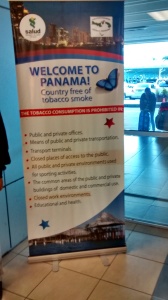
We were just in Panama, and were greeted at the airport with an optimistic sign announcing that it’s a smoke-free country. Not a reality, but I must say smoking was a very small inconvenience there. Far, far worse in many other countries I’ve visited.Welcome to Panama: Country Free of Tobacco Smoke (Sign in Panama City International Airport)

One of the things I’m really proud of in my life is that I initiated the first nonsmokers’ rights regs in Northampton, Massachusetts, back in 1983. We made restaurants set aside 25% of seating area for nonsmokers, and within a few years, not only had most restaurants gone nonsmoking, but a whole lot more had opened and they were drawing from a 50 mile radius–because once they didn’t have to gag on other people’s smoke, a whole lot more people started going out to eat! Actually, the very first bit of activism that I can remember engaging in, at age THREE (yes really), was taking cigarettes off the coffee table and breaking them in half, during a party my parents were throwing. It wasn’t out of malice but out of a very clear sense of self-protection.

From there came a lifetime of social and environmental activism. I just turned 58 this week, so I’ve been at it for 55 years! It;s nice to be able to claim a few victories, one of which was that nonsmoking law more than 30 years ago.

Facebooktwitterpinterestlinkedinmail

I saw “42” when it came out and liked it a lot.

It is hard to stay focused on changing the world when you look around and see not only the same battles all over again, but in many cases the same increasingly elderly activists joining those battles. For me, the wave of youth activism that started with Seattle in 1999 and crested with the Occupy movement–and will return when we least expect it—is very exciting, because it means there IS a critical mass for social change one and two generations younger than us.

I also avoid burnout by regularly thinking about all the areas where we HAVE made progress. And while police violence is an area that needs a LOT of work (since the 1960s, I haven’t understood why they reach for bullets instead of stun guns first), I think about what it was like for blacks in South Africa, Rhodesia, and the American South in my own lifetime…the way the environmental movement has gone from fringe to mainstream…the shattering of the idea common when I was a kid that the only appropriate careers for women were teaching and nursing and domestic work…the relatively new understanding that domestic violence and hate speech and school bullying are crimes we don’t have to tolerate…the string of fallen-dictator dominoes around the world, from throwing off the shackles of colonialism in Africa to the Arab Spring. (We may not always find the replacement governments an improvement, but the truth is, when the people say ENOUGH, governments topple and there is a brief space for something better. Once in a while, as in Mandela’s South Africa, that better thing actually emerges victorious.)

In other words, I look around and I see that within the brief span of my own lifetime (I turn 58 on Wednesday), we’ve made very real change on many fronts, even if it feels like we’re running in place or even backsliding.

These are what gives me hope and keeps me working for peace, justice, and the planet.

The above is my response to a friend posting her response to the movie, “42,” about Jackie Robinson and the integration of baseball. She wrote,

Black Lives Mattered in that struggle against racism in baseball–perhaps the beginning of the civil rights movement…Sixty years later, same struggle. Oh, God help us win this time ’round. Does the arc of justice bend?

Facebooktwitterpinterestlinkedinmail

I got sucked into a debate on Facebook following a high school classmate’s posting a meme of some of Obama’s  economic achievements: Dow Jones increasing from 7949 to 17,830 (that’s more than 124 percent, if I’m figuring correctly); unemployment down from 7.8 to 5.8 percent; GDP from NEGATIVE 5.4 to POSITIVE 3.5 percent; and consumer confidence from 37.7 to 94.5 percent from the time Obama took office.

But as these kinds of discussions often do, it quickly turned toward non-economic politics. And good progressive that I am, I put in this comment:

Robin, you wrote, “OH I know Bush had his share of crap also but at least he proudly and openly loved this country.” I am sorry, but if loving your country means bringing it illegally into wars under utterly false pretenses, wrecking the economy, suppressing dissent (continued, to his shame, by Obama), instituting torture, dissipating international goodwill, etc., this is a “love” that needs serious social-work intervention. When an abuser says “I love you and I’ll never hit you again,” we’re skeptical. Bush was an abuser.

The person I quoted than asked me if I didn’t remember 9/11, and wasn’t Bush justified in going to war. She also asked me if I was “also a Jewish Democrat that thinks Obama is good for Israel or do you care”

I responded:

1. Of COURSE I am aware of the horrors of 9/11. I spent two weeks afterward trying to find out if my ex-housemate from Brooklyn days was OK; she was living two blocks from the WTC (she was uptown at the time, fortunately, and now lives in Colorado). And I’m one degree of separation from a couple of people who died that day. BUT Bush made war on Iraq, which had absolutely nothing to do with it (it’s well documented that Bin Laden and Saddam hated each other)–and, it turned out, didn’t have WMDs either. The terrorists were mostly Saudi. Afghanistan, along with Pakistan, actually did shelter the terrorists–but the appropriate response to a criminal conspiracy and criminal acts is not to destroy an entire country but to go in with a police action, capture the perps, and put them on trial. You talk about “an arrogant and narcisitic man who has tunnel vision and refuses to listen to the American people.” That would describe several US presidents, including both Obama and Bush, as well as Nixon, among others. I was out there as part of the largest peace demonstrations in history, urging Bush NOT to make war on Iraq. It was totally predictable that this would only create instability, blow away our foreign allies, and provide lots of recruitment material for terrorists. I think the Iraq war may be the worst foreign policy debacle of all US history.

2. As for Israel: I was just there this summer, and spent a LOT of time talking to all sides (including my Israel-right-or-wrong West Bank settler family members). This is not a simple situation, but ultimately, the repression and racism from Israel against the Palestinians is a far more destabilizing influence. Netenyahu’s policies do not encourage peace. They inflame hatreds. Then the Israelis cry that the Arabs hate us. There have been horrible crimes on both sides–but revenge is not the answer. Somehow, we have to get past that and make peace, as happened in Ireland/Northern Ireland and South Africa. Wallowing in the hatred just boils the cauldron harder. I do think that the majority of Israelis AND Palestinians actually want peace–but the extremists on both sides look for any wedge they can. I take hope from groups like Combatants for Peace and Neve Shalom, and it made me very sad today to hear that a joint Jewish-Arab school was torched by anti-Arab extremists. You make peace with your enemies, not necessarily your friends. Obama showed some leadership early in his presidency and then largely ignored the whole issue. He should show some more.

So, at the risk of throwing kerosene on the flames, let me ask you: what do you think of these two presidents’ foreign policy legacies? I will not censor dissent, but I will block name-calling and uncivility—so play nice, but tell me what you think.

Facebooktwitterpinterestlinkedinmail

To lose Pete Seeger so soon after Nelson Mandela–two great champions of justice and democracy! If you want to know the true definition of an American Patriot, it’s spelled P-e-t-e  S-e-e-g-e-r. Not only was he an extremely talented musician and a devoted rabble-rouser on a host of social, labor, and especially environmental causes–for which he suffered greatly in the 1950s and ’60s–and not only can he claim a major role in cleaning up the Hudson River and co-founding the amazing Clearwater sloop and organization and folk festival…he was one of the most humble people I’ve ever met.

I used to see Pete Seeger at the Clearwater Revival, wearing a volunteer shirt and picking up trash. I got to bang a few nails with him once as he was building the Woody Guthrie (one of I think three small boats he built along with the Clearwater and the Sojourner Truth). And I interviewed at least once, saw him perform dozens of times live and numerous more on TV–growing up as a public television kid in New York City, where once the blacklist was lifted, he was frequently found on Channel 13–and hung out with him at some People’s Music Network conferences. He helped start PMN, started Sing Out! magazine, the Newport Folk Festival, a bunch of environmental and peace organizations, and many other ventures for the public good.

His 1963 Carnegie Hall concert is one of the 10 albums I’d absolutely insist on having if I were stranded on a desert island with one CD holder. Among other things, it contains the best of his dozen or so recordings of Wimoweh, long before that other group made it a top-40 hit. I own many other of his records, but that one is a standout.


And Pete walked his talk. Though he could certainly have afforded much grander housing, he lived for the last many decades in a small cabin outside Beacon, New York, on his beloved Hudson River, heating with wood he chopped himself. Though he could have gotten all wrapped up in ego, he spent his entire life championing newer musicians. He helped bring Bob Dylan and Tom Paxton to the world’s attention, as well as later songwriters like Dar Williams and many others.

Pete was one of three amazing lifelong activists born in the spring of 1919 who I knew personally. Miriam Leader (not much known outside of her various home communities) passed about a year ago. And Frances Crowe continues her active work for peace, justice, and the environment. The world is richer because these three people with giant hearts walked its ground. Goodbye, Pete, and thanks for all you’ve done to make my life richer. You’re probably already starting to organize amongst the angels ;-).

Facebooktwitterpinterestlinkedinmail

Progressives can be a gloomy lot. Too often, we focus on all the things wrong with society, all the problems we need to fix. I say “we,” because I’ve certainly done my share of that global kvetch.

But every once in a while, we actually win a major victory. I’ve been actively involved in a few of them, and I have to tell you, they feel great.

One of my favorite members of Congress, Rep. Alan Grayson (D-Fla) knows the importance of celebrating our victories. He sent out an e-mail with the headline, “Hey, We Progressives Won Something.”

I opened the e-mail and discovered what we won: we didn’t go to war against Syria. And Syria destroyed its chemical weapons stockpile, under international supervision. The massive outcry of opposition certainly helped us get there.

Grayson gives us a lot to celebrate:

Let’s celebrate the war that never happened.

Let’s celebrate NOT having to hold sad and somber funerals for young Americans who would have lost their lives fighting in Syria.

Let’s celebrate NOT having to nurse and care for the wounded veterans who would have returned from the U.S.-Syrian war.

Let’s celebrate Congress NOT having to appropriate billions of tax dollars in emergency spending to support U.S. military operations in Syria.

Let’s celebrate NOT having to attend bitter marches protesting the U.S. war in Syria.

Let’s celebrate NOT having to rebuild Syria’s roads and bridges and schools, so that we can have a shot at rebuilding our own.

Let’s celebrate peace.

We won the battle, and the military-industrial complex lost the war.

We should be proud of our victories, because our victories matter. I know that politics sometimes can seem discouraging right now. Progressive often seem to lose, and lose frequently. But, you know what? Sometimes we win. And when we win, we save lives. We promote equality. We serve the cause of justice. We improve people’s lives.

(You can read Alan Grayson’s whole essay at this blog.)

Indeed, we do! Our actions–as individuals, and especially when we band together–actually do make a difference. Think how much poorer the world would be if the likes of Nelson Mandela, Lech Walensa, Wangari Maathai (the tree-planting woman of Kenya, who won a Nobel Prize for her work establishing a greenbelt in her country), Gandhi, Gray Panthers founder Maggie Kuhn, and Martin Luther King, Jr. had not walked it.

And you don’t need to be an activist. The world is richer for the presence of scientists like the brilliant energy strategist Amory Lovins, who is still very much alive–and Jonas Salk, Rachel Carson, and George Washington Carver, who are not…writers like Harriet Beecher Stowe, Alice Walker, and even Chicken Soup’s Jack Canfield (his The Success Principles is the one self-help book I regularly recommend)…and ordinary people whose names you won’t recognize, who turned their lives into blessings for the world. I’m going to honor one of those unknown heroes by name: my late mother, Gloria Yoshida, who was a civil rights volunteer in the 1960s. If a black person was told an apartment had already been rented, my 5’3″ white, Jewish mom was one of the people who would go and try to rent it afterwards. I remember her yelling at our own landlord, who towered over her, and looked pretty ashamed as she lit into him because “you just don’t want to rent to them because they’re black.”

That family history made it easier for me to take on a long list of causes over the past 40 years–even organizing the movement that saved a threatened mountain while all the “experts” said “this is terrible, but there’s nothing we can do.”

What are YOU doing to make the world better? Please share in the comments section, below.

Facebooktwitterpinterestlinkedinmail

Buying local. Worker co-ops. Neighborhood resiliency. Community control. Does it feel overwhelming trying to track and sort out all of these community economy movements and buzzwords?

Writer Laura Flanders, Yes Magazine, and GritTV have collaborated to make it easier for the rest of us. They’ve launched a new feature called Commonomics, and the first installment is a nice roundup of some of these trends, told through the stories of people whose stories rarely make it into mainstream media.

The initial installment is called “Welcome to Commonomics: How to Build Local Economies Strong Enough for Everyone,” and OI recommend reading it.


Facebooktwitterpinterestlinkedinmail

I revisited a post I’d written on election reform, back in 2007. In that post, I listed seven specific steps the United States could take to make its elections more representative and relevant.

But I left out a huge one—did I think back then, that it was so obvious it didn’t need to be listed?

Getting. Money. Out. Of. Politics.

That means not only repealing the wretched anti-democratic Citizens United decision, but much more. It means making politicians once again responsible to the people, and not to well-funded lobbyists. It probably means public funding of candidates, and limits on the dollars that can be spent. Ideally, it would mean an end to TV advertising of smear ads, and replacing them with a list of candidate websites (not just the largest parties but any party that achieves an agreed threshold of support) where people could learn the candidate’s positions on actual issues—in more depth than attack sound bites.

Facebooktwitterpinterestlinkedinmail

I hope Obama and the Democrats learn their lesson. when they refuse to comprise on things that should not be compromised on, when they stand up for their principles, they win.

What a great president he might have been (and perhaps still could be) if he had figured that out in 2009. There is a difference between conciliation and giving away the store, and every time he kowtowed, the other side saw him as weak, and took out their lances again to whittle things down even further.

Of course, it helped that progressives and liberals came out in force to tell him he was doing the right thing. One of the lessons Obama should have taken from the 2008 election campaign is that he can organize a large constituency that “has his back.” and we progressives can also organize to push him leftward when he dirfts like a rudderless boat in the face of pressure from the right.

We have to remember that Obamacare was a Heritage Foundation invention. The left wanted single-payer, which Obama refused to even discuss.

Facebooktwitterpinterestlinkedinmail

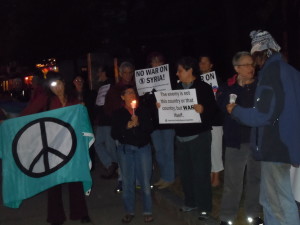
No War in Syria Candlelight Vigil, Northampton MA 9-9-13

Something magical happened at the peace demonstration in Northampton, Massachusetts tonight.

A young man crossed the street to read our signs, and then engaged in dialog with four of us. He told us that he was very ambivalent, because he didn’t want to be seen as supporting chemical weapons. I told him, “I don’t think you’ll find a single one of us [sweeping my hand to indicate the more than 200 demonstrators] in favor of chemical weapons. And it isn’t clear who it was that used the chemical weapons—but it is clear that war will not solve the problem, and will destabilize the region. It doesn’t have to be only two choices: war or no action. There are a lot of other options.”

Another demonstrator talked about the likelihood that Iran and Israel would be drawn into the conflict. And someone else noted, “200,000 people have died in this conflict. I don’t see that chemical weapons are so much worse than landmines as to be worth going to war.” To which the young man replied, “That’s a really good point. I hadn’t thought of it that way before.” No doubt reflecting on our questioner’s age, the fourth demonstrator talked about the likelihood that a new war could reinstate the draft.

I spoke again: “With the possible exception of the former Yugoslavia, I can’t think of a single war after World War II where war solved the problem, and I can think of many where it made it worse. I don’t understand how killing innocent people to protest the killing of innocent people makes any sense.”

At that point, the young man said he had to go meet his friend, but he thanked us for the dialogue and said we’d left him with a lot to think about.

To me, participating in this dialogue and watching a mind open in front of us (not necessarily change, but open) makes it all worthwhile. It is so rare to get immediate feedback that our actions make a difference—but tonight, I and three other people made a difference in thinking of one young man.

Never doubt that a small group of thoughtful, committed citizens can change the world; indeed, it’s the only thing that ever has.
—Margaret Mead

In 44 years of participating in political protest, I can count a dozen or so times where I could see instantly that my actions actually mattered. This was one of them. Another was the very first demonstration I ever went to, in 1969 when I was 12. That time, the person who was changed was me.

Facebooktwitterpinterestlinkedinmail