It covers a lot of ground: optimism, hope, organizing mass movements, climate justice, the role of indigenous people in todays struggles, and much more. I found it well-worth the 15 minutes or so it took to read the whole thing.
Three short excerpts from this long article:
1] I have often met people who think the time I have spent around progressive movements was pure dutifulness or dues-paying, when in fact it was a reward in itself – because to find idealism amid indifference and cynicism is that good.
2] [Halting the Keystone XL pipeline] was not a gift from Biden; it was a debt being paid to the climate activists who had made it an important goal. Patience counts, and change is not linear. It radiates outward like ripples from a stone thrown into a pond. It matters in ways no one anticipates. Indirect consequences can be some of the most important ones. [She goes on to trace the Standing Rock movement and AOC’s decision to run for Congress to earlier struggles that appeared, in the moment, to fail. These types of indirect sparks to deep change are something I’ve often written and spoken about, including this post about how one environmental justice action changed the world.]
3] We have victories. Some of them are very large, and are why your life is the shape it is. The victories are reminders that we are not powerless, and our work is not futile. The future is not yet written, but by reading the past, we see patterns that can help us shape that future.
One small quibble: while I agree with Solnit that individual lifestyle changes are far less consequential than mass organizing, and that the solutions have to really reinvent the entire worlds of business and government–I do think the lifestyle choices, the changes we make in the ways we are on this planet, should not be trivialized or dismissed.
Via Robert Hubbell’s always-optimistic Today’s Edition newsletter, which I read before breakfast every weekday morning. Hubbell is a champion of the Democrats and far more centrist than I am. But I love that he is always a cheerleader for what went right and a strong advocate of the need to keep organizing and working for change when things don’t go according to our wishes.
It is very unfortunate that the original developer didn’t get any guarantees that a buyer would maintain the fossil-free commitment written into the sale documents. Nonetheless, I think a creative and skilled attorney could make a number of different legal arguments that could force the developer to honor the agreement. Could the Environmental Defense Fund? perhaps take this on? It would be a great precedent to say that a community developed specifically as an eco-community could not then be put at the mercy of eco-hostile development.
As a non-lawyer, all I can do is speculate about the arguments a lawyer might use to block the conversion of the acquired parcels to fossil fuels (I have no idea if any of these would hold up in court and I am not presenting this as legal advice). Arguments could be made about such harms as
Introducing new health risks (especially to children)
Negative progress on climate that goes against International, US,Colorado, and neighborhood climate goals
Adverse possession (a doctrine that gives rights to squatters in certain circumstances)
The deliberate destruction of a cohesive intentional community
And of course, about consumers’ rights: this could clearly be seen as bait-and-switch: buying into a community with a stated purpose, and having that purpose violated, even shredded.
But the courts aren’t the only recourse. I do know something about organizing movements, and these neighbors should be organizing a movement. To list a few among many possibilities, they could be:
Organizing mass protests outside the developer’s office
Saturating the local paper with letters to the editor and op-eds
Enlisting allies in powerful environmental organizations, of which Colorado has no shortage
Protesting at the capital in Denver that their rights are being taken away
Contacting the press ahead of and after all of these events
Physically but nonviolently blocking attempts to connect the pipelines (note: this is illegal civil disobedience and participants might be subject to arrest)
Researching obscure laws that might provide tools that can successfully block the connection
Organizing boycotts and other public shamings of the developer
Plus, I really have to wonder what the developer is thinking. Eco-friendly homes are in high demand, can often sell for more than the price of comparable fossil-powered homes, and prove a skill set that many homeowners want. After all, people moved from other states just to participate in this community. And forcing eco-hostile housing development into an eco-friendly community is a recipe for public relations disaster and a bad, bad reputation.
Why not simply stop, think about the benefits of keeping this community identity, and use it as a marketing tool? That would make so much more sense than risking ongoing hostility, a ruined reputation and possibly much worse.
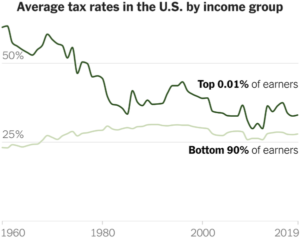
One of the graphs in the Leonhardt article shows that tax rates for the top 0.01 percent of earners are approaching the rate foe the bottom 90 percent.
But while those whose multiple lavish mansions represent only a tiny fraction of their financial worth also pay property taxes, most of their wealth is not taxed except that portion that arrives new each year (income).
The effective rate is much lower, though. Only the amount of income above the threshold for that rate (currently $628,301) is taxed at that rate. Each portion of income is taxed at the bracket for that level. So if you file singly and make $700,000 (and I don’t come anywhere near that), only $71,699 is taxed at 37 percent. The first $9950 is taxed at just 10 percent, the next $30,575 is taxed at 12 percent, and so on. This is why it is often an advantage to file jointly with your spouse–because more of your money is taxed at the lower rates. In the above example, $19,900 would be taxed at the 10 percent level, versus $99,000 if you split the income evenly and each filed separately.
Having dropped the tax rate on the wealthiest income earners by about 60 percent, the government has been considerably less aggressive about making up the difference. The One Percent used to pay heavily in the year they acquired the money–but now that they’re paying much less, an asset tax could help fund the things we really want government to do: Clean up the planet, educate and protect all its citizenry, provide services and a leg up for the disempowered, and make sure no one is crushed by the ever-growing costs of basic survival. In other words, Build Back Better and the Green New Deal. Both of these will create massive numbers of new jobs, clean up the planet, and leave the average person with more money in their bank account.
Advanced support systems for elders, children, people with disabilities, and others in need (this is a long academic paper but it has a one-paragraph abstract)
In our country, we are facing an absurd situation where two Democratic Senators representing less thanthree percent of the total population are holding America hostage. They say we can’t afford these investments, but they also shoot down all attempts to institute mechanisms to pay for them. And an even more absurd situation where most laws can only pass with a supermajority and virtually all Republican Senators refuse to vote for anything that the Democrats support. So much for the vaunted bipartisanship Senator Manchin in particular keeps insisting on. But the American people strongly support these investments.
It’s time to turn that support into action. First, write your Senators. You can find their addresses here. Use the appropriate sample letter (or letters, if you have one Senator in each party) from the three below as a model, but take three minutes to make it uniquely your own (especially the first sentence and the last three sentences), so it doesn’t look like a form letter. Better yet, write yur own, from scratch. If you live out-of-state, don’t lobby Manchin or Sinema directly. That will be counterproductive. Instead, reach out to friends, family members, people who are in the same organizations you participate in who do live in those states. If you are a business owner, start with “As a business owner and constituent in…”
Second, get involved. Do some phone banking or text banking or postcard writing. Show up when organizations like Fairvote, Movement Voter Project, Common Cause, voting rights divisions of NAACP and ACLU, and environmental groups hold rallies, lobbying days, meetings, and presentations. Personally contact your own friends and family. write letters to the editor for publication in your local newspaper. Be an election protection volunteer.
If you live in West Virginia or Arizona
Dear Senator,
As a constituent in [your town and state], I am deeply concerned at your role in blocking an agenda that most Americans support. 48 of your fellow Senate Democrats have shown incredible willingness to compromise with your demands–but you keep moving the goalposts. It is well past time for you to find a way to support these necessary Build Back Better, Green New Deal, and Voting Rights bills that will get the job done, give the Democrats something to brag about in next year’s crucial elections, and improve lives for all residents of our wonderful state. You will have another feather in your cap if you can bring these bills into law, even if it means getting them out from under the filibuster. But you will lose local support if you keep blocking the progress we so desperately need. I am eager to vote for a Senator who has put the needs of constituents ahead of narrow corporate and special interests. Please BE that Senator.
Sincerely,
[Your name and postal/email addresses]
If You Have One or Two Republican Senators
Dear Senator,
As a constituent in [your town and state], I am deeply concerned at your role in blocking an agenda that most Americans support. President Biden came to you in a spirit of bipartisanship. Senators Manchin and Sinema came to you in a spirit of bipartisanship. 48 of your fellow Senators have shown incredible willingness to compromise with your demands–but you keep moving the goalposts. We citizens of [your state] did not elect you to be an obstacle to programs that we desperately need, just because it wasn’t the Republicans who proposed them. It is well past time for you to find a way to support necessary infrastructure that goes beyond roads and bridges, address the carbon crisis with job-creating green initiatives, and ensure that every citizen has the right to vote and have that vote counted. Please, let’s see you be a Senator who represents the entire state, not just narrow special interests and conspiracy theorists. You will lose local support if you keep blocking the progress we so desperately need. I will use my volunteer hours and my campaign contributions dollars to vote for a Senator or candidate who has put the needs of constituents ahead of narrow corporate and special interests. Please BE that Senator.
Sincerely,
[Your name and postal/email addresses]
If You Have One or Two Democratic Senators
Dear Senator,
As a constituent in [your town and state], I am deeply concerned at the lack of progress on an agenda that most Americans support: upgrading necessary infrastructure that goes beyond roads and bridges, addressing the carbon crisis with job-creating green initiatives, and ensuring that every citizen has the right to vote and have that vote counted. I appreciate that you and 47 of your fellow Senators have shown incredible willingness to compromise–but Senators Manchin and Sinema keep moving the goalposts farther backward and the Republicans are not even interested. We citizens of [your state] are counting on YOU to move those goal posts forward again, to convince those obstructionist Senators that they need to represent the entire state, not just narrow special interests and conspiracy theorists. If you can get them to stop blocking the progress our nation so desperately needs, I will eagerly use my volunteer hours and my campaign contributions dollars to support you as a Senator or candidate who has convinced the holdouts to put the needs of constituents ahead of narrow corporate and special interests. Please BE that Senator.
This is an issue important enough to me that I have a category in this blog called “Talking to the Other Side.” If you click on the tab with that label, you’ll see all my posts on that topic. You’ll also see a whole lot of discourse between liberals/progressives and conservatives over the last many years of my Facebook feed. And yes, I go to as many Braver Angels events as I can.
I don’t typically get to play detective—but one recent morning, I received a priority morning FedEx delivery containing a check for just under $6K from a company I’d never heard of. No note. No trace of this company or even the dollar amount when I searched my email. Some other red flags, too, like a total mismatch of sender and company (different states), the misspelling of the bank’s name and the absence of any branch address—although it had several security features that seemed to check out.
Having trained as a journalist and been online since 1994 (not counting a brief experiment with Compuserve in 1987), I have pretty decent research skills. So the first thing I did was call the phone number on the check, where I got a recording about the “text subscriber” not being available (not a company phone, in other words). Second, I googled the bank routing number, which came up empty—so I flipped it around, searched for the routing number for this bank’s Pennsylvania branches, and got a match. I was expecting it to be the group of numbers on the left, but it was the middle set, which is why I didn’t find it the first time. Next, I searched for the company name. It’s a real company, it’s in the green energy industry, and it is located where it says on the check. And then I left a voicemail for the accounting department.
The company controller called me back about two minutes later, confirmed that the check was bogus, and was thrilled that I was willing to send pictures of the check and the FedEx envelope. She said it was the second call like this she’d received today. So, hopefully, we’re catching a crook. It was actually kind of fun, and not hugely time-consuming. Plus, since I’m a consultant to green and socially conscious businesses, I mentioned that I’d be happy to send information on how I help companies like hers, if she wanted to pass it on to her marketing people—and in her thank-you note, she mentioned that she’d passed the correspondence to the company president. It would be such sweet irony if this ended up netting me a real client.
And later in the day, I got a note from someone who had been in discussion with me about writing an article—and with whom I was treading cautiously (including requesting payment ahead in full via teller’s check) because there were definitely some yellow flags in his correspondence. It was the scammer! So I wrote back to him, “I only received the check this morning with no note, drawn on the account of a company I’d never heard of, and for an amount almost triple what I had requested. I didn’t even know it was from you until just now (there was a sticker over the return address so I couldn’t see it until I pulled it off). The phone number on the check was bogus, so I called the company, and they said the check was bogus as well. Needless to say, we will not be doing business.” And then I forwarded the entire email correspondence to the company whose check he forged! Now, the company has the phone number the sender gave FedEx, the one on the check, and the crook’s working email address. I’m hanging on to the original check and envelope for now, in case they are needed for a mail fraud case.
This shortcuts the typical interaction, where scammers say they accidentally overpaid, you refund the difference, and then you’re out of luck when the first check bounces :-).
I still believe that most people are basically good—but there are enough bad apples in there that you really do have to be careful. When I punch my security code into an ATM or card terminal, I always shield the keyboard with my other hand. My passwords are not guessable and the cheat sheet I’ve made for them not only uses a non-obvious file name but has nicknames that are only meaningful to me. I will instantly understand what “1stdaupobhse” means, but it would be meaningless to anyone else. And I keep a virus scanner on my computer, as well as file backup to the cloud. And when I get a Facebook friend request from someone who is already my friend, I post publicly on their timeline to warn people, give the URL of the scam profile, and suggest they change their password and report the scammer. In rare instances, it turns out the person found it easier to start a new profile than to get a new password for the existing one (yes, I have some seriously technophobic friends)–but usually, it’s an attempt at identity theft.
In short, we can all take little steps to ensure security and make us all safer, without getting compulsive about it. If you’re still using any passwords that are really easy to guess, change them! And if you’re suspicious, listen to your intuition and take some basic precautions. Don’t send money or give cc information to anyone who contacts you by phone or email with a crazy story (like your grandkid is stranded in a foreign country with no money). If someone claims to be from a government agency (especially a tax department), verify by calling the agency through the number on their official website (NOT a number they give you over the phone or in an email). Don’t panic and do verify. If you get the “grandkid” call, call your grandkid’s cell phone, and if you don’t get an answer, call their parents. And remember: a foreign prince doesn’t need your help to facilitate an illegal money transfer, an award that requires you to pay anything is not an award but a scam, and if it sounds too good to be true, it probably is. Snopes and Google are your friends. So is AARP’s fraud research, if you’re a member. A little due diligence can save a lot of heartache.
This is not a coincidence; Gil sent the link to Joel’s article around before the call to everyone who registered for it.
I found the article provocative enough that I posted this comment (and the Living Between Worlds open discussion was so fascinating that I plan to listen again once the video is available):
Good piece, Joel. You’ll be glad to know Gil Friend @gfriend kept his promise to discuss this topic in the monthly “Living Between Worlds” brain trust Zoom.
I come at systemic change through a lifetime of weaving together my two “split personalities” as both a marketer specializing in green and social change companies/products/services and as an environmental, social justice, and peace activist whose credits include starting the movement that saved a threatened local mountain.
Through the nonviolent social change lens of people like George Lakey and Erica Chenoweth, I look at institutional structures: how they prop up the system, create major barriers to change, and ultimately fail because they fail to change–and where they are weak and shaky and vulnerable. Sometimes they collapse with surprising speed (think about the Arab Spring a decade ago, or the government of Afghanistan just in the last ten days. Sometimes, it takes decades. The Quakers targeted slavery for about a century before it was illegalized.
But the marketer in me says systemic change is far more likely to succeed if the effort was made to change popular opinion first. The US civil rights movement created the opinion shift that made civil rights legislation not only possible but enforceable. Opposition to the Vietnam war was strong enough that LBJ felt a need to withdraw from his re-election campaign, years before the troops finally came home. And when we did Save the Mountain here in Western Massachusetts 21 years ago, our first task was to change the “this is terrible, but there’s nothing we can do” mentality. Once we shifted that, the victory was very quick.
The owner of the Step Into the Spotlight discussion group, Tsufit, asked what kind of marketing could help Canada go smoke-free by 2035. My answer doesn’t fit into LinkedIn’s comment space, so I’m sharing it here:
Ooooh, what a wonderful project! If I might make some cross-border observations that an actual Canadian might find lacking, I would, first of all, identify the key attributes of not just each province but each region of each province and target different themes and different platforms that will work will for each. I’d remember the wild successes on my side of the border of “Don’t Mess With Texas”–which started as an anti-littering campaign and became an unofficial state slogan and a core part of Texans’ identity–and the “I Love New York” campaign that helped the Big Apple find its way from near-depression in the 1970s to, once again, the happening place that “everyone” wants to be part of–and then the state successfully expanded the campaign to talk about all the other parts of New York State.
In libertarian rural Alberta, it might be about the personal freedom to enjoy clean, smoke-free air and the desire to keep out of the clutches of National Health Service doctors by staying healthy. For Quebec City, ads (in French, of course) that might make Anglophone Canadians choke but appeal to the sense of separate identity, e.g., “Oui, we are a beautiful capital city–but we also want to be the capital of good health and clean air.” In a more rural part of Quebec, such as the Gaspésie, they might tout the health benefits of the rural lifestyle, fresh food, and clean lungs.
In the Inuit areas, it might focus on communitarianism, tribal values, etc. For the Metro Toronto and Vancouver markets, perhaps an appeal to cosmopolitan sophistication. “Thinking of smoking as cool is SO 1950s. We’re too smart for that now.”
This national effort of a series of hyperlocal campaigns would need people on the ground in each area to really figure out the touchpoints for each audience slice. And it would be across many media, from traditional TV and print and radio to Instagram, TikTok, etc.
AND it would include a significant curriculum component starting around 3rd grade, to build the defenses of rising generations against tobacco industry hype, to inoculate students with the knowledge of health, economic, and pollution/carbon consequences, and to foster development of healthy lifestyles and a different set of pleasures.
We hear a lot about being shamed for doing the right thing–yet there’s little mention of the internal shame we might feel when we FAIL to step up and be vulnerable. I have very few regrets in my life, but I feel shame about three incidents where I had the chance to do the right thing and didn’t take it: one was right after we bought our first house and our immediate neighbors invited us over to get acquainted–and made a racist remark about Puerto Ricans. Knowing I was going to have to live next to these people for years, I chose to remain silent and I still feel shame over that. The other was many years earlier, when, as a teenager in high school, I walked by a large man who was addressing a petite young woman. He turned straight to me and asked, “doesn’t she have tiny t–ts?” I knew I didn’t want to encourage him but at 14 or 15, I didn’t yet have the languaging to effectively interrupt that kind of oppression. I didn’t know how to throw some comfort her way without sending him into a potentially violent rage against her. I took the cheap cop-out, “I can’t see. Her arm is in her way.”
The third was even earlier. I think I was 11. My only summer in sleep-away camp. There were six of us in my bunk. Three were bullies, two of us were constantly picked on, and the 6th was our protector. Near the end of that horrible two weeks, the bullies forced me and the other scrawny kid to fight each other. He was even weaker than me. Shamefully, I chose the self-protection of not getting beaten up by the three thugs. I hit him as gently as I could. Our protector (a small-framed boy, but one with enormous self-confidence) walked in near the end of the battle and was disgusted with the me. I lost his respect. He gained even more respect from me. And I don’t think I’ve hit anyone since.
And I was enormously proud decades later when my daughter, then just six years old, interrupted the bullying of the odd-boy in her kindergarten.
The shame of letting others down and not being true to myself I felt in these three incidents is very different than the shame I felt at about age 11 when I experienced a rape by a stranger on the street (yeah, I’m a male #MeToo). I felt horribly unclean and ashamed, but I knew this was out of my control. Still, it was four years before I could bring myself to tell anyone–and I don’t think it’s a coincidence that I didn’t discover my bisexuality until I moved 600 miles (1000 km) away from that stairwell.
There are plenty of times when I did speak out. When I did the right thing. When I took some personal risk. But these three failures still hang over me. The most recent was in 1986, yet, all those decades later, I am still ashamed.
Are there times in your life that YOU regret not stepping up?
Editor’s Note: Not only do I love the message about overcoming others’ fears, but I love that Dan was inspired to write this by a visit to the zoo. I’ve been saying for many years that we can find ideas anywhere. I even have a big research folder for a book I haven’t yet gotten around to writing, “How to Find Your Next 10,000 Ideas.”
Not too long ago, when I was at the Nashville Zoo with my granddaughters, we watched as the zookeeper offered to let small children hold an ostrich egg.
These amazing eggs are approximately twenty four times the size of a chicken egg and weigh about three pounds. But rather than embracing a once- in-a-lifetime experience, almost without exception the parental caution was—”Now, don’t drop that egg.”
Just what do you suppose was at the top of every little child’s mind as they carefully took that big egg into their arms? Were they marveling at the size, wondering how long it would take to hatch, imagining using that egg as a volleyball, or basking in the educational enrichment of the moment?
No, I suspect that the thought foremost in their minds was—”If I drop this egg I’m in big trouble.” I doubt that the teaching experience went much beyond the fear of dropping that egg.
Fear masks our ability to see the positive. If you’re focused on not dropping the egg you:
1. Will not try for the promotion now. “I’ll just hang on to what I have.”
2. Will not start a business in this economy. “It’s too risky.”
3. Will not buy a house. “If I ever get behind on payments the bank could foreclose.”
4. Will never love deeply. “What if I’m not loved in return?”
Most parents have never held an ostrich egg. They base their experience on knowing chicken eggs are fragile and break with the tap of a spoon.
Most people don’t know that an ostrich egg has a thick shell that requires a hammer or drill to crack.
Maybe the people holding you back have experienced too much pain, shortage and despair. They may be watching too much news on TV.
But don’t let their fear deprive you of a once-in-a-lifetime thrill.
Go ahead, take that trip, write that book, open that ice cream shop or buy that little house you’ve been wanting.
Live your life driven more by curiosity and passion than by fear.
And if you drop the egg, call twenty of your friends and enjoy an incredible omelet.
I hope this serves you well,
Dan Miller
This is an excerpt (used with permission) from Dan Miller’s book 48 Days To the Work and Life You Love. You can find out more at https://www.48days.com
Open letter to the government of the City of Northampton, Massachusetts
Context: Residents of a tiny one-block street called Warfield Place have been fighting to preserve a line of beautiful cherry trees planted several decades ago. The city (pop. 28,726) has claimed that the street needed to be redone and these trees are at the end of their useful life, while residents said the trees could easily survive for a few more years–and that many other streets with more traffic and worse infrastructure conditions deserved higher priority. Both sides have brought in arborists who support their positions. The residents recently brought in support from national leaders in the Buddhist community, and ordained the trees as Buddhist priests. Neighbors were actively negotiating with the city, as well as seeking help in the courts. Thursday morning, the city brought in heavy equipment and a large police presence and destroyed the trees.
For the numerous stories chronicling the controversy over the past several months, visit http://gazettenet.com and use the search tool at the top to look for “warfield place cherry trees” (nonsubscribers get five free articles per month). See more pictures of the trees in bloom taken by Shel Horowtiz (author of this open letter and owner of this blog) and protest signs at (20+) Facebook
A Warfield Place cherry tree in bloom, May 2, 2021. Photo by Shel Horowitz.
A Warfield Place cherry tree–close-up of flower, May 2, 2021. Photo by Shel Horowitz.
It was shocking to read in yesterday morning’s Daily Hampshire Gazette that the sacred cherry trees the community has fought so hard to preserve that it actually ordained them as Buddhist priests–the trees that hundreds of local residents and many others from farther afield, including several of national stature, signed petitions and joined protests and wrote letters to the editor to save–were torn down with no warning, even while the city was aware that a judge was considering a restraining order, and even while the city and the residents of the street were still negotiating.
The trees were murdered at 9:00 a.m. and the restraining order that would have prevented their untimely death was given at noon.
Why the rush? Why the need to act unilaterally when many people were willing to work out a solution that made sense for all parties: the city, the residents, and of course, the trees?
This is the legacy of Public Works Director Donna LaScaleia and Mayor David Narkewicz. All the considerable good work of the 10-year Narkewicz administration will not sustain its former reputation for progressive policies and fostering democracy. When people remember this adinistration, they will not remember how it stood against racism and for inclusion, how it was a champion of addressing climate change. Their memories will be rooted in this horrible and utterly avoidable incident.
It was an attack not only on these beloved trees, but an attack on democracy–on the ability of people to feel they have influence over their own lives, and their ability to have their concerns listened to, and, hopefully, acted on.
And it was also an attack on separation of powers in government; the city was aware that a judge was considering the injunction that was eventually granted (too late), but couldn’t be bothered to let that process play out.
And of course, removing living trees goes against the Narkewicz administration’s long-stated goals of mitigating climate change locally. Trees are far and away our most effective weapons against climate catastrophe.
I think what may have happened was a felt need to be right at all costs–not to admit that there could have been one of several other ways forward that would have had far more positive outcomes, such as:
Harnessing the neighbors’ considerable energy into a working committee that would actively participate WITH the Department of Public Works Director to develop solutions that worked for the city and the residents. Even if the ultimate outcome were the same, the residents would have owned it.
Moving Warfield Place off the calendar for a few more years until the trees died naturally, while adding plantings of newer trees so when that day came, the street would have a decent tree-canopy-in-process.
Redirecting the construction funds to a city block whose need for repair was undisputed.
This need to be right, to save face, culminated in an extreme wrong. The city engaged in a “process” that not only disenfranchised the Warfield Street residents, ending in a hostile unilateral action–it undermined Northampton’s reputation as a citadel of democracy, a place that values its citizens’ public discourse and involvement. This violation of residents’ real concerns makes it harder for the next administration to get people to even trust–let alone become involved in–city government. And the city has even created a construct where it faces accusations of a hate crime–even though Mayor Narkewicz spent so much of his decade as mayor creating a wonderful climate of acceptance and even embrace of diversity.
It’s very sad. It’s irreversible–the trees are gone, democracy was seriously weakened, and the city’s reputation is in tatters–and it was completely avoidable. I expected better of Northampton and am deeply disappointed.
While we can’t bring the trees back, and this action has done potentially permanent harm to Northampton’s civic virtue, it is still possible to atone. I ask in all seriousness: How, specifically, will the city make restitution? How will this administration restore confidence in the city? How will the city offset the negative climate impacts of the tree destruction? And how will the city make the residents and neighbors of Warfield Place whole again? It won’t be easy, especially this close to the end of this administration, but it has to be done, and done very soon. What exactly is the plan?