After I posted something opposing Brett Kavanaugh’s nomination, I received this comment from someone who prefers not to be named:
I voted for Hillary and most Democrats. Hillary lost. Trump won. The Republicans won. They get to govern and part of governing is choosing and confirming a judges. You can voice opposition, but when you are not in the majority, there is little else you can do. You are best advised to stop tilting at windmills with meaningless protests, petitions, and propaganda and instead find better candidates, finance them, work your precincts, get out your vote, win your elections, and become the majority again.
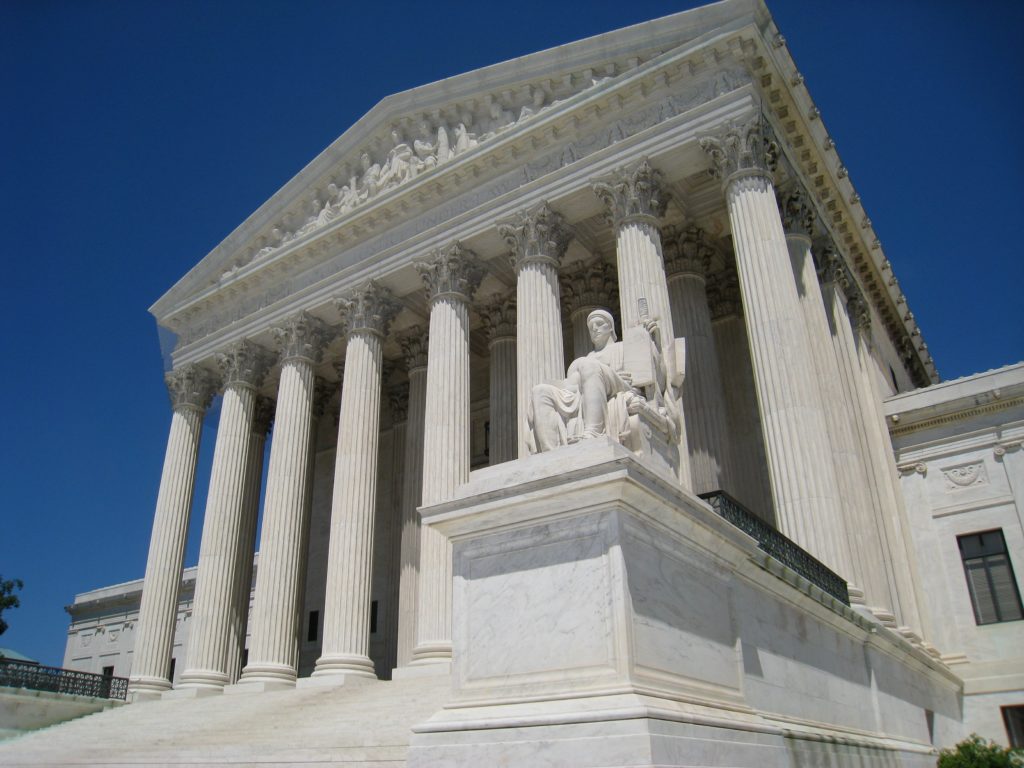
US Supreme Court building, Washington, DC
This is my response:
1. A little history lesson. Judges on both sides of the spectrum have been successfully blocked if enough people see them as extremist. Nixon failed to get Hainsworth and Carswell. LBJ couldn’t get sitting SCOTUS Justice Abe Fortas into the Chief Justice seat. Reagan failed with Bork.
2. Kavanaugh’s positions on presidential power alone disqualify him as extremist. He wants to preclude any possibility that DT can be held accountable for his many crimes. Even some Republicans are saying Helsinki was treasonous. And DT was fully aware on the day he took office that he was violating the domestic and foreign emoluments clauses of the Constitution. And then there are DT’s consistent violations of so many other laws. (Click here for a listing of specifically criminal activity and here for an Atlantic Magazine piece on DT scandals, many of which involve criminal activity; both contain several source links–and both were published well before the current kerfluffle.) Since he is an Executive Branch absolutist, it would not surprise me if Kavanaugh even wanted to overturn 215 years of precedent and say that the courts have no power to declare something unconstitutional–something John Marshall created as Chief Justice during Thomas Jefferson’s presidency in his ruling in Marbury v. Madison, 1803 and does not actually appear in the Constitution. Right now, the courts are our best check on executive overreach or criminal behavior other than public pressure.
3. Lawrence Tribe, noted legal scholar, has stated that a president under investigation should not be allowed to appoint the person who will ultimately decide his fate. This has gained some traction and makes more sense to me than attempting to use the despicable McConnell precedent that allowed the theft of one seat from the Democrats (with the cooperation of Obama, who should have fought it much harder).
4. You talk about majorities. Let’s remember that even as weak a candidate as she was, Hillary won the popular vote with about 3,000,000 more than DT. If that group were a city, it would be bigger than the in-city-limits population of every city in the country other than NYC or L.A.. Bigger than Chicago or Houston, nearly twice as big as Philadelphia.
Why This Matters: A Metaphor for Something Much Deeper
Why am I going on about this? Why does it matter? Isn’t it just some people having fun making a feel-good film?
Answer: I do marketing and strategic profitability consulting for green and social change organizations, as well as for authors and publishers–and I’m also a lifelong activist. This combination of activism and marketing gives me another set of lenses to filter things, as well as a magnificent toolkit to make the world better. My activism also brings a strong sense of ethics into the marketing side.
Both as a marketer and an activist, I pay careful attention to how we motivate people to take action–to the psychology of messaging, One category for this post is psychology; click on that category to get posts going back many years. I worry deeply about our tendency as a society to crowd out facts with emotions. (I also worry about another tendency, to crowd out emotions with facts, but that’s a different post.)
And this is an example of crowding out facts with emotion. While this particular instance is innocuous as far as I can tell, we see examples of overreach on both the left and right, and they work to push us apart from each other, talk at each other instead of seeking common ground, and push real solutions farther and farther out of reach.
My inbox is full of scare-tactic emails from progressive, environmental, or Democratic Party organizations. Because I’m in the biz and understand what they’re doing, I leave most of them unopened. I just searched my unread emails for subject lines that contain the word “Breaking” and came with hundreds, including this one from a group called Win Without War:
An unarmed man with a small flag stops four Chinese tanks in Tiannanmen Square, Beijing,
It’s a clear attempt to generate hysteria, to have people perceiving tanks in the streets with their guns pointed at dissenters.
Only in the body of the email do we find out what’s really going on:
Shel —
Last night, the Washington Post broke the story that Donald Trump has ordered a giant military parade with tanks, guns, and troops taking over the streets of our nation’s capital. [1] This is the kind of parade that dictators around the world use to intimidate their enemies and, more importantly, their own citizens.
This is what authoritarian dictatorships look like.
But Trump can’t change the fact that we still live in a democracy — which means Washington, D.C.’s local government gets to have a say before Donald Trump’s tanks roll down its streets.
Note the use of mail merge software to appear personal. Does that really fool anybody anymore? But OK, even when you know it’s a mail merge, it still generates at least a small warm fuzzy.
More importantly, note that the actual content is totally different from the expectation in the headline. We can argue the foolishness of Trump wanting a military parade (I think it’s foolish, and an expensive attempt to stroke his ego)–but in no way is this the same as attacking demonstrators in the streets of Washington, DC.
The right wing is at least as bad. I don’t subscribe to their e-blasts, but I found this juicy example (with an introduction and then a rebuttal by the site hosting this post) in about ten seconds of searching.
And then there are DT’s own Tweets, news conferences, and speeches, both during the campaign and since he took the oath to uphold the constitution as President of the United States (an oath he has been in violation of every single day of his term). They are full of lies, misrepresentations, name-calling, bullying, and fear-mongering. They are hate speech. I will not give them legitimacy by quoting them here; they’re easy enough to find.
As a country, we are better than this..
How You Can “Vaccinate” Yourself Against Sensationalist Fear-mongering
Before sharing any news story or meme, run through a series of questions to help you identify if it’s real.And if it passes that test, pop on rumor-checking site Snopes and check its status. For that matter, go through a similar questions for advertising claims.
The questions will vary by the situation. Here are a few to get you started:
Does the post link to documentation? Are most of the linked sites reputable? If they advance a specific agenda, does the post disclose this? (Note that THIS post links to several reputable sites, including NPR, New York Times, history.com, Wikipedia, Youtube, Google, CNN, Snopes, and my own goingbeyondsustainability.com and greenandprofitable.com. Yes, I am aware of the issues in using Wikipedia or Youtube as the only source. I am also aware that Google gives them a tremendous amount of “link juice” because on the whole, they are considered authoritative. For both those citations, I had plenty of documentation from major news sites.) Strong documentation linking to known and respected sources is a sign to take the post seriously.
Does the post name-drop without specifics? See how the Win Without War letter mentions the Washington Post but leaves out the link? Remember that ancient email hoax citing longtime NPR reporter Nina Totenberg? Name-dropping to buy unsusbstantiated respect is not a good sign.
Are the language and tone calm and rational, or screaming and sensationalist or even salacious?
Is the post attributed? Can you easily contact the creator?
And last but far from least, the most important question: Who benefits from the post’s point of view ? What are their relationships to the post’s creator? (Hello, Russian trollbots!). Don’t just follow the money. Follow the power dynamics, too.
I could go on but you get the idea. Please share your reactions in the comments.
I posted a petition on Facebook, and someone commented, “Like this would make a difference?”
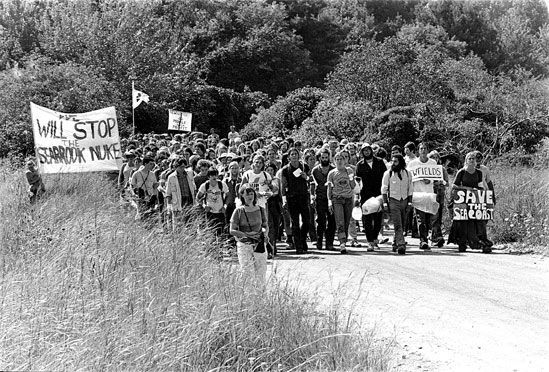
But here’s the thing: You never know what makes a difference. It was a pleasant shock to discover years later that Nixon was actually paying attention to the peace protests. I think the protests after the first Muslim ban and over the tearing of children from parents seeking asylum certainly made a difference. Amnesty International has made a demonstrable difference in the lives of thousands of political prisoners around the world. And I know that my participation in certain other actions, especially the Seabrook occupation of 1977, made a difference.
Nonviolent occupiers approach the construction site of the Seabrook nuclear plant, April 30, 1977. Unattributed photo found at https://josna.wordpress.com/tag/anti-nuclear-movement/
So we keep working and maybe sometimes we have far, far more impact than we thought we would. Who would have predicted how much traction the Arab Spring, or Tiannanmen Square, or Occupy would have gained, how much impact they had?
Who could have imagined in 1948 that all the Jim Crow segregation laws would come tumbling down, not only in the US but even in South Africa and Zimbabwe (then called Rhodesia)? Who could have predicted as recently as 2000 that same-sex marriage would be a legal right in all 50 US states and many other countries around the world? All of these victories are anchored in activism, sometimes decades of activism.
Who would have guessed that the incredible kids who survived the Parkland shooting on Valentine’s Day 2018 (toddlers when Massachusetts became the first state with marriage equality) would channel their angst into a movement that brought millions into the streets, tens of thousands to their voter registrars to register for the first time? Who knows which ones will grow up to be world leaders, and which long-time elected officials will be displaced by a wave of change?
In recent months, we’ve seen the cycle of impact quicken. Movements and memes that had been kicking around for years suddenly reach critical mass. Who would have expected the flowering of older and dormant movements such as #MeToo and #BlackLivesMatter?
As an activist for more than 48 years, I remain optimistic, even in the face of so many defeats—because I also see these and many other victories. I see hope in so many people’s movements in the US, and in the complete change within two generations from a Europe ruled by power-mad fear-mongering dictators to one whose purpose actually seems to create a better world for the planet and its residents.
So yes, it makes a difference. Ordinary people can make a difference. Ordinary people make a difference constantly in fact: when I give my “Impossible is a Dare” talk, I cite examples like a seamstress (Rosa Parks) and a shipyard electrician (Lech Walesa) who changed their entire society.
What are you doing currently to make a difference? Please share in the comments.
Parkland HS activists including David Hogg, left, and Emma Gonzales, in tank top. Photo courtesy of Wikimedia Commons.
Editor’s note: This was written back in February. I don’t know why I never hit Publish. Unfortunately, even the Parkland activists—as amazing and powerful as they are—even the mass rallies they organized, even the wide public outcry—has not ended the violence even at schools yet, though they’ve already made more progress than anyone has ever done on this issue. In Arizona alone, there were 17 shooting threats (not actual shootings) just between Valentine’s Day and March 10th. I hope their activism sparks a massive rejection in November of guns-uber-alles politicians.
Meanwhile, just in the past week, we’ve seen a merchant of hatred, the always-despicable Milo Yiannopoulos, call for “vigilantes” to attack journalists. Yiannopoulos was forced to backpedal, but this is getting even uglier. The crazies will take this stuff seriously. We’ve also seen consistent, repeated attacks against the press by the current occupant of the Oval Office. And we’ve seen a mass shooting inside a newspaper newsroom in Maryland. Everything Kropotkin says below about people who make death threats against child activists is true of those who attack journalists, too, and thus this post is more relevant than ever. Remember: when dictators take over, they start restricting the press.
Guest Post By Pyotr Kropotkin
In the wake of the horrible (and so could-have-been-avoided) shooting at Marjory Stoneman Douglas High School in Parkland, Florida, several of the surviving students have spoken out. In this short time, they’ve shown themselves as articulate spokespeople for common sense, and they are changing the conversation around the right to own any type of weapon versus the right to personal and public safety.
But despite the incredible trauma they’ve been through, quite a few people don’t think they should be speaking out. Some are even making death threats against these kids!
If you are making death threats against people just because you disagree with them, here are some of the things we know about you:
Somewhere along the way, you lost your compassion, lost your heart
You don’t understand the difference between freedom to and freedom from—that your freedom to shoot an assault rifle ends when it impinges on others’ freedom from attack
You are mentally or emotionally unbalanced and should not have access to firearms, because you’ve made a death threat against an innocent child who has done you no harm
You should be the subject of immediate criminal investigation, for threatening the life of another
You don’t love the Constitution—the 2nd Amendment is fine for you, but not the 1st Amendment, which protects the rights of free speech, free assembly, worship, and petitioning the government to redress grievances
You probably believe that an armed presence is a deterrent to violence—even though an armed deputy was outside Stoneman High, and even though the majority of people at Fort Hood the day of that massacre were armed
You might also believe that there’s some crazy government conspiracy to take away your guns so they can take away the rest of your freedom—even though even an assault rifle is no protection against tanks and howitzers
You like to feel powerful, and you think your assault rifles and your threats make you powerful (they don’t—they make you the equivalent of a two-year-old at playtime)
You’re a bully who thinks the way to succeed is by throwing your weight around and scaring other people
You probably have not experienced enough love in your life—and I feel sorry for you.
Perhaps you didn’t think it could get worse But in the past six weeks, this vile administration has reached a new low. The decision to wrench 1995 helpless children from the arms of their loving parents and put them in cages is not only inexcusable on moral and humanitarian grounds, it’s also a long-term disaster for the safety and security of the United States. Yes, it puts every American at risk.
Let’s look at both the moral and practical reasons why this must stop.
The Moral Issues
Many figures in this administration have been long-time champions of self-described “family values.” In other words, they say they are in favor of keeping families together, as long as those families are heterosexual. They talk earnestly about the importance of having a child grow up in a home with both parents. Yet, when mothers take their children and flee gang violence, domestic abuse, and other genuine evils, the US incarcerates them at the border and takes their children away. The parents treated like violent criminals. Their children put in cages.
Attorney General Sessions quotes one verse in the Bible to justify this barbarism: a verse that was used in the 19th century to justify the worst aspects of slavery.
Last I checked, the Attorney General is one of the people charged to protect the separation of church and state (as well as freedom of speech AND assembly) enshrined in the First Amendment. But even granting that the Bible can be a moral compass for a sitting Attorney General, Mr. Sessions’s interpretation is highly selective. Consider a few of the other things the Bible says. I’ve posted a whole bunch of them at the end of this blog post—but first, let’s talk about the practical impact.
The Practical Case
As taxpayers and citizens, we should be deeply concerned about what’s being done in our names. The consequences to the US could be deep, severe, and very negative. A few examples:
This policy creates an entire class of enemies—creates potential terrorists
Deliberately adding trauma creates maladjusted human beings: PTSD and other diseases. Any child ripped away from his or her family and put in a cage is going to be hostile to the government that did this. Family members will also be hostile. Taken to the extreme, you create something that looks entirely too much like the Israeli-Palestinian conflict, where hurts lead to rage, rage leads to violence, and violence leads to even more abrogation of rights. Once this cycle of violence gets established, it’s really hard to break (though, of course, lots of people are trying, including my colleague Andrea Ayvazian. Do we really want to create a whole new class of enemies who will feel justified in attacking US-related sites around the world? Hasn’t the US been fighting terrorism as its major foreign policy stance since 2001? This policy could create a whole new generation of terrorists.
Also, do we really want to attempt to repair avoidable psychological damage that prevents people from functioning effectively and finding gainful employment? Many of these folks will end up in the US eventually. By making it harder to function, we turn them into social burdens. Our tax dollars will have to cover the survival mechanisms for those not resilient enough to recover on their own.
It puts the US in violation of international law as well as our own constitution
The path the US is taking is in gross violation of various human rights charters, UN regulations, and our own constitutional requirements for due process. Imagine the consequences to business, for instance, if organizations in other firms because the US is guilty of crimes against humanity. It has happened to other countries and it could happen to us. There should be a massive outcry from business about the risks of this policy.
It positions the US as an unworthy partner for joint projects with other governments and businesses
The US has become a rogue state, blowing away trust on a host of issues, from the Paris Accord to the G7 Agreement. Now, other governments may face pressure from their own constituents not to do business with abusive governments, just as economically and organizationally isolating South Africa forced that country to get rid of apartheid.
A Few More Bible Quotes Mr. Sessions May Want to Study
On the importance of family:
8 Anyone who does not provide for their relatives, and especially for their own household, has denied the faith and is worse than an unbeliever. —1 Timothy 5:8
3Children are a heritage from the LORD, offspring a reward from him.
4Like arrows in the hands of a warrior are children born in one’s youth.
5Blessed is the man whose quiver is full of them. They will not be put to shame when they contend with their opponents in court. —Psalm 127:3-5
15She gets up while it is still night; she provides food for her family and portions for her female servants.
16She considers a field and buys it; out of her earnings she plants a vineyard.
17She sets about her work vigorously; her arms are strong for her tasks. —Proverbs 31:15-17
On immigrants’ place in society
21“Do not mistreat or oppress a foreigner, for you were foreigners in Egypt. —Exodus 22:21
35For I was hungry and you gave me something to eat, I was thirsty and you gave me something to drink, I was a stranger and you invited me in, —Matthew 25:35
32but no stranger had to spend the night in the street, for my door was always open to the traveler —Job 31:32
35“ ‘If any of your fellow Israelites become poor and are unable to support themselves among you, help them as you would a foreigner and stranger, so they can continue to live among you. —Leviticus 25:35
A remarkable document came out of the G7 summit. It’s a blueprint for creating a just, fair, and environmentally viable world. Leaders of the world’s most powerful industrial economies are coming together in unity and releasing a document that I agree with almost all of. Among other things, the G7 Charlevoix Declaration:
Affirms the rights of minorities (including indigenous people) and women
Positively addresses the conflict between Israel and Palestine, tension around Korea and Iran, Russian power grabs, and even the misery inflicted by Daesh (a/k/a the Islamic State)
Calls for worker protections
Promotes sustainable and democratic health care, economic growth, and even tax structures that benefit all
Has strong language urging protection of the earth and its resources
With nearly 50 years as an activist, I find it utterly amazing that the “Leaders of the Free World” can agree on a document of such scope. We could actually call it revolutionary. The leaders of nations–and, in other forums, many leaders of major corporations–are agreeing to a manifesto of people’s and planetary rights. I’m not really used to having them on my side.
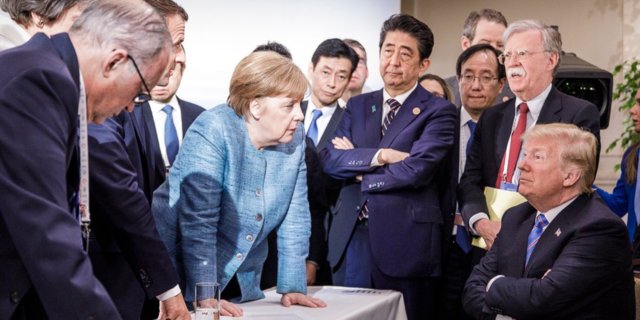
This photo released by the German government sums up the US president’s attitude.
And of course, the fly in the ointment was the disgraceful behavior of the “world leader” who happens to be in charge of my own country right now. The barrage of in-person pouts and Twitter nastygrams including repudiating the statement he signed make me embarrassed once again that this cruel, mean-spirited, and incompetent person supposedly represents me. Sigh!
When gallery owner Richard Michelson asked Jules Feiffer if he wanted a retrospective for his 89th birthday, the brilliant artist replied, “I am doing the best work I’ve ever done and want this exhibit to be new and explosive, with figures sprawling and flying everywhere, and focused on dance…It only took 89 years to figure out how to do this stuff!”
Jules Feiffer, 89, at Michelson Gallery, April 13, 2018
That wonderful and extensive show is now on display at R. Michelson Gallery in Northampton, Massachusetts. We went in to peruse it, and Rich’s wife Jennifer told us that Feiffer was about to do a Q&A. Of course we went upstairs, chatted a bit with Jules and his Phantom Tollbooth collaborator Norton Juster (who lives locally), and settled in to listen.
Jules has a quick and acerbic wit and a strong sense of social justice. Someone asked him what the best response was to the current situation in national politics and he instantly responded with a primal scream. I asked him how he was able to capture the 3-dimensional, flowing art of dance so well in static two-dimensional pictures and he talked about capturing the illusion, that everything was an illusion.
His new work is indeed brilliant. While it descends directly from his famous Village Voice cartoons of he 1960s and 70s, it really is what he told Rich. It has so much vibrancy, often very sophisticated and detailed captioning, and the figures really come alive—especially those using colored inks, which he’s begun to use here and there (though most of the show was black-and-white).
Jules is the latest in a long line of inspirational role models for growing older. I’ve profiled some of them here: Arky Markham, centenarian and activist; Bob Luitweiler, founder of the international homestay organization Servas, for instance I’ve been fortunate to know many others, including Pete Seeger and Chicago Seven/Eight defendant Dave Dellinger—with whom I became friends as a teenaged college student when he was 60, and whom I consider one of my personal mentors—as well as Gray Panther founder Maggie Kuhn; I met her when I was working for the Gray Panthers as a VISTA Volunteer, at the group’s national conference.
These are the kinds of people I want to emulate as I (hopefully) reach well past my current age of 61. When I was a teen activist, I often heard that I was too young to change the world. Now, I’m beginning to hear people tell me I’m too old to do the work I do. But I remind them that Grandma Moses started painting in her 70s and enjoyed a 20-plus-year run as a painter. Today, for example, I’m going networking at a sustainability fair, then attending a peace and tax fairness rally, then hiking a mountain, and probably going out to hear some live music or theater in the evening. You’re only as old as you feel.
I started answering this question on Quora but ran out of room.
First, it does make a difference. Little things add up.
For instance, where I live in the northeastern US, many people turn the water on full blast and leave it running the whole time they’re brushing their teeth. So in many of my speeches and interviews I talk about a way to brush your teeth that uses teaspoons instead of gallons: turn the water on a trickle, wet the toothbrush, then turn the water off until you’re ready to rinse with another trickle. Let’s say that this saves even just one gallon of water each time.
Child brushing teeth (FreeImages.com)
If someone hears my message and lives for another 40 years and brushes twice a day without squandering that huge amount of water each time, that one person has saved 29,200 gallons. Now, if I can influence just 50 people a month and I talk about this for the next 19 years until I’m 80, that means a total of 332,880,000 gallons saved. And if just one person in each of those 50 goes on to influence just ten of their friends, the total savings become astronomical.
More and more places around the world are discovering that water is extremely precious, so eventually this will become the common best practice for brushing teeth.
Second, it changes the way you look at the world. You start looking holistically, seeing connections among things that appeared random and unconnected to you before. Who knows—maybe you’ll be the person to make the next big scientific breakthrough in sustainability because of that shift in your thinking ;-).
Third, it changes the way you feel. You see yourself as someone who can make a difference in some small ways that add up to big ways. Guess what: Ordinary people can change the world–but only with a mindset that their actions make a difference. What’s more ordinary than a seamstress? Think about a seamstress named Rosa Parks. How about a high school student? Just in the last few weeks, a group of them in Parkland, Florida sparked a new national movement and managed to get a few restrictions on guns passed into law in Florida after decades of failures on this issue, less than one month after 17 of their schoolmates were murdered in a school shooting. What about an electrician working in a shipyard? That would be Lech Walesa, who led the movement to kick the Russians out of Poland and became its president. I personally started a movement that saved a local mountain.
Under the guise of protecting small business from frivolous lawsuits, the House of Representatives just gutted the Americans With Disabilities Act—a major piece of civil rights legislation signed by George H.W. Bush. I have to say, I’m on a LOT of small business discussion boards, and I haven’t heard any business owners screaming about hardship. Small businesses in pre-ADA buildings are exempt unless they do major renovations.
One way to rethink transportation for wheelchair users
It’s up to us to make sure the Senate doesn’t follow along. Contact your Senators and let them know this is a vote where you will hold them accountable. And if your Rep was one who voted Aye, give them a piece of your mind too.
Of course, we’ll be tempted to argue on the basis of compassion. But remember who we’re dealing with here. These people have a long history of NOT acting out of compassion, often of doing the opposite. So compassion arguments “ain’t gonna cut it.” We have to get to them on the things they will listen to: costs to taxpayers, personal hardship to them, and of course, voting and campaigning for and donating to their opponents.
Don’t Waste My Tax Dollars: How dare you make it harder for productive citizens to work, just because they have disabilities. If you think I want my tax dollars squandered on welfare payments to people who could have had a job until you made it impossible to get to work, you’d better think again.
Don’t Hurt the Economy by Hurting Disabled People: For new construction, it’s really easy to design in ADA compliance from the ground up. By allowing builders to take shortcuts because you took away the teeth of this legislation, you’re encouraging them to stop designing in ramps and wider doorways, setting aside parking, making elevators disabled-friendly, etc have you noticed how many people with disabilities who in pre-ADA days had to sit home and be a burden have gone on to start job-creating companies making our economy better (like the personal-transportation vehicle for wheelchair users in the photo—designed by a wheelchair-using Texas woman)? There’s even an organization of disabled business owners that was named one of President George H.W. Bush’s 1000 Points of Light. Do you really want the blame for squashing that on your shoulders?
Protect Our Veterans: Do you realize that veterans have much higher disability rates than the general population (due to war wounds), and that many have a hard time finding work and frequently start their own businesses? Thus, many of these job creators are veterans.You are hurting the people who served our country and defended our freedom.
Pointless Government Meddling: The ADA has been around since 1990. Most public buildings are already accessible. This is bringing in the government to break a system that’s working just fine right now, and that has enabled millions of people to be productive members of society. And if buildings are allowed to come online without meeting current ADA code, it will be expensive to retrofit them later, when (not if) this weakening of the law is repealed.
Personal Inconvenience to the Senator (this one takes a wee bit of research): I noticed that [name a family member of theirs with a disability] uses a wheelchair [cane, walker, seeing-eye dog, whatever]. Do you really want to be called away from important Senate business every time [name]has to go to the bank? How do you think I’m going to feel as a [business owner, manager, productive employee supporting my family] if I have to leave work to help my Aunt Mary do things she could have done for herself until you put obstacles in her way? And what’s going to happen to you, 20 years from now, when you may not be able-bodied yourself?
Vote No or You’ll Organize to Defeat the Senator During the Next Election: Don’t just pledge to vote for your Senator’s opponent. Say you’ll be willing to campaign and fundraise for someone who understands that disability rights are important. If you’ve voted, donated, or volunteered for your Senator in the past, be sure to let them know.
Some marketers are engaged in a vigorous debate between people who identify as “thought leaders” and those whose skins crawl when they hear the term.
Whether you love or hate the term, “thought leader”, marketing by showing leadership through content and letting people meaningfully engage with those ideas is undeniably powerful.
That type of marketing hooked me when I first tried it, as a 15-year-old 3rd-year high school student, and I’ve been using it ever since. First, I used it only to spread my ideas. Later, I also marketed products and services based on those ideas. And those ideas built me a decent following (and, eventually, a decent consulting practice)—sharing them through my books, articles, presentations, interviews, media coverage, etc.
This takes time and energy, and I know many people who do it better than me. But it certainly can be done. One of my book launches garnered over 1,000,000 short-term Google hits (for the book title, an exact-match four word string that wouldn’t show up in any other context). It’s the only time anything I’ve done got a million hits on Google.
I’ve even managed to help shift several mindsets at the international or national or local level.
My biggest success was changing the attitude about a proposed local mountaintop housing development from “this is terrible but there’s nothing we can do” to “of course we’ll win! The question is how.” This campaign took just over a year and used everything I knew in 1999-2000 about marketing AND community organizing (and the knowledge/labor of many others)—but the mindset shift took only four or five months. And that mindset shift created the conditions for our victory.
Lawn sign from the Save the Mountain campaign in Hadley, MA, in front of Mount Holyoke (a state park next to the mountain we saved)
I also like to think I helped change the idea that business has to be evil. Of the five books I’ve published since 2003 (and the 10 since my first book came out in 1980), four show how business can profitably address issues ranging from business ethics to ending poverty—while reversing environmental destruction. I’ve given dozens of “Making Green Sexy”, “Impossible is a Dare,” and other talks on how business can be heroes.) And it’s been years since I’ve heard “business ethics? That’s an oxymoron!” When I first started talking about business ethics as a success strategy, I heard that false “wisdom” constantly.
I like to think my activity is part of WHY I no longer hear that horrible sentence.
Leading with ideas means finding others who will amplify those ideas. It’s not a coincidence that I actively seek out media coverage, endorsements, and more.
My latest book, Guerrilla Marketing to Heal the World has a blurb from Chicken Soup’s Jack Canfield on the front cover, another from Seth Godin on the back, and some 50 endorsements on the front pages. It has 4 guest essays from best-selling authors. These are some of the ways I’ve built credibility and gotten people interested, even though the book no longer has a current-year copyright.
One review of that book didn’t appear until 17 months after publication—and I’ve gotten reviews on books that were up to eight years old at the time. When you write about issues and do so with substance, your book can attract interest for years.
Of course, events can shift the relevance. If you try to repurpose articles on how to survive the coming Y2K crisis or books on the presidencies of Hillary Clinton, Mitt Romney, or Al Gore, thought leadership is not the image you’ll project. 😉