Part 2 of a series of reminiscences of the April 30/May 1, 1977 occupation at the Seabrook, NH nuclear power plant construction site, and its aftermath. If you missed Part 1, read it here.

The Nuclear Controversy Makes the News

In 1977, the vast majority of Americans had never looked into the arcane technical issues around nuclear power. The government told us this technology was safe, and most of us believed them. Three years earlier, I had taken on a research project for a college class on the pros and cons of nuclear power—and I discovered as I read several obscure books on the subject that there were a lot of cons, and no pros. But I was a tiny minority. What few news stories there were mostly pretty rah-rah. I’d never seen any media coverage about nuclear’s serious problems, accident history, or economic house of cards.

All that changed while we were in the armories. We got tons of coverage of the movement, and some reporters decided to look into our claims. As they saw that our resistance had merit, the culture shifted, and the media began to help us prove our case.

Impact on New Hampshire

New Hampshire was a very quiet place in 1977. Its population was much more rural and it didn’t have a lot of criminal justice infrastructure. The reason we were kept in National Guard armories rather than jailed was because 1414 arrestees far outstripped the capacity of New Hampshire’s jails and corrections officers; the state normally had about one third as many prisoners. Governed by Republicans who favored a libertarian ideology when it was convenient, the state had (and still has) no sales tax and a very lean budget. When they arrested us, they clearly expected us to make bail and go back where we came from until we came back for our court dates and patronized local hotels and restaurants in the process.

But in those strategy circles I described yesterday in Part 1, we decided as a group to do “bail solidarity”—to not post the modest bails and to stay as unwanted guests of the state. For several days, nearly all 1414 of us refused to post bail, leaving the state with a lot of extra mouths to feed, as well as a lot of staffing costs to pay the National Guard reservists who had to be called up to monitor us—costing the state $50,000 per day, according to Rolling Stone’s account of July 1977 (probably at least $150,000 per day in 2017 dollars). This created enormous pressure on the state to come to terms with us. People stayed as long as they could, and bailed out in small numbers as they were needed on the home front. (I bailed out after a week because I was running an event back in Providence; Nancy stayed the entire two weeks).

In other words, the Occupation continued after our removal from the site. It simply shifted to the multiple venues where we were held. And this became so expensive that the New Hampshire government capitulated on May 13, 1977 and released all remaining detainees without bail.

Until this occupation, opposition to the construction plans at Seabrook was mostly localized. While very strong in the Seacoast region of New Hampshire and the immediately adjacent communities in neighboring Massachusetts—opposition was not strong enough to block the plant through mainstream methods such as regulatory appeals and lobbying. Clamshell Alliance, formed in July 1976 and inspired by a nuclear plant occupation in Germany, turned to nonviolent direct action. Clam waged two small nonviolent occupations in August 1976, with 18 and then 180 arrests, and began organizing across New England for the April 1977 occupation. And the more people learned about nuclear power and its dangers, the more the resistance gained strength. Safe energy became mainstream.

Fake News, 1977 Style

Despite our incarceration, we had access to newspapers, delivered daily (presumably by the outside support system of people who had chosen not to be arrested to they could provide us what we needed.

One of those papers was the Manchester Union Leader. Despite its progressive-sounding title, this was a right-wing rag, owned by the notorious William Loeb, who would have been right at home in a Steve Bannon world. I believe it was Loeb, but it may have been his protégé, then-Governor Meldrim Thomson, who called us “The Clamshell Terrorists” (I can’t find the quote on Google).

Pretty much alone in its denunciation of us, the Union Leader lumbered through its daily attacks on us.

Meanwhile, we were getting very sympathetic and much more accurate coverage on a slew of both mainstream and progressive publications and broadcast media. And we had a lot of media-savvy people, both inside the armories and outside, that helped us tell the story our way. In the armory I was in, there was even a “graybeard caucus” that pressed the news media for acknowledgement of our age diversity every time a story said the protestors were “mostly in their 20s.”

The Idea of Alternatives Takes Root

One reason why nuclear had not been much questioned was that the alternatives were hard to see. Even though the 19th-century industrialization had been largely powered by water, and agriculture in the early 20th century used wind power extensively, as a society we hadn’t been trained to look past fossil and nuclear. But Clamshell made an important strategic breakthrough: being against nuclear was far more effective if we were for something else. Energy that falls from the sun, is pulled by the wind, or harnesses the current of a river is infinitely renewable. Once the infrastructure is in place, it doesn’t cost more to harvest and harness those sources—unlike fossil and nuclear that keep demanding more.

And we had this understanding well before the consciousness about global climate change and carbon footprint penetrated the general consciousness.

Admittedly, these systems aren’t always can be designed to be in harmony with their microenvironment and with the planet as a whole (especially at industrial scale, where they can be quite destructive). But they can be designed for true sustainability, while fossil and nuclear can’t.

Replicators: Dawn of a National Movement

As we emerged from the armories, we began to understand more of our true impact. We discovered that other dozens of Alliances named after their own local flora and fauna were springing up around the country, turning their sights on existing or planned nukes in their own areas. And this national movement successfully reversed the drive toward nuclear. Seabrook did go on line, so we lost that battle (although the power company only built one of the two permitted plants, and that was a significant victory for us). As far as I know, Seabrook was the last plant permitted in the 1970s or 1980s that went online as part of the electric grid. The terribly positioned Shoreham plant on Long Island, New York, was completed and turned on for testing, but then rapidly shut down and was never used to generate power. And for more than 30 years, no new nukes in the US moved forward. Those in the planning stages were scrapped, and many existing plants, facing the wrath of these citizen groups, eventually shut down.

We’ll revisit the deeper implications of that movement in Part 4 of this series. Meanwhile, stay tuned for Part 3.

Facebooktwitterpinterestlinkedinmail

Yesterday, I posted something on Facebook about reaching a real, and sympathetic, human being on the White House Comment Line. Since the US election last November, I’ve called my elected officials a lot more than in the past. Someone wrote back, saying I was “like the Energizer Bunny” with my consistent activism.

My reply revealed the secret:

Actually, [his name], it’s less Energizer Bunny and more a matter of what I call “the fulcrum principle”: doing not all that much but doing in ways that leverage and multiply the impact…I use my time strategically so the 10 to 15 hours or so I spend on activism per week has a big ripple. Of course I never know when a meeting or demonstration is going to be worthwhile and when it will be a waste of time. I have guessed wrong on a few meetings lately—but then I go to one that’s so energizing and activating and inspiring that it actually recharges me. I went to one like that Saturday and hope the ones I plan to attend Wednesday and Thursday (and the socially responsible business conference next week where I’m MCing two sessions) will be just as awesome.

A fulcrum is the bump underneath a lever that allows that lever to magnify its force—to quite literally create leverage. This concept inspired Archimedes to say, more than 2200 years ago, “Give me a lever long enough and a fulcrum on which to place it, and I shall move the world.”

Three men on river structures with ladders and levers. Retrieved from https://digitalcollections.nypl.org/items/06e13eb0-8a8e-0131-0778-58d385a7bbd0
Three men on river structures with ladders and levers ” New York Public Library Digital Collection.

I’ve played with this metaphor for a long time. I was able to find rejection letters I received for my original The Fulcrum Principle: Practical Tools for Social Change, Community Building, and Restructuring Society book proposal as far back as 1992—and a printout of the proposal itself, though not the electronic file.

Looking at this proposal 25 years later, it would have been a big, ambitious, world-changing book. And other than

  1. Adding in recent developments such as the Arab Spring, Climate Change activism, Black Lives Matter, and of course the massive resistance to the new US president, and
  2. Technology shifts including the Internet and social media, smartphones, 3D printing, and the amazing breakthroughs in green design,

The proposal is still remarkably relevant. Let me share a few highlights:

  • The Fulcrum Principle lets us “achieve the greatest result with the least amount of effort,” including finding others to do some of the work
  • Change happens as fast as possible, but as slow as necessary
  • Why we need both “shock troops” and “put-it-back-togethers”
  • We build momentum for change by presenting the possibility (and manageability) of positive change, finding points of agreement with our opponents—and then expanding those points, changing enemies into allies
  • This momentum can change the world—and it has, many times
  • It’s accomplished more easily when you remember to have fun
  • Grassroots organizers can learn a lot from business (and with 25 years of hindsight, I’d add that business can learn a lot from grassroots organizers); similarly, Left and Right activists have lessons to share with each other
  • Economic and environmental goals can work in tandem (did I really understand that all the way back in 1992? I’ve gone on to write five books that explore this idea)
  • Organizers have quietly developed lots of tools we can harness to make this journey easier: new approaches to everything from how to facilitate productive meetings to how to get the most information in the least time by dividing up a book among different readers who report their insights

The proposal also touched on a raft of social issues, among them:

  • Nonviolent alternatives to the military
  • The role of multinational corporations
  • True democracy going far beyond elections
  • Does it even make sense for change organizations to chase after funding?
  • New ways of looking at drugs and crime, housing, healthcare, transportation, parenting, world distribution of resources, and even sexuality

Interestingly, without revisiting this proposal, I essentially put it into practice when I founded the movement that saved our local mountain in 1999-2000. And I think that’s a lot of why we won in 13 months flat. The “experts” thought we couldn’t win at all. I felt sure that we would succeed, but even I thought it would take five years. I didn’t realize at the time that I had already created the roadmap years earlier.

Perhaps I should dust off this proposal, update, and resubmit.

Facebooktwitterpinterestlinkedinmail

Nonviolent action theorist/activist/author George Lakey published a fabulous essay, “A 10-point plan to stop T***p and make gains in justice and equality” last week*

George Lakey, activist and author (most recent book: Viking Economics)

George has been a hero and mentor of mine ever since I first heard him speak around 1977. His presence at Movement for a New Society’s Philadelphia Life Center was a big part of why I moved to that community for a nine-month training program in nonviolent action, back in 1980-81.

He argues that this is our moment to break out of reactive protests and into big sweeping social and environmental demands. He notes that the LGBT movement was one of the only progressive movements to gain traction under Reagan—because its agenda was so much bigger than just fighting cutbacks. Twenty and thirty years earlier, the Civil Rights movement accomplished sweeping social change as well.

So instead of defending the weak centrist gains of the past 30 years, we go beyond and organize for our wider goals. We refuse to play defense against DT’s shenanigans and instead take the role of pushing for a new, kinder, people- and planet-centered normal. With direct-action campaigns that link multiple issues, such as Standing Rock, and with alternative institutions like the Movement for Black Lives, we create a nonviolent invasion of deep social change (this is my metaphor, not George’s).

In short, we think bigger—and act bigger. and instead of crawling to the politicians, we force them to court us as they see us come into our true power.

I’ve been saying we need to think bigger and more systemically for years. George says it succinctly and eloquently, and with a lens I hadn’t looked through.

How does this apply in today’s world?

  • The Republican attack on what George calls the “medical industrial complex-friendly Affordable Care Act” (a/k/a Obamacare) is a chance to bypass the witheringly bureaucratic and unfair insurance system and push for real single-payer, Medicare-for-All plan of the sort that’s worked so well in Scandinavia (he explores the Scandinavian social safety net in his latest book, Viking Economics)
  • The Standing Rock Water Protectors have linked multiple issues into a coherent whole: clean water, the environment generally, the rights of indigenous people (among others)
  • Movements around creating a meaningful safety net, such as the $15 per hour minimum wage, can reach disaffected white working class voters as well as people of color; when those who voted for DT on economic grounds realize he has betrayed them, we can win them over (I would add that this will only work if we have mechanisms in place to defuse the racism and nativism that DT used to attract them, and have meaningful ways to integrate the lesson that all colors, races, and religions can be allies to each other and are stronger together—and Lakey does point out that the United Auto Workers has been successful organizing on these unifying principles)

I could add a lot to George’s list. As one among many suggestions, let’s push to not only end all subsidies to the fossil and nuclear industries but let’s push for a complete transition to clean, renewable energy—whether or not we get any help from the government.

Read his essay. Come back the next day and read it again. Then share it with friends, social media communities, and colleagues and discuss how you personally and your group of individuals with shared positive purpose can make these changes happen.

*Why did I replace DT’s last name with stars? And why do I call him DT rather than by his name? Because I am doing my best not to give him any search engine juice. I don’t want him showing up as “trending” or driving traffic to him.

Facebooktwitterpinterestlinkedinmail

Stumbling across this article on bicycle-powered-everythings (bicimaquinas) in Guatemala—grain mills, water pumps, nut-shellers, blenders, and more—I’m reminded once again of the key question to ask if you want to spark innovation while keeping an eco-friendly focus on using fewer resources.

Too often, we focus on the tool: asking questions like “how do I get a new tractor?” But what is a tool? It’s a means of accomplishing a task! So the real focus should be on the task: “How can I get this done?” Asking “how can I get harvestable plants” might lead to plowing with draft animals—or to no-till farming techniques.

Green entrepreneurs (or frugal ones) refine that question. It morphs into “How can I accomplish this with the fewest resources?” Money and time are resources. So are raw materials, energy, water, plant seeds, animals, and so forth.

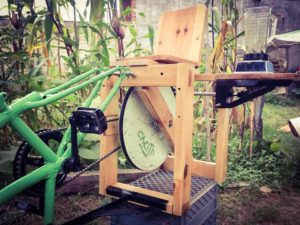
The people at Maya Pedal, the organization profiled in the bicimaquinaarticle, understood this. They looked around and realized there were a lot of junk bikes out there that could still do plenty of useful work, just not as transportation. They’ve come up with 19 different models so far.

Bicycle technology is cheap, accessible, understandable, and versatile. In fact, my latest book Guerrilla Marketing to Heal the World mentions a number of creative bike technology uses, even including a bike-powered trash hauling company. I also know of a fitness center that harnesses the energy of their bike-pumping clients to light the room.

We can ask this question in many situations—and it creates abundance. Asking “how can I power my electronic devices easily and cheaply without negative environmental consequences” might lead to developing something like the amazing Blue Freedom frisbee-sized hydroelectric plant (no dam required).

This blender is one of 19 different types of bicimaquinas—bike-powered equipment—developed by Maya Pedal in San Andrés Itzapa, Guatemala

Back when laser printers were retailing for $7000 and I had only a dot matrix, I asked myself how I could offer laser quality to my clients without spending that kind of money. That led me first to rent time on a nearby laser printer for a dollar a page, and later—when I spotted a remaindered model for $2500—to organize a co-op of four local business owners who chipped in $700 each to buy the printer and a sturdy stand for that very heavy machine. Since I organized the co-op, the printer lived in my office.

Amory Lovins, founder of Rocky Mountain Institute, asked himself how to build a really energy-efficient house  that could fund the energy improvements out of capital savings. All the way back in 1983, he built a near-net-zero-energy luxury home that didn’t need a furnace or an air conditioner (in the snowbelt outside Aspen, Colorado, where the biggest industry is skiing). I have a detailed study of Lovins’ work in Guerrilla Marketing to Heal the World, by the way—including the energy retrofit of the Empire State Building that saves $4.4 million per year in that building’s energy bills.

What’s the second question you might ask? How has nature already accomplished this task? But that’s an exploration for another time.

Thanks Heath Dannis, @dannis_heath for sharing the great story about bicimaquinas.

Facebooktwitterpinterestlinkedinmail

As someone who is decidedly NOT a fan of the annual Black Friday shopping orgy—and who participates instead in celebrating Buy Nothing Day (like Black Friday, always on the day after US Thanksgiving), I just love this!

Patagonia had pledged to donate all of its worldwide online and offline revenues on Black Friday to environmental causes.

Patagonia's fish/mountain range-shaped logo
Patagonia’s fish/mountain range-shaped logo

Here’s what happened, as reported by ABC News:

The outdoor clothing maker previously announced it would donate 100 percent of its global retail and online sales on Black Friday. It says it expected to reach $2 million in sales, but instead generated five times more. Patagonia says the fundraiser “attracted thousands who have never purchased anything from Patagonia before.”

Mind you, that’s not the profits from its $10 million in sales. It’s the whole amount, the gross revenue. Nothing set aside for product costs, operating costs, or anything else. I hope this generates many loyal new customers and lifelong fans. May the company’s generosity be a source of continued abundance, and maybe next year they can repeat and do even better.

All I can say is BRAVO and WOW!

Personally, I’ve been a fan of Patagonia for decades. I even profile the company in my latest book, Guerrilla Marketing to Heal the World. I didn’t happen to hear about this ahead, but might have actually moved from participating in Buy Nothing Day to making an online Black Friday purchase to support the environment. That would not have felt like the crass commercialism that seems to fill every moment of airspace in November and December, and feels especially extreme on Black Friday.

Facebooktwitterpinterestlinkedinmail

I have publicly condemned election-related/hate crime violence on both sides.  But it’s important to note that there are already more than 700 documented instances of right-on-minority or right-on-female violence and a far smaller number of left-on-Trump-voter incidents.

I do not condone the violence on either side. But I’m sorry, when you have just elected a president who has given license to bullies and attackers for months, it is time for Trump voters also to say “this is not OK.”

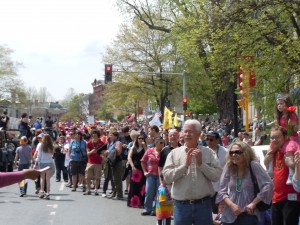
Spectators applaud the Forbes Library contingent, #Nohopride 2011
Spectators applaud an LGBT pride march. Photo by Shel Horowitz.

And if DT is really going to take his own “president for all Americans” election-night rhetoric seriously, he needs to issue a far stronger and more convincing demand to stop that behavior than the wimpy few words he reluctantly issued after a CBS reporter asked him directly to rebuke the attackers. And those who voted for DT for reasons that have nothing to do with the subjugation of women, people of color, and non-Christians need to speak out loudly and publicly. Hate crimes of any kind are not OK—and the Right as well as the Left both need to say so.

Trump voters who refuse to speak out and call for cessation of the violence are proving Hillary’s “deplorables” comment. The way to prove her wrong (and I think she is) is to speak out loudly that you, as a Trump voter, will not tolerate violence and threats against racial/religious/sexual minorities and women. That we as a country are better than this. That we can disagree and still be a democracy.

I am putting a safety pin on my coat as a sign that I am someone willing to intervene if I am a witness to a hate crime. I’ve been trained in nonviolence and conflict de-escalation (though it was long ago). If you’ve had some training, think about joining that movement. And if you haven’t, find a way to get that training. Google “nonviolence training” with your city’s or state’s name. And if DT actually implements his proposed Muslim registry, I will be part of a movement to flood that database with non-Muslim registrants so it becomes useless. These are personal risks I am willing to take. We have seen too many times what happens when good people do nothing while others perpetuate evil in their name.

I understand if those actions might be more than you’re willing to do; here’s one that’s totally safe: Sign this petition. Please note in the comments section of THIS that you’ve signed, or better yet, share your own personal letter that you’ve written to Trump.

Facebooktwitterpinterestlinkedinmail

It’s been less than a week since the US presidential election and the news is filled with more than 200 deeply disturbing reports of violence by Trump supports against people of color, women, gays, and Muslims.

There also news of leftists attacking people who they feel enable racism and sexism, although I’ve found only one documented incident in a pretty thorough search (that was a Fox video of a beating, which I will not share, because I don’t post violent videos on my blog). But I did see a picture posted of a protestor holding a sign that said “rape Melania.”

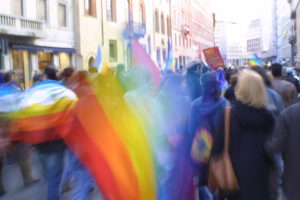
Rainbow Peace banner at a demonstration. Photo by Michele Migliarini

I’ve signed many petitions urging Trump to speak out against the physical and psychological violence of his followers. Trump actually did issue a direct request to “just stop it” (on CBS News) and for that I thank him.

And just as I condemn the wide-ranging violence (hundreds of reported incidents) BY Trump supporters, I also condemn the acts of physical and psychological violence AGAINST them. Holding a sign advocating rape is psychological violence. It is not acceptable. As Trump said, “Stop it!” And as Michelle Obama said, “when they go low, we go high.”

Facebooktwitterpinterestlinkedinmail

Two kernels of wisdom to help us all understand what happened on Tuesday.

First, this story in the Boston Globe, “The red state no one saw coming.” A few things worth noting there. First, Hillary’s campaign has only themselves to blame for being complacent, for not shoring up a weak base in states, like Wisconsin, they took for granted.

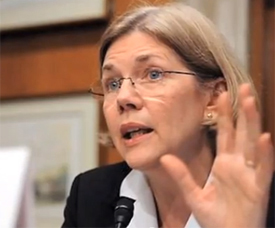
Senator Elizabeth Warren of Massachusetts

When Sanders trounced her by 13 points in the Wisconsin primary, she didn’t see the warning signs. She didn’t see that people were hurt and angry and demanding change. She didn’t bother to campaign in Wisconsin, while Trump visited five times in the past few months. She didn’t even start running ads there until the final week. And a thin wisp of a margin lost her the state. Rinse and repeat in other places, and you see the pattern. The Globe article notes that some Sanders voters switched to Trump, and this pattern (in my very unscientific observation via Facebook and elsewhere) shows up all across the country. Others, of course, stayed home or voted third-party.

Yes, there were those who voted for Trump out of bigotry. But according to Elizabeth Warren, in a powerful post-election speech, more of his voters were voting for economic change. They supported (she claims) the liberal parts of his agenda, such as trade reform, restoring Glass-Steagall (which I don’t remember him supporting), and rebuilding our country’s infrastructure while creating jobs. Undeterred by the lack of specifics and in many cases holding their noses over his character issues, they voted for a Republican with an old-line Democrat domestic agenda and an appeal to the racist populism that propelled the Democratic Party even into the 1960s. The above link takes you to the video. Full transcript: https://www.elizabethwarren.com/blog/president-elect-donald-trump. Watch or read it; there’s much to learn about how we frame this election and where we go from here.

Facebooktwitterpinterestlinkedinmail

Waking up to the shock of almost every swing state going for Trump, crying the first tears I’ve ever shed over an election result, it would be very easy to join the hair-pulling and overanalyzing that will be sure to follow.

The White House. Photo by Emilien Auneau

I have lots of ideas about that–but I’m not going to play that game. The past is past. The future is at stake.

The Left needs to ask itself two questions:

  1. What will effective nonviolent resistance to the expected aktions (I deliberately use the German word) around immigrant rights, freedom of the press, etc. (as well as the day-to-day policy struggles around the 1%, climate change, and other issues) look like?
  2. How do we most successfully organize that resistance?

On #2, I finally signed up for (and sent money to) Bernie Sanders’ Our Revolution movement today. I think it has the best chance of bringing this movement forward through electoral channels. But of course, we need a lot more than electoral channels. We need to challenge this new and ugly reality at every turn. The resistance must be strong, rooted in the power of nonviolence, and willing to use every tactic of other successful nonviolent struggles like the US Civil Rights and women’s suffrage movements, the Gandhian struggle for Indian independence, and yes, Occupy.

Facebooktwitterpinterestlinkedinmail

“When they go low, we go high.”—Michelle Obama

The US election is tomorrow, and I’m hoping for a result that utterly repudiates the racism, misogyny, and general hatred spewing from the mouth and keyboard of Donald Trump. That hope got me thinking about a column that ran in our local paper this summer.

The writer is progressive and I usually agree with him. But when he wrote about his experiences as a counterprotestor at a Trump rally, tossing insults at the attenders with his child in tow, I had a growing sense of unease.

Michelle Obama gardening with an elementary school student. Photo courtesy of Whjte House Public Domain
Children from Bancroft Elementary School in Washington, D.C. help First Lady Michelle Obama plant the White House Vegetable Garden, April 9, 2009. (Official White House Photo by Samantha Appleton)

He forgot Michelle Obama’s excellent advice at the Democratic Convention not to stoop to the level of those we oppose.

Yes, it’s very easy to get caught up in a temporary good feeling, hurling insults at Trumpsters and feeling like you’re striking a blow for what’s right and true. But it negates the other side’s humanity. It demeans people. It ignores the phrase popularized by 17th-century Quaker theologian George Fox, “that of God in every [hu]man.”

And it accomplishes the reverse of the desired goal! No one’s mind is changed by being insulted. If anything, when people are belittled, they are more likely to harden their hearts, reinforce their defenses, and stand resolute against what they perceive as the rowdy mob.

Think about the mindset of a Trump supporter encountering a protestor hurling insults. Many of Trump’s supporters are already feeling attacked; that’s why they respond to ideas like building a wall to keep Mexicans out or blocking any Muslim from entering the US. When they get insulted, they’re going to feel even more attacked. Instead of changing their minds, they’re more likely to come away from an encounter with a name-calling protestor feeling more justified in their condemnation of protestors. Instead of being touched at a human level, they wall themselves into the gated communities of a mind that now finds more safety in Trump’s lies and empty threats.

He writes, “what became clear as we shouted back and forth is that there is no common ground whatsoever between Trumpistas and the rest of us.”

But I disagree. When we focus on our differences, on the “otherness” of our “enemy,” we lose sight of what binds us together—yet our commonalities are still there. We all want a word where we feel safe, can earn a decent living, and can raise our children to feel like they matter in this world.

Are there some Trump supporters who are attracted to Trump’s blatant racism and misogyny, the constant lying, incessant bullying and name calling, and all the rest of his hateful message? Of course. But I don’t think it’s anything close to a majority of his voters. He has learned the fine art of framing. Helped by a vitriolic, slanderous 20+ year campaign against his Democratic opponent in right-wing media, he has framed his opponents as crooked and incompetent liars, who are bringing this country down, and he portrays himself as the Messianic savior who can turn the whole thing around, even without clear policy positions—and he’s managed to get enough people to believe this to win the nomination.

Trump is a master of crowd psychology. He speaks to the amygdala, the “reptilian” part of the brain that doesn’t care about facts—and he knows how to work an audience. I’m guessing that he’s probably read many works on manipulating the psyche, including Neurolinguistic Programming. I’m guessing that he has carefully studied the methods the Nazis used to get elected in 1933. This makes his refusal to be bound by facts more understandable. Catch him in a lie and he denies he ever said it, or denies it means what it appears to—because to admit and apologize would pry loose his grip on the minds of his followers. If we mirror his nastiness, we fertilize the field where his metaphorical bacteria can grow. But when we take the high road, we defuse his manipulations with a powerful natural antibiotic: the truth of our common humanity.

Let’s not stoop to Trump’s level. Let’s honor Michelle Obama’s call to take the high road. Rather than call our opponents nasty names, we must win them over to the promise of a better world than Trump can offer: a world that helps them achieve our common universal desires—without stomping on the backs of others.

“When they go low, we go high.” Let’s go really high tomorrow, and show that as a country, we are better than that.


Facebooktwitterpinterestlinkedinmail