I was not expecting to be totally blown away by a politician’s victory speech on Election Night. But I was moved to tears several times.

Whether you like his politics or not, you have to acknowledge his oratorical skills—both in the crafting of this speech and in the delivery, where he comes across to me as humble, inclusive, and committed. And if speaking is any part of your communications (which it should be), there are a lot of lessons in this speech.

The politician is Zohran Mamdani, just elected as the first Muslim mayor of New York City—a municipality with more population than 38 of the 50 US states.

You can view it at https://www.c-span.org/program/campaign-2025/zohran-mamdani-election-night-victory-speech/668370 (including the sweet family moment at the very end) and read the full transcript at https://www.nytimes.com/2025/11/05/nyregion/mamdani-speech-transcript.html (I had to set up a free account to see it).

He hits high notes immediately, quoting Eugene Victor Debs, “I can see the dawn of a better day for humanity.” Debs ran for president as an open socialist—from his prison cell. Then Mamdani hits us with this powerful and poetic paragraph centering his working-class base:

Fingers bruised from lifting boxes on the warehouse floor, palms calloused from delivery bike handlebars, knuckles scarred with kitchen burns: These are not hands that have been allowed to hold power. And yet, over the last 12 months, you have dared to reach for something greater.

Next, a hat tip to his opponent, who he wishes “only the best in private life.”

Then came the only thing I would have edited out: “But let tonight be the final time I utter his name, as we turn the page on a politics that abandons the many and answers only to the few.” His deeper meaning is ambiguous, but it could be seen as holding some resentment, not wanting to even speak the opponent’s name again. I would have skipped the first clause and jumped to “We have turned the page on a politics that abandons the many and answers only to the few.” When I listened, I misheard the word “utter” as “honor,” and that may color my negativity toward the bit about not speaking his name.

But he pivots immediately to his mandate for change, for making the city affordable, and for including marginalized populations:

Thank you to those so often forgotten by the politics of our city, who made this movement their own. I speak of Yemeni bodega owners and Mexican abuelas. Senegalese taxi drivers and Uzbek nurses. Trinidadian line cooks and Ethiopian aunties. Yes, aunties.

He then tells stories of a few people he met during the campaign: a man who has to commute two hours each way because he can’t afford to live in the city, another who can’t afford to take a day off, and a woman who says she’d lost her love for her city.

His inclusiveness and focus on the glowing future expand to his enormous volunteer network:

This victory is for all of them. And it’s for all of you, the more than 100,000 volunteers who built this campaign into an unstoppable force. Because of you, we will make this city one that working people can love and live in again. With every door knocked, every petition signature earned, and every hard-earned conversation, you eroded the cynicism that has come to define our politics… To my campaign team, who believed when no one else did and who took an electoral project and turned it into so much more: I will never be able to express the depth of my gratitude. You can sleep now.

Then he acknowledges just how ambitious his goals are:

Central to that vision will be the most ambitious agenda to tackle the cost-of-living crisis that this city has seen since the days of Fiorello La Guardia: an agenda that will freeze the rents for more than two million rent-stabilized tenants, make buses fast and free, and deliver universal child care across our city.

Years from now, may our only regret be that this day took so long to come. This new age will be one of relentless improvement. We will hire thousands more teachers. We will cut waste from a bloated bureaucracy. We will work tirelessly to make lights shine again in the hallways of NYCHA developments where they have long flickered.

Safety and justice will go hand in hand as we work with police officers to reduce crime and create a Department of Community Safety that tackles the mental health crisis and homelessness crises head on. Excellence will become the expectation across government, not the exception. In this new age we make for ourselves, we will refuse to allow those who traffic in division and hate to pit us against one another.

From there, he segues directly into something even more ambitious: confronting a hostile federal government and the bigots who enable it—those who want to sow division and hatred, while he calls for unity and invokes, one after another, Jews and Muslims (two other groups who are often at odds on certain issues)—leading first with the community that he is not a member of, but that I am:

In this moment of political darkness, New York will be the light. Here, we believe in standing up for those we love, whether you are an immigrant, a member of the trans community, one of the many Black women that Donald Trump has fired from a federal job, a single mom still waiting for the cost of groceries to go down, or anyone else with their back against the wall. Your struggle is ours, too.

And we will build a City Hall that stands steadfast alongside Jewish New Yorkers and does not waver in the fight against the scourge of antisemitism. Where the more than one million Muslims know that they belong — not just in the five boroughs of this city, but in the halls of power.

No more will New York be a city where you can traffic in Islamophobia and win an election. This new age will be defined by a competence and a compassion that have too long been placed at odds with one another. We will prove that there is no problem too large for government to solve, and no concern too small for it to care about.

This next bit could sound like bravado—I’d love to hear some specifics on HOW he will meet those high expectations—but to me, it comes across instead as another call for unity and actual bravery: being willing to stand up and be counted—and looking ahead to what future would-be dictators we will need to organize against:

They want the people to fight amongst ourselves so that we remain distracted from the work of remaking a long-broken system. We refuse to let them dictate the rules of the game anymore. They can play by the same rules as the rest of us.

Together, we will usher in a generation of change. And if we embrace this brave new course, rather than fleeing from it, we can respond to oligarchy and authoritarianism with the strength it fears, not the appeasement it craves.

After all, if anyone can show a nation betrayed by Donald Trump how to defeat him, it is the city that gave rise to him. And if there is any way to terrify a despot, it is by dismantling the very conditions that allowed him to accumulate power.

This is not only how we stop Trump; it’s how we stop the next one. So, Donald Trump, since I know you’re watching, I have four words for you: Turn the volume up…

So hear me, President Trump, when I say this: To get to any of us, you will have to get through all of us. When we enter City Hall in 58 days, expectations will be high. We will meet them. A great New Yorker once said that while you campaign in poetry, you govern in prose.

If that must be true, let the prose we write still rhyme, and let us build a shining city for all. And we must chart a new path, as bold as the one we have already traveled. After all, the conventional wisdom would tell you that I am far from the perfect candidate…

He goes on to poke a bit of fun at himself, listing several characteristics that would have been thought of as liabilities—then proclaiming, “I refuse to apologize for any of this.”

And he concludes with inspiration: another strong call for hope:

Let the words we’ve spoken together, the dreams we’ve dreamt together, become the agenda we deliver together. New York, this power, it’s yours. This city belongs to you.

Again, I suggest that you watch the speech, take notes on what you feel did and didn’t work, and think about what you can bring to your own presentations.


Facebooktwitterpinterestlinkedinmail

When Unilever acquired B&J’s, the agreement guaranteed the ice cream company the right to an independent Board empowered to continue B&J’s decades of social and environmental activism as they see fit. But apparently, Unilever, one of the largest consumer packaged goods (CPG) conglomerates in the world, disagrees with the Board’s repeated attempts to support the people of Palestine, a situation much more dire now after more than a year of constant Israeli attacks that have killed more than 43,000 Palestinians and injured and/or made homeless hundreds of thousands more, including thousands who’ve had their replacement homes or shelters destroyed and had to flee multiple times.

Most of the time, Unilever is one of the better corporate citizens. It’s done a lot of good in the business world for environmental and human rights efforts. Many of its business units, beginning with Ben & Jerry’s in 2012, are certified B Corporations (a business structure that allows environmental and social good to be factored in alongside profitability)–and the parent company has been undertaking a Herculean effort (ongoing since 2015) to get the entire corporation B-corp certified.

But now, Unilever is censoring the B&J’s Board and threatening to dissolve the Board and sue individual Board members. And, once again, B&J’s is suing the parent company over censorship around Gaza.

Israel’s position is unusual because it is treated differently than other governments, in two different ways. Some people grant Israel special status because of its history, and some use that history to condemn it and even question its existence. Here are some of the reasons why Israel-Palestine conflict is treated differently than elsewhere:


The Pro-Israel Reasons Why Israel is Treated Differently

  • European and US guilt in the aftermath of World War II, when it became obvious that millions of Jews, Roma, lesbians and gays, people with disabilities, and political opponents of the Nazi dictatorship could have been saved by other nations and were instead murdered in Germany and the lands it occupied.
  • Extremely effective pro-Israel lobbying that has demonized Arabs, Muslims, and Palestinians (overlapping groups, but not interchangeable) both within the Jewish community and in the wider culture. I recommend the film “Israelism” as the quickest way to gain understanding of how this has worked. This has been so effectively percolated into the culture that any attack on the Israeli government—even in its current super-brutal iteration—is labeled antisemitism.
  • The industrialized world’s continued reliance on fossil fuels from the Arab lands—and the widely-held view within the US government that Israel is our foreign-policy surrogate and enforcement agent in the Middle East (one of the most important strategic regions in the world: a crossroads of trade since ancient times and a place where political, energy, and military control conveys enormous influence over Europe, Africa, and western Asia).


The Reasons Why Others Condemn Israel

  • In the larger population, this role as US surrogate gets translated into accepting at face value the common belief that Israel is a bulwark of Western democracy in a region lacking in democracies. And that, in turn, causes conflict with those who criticize Israel’s appalling record of violence and subjugation in the Gaza war. The democracy meme is partially true. If you are a white Jewish citizen of Israel, you have rights under a democracy—but those rights are limited for your Israeli Arab neighbors and do not exist for your Palestinian neighbors in East Jerusalem and just outside Israel’s borders.
  • Pretty much every Israeli and Palestinian has experienced direct harm: the loss of loved ones, the destruction of and/or eviction from property, denial of human rights. For 76 years, Israel has oppressed Palestinians, dating back to independence in 1948—and Arab nations have repeatedly waged wars and nongovernmental attacks against Israel. More recently, Israel has initiated several wars. On my second trip to Israel and Palestine ten years ago, I listened to a man who had been only 11 years old when the Israelis told his family not to take a lot of their possessions because they would be back in a few weeks (scroll down in the linked article to the section on Bar-Am). He’s one of many whose story I’ve heard over the years that describe the oppression, loss, and bitterness —as the many Israeli Jews who’ve recounted their own losses through terrorism have also experienced. The gruesome toll affects people on both sides.
  • The denial of rights to ethnic and religious minorities within Israel and to majorities in the Palestinian Territories, the violence done to these populations, and the forced resettlement have all combined to make Israel a pariah in the eyes of many.

Unfortunately, what should be anger directed at the government of Israel is often misdirected into attacks on Jews. And it doesn’t help that so many people who should know better equate any criticism of Israel with antisemitism.

Mind you—antisemitism is real and it is not OK. But there’s a big difference between “Israel, stop bombing civilians, stop denying food access, stop destroying hospitals, stop killing journalists,” etc. and saying that the heinous Hamas attack of October 7, 2023 was justified or that the Jews as a people should be destroyed. Those latter constructs are antisemitic. The former are legitimate criticisms of a government gone amok.

Rabbi Jill Jacobs, the head of the rabbinic human rights organization T’ruah, has a helpful article on how to tell the difference.

But legitimate criticism of violent and discriminatory Israeli policies and actions, even those before October 7, cannot justify what Hamas did. There is NO justification for kidnapping, killing and raping innocents because they happen to be Jewish and living in Israel—just as there is NO justification for killing and torturing innocents because they happen to be Palestinian, Arab, and/or Muslim. And there is also no justification for treating Israel far more harshly in the diplomatic arena than other countries brutalizing occupied populations. If it’s wrong when Israel does it, it’s also wrong when other countries do it. Not to make that clear is another form of antisemitism.


And How Does This Relate to Unilever and Ben & Jerry’s

What Unilever is doing to Ben & Jerry’s is just a less intense version of the censorship and repression on college campuses last spring when Palestinians and their allies demanded justice and peace. What it says is “we espouse values of multiculturalism but we don’t actually believe it. In fact, we believe in demolishing entire populations based on ethnicity, religion, or other factors that we say shouldn’t matter. And we will bring repression down upon the shoulders of those who defend the groups we want to marginalize.”

To make real change, we have to make space for dissenting voices, especially from marginalized populations. That gets stripped away when criticism of Israel’s malignant actions are blocked. If you agree, click to tell Unilever to stop stomping on dissent at Ben & Jerry’s. You’re welcome to copy and modify my message:

As a proud Jew and an activist for 55 years who’s worked on peace, Middle East, the right to dissent, environmental, business as a social change agent, and immigration justice among other issues, I take strong issue with Unilever’s unilateral abrogation of Ben & Jerry’s right to protest genocidal policies in Gaza. With the Board’s independence written into the acquisition agreement, the umbrella entity of Unilever is not obligated to agree with their position and nor does that position have to be thought of as representing the whole corporation—but you are obligated to let them express it. Palestinian rights are compatible with Jewish rights, and the world needs to stop accepting the argument that criticism of Israel’s government is antimsemitism.

Facebooktwitterpinterestlinkedinmail

A friend of mine, a very successful author and marketer, a deep student of the human psyche, asked on Facebook, “Why do you love/hate Trump? (Disclaimer: I’m indifferent.)”

It was the disclaimer that got me worried. This is part of my response to him:

I have enormous respect for your analytical skills, M.______, but I question deeply your indifference…

M.______, I hope you’re pulling our legs. You of all people understand human motivations and psychology. Trump is a master marketer and manipulator. I don’t know if he’s studied NLP [Neurolinguistic Programming] (or maybe you) or if he’s actually a natural.

I do know that if he wins, I will be looking seriously at what other country I might live in for the next 4 to 8 years. I have family who died in Nazi concentration camps. I don’t want to be part of an America where ordinary citizens are rounded up because they’re Muslim or Mexican, just as my parents’ cousins were for being Jewish.

I don’t say this lightly. I consider him extremely dangerous, and it scares me that enough people in the US take him seriously enough that he’s doing well in the polls (we’ll see if this translates to actual votes).

 Some things I didn’t say to my friend:
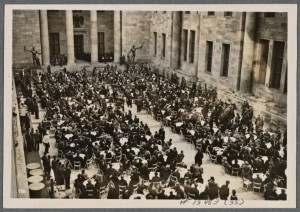
In the courtyard of the new Reich Chancellery, the Fuhrer partakes of the "one-pot" communal stew meal in the company of invited fellow citizens. Photo by Heinrich Hoffman, courtesy New York Public Library
In the courtyard of the new Reich Chancellery, the Fuhrer partakes of the “one-pot” communal stew meal in the company of invited fellow citizens. Photo by Heinrich Hoffman, courtesy New York Public Library
 But my deep message to my friend is that we cannot afford indifference. Let’s remember that Hitler was democratically elected, and that Berlin in the 20s was a liberal, arts-centered city. We must not get complacent. We must not think “it can’t happen here.” And we must not be swallowed by indifference.
Facebooktwitterpinterestlinkedinmail

It is so amazing for me to watch a major foreign policy and development speech by a sitting US president and actually agree with more than 80 percent of it–yet that was the case for Obama’s speech in Cairo, Egypt. Even under Clinton, I was lucky if I agreed with him 25 or 30 percent of the time, and the number was far lower for speeches of the other presidents in my conscious lifetime.

As a progressive, I issue this challenge to other progressives: hold him to the grand rhetoric of peace, international cooperation, multicultural tolerance, and yes, feminism in the Arab world and at home…and to keep him maintaining his acknowledgment of the important roles of Israel and Iran as well as the Arab and Muslim countries.

But what was that he said about being in Iraq until 2012? Waaay too long.!

Facebooktwitterpinterestlinkedinmail