Part 4 of a series of reminiscences of the April 30/May 1, 1977 occupation at the Seabrook, NH nuclear power plant construction site, and its aftermath. If you missed Part 1, read it here, and then follow the links to Parts 2 and 3.

How Clamshell Changed the Consensus on Nuclear Safety

Remember the Three Mile Island (TMI) nuclear accident near Harrisburg, Pennsylvania, in March 1979? How about Chernobyl in the Ukraine, 1986, or Fukushima, Japan, 2011?

Of course you know about these three accidents. They received extensive news coverage at the time, and now they’re part of our history.

But unless you’re actively involved in the safe energy movement, you probably never heard of the near disasters at the Enrico Fermi breeder reactor in Michigan in 1966, or the one at Brown’s Ferry, Alabama, in 1975. These were at least as serious as TMI. In fact, there have been at least 100 potentially devastating nuclear accidents since humans began harnessing “the peaceful atom” to generate electricity.

But one important thing had changed between 1975 and 1979. By the time of TMI, nuclear power safety questions had become newsworthy. Why were they suddenly newsworthy? We can’t know the answer for certain, but I’d say the odds are very good that it was because of Clamshell and the national citizen action movement it sparked. Those efforts caused a lot more people to learn about nuclear power, and to become scared, and to take action, which inspired more people, etc.

In other words, the 1414 of us who got arrested, and the roughly 600 involved supporters who kept the lines of communication open between those of us inside and the wider world, made a difference not just in the immediate struggle but in the national consciousness. We uncorked the bottle with our questioning and our very public action, and once that bottle was uncorked, the magic spread. As a country, we learned to question the authority of nuclear utilities and of the regulators who granted them permission. We learned that the system was not protecting us. We made the issue of nuclear safety important enough to the media that they reported immediately on what was happening at TMI, Chernobyl, and Fukushima.

Even the Nuclear Regulatory Commission admits this. Tom Wellock, a historian there, told the Boston Globe,

What happened with the Clamshell Alliance at Seabrook is that it really nationalized consciousness about nuclear power and inspired similar groups around the country. Their influence on policy-makers certainly mattered.

Rebecca Solnit notes, “Sixty-six nuclear power plants were cancelled in the wake of Clamshell.”

And Harvey Wasserman, one of the safe energy movement’s early activists and chroniclers, noted in 2007 that the protests led to an important secondary impact:

Inspired in part by the protests, Jane Fonda and Michael Douglas’s China Syndrome, happened to open in theaters just as TMI went to the brink. The industry took the double body blow of a terrifying disaster and a Hollywood blockbuster.

What Clamshell Changed About Later Activism (Occupy, DT resistance, Sugar Shack Alliance, etc.)

Organizationally, Clamshell Alliance provided many lessons to later social change struggles. Nonviolent resistance in the US—the iconic strategy of the Civil Rights movement—had been fairly dormant since the US military pulled out of Vietnam in 1975. Clam revived it, and our spiritual younger siblings around the country like the Abalone Alliance in California and the Sunflower Alliance in Kansas spread it far and wide.

Interestingly, a group of disillusioned protestors, impatient with the slowness of nonviolent struggle, formed the Coalition for Direct Action at Seabrook in 1979—a group willing to use property destruction and to physically battle with law enforcement. CDAS’s actions were failures, serving mostly to discredit the protestors in the eyes of some locals—a failure that would be repeated in “The Battle in Seattle,” a protest against the World Trade Organization in 1999 where the small number of violent protestors dominated the media coverage and alienated many people.

Later struggles, such as Tiananmen Square and Arab Spring, returned to committed, principled nonviolence. This was also much in evidence in the South African struggle against its apartheid government in the 1980s (though not all elements were nonviolent).

Many movements in this current decade of the 2010s built directly on Clamshell’s process and tactics: Occupy, the stop-fossil-fuel-pipelines struggle (including Standing Rock), and the intersectional movement of resistance against the Trump administration.

Occupy’s ultra-democratic process no-leader, with innovations such as using a human chorus as a microphone to repeat a statement so others could hear, would probably never have evolved if it weren’t for the process innovations of Clam.

From that article by Rebecca Solnit linked above:

Their spirit and their creative new approach inspired activists around the country and helped generate a movement…Clamshell Alliance and many of the antinuclear groups that followed developed non-hierarchical, direct-democracy methods of organizing since used by activists and movements throughout the U.S. and beyond, including Occupy Wall Street, whose consensus-based general assemblies owed a lot to a bunch of hippies no one remembers.

Pipeline opponents took many leaves from Clamshell’s playbook, including naming their resistance groups. For example, the name of the Sugar Shack Alliance near me, contesting pipelines across Massachusetts, Connecticut, and New Hampshire, reminds us that gas and oil pipelines threaten the maple sugaring industry—as does the severe climate change that fossil fuel infrastructure enables. Members pledge to train in nonviolent resistance and its code of conduct (click Nonviolence Training on the group’s home page) is almost identical to Clamshell’s 40 years earlier. In fact, just this week, 18 people were arrested at a Sugar Shack Alliance sit-in to protect trees in Otis (MA) State Forest that the pipeline company had gotten federal permission to cut down (in violation of state law). Meanwhile, in North Dakota, Water Protectors at Standing Rock opposed to a different pipeline waged a months-long occupation combining Native American spirituality and deep nonviolence in the face of serious repression.

And the post-election resistance understands the power of multiple sustained actions and on addressing multiple issues and constituencies while focusing on a more targeted immediate goal. It’s exciting to see these movements (and to participate in some).

Activists for a Lifetime

Clam not only changed the landscape in terms of resistance to nuclear power, but also changed the lives of many (perhaps all) who were involved. Over the years, I’ve constantly discovered that many people who were doing some of the best organizing work in sector after sector turn out to be Clamshell alumni. And as I prepare to attend a Clamshell reunion this weekend, I look at the list of attenders (and their email signatures) and I see that lots of them are still deeply involved in social change (as I am). I was one of the younger Clams, so many of these folks are well into their 60s and beyond.

My own life was impacted in lots of ways. One of those was my decision to live in an intentional community populated heavily with Clam veterans steeped in nonviolence theory and practice—the group that had developed the small-to-large consensus process, in fact. I lived at the Philadelphia Life Center in 1980-81, and learned much about meeting process, social change theory, and how personal growth can integrate with organizing.

A second was Save the Mountain, the movement I founded in 1999 (and devoted more than a year of volunteer time to) that saved our local mountain. I used many tools I’d learned at Seabrook and in that later nonviolent activist community.

Climate marchers in front of Trump Hotel, Washington DC 4-29-17 (Clamshell Alliance's spiritual heirs)
Climate marchers in front of Trump Hotel, Washington DC 4-29-17 (Clamshell Alliance’s spiritual heirs)

More recently, starting in 2013, I’ve focused my career on combining both marketing and community organizing to achieve social change and environmental justice: leveraging the business community to turn hunger and poverty into sufficiency, war into peace, and catastrophic climate change into planetary balance—not through guilt and shame, but harnessing enlightened self-interest. Among other things, this involves helping businesses develop and market profitable products and services that directly address these goals.

Nuclear’s Deep Sleep (only 1/10 of Nixon’s goal)

The final impact I want to discuss (there were others) was the end of the industry’s dream. Richard Nixon called for 1000 nuclear plants in the US; it topped out at 112 and is now at 99 or 100. And nuclear power plant construction ground to a nearly complete halt for decades. After 1996, the next new commercial reactor in the US only went online in 2016. Four are under construction in Georgia and South Carolina, but these have been plagued by cost overruns, delays, manufacturing issues, and horrible economics including a bankruptcy by the reactor designer, Westinghouse, directly related to these projects; experts predict that they will never go online. Meanwhile, several plants including Vermont Yankee won a license extension from the NRC only to close just a few years later.

This series will wrap up with Part 5, on the current state of nuclear power and how the safe energy movement can organize to block a “zombie nuclear return from the dead.” Stay tuned!

Facebooktwitterpinterestlinkedinmail

Part 3: Inside the Armories

Part 3 of a series of reminiscences of the April 30/May 1, 1977 occupation at the Seabrook, NH nuclear power plant construction site, and its aftermath. If you missed Part 1, read it hereAt the bottom of that page, you’ll find a link to Part 2, and at the bottom of Part 2, a link back here.

In Manchester at least, we were all held in one big room. Each affinity group had an area, and we kept our own areas clean. All the poles that held up the ceiling were numbered, so we had an easy system to identify our locations within the large floor.

Small-to-Large-Group Consensus Decisions

Have you ever tried to get even 70 people to agree on anything? Even with 700 people in the Manchester Armory, we maintained a commitment to consensus; we did not move forward organizationally until everyone was OK with the decision. That didn’t mean everyone was in total agreement, but it did mean that the people who preferred another choice were OK with going forward after their concerns were heard. We had numerous decision-making meetings about strategy, about the roles of our support people on the outside, and about how we were being presented to the world. And consistently, we were able to reach rapid consensus.

How? By using hubs and spokes on top of the affinity group structure: Each affinity group selected a spokesperson to represent our views to a circle of spokespeople. The representative was not empowered to make decisions on our behalf, but to express our views and bring the views of other groups back to the affinity hubs to discuss whatever issues those other groups’ spokespeople had brought up.

Over and over, this structure, which sounds cumbersome and slow from a distance, proved to work well and work quickly. We settled even the most complex decisions through consensus, and that consensus was always achieved within two hours or less—sometimes just a few minutes. And because every issue or concern was explored, and we only implemented after no one was blocking, the decisions we reached carried weight and took root smoothly and rapidly; no one was trying to sabotage them, because we all felt ownership of the process.

Creating a Learning Community

Another exciting piece was the way we took advantage of our time together in a confined empty space to teach and learn from each other. You could call it “University Within Walls.”

Detainees offered a myriad of workshops around energy issues, green living/self-sufficiency, creating inclusive and active communities, environmental justice, and social change. All of us had expertise in something, and many were willing to share their knowledge. Some of the offerings, as I remember them:

  • Nonviolence theory and practice
  • Understanding the mechanics of—and problems with—nuclear power
  • Building quick, cheap and easy do-it-yourself alternative energy projects
  • Organic food production and preparation
  • Organizing and fundraising skills
  • How to get media coverage
  • Strategy of social change
  • Meeting facilitation that works

Workshop leaders would put up notices or announce sessions at meetings, including the nearest pole number.

From what I could see, it looked like nearly all the detainees were taking advantage of this opportunity, so almost all of us emerged from our incarceration with more knowledge and better skills. And from what I heard afterward, similar education was happening in the other armories. This is probably one reason why so many Clamshell Alliance folks have remained involved in social change all these decades later.

Reaching Past the Choir

A few days into our incarceration, some of us started realizing that we had a captive audience for our message: the young National Guard reservists called up to ensure security and order. Since we were all trained in nonviolence and a pretty orderly group—other than two detainees who sneaked out, made a run to the nearest Haagen Dazs, and were re-arrested bringing back ice cream to share—they didn’t have a lot to do.

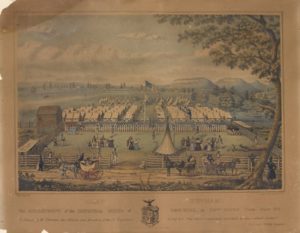
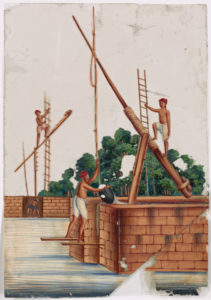
Unlike these National guardsmen of 1852, our primitive accommodations inside the armories included indoor plumbing. Picture credit: New York Public Library Digital Collections
Unlike these National Guardsmen of 1852, our primitive accommodations inside the armories included indoor plumbing. Picture credit: New York Public Library Digital Collections

So a lot of us started hanging out with the Guardsmen (I don’t remember any women in uniform) and chatting them up. We asked some questions about what being in the Guard was like, what they liked to do in their spare time—and what they knew and felt about nuclear power and our protest.

Clamshell was deep in the counterculture, with new ways to make decisions, a willingness to challenge any authority, and the scruffy hippie look of 1970s activism. Yet, among this very non-counterculture audience, we found most of them open to talking, and some of them open to changing their positions. As Rolling Stone described it back then, “But the prisoners hung on, politicizing their jailers, the guardsmen, whom they treated as friends.

For me, that was the only the second time I’d reached across to people I saw as “on the other side.” The first was at a peace demonstration at Wright-Patterson Air Force Base in Ohio, a couple of years earlier. It had felt like a revolutionary act, humanizing each other and finding places of commonality while defusing tension. Since then, it’s been a part of my social change toolkit.

Part 4 will look at what Clamshell and the Seabrook Occupation accomplished in the wider world, the ripples of impact we had that continue to this day.

Facebooktwitterpinterestlinkedinmail

Part 2 of a series of reminiscences of the April 30/May 1, 1977 occupation at the Seabrook, NH nuclear power plant construction site, and its aftermath. If you missed Part 1, read it here.

The Nuclear Controversy Makes the News

In 1977, the vast majority of Americans had never looked into the arcane technical issues around nuclear power. The government told us this technology was safe, and most of us believed them. Three years earlier, I had taken on a research project for a college class on the pros and cons of nuclear power—and I discovered as I read several obscure books on the subject that there were a lot of cons, and no pros. But I was a tiny minority. What few news stories there were mostly pretty rah-rah. I’d never seen any media coverage about nuclear’s serious problems, accident history, or economic house of cards.

All that changed while we were in the armories. We got tons of coverage of the movement, and some reporters decided to look into our claims. As they saw that our resistance had merit, the culture shifted, and the media began to help us prove our case.

Impact on New Hampshire

New Hampshire was a very quiet place in 1977. Its population was much more rural and it didn’t have a lot of criminal justice infrastructure. The reason we were kept in National Guard armories rather than jailed was because 1414 arrestees far outstripped the capacity of New Hampshire’s jails and corrections officers; the state normally had about one third as many prisoners. Governed by Republicans who favored a libertarian ideology when it was convenient, the state had (and still has) no sales tax and a very lean budget. When they arrested us, they clearly expected us to make bail and go back where we came from until we came back for our court dates and patronized local hotels and restaurants in the process.

But in those strategy circles I described yesterday in Part 1, we decided as a group to do “bail solidarity”—to not post the modest bails and to stay as unwanted guests of the state. For several days, nearly all 1414 of us refused to post bail, leaving the state with a lot of extra mouths to feed, as well as a lot of staffing costs to pay the National Guard reservists who had to be called up to monitor us—costing the state $50,000 per day, according to Rolling Stone’s account of July 1977 (probably at least $150,000 per day in 2017 dollars). This created enormous pressure on the state to come to terms with us. People stayed as long as they could, and bailed out in small numbers as they were needed on the home front. (I bailed out after a week because I was running an event back in Providence; Nancy stayed the entire two weeks).

In other words, the Occupation continued after our removal from the site. It simply shifted to the multiple venues where we were held. And this became so expensive that the New Hampshire government capitulated on May 13, 1977 and released all remaining detainees without bail.

Until this occupation, opposition to the construction plans at Seabrook was mostly localized. While very strong in the Seacoast region of New Hampshire and the immediately adjacent communities in neighboring Massachusetts—opposition was not strong enough to block the plant through mainstream methods such as regulatory appeals and lobbying. Clamshell Alliance, formed in July 1976 and inspired by a nuclear plant occupation in Germany, turned to nonviolent direct action. Clam waged two small nonviolent occupations in August 1976, with 18 and then 180 arrests, and began organizing across New England for the April 1977 occupation. And the more people learned about nuclear power and its dangers, the more the resistance gained strength. Safe energy became mainstream.

Fake News, 1977 Style

Despite our incarceration, we had access to newspapers, delivered daily (presumably by the outside support system of people who had chosen not to be arrested to they could provide us what we needed.

One of those papers was the Manchester Union Leader. Despite its progressive-sounding title, this was a right-wing rag, owned by the notorious William Loeb, who would have been right at home in a Steve Bannon world. I believe it was Loeb, but it may have been his protégé, then-Governor Meldrim Thomson, who called us “The Clamshell Terrorists” (I can’t find the quote on Google).

Pretty much alone in its denunciation of us, the Union Leader lumbered through its daily attacks on us.

Meanwhile, we were getting very sympathetic and much more accurate coverage on a slew of both mainstream and progressive publications and broadcast media. And we had a lot of media-savvy people, both inside the armories and outside, that helped us tell the story our way. In the armory I was in, there was even a “graybeard caucus” that pressed the news media for acknowledgement of our age diversity every time a story said the protestors were “mostly in their 20s.”

The Idea of Alternatives Takes Root

One reason why nuclear had not been much questioned was that the alternatives were hard to see. Even though the 19th-century industrialization had been largely powered by water, and agriculture in the early 20th century used wind power extensively, as a society we hadn’t been trained to look past fossil and nuclear. But Clamshell made an important strategic breakthrough: being against nuclear was far more effective if we were for something else. Energy that falls from the sun, is pulled by the wind, or harnesses the current of a river is infinitely renewable. Once the infrastructure is in place, it doesn’t cost more to harvest and harness those sources—unlike fossil and nuclear that keep demanding more.

And we had this understanding well before the consciousness about global climate change and carbon footprint penetrated the general consciousness.

Admittedly, these systems aren’t always can be designed to be in harmony with their microenvironment and with the planet as a whole (especially at industrial scale, where they can be quite destructive). But they can be designed for true sustainability, while fossil and nuclear can’t.

Replicators: Dawn of a National Movement

As we emerged from the armories, we began to understand more of our true impact. We discovered that other dozens of Alliances named after their own local flora and fauna were springing up around the country, turning their sights on existing or planned nukes in their own areas. And this national movement successfully reversed the drive toward nuclear. Seabrook did go on line, so we lost that battle (although the power company only built one of the two permitted plants, and that was a significant victory for us). As far as I know, Seabrook was the last plant permitted in the 1970s or 1980s that went online as part of the electric grid. The terribly positioned Shoreham plant on Long Island, New York, was completed and turned on for testing, but then rapidly shut down and was never used to generate power. And for more than 30 years, no new nukes in the US moved forward. Those in the planning stages were scrapped, and many existing plants, facing the wrath of these citizen groups, eventually shut down.

We’ll revisit the deeper implications of that movement in Part 4 of this series. Meanwhile, stay tuned for Part 3.

Facebooktwitterpinterestlinkedinmail

April 30, 1977 was a date that changed history—and I was there.

I was 20 years old. My then-girlfriend Nancy Hodge and I were part of the Rhode Island Affinity Group of Clamshell Alliance, a New-Hampshire-based safe energy activist group.

Like all the other participating affinity groups (typically consisting of 10-20 people), we’d been trained in nonviolent resistance. And we’d studied up on some of the many issues about nuclear power, among them:

  • Risk of catastrophic accidents (including several that had already occurred and were not widely known)—and the subsidized limited-liability insurance that was no insurance at all for pretty much anyone other than the plant’s investors
  • Cancer risks in routine operations, and much greater health risks when things went wrong
  • Need to isolate the wastes from the environment for 220,000 years (and no known way to do this)
  • Insecurity of the facilities, requiring extreme protection against natural disasters, human-caused failures, AND terrorist attacks—and thus threatening the freedoms of our whole society
  • High capital cost and short lifespan, making this an extremely expensive way to generate electricity
  • Hazards of ground, water, and air contamination

And many others. We also knew at least the rudiments of what was even then a far better alternative: harnessing clean, renewable technologies such as sun, wind, and water, and using the energy we already had much more efficiently.

And we knew that just a few years earlier, then-President Richard Nixon had called for 1000 nuclear power plants around the US. That the industry’s 1950s claim that nuclear would be “too cheap to meter” was utterly false. That the second-generation nuclear plants of the 1970s that were supposed to be safer were already showing problems. And that movements across Europe demanding an end to this unsafe and uneconomical technology were gathering strength, organized into affinity groups and providing a model for us. As far as I know, Clamshell Alliance, then about a year old, was the first organized regional movement of resistance against nuclear power in the US, but the movement in Europe, often involving nascent Green Parties, was becoming a significant force.

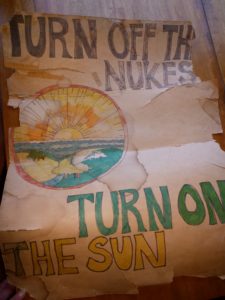
Nancy had made this beautiful sign with not-usually-permanent felt-tip markers, which she carried. Somehow, I ended up with it when I moved from Providence to New York. I have moved to a new place 12 times since I became custodian of the sign, and still know exactly where to retrieve it. And miraculously, though it’s faded and the cardboard is crumbling, that proud defiant common-sense message still comes through.

Sign by Nancy Hodge Green, used at Seabrook, 1977. Photo by Shel Horowitz
Sign by Nancy Hodge Green, used at Seabrook, 1977. Photo by Shel Horowitz.

About two thousand of us marched into the construction site, armed with such “dangerous weapons” as tents, sleeping bags, and healthy snacks. I think a couple of people thought to bring small shovels to dig latrine pits. We camped out on the site that night and did various things to get centered in the morning. I chose to attend a deeply powerful Quaker Meeting in the parking lot that still stands out as one of the.most deeply spiritual encounters of my life.

1414 of us, including Nancy and me, formed our affinity groups into circles, linked arms, and refused to leave when the order to leave or be arrested was given the next day. We were taken one at a time from our circles and placed on school buses by State Police from all the New England states, and eventually driven to one of several National Guard armories. The Rhode Island Affinity Group was all together in the Manchester National Guard Armory, with about half of all the arrestees. If I remember correctly, we were able to take our possessions and we used those sleeping bags during our incarceration. Pretty sure the state did not supply cots.

What happened during our time “inside” was amazing, both inside the armories and out in the “real world.” Tomorrow, Part 2 will cover some of the outside-world shifts that we caused.

Facebooktwitterpinterestlinkedinmail

Are big protests a waste of time unless they’re part of an overall strategic plan? Nonviolent social change theorist George Lakey and I have been discussing this.

After my February post about Lakey’s idea that DT is creating enormous opportunities for social change workers, I got an interesting response from George (which I only just saw, thanks to a quirk in the WordPress interface). Please go read the original post and his response.

I believe my settings close comments after two weeks, and I couldn’t find a way to turn that off temporarily for this one post). So just to make sure there’s a way to keep the dialogue going, I’m posting my response here, as a new post, starting just below:

Marching at the Women's March on Washington with my wife and children
Marching at the Women’s March on Washington with my wife and children (from left: son-in-law Bobby, daughter Alana, wife Dina, me, son Rafael)

I agree with most of what you’d laid out here, George and certainly the key kernel that mass action makes the most sense as part of a well-thought-out and multidimensional campaign. And yet, I’m more optimistic than you about the power of a one-off mass action to build momentum for change. It has to be sustained, of course—but it can play a key role.

  • My own involvement with the Movement began because I attended a mass rally about Vietnam, at age 12 (1969). One of the speakers said something that was life-changing for me. But it was not until I was in high school that I began to realize that the real work of social change happened in the meetings to plan those marches, more than the marches themselves—and to participate as other than a drone showing up to other people’s events.
  • The reason all those no-nuke Alliances sprang up was because of what we did at Seabrook, a mass action.We inspired many other groups around the country to borrow our strategy, process, tactics, and even nomenclature, to organize affinity groups as we did, to educate about the issues around nuclear power and the safe-energy alternatives, and to be trained in nonviolent civil disobedience. And the reason we heard about Three Mile Island in the news two years later when we hadn’t heard about the earlier accidents at Enrico Fermi, Browns Ferry, and elsewhere was because of this national/international mass movement that started at Seabrook. It was having thousands at the site and 1414 arrested that pushed the issue into America’s consciousness. The first two Seabrook occupations almost a year earlier, much tinier, had almost no impact outside the local area.
  • Occupy could have been much stronger with leadership and goals, I agree. But still the movement had a great deal of impact. Like Clam, some of its process innovations have become part of the Movement. You talk about those turned off by Occupy, but what I saw was a generation of young people who moved from inaction, maybe even apathy, to deep, personal, and highly inconvenient action. They made sacrifices for social change. And I think a lot of them moved into actual organizing after the camps closed.
  • The recent Women’s March had very little strategy behind it but sparked the immediate and clear message that resistance is mainstream, that DT does not represent normal, and that oh yes, there was something we could do. And of course, it provided yet another opportunity for DT to make a fool of himself saying ridiculous things about the protests. I don’t remember another time when nonviolent protests unscrewed the legs of legitimacy from a government less than one day old. And again, a lot of folks who had never done anything political went from the march to the meetings. The thousands of hives of the resistance were enormously strengthened by that unstrategic mass event.

I’m glad you brought up the business community. This is where I have very strategically placed most of my own organizing in recent years: showing that business can create meaningful social change, not out of guilt and shame but out of enlightened self-interest: the profit motive. This is the subject of my 10th book, Guerrilla Marketing to Heal the World, as well as my “Impossible is a Dare” talks. It’s the opposite of mass organizing: small groups and even one-to-one conversations.

So yes, let’s incorporate big protests into a wider strategic view, as the Civil Rights organizers did. Let’s read Alinsky and Gene Sharp, MLK and Gandhi, Barbara Deming and Dorothy Day, and of course, George Lakey. Let’s study the successes AND weaknesses of all these movements including Occupy, BLM, and the current resistance. And lets create strategies that keep the needle moving, both publicly and behind the scenes, toward the world we want. Outside of my social change work through my business, I’ve been focusing my own parts of the resistance on the amazing opportunity to get people who haven’t been talking to each other not just talking but supporting and acting in solidarity. I see this work—and especially the chances for Jews and Muslims to work together in solidarity—as deeply strategic based on seizing the moment where a conversation is much easier to have under the lens of both groups being under threat.

PS: George, I apologize for the late reply. WordPress only showed me your waiting comment last night. I approved it immediately but wanted to bring my much clearer early-morning thinking to my response. [end of my quoted response]

Facebooktwitterpinterestlinkedinmail

For the past 3-1/2 years, I’ve been not just thinking but taking steps to change the entire direction of my business from basic marketing consulting for green businesses to shaping profitable ventures that directly turn hunger and poverty into sufficiency, war into peace, and catastrophic climate change into planetary balance. In other words, showing how social entrepreneurship is a business success strategy that increases revenues and decreases costs. Obviously, more revenue plus lower expenses = higher profits.
Yeah, thinking big. Big enough so it took some serious time to get ready (far more than I thought it would. Here are some of the steps I’ve taken:
  • Hired a remarkable business coach, Oshana Himot, who helped me see that I didn’t have to wait until certain metrics were in place before dong this work that’s been in my heart for decades—and that if I did wait, I’d never get there. She has also worked with me on role-playing sales conversations, etc., to the point where now I really am ready.
  • Launched several new talk topics, including “‘Impossible’ is a Dare”—which I first gave as a TEDx in 2014; I’ve done it several times since, in longer (and once, shorter) formats. You can get a nice taste of it in my 4-minute demo video, if you’re interested: https://www.youtube.com/watch?v=tooSVbHQ5Ik&feature=youtu.be
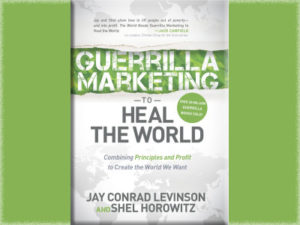
  • Wrote and found a publisher for my 10th book, Guerrilla Marketing to Heal the World, and went to press (a year ago) with about 50 endorsements, Chris among them—alongside Seth Godin, Jack Canfield, and guest essayists Cynthia Kersey (“Unstoppable”) and Frances Moore Lappé (Diet for a Small Planet). The book has won two small awards so far.

    Cover of Guerrilla Marketing to Heal the World by Jay Conrad Levinson and Shel Horowitz
    Cover of Guerrilla Marketing to Heal the World by Jay Conrad Levinson and Shel Horowitz
  • Organized a very ambitious telesummit (also in 2014) that flopped utterly and made me realize I was NOT ready to go after clients in this new niche—and began to do more work to get myself ready.
  • Put up several websites to help me figure out where to put my energy: I had to develop https://transformpreneur.com and https://impactwithprofit.com before I figured out what I really wanted to say and to whom. The result is https://goingbeyondsustainability.com
  • Determined that small businesses were probably my most likely clients, but that they were not likely to have the budget freedom. Thus, I chose to go after larger companies who might sponsor me to work with their clients, suppliers, NGO partners, etc. Bought a program on how to get sponsors and created a fabulous proposal, driven by benefits to the sponsoring company, that (hopefully) will get my hired to speak and consult.
  • Created a list of ~200 companies I mention favorably in the book and hired someone to research the contact info.
  • Hired a designer to develop a log.
And now I’m finally at the point where it makes sense to reach out to those companies and see if I can get traction. I only need about three to say yes to a medium-to-large project to have a full pipeline.
To me, this is true sustainability; business has to survive—and thrive—in order to make that difference. But the business world often defines sustainability much more narrowly: as simply going green. In positioning my services, I wanted to make a statement that “sustainability,” under that definition, is not enough. It’s keeping things from getting worse, where I think we can make things better. Thus, the name, “Going Beyond Sustainability. And this logo:

https://goingbeyondsustainability.com logo and tagline
Going Beyond Sustainability logo and tagline

This, I believe, is the future of Corporate Social Responsibility (CSR): fundamentally reinventing society to better serve the needs of its planet and its people, self-funding through profitable products and services.

Facebooktwitterpinterestlinkedinmail

Have you seen the infamous Pepsi ad that’s been called “tone-deaf” by progressives, and which Pepsi pulled quickly? Before you read the rest of this post, please write your impression of it in the comments.

I watched the part of it shown on this segment of The View.

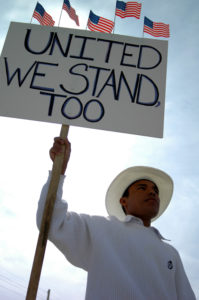
Protestor calls for unity


And I agree with Whoopi: the message is about inclusion.

Yes, it is co-opting the movement. Advertisements have always co-opted cultural memes. If you wear $60 torn jeans, you can thank the hippies and grunge-punks who wore their clothes to rattiness. For that matter, Bud commercials and Wheaties cereal boxes have been co-opting sports culture for decades (it feels like millennia).

I’m old enough to remember when hijab-wearing women and people of color and same-sex couples would not have been allowed anywhere near a commercial. What I see most of all is a message to DT that we are united in our diversity (and that includes the cops, who are actually our allies most of the time–and which the movement made a big mistake in automatically trashing in the 1960s).

I also agree with Whoopi that water is my preferred drink over any kind of soda.

That Pepsi was attacked to the point where they pulled the ad is much more shocking to me than the ad itself.

But I guess I shouldn’t be shocked. Here in the Blue Bubble, behind the “Tofu Curtain” (not a phrase I invented) in Massachusetts’ Hampshire/Franklin Counties—one of the bluest parts of a very liberal state—those accusations of “tone deaf” are all-too-familiar. Two among many examples:

  • A program in which cops in the schools did something sociable with the kids was kiboshed and the very progressive police chief (an out lesbian who was seen at Pride Day marches long before she became chief) was trashed as tone-deaf
  • Two towns over, several years ago, a production of “West Side Story” was canceled because some people thought the whole idea of the play was racist. I don’t know if they read the script or saw the movie, but to me, that movie makes a statement against racism, just like Twain’s Huckleberry Finn (which has also been criticized for racism, because it uses the N-word—even though it was written in the 19th century when that was the term used and the whole premise of the story is to show the absurdity and cruelty of racism)

It reminds me of the days when the left (my teenage self included) would practically canonize any extreme statement that happened to be made by a person of color or one who identified as any shade of LGBTQ, even if that statement incited violence against innocent people who happened to be white and straight. I should have spoken out against those outrages 45 years ago, but I was just as hoodwinked.

I’m not talk about any false unity of sweeping real grievances under the rug. But I am objecting to the shrill side of political correctness that demonizes the Other without even listening, even when the Other is mere steps away on the political spectrum, dividing instead of uniting and leaving us all at risk when the real forces of repression sweep in.

Facebooktwitterpinterestlinkedinmail

Yesterday, I posted something on Facebook about reaching a real, and sympathetic, human being on the White House Comment Line. Since the US election last November, I’ve called my elected officials a lot more than in the past. Someone wrote back, saying I was “like the Energizer Bunny” with my consistent activism.

My reply revealed the secret:

Actually, [his name], it’s less Energizer Bunny and more a matter of what I call “the fulcrum principle”: doing not all that much but doing in ways that leverage and multiply the impact…I use my time strategically so the 10 to 15 hours or so I spend on activism per week has a big ripple. Of course I never know when a meeting or demonstration is going to be worthwhile and when it will be a waste of time. I have guessed wrong on a few meetings lately—but then I go to one that’s so energizing and activating and inspiring that it actually recharges me. I went to one like that Saturday and hope the ones I plan to attend Wednesday and Thursday (and the socially responsible business conference next week where I’m MCing two sessions) will be just as awesome.

A fulcrum is the bump underneath a lever that allows that lever to magnify its force—to quite literally create leverage. This concept inspired Archimedes to say, more than 2200 years ago, “Give me a lever long enough and a fulcrum on which to place it, and I shall move the world.”

Three men on river structures with ladders and levers. Retrieved from https://digitalcollections.nypl.org/items/06e13eb0-8a8e-0131-0778-58d385a7bbd0
Three men on river structures with ladders and levers ” New York Public Library Digital Collection.

I’ve played with this metaphor for a long time. I was able to find rejection letters I received for my original The Fulcrum Principle: Practical Tools for Social Change, Community Building, and Restructuring Society book proposal as far back as 1992—and a printout of the proposal itself, though not the electronic file.

Looking at this proposal 25 years later, it would have been a big, ambitious, world-changing book. And other than

  1. Adding in recent developments such as the Arab Spring, Climate Change activism, Black Lives Matter, and of course the massive resistance to the new US president, and
  2. Technology shifts including the Internet and social media, smartphones, 3D printing, and the amazing breakthroughs in green design,

The proposal is still remarkably relevant. Let me share a few highlights:

  • The Fulcrum Principle lets us “achieve the greatest result with the least amount of effort,” including finding others to do some of the work
  • Change happens as fast as possible, but as slow as necessary
  • Why we need both “shock troops” and “put-it-back-togethers”
  • We build momentum for change by presenting the possibility (and manageability) of positive change, finding points of agreement with our opponents—and then expanding those points, changing enemies into allies
  • This momentum can change the world—and it has, many times
  • It’s accomplished more easily when you remember to have fun
  • Grassroots organizers can learn a lot from business (and with 25 years of hindsight, I’d add that business can learn a lot from grassroots organizers); similarly, Left and Right activists have lessons to share with each other
  • Economic and environmental goals can work in tandem (did I really understand that all the way back in 1992? I’ve gone on to write five books that explore this idea)
  • Organizers have quietly developed lots of tools we can harness to make this journey easier: new approaches to everything from how to facilitate productive meetings to how to get the most information in the least time by dividing up a book among different readers who report their insights

The proposal also touched on a raft of social issues, among them:

  • Nonviolent alternatives to the military
  • The role of multinational corporations
  • True democracy going far beyond elections
  • Does it even make sense for change organizations to chase after funding?
  • New ways of looking at drugs and crime, housing, healthcare, transportation, parenting, world distribution of resources, and even sexuality

Interestingly, without revisiting this proposal, I essentially put it into practice when I founded the movement that saved our local mountain in 1999-2000. And I think that’s a lot of why we won in 13 months flat. The “experts” thought we couldn’t win at all. I felt sure that we would succeed, but even I thought it would take five years. I didn’t realize at the time that I had already created the roadmap years earlier.

Perhaps I should dust off this proposal, update, and resubmit.

Facebooktwitterpinterestlinkedinmail

Does your work fulfill you? (And I mean, really fulfill you?)

Do you go to bed smiling each day because you know you’ve made the impact you were put on this planet to make…and wake up excited and ready to do it again?

If you just answered, “No,” you’re not alone. In fact, a staggering 90% of the global working population is unsatisfied with the work they do, according to a Gallup study.

What if I told you that you CAN identify – and monetise [yes, we’re using Aussie spellings today, because our summit host is Australian] – your passion…so you live a life you love, making the impact you were born to make?

You can!

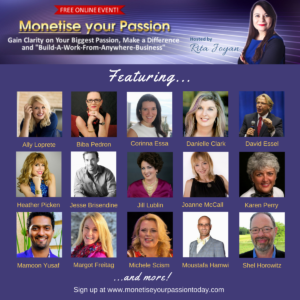
My friend Rita Joyan has been exactly where you are, if you resonate with the above. She’s cracked the code on monetising your passion (by doing it for herself!). Now, she’s bringing together top experts from around the world (including me) to share our best secrets and tips for doing exactly that, in a brand new virtual event: Monetise Your Passion, beginning 13th February, 2017.

Skip the reading and sign up to join us, here:

Monetise – Your Passion <<< Sign Up Here – NO CHARGE >>>

Shel Horowitz and other speakers at Rita Joyan's Monetise Your Passion Summit
Speakers at Rita Joyan’s Monetise Your Passion Summit

When you go to the link above and sign up to join us for this powerful, complimentary interview series, you’ll hear personal, real-life stories of total transformation from experts who have all found and monetised their passion.

We’re living each and every day around our passion – which means we’re also living highly-fulfilled, complete and joyful lives!

Now, we want to help you do the same.

Join us, and:

  • Discover your passion, and how to get past the blocks that may keep you from monetising it.
  • Learn the #1 mistake most people make that keeps them stuck — struggling to make money with their passion — while others (in the same business) make consistent money doing what they love.
  • Find out how to crack the code when it comes to monetising your passion, so you can spend more time with your family, be your own boss, and make an impact.
  • Get proven methods to stop being ‘busy,’ and start being productive, so you can make big strides toward earning a living with your passion.
  • And more!

Plus, you’ll receive amazing gifts and resources designed to assist you on this incredible journey toward making money with your passion!

Click the link below and take the first step, by reserving your spot – GRATIS – for Monetise Your Passion here, now:

Live Your Most Fulfilled, Happiest Life <<< Reserve Your Spot >>>

I want you to know, I believe in this message (I’m a living example of it) and Rita’s library of training, and I highly recommend this interview series. Rita practises what she teaches (including escaping a miserable 9–5 in order to create a life and business that allows her to give back and make money at the same time), and it’s now her mission to support other existing and aspiring entrepreneurs in doing the same.

I can’t wait for you to join us 😉

Warmly,

P.S. Sign up now and start creating a new, happier, more fulfilled life for yourself! You can’t imagine how EVERYTHING changes, when you live and monetise your passion.  Plus, this virtual event (which has the potential to change your life!) is completely FREE! Why wait another moment? Reserve your spot by clicking the link in the next line:

Your Passion Is Waiting – Claim It! <<< Join Us Here 13th February 2017>>>

[reprinted from my newsletter with permission from guest author Rita Joyan]

Facebooktwitterpinterestlinkedinmail

Nonviolent action theorist/activist/author George Lakey published a fabulous essay, “A 10-point plan to stop T***p and make gains in justice and equality” last week*

George Lakey, activist and author (most recent book: Viking Economics)

George has been a hero and mentor of mine ever since I first heard him speak around 1977. His presence at Movement for a New Society’s Philadelphia Life Center was a big part of why I moved to that community for a nine-month training program in nonviolent action, back in 1980-81.

He argues that this is our moment to break out of reactive protests and into big sweeping social and environmental demands. He notes that the LGBT movement was one of the only progressive movements to gain traction under Reagan—because its agenda was so much bigger than just fighting cutbacks. Twenty and thirty years earlier, the Civil Rights movement accomplished sweeping social change as well.

So instead of defending the weak centrist gains of the past 30 years, we go beyond and organize for our wider goals. We refuse to play defense against DT’s shenanigans and instead take the role of pushing for a new, kinder, people- and planet-centered normal. With direct-action campaigns that link multiple issues, such as Standing Rock, and with alternative institutions like the Movement for Black Lives, we create a nonviolent invasion of deep social change (this is my metaphor, not George’s).

In short, we think bigger—and act bigger. and instead of crawling to the politicians, we force them to court us as they see us come into our true power.

I’ve been saying we need to think bigger and more systemically for years. George says it succinctly and eloquently, and with a lens I hadn’t looked through.

How does this apply in today’s world?

  • The Republican attack on what George calls the “medical industrial complex-friendly Affordable Care Act” (a/k/a Obamacare) is a chance to bypass the witheringly bureaucratic and unfair insurance system and push for real single-payer, Medicare-for-All plan of the sort that’s worked so well in Scandinavia (he explores the Scandinavian social safety net in his latest book, Viking Economics)
  • The Standing Rock Water Protectors have linked multiple issues into a coherent whole: clean water, the environment generally, the rights of indigenous people (among others)
  • Movements around creating a meaningful safety net, such as the $15 per hour minimum wage, can reach disaffected white working class voters as well as people of color; when those who voted for DT on economic grounds realize he has betrayed them, we can win them over (I would add that this will only work if we have mechanisms in place to defuse the racism and nativism that DT used to attract them, and have meaningful ways to integrate the lesson that all colors, races, and religions can be allies to each other and are stronger together—and Lakey does point out that the United Auto Workers has been successful organizing on these unifying principles)

I could add a lot to George’s list. As one among many suggestions, let’s push to not only end all subsidies to the fossil and nuclear industries but let’s push for a complete transition to clean, renewable energy—whether or not we get any help from the government.

Read his essay. Come back the next day and read it again. Then share it with friends, social media communities, and colleagues and discuss how you personally and your group of individuals with shared positive purpose can make these changes happen.

*Why did I replace DT’s last name with stars? And why do I call him DT rather than by his name? Because I am doing my best not to give him any search engine juice. I don’t want him showing up as “trending” or driving traffic to him.

Facebooktwitterpinterestlinkedinmail