I went through a course from Pachamama Alliance called “Awakening the Dreamer,” a prerequisite for an activist training course I signed up for.
Near the end, I was asked, “Identify and write down the actions you will take to express your commitment to creating a thriving, just, and sustainable future.
And, for added effectiveness, include the date by which you will complete the action.”
My response has a lot to do with who I am, who I have been, who I hope to become, and why I do what I do. I’m sharing it in full:
Continue to work on immigration justice through Jewish Activists for Immigration Justice (ongoing since 2019).
Continue my career path of showing business that meaningfully addressing climate change, hunger/poverty, racism/otherism, war, etc. through core products, services, and mindset can be a success path (ongoing since 2003).
Continue to nurture democratic impulses in my own town/region and help some of them run for local office (ongoing since 1983).
Continue using my writing, speaking, and organizing skills to spotlight important issues locally, regionally, nationally, and globally (ongoing since 1972)–and strengthening these skills through continuous learning (which is why I signed up for this training).
Continue to be an activist who shows up to make a difference and be counted whenever practical (and sometimes when it’s not).
Continue to act on my belief that each of us can make a difference, and that difference is greatly amplified by working with others.
Continue to celebrate the victories I help achieve or passively support.
Continue to find ways to evolve as a person: to be more supportive of others, to recognize barriers others may face, and to face new experiences with gratitude and enjoyment.
None of these have completed-by dates. Most will not be completed in my lifetime.. I will do this work as long as I can.
<End of my response>
Three quick takeaways I want to leave you with:
Each of us can have an impact, especially if we go about our work with focus and determination
That work is amplified when we collaborate with others in an organized way
We are all growing and changing and evolving–ideally, into our best selves; that journey never stops
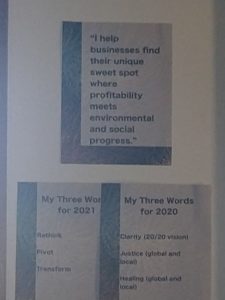
For the past few years, I’ve been doing Chris Brogan’s exercise of picking three words to guide my year. In 2020, they were Clarity (20/20 vision), Justice, and (perhaps presciently) Healing. Last year, Rethink, Pivot, Transform.
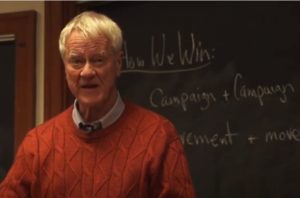
Lakey sees the increasing polarization of modern US society as a forge: a way of generating the heat necessary to create lasting social change (toward freedom and equality or toward authoritarianism—“the forge doesn’t care”).
This is not a new trend. The Scandinavian countries had their huge social revolution of the 1930s in times of great polarization (something he chronicled in his earlier book, Viking Economics). The trick is to harness that energy and channel it toward gaining mass support. He walks his talk, too; in the summer and fall of 2020, he led or co-led numerous workshops on what to do if the Trumpists tried to seize power after losing the election, training thousands of people.
He charges us to express our best concepts—not just what’s wrong with the system but the vision to make it better—in ways that feel like common sense to working-class people who want the system to work for them, too. After all, most of us actually do want a system that promotes equal access, a fair economy, and real democracy. We have to show them that our vision “has a spot for you,” even if that “you” finds the movement’s tactics disruptive and uncomfortable.
But he says progressives have largely lost that vision since the 1970s; we need to get it back. If we can get the diverse movements working together to confront their common opponents, we foster an intersectional “movement of movements” capable of creating real change—as the Scandinavians did then, with farmers, unionists, and students joining together to drive the moneyed elite from power. He warns us that polarization will get worse, because economic inequality is built so strongly into the culture. He says that we should consider organizing campaigns as “training for [nonviolent] combat.”
And we should expect those campaigns to take a while. Campaigns are well-planned (but adaptable) and sustained over time. It might take years, but you can win. One-offs (like the Women’s March at Trump’s inauguration) don’t typically accomplish change on their own. Traffic disruptions don’t make change; they just piss potential allies off. Disrupting banking operations is much more strategic because the bank is the perpetrator of the evil. How is the specific goal of the campaign advanced by this action? If it doesn’t advance the cause, don’t do it. A campaign he was involved with moved $5 million into credit unions and cooperative enterprises in one campaign that started in a living room and grew to encompass 13 states.
Oppression is only one lens we can look at things through—there are many others (he didn’t elaborate). The elite seeks to divide us (by color, gender, values, etc.)—but canny organizers look for the cracks in those divisions, and expand them. And stays optimistic, not getting stuck in “can’t be done” but figuring out how to do it.
Campaigns often start small. We can build our skills when the stakes are lower and make our mistakes then. Later, as the big challenges arise, we know how to handle them. You can lose a lot of battles and still win the campaign (eventually). And any tactic will be greeted with “this will never work” skepticism. But “Anyone who is arguing for impossibility” should remember the Mississippi Summer volunteers. When news got out of the abduction of Goodman, Schwerner, and Cheney, Lakey (a trainer of volunteers for trhat movement) expected most of the next volunteer wave to abandon their commitments—but nearly all of them stayed, mentored by Black SNCC activists who had been living with the overt racism for decades.
The best-known antidote to terror is social solidarity. Get close to people. Organize campaigns not just with those who share your goals but those who are “willing to be human with you.” Make your peace with the personal risk, face it head-on. We risk by driving on the highway, we risk by NOT meaningfully addressing climate change. Accepting the possibility that you might die in service of the common good is liberating (and it’s not the worst way to die).
SNCC survived in the Deep South without guns; they would not have survived with them. Erica Chenoweth shows us that nonviolent movements have twice the success rate of violent ones.
If you want innovation, conflict helps to get you there. Yet, conflict resolution is a crucial skill, and it’s expanded enormously in recent decadesWe need those tools and people who will jump into the fray (to use them). But if our tools are too highly structured, you need to add interventions in informal settings.
Lakey expects surveillance and isn’t worried about it: “I think it’s a wonderful thing. We take that as pride: we are so important that they put staff time and energy into knowing what we’re up to—so we’re making a difference. Gandhi told India, if you gave up fear of them, the British would be gone. If people spread fears about Trump, invoice him for the hours because you’re doing his work.”
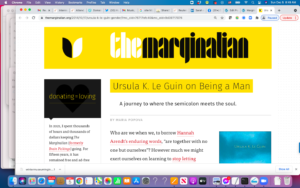
Years ago, I subscribed to Brain Pickings (recently rebranded as The Marginalian): Maria Popova’s amazing twice-weekly celebration of science, art, music, literature, and nature. While I have no memory of how I first discovered it, I immediately embraced the abundant world she lives in, and her eagerness to share the treasures she finds.
First screen of Maria Popova’s introduction to Ursula Le Guin’s essay, On Being a Man”
I rarely read it, but I will keep my subscription, thank you. Every issue is a gem—and every issue is a rabbit hole that leaves me following so many links that I don’t emerge for 30 or 60 minutes. And if I only dip in every once in a while, it’s still a special pleasure.
Long ago, I resigned myself to knowing that the richness of the world’s knowledge is something I can only skim the surface of, no matter how many books and articles I read and how many podcasts and seminars I listen to. I read more than most people—80+ books and thousands of articles in a typical year—but it’s still 0.000000001 percent of what I COULD immerse myself into, if I didn’t have a life to live, a living to earn, and eyes that need to rest. I’ve made my peace with that reality and don’t waste energy on FOMO (fear of missing out), nor do I beat myself up for not striving harder to soak it all in.
I’m really glad I opened today’s newsletter. I followed links to Ursula Le Guin’s poem “Kinship,” which Popova describes accurately as a “love poem to trees.” That led me first to one then another remarkable poem by Jane Hirshfield—the first read by the author and the second by Amanda Palmer (unfortunately, I took an unmarked turn somewhere in the rabbit hole and can’t get back to those—but I did create a long list of Hirshfield poems on Popova’s site). Then I went back to the current edition and read Le Guin’s witty essay on gender pronouns and aging. I could have stayed much longer, following links until my eyes bugged out.
In fact, I finally became a paying monthly sustainer just now—something I should have done years ago!
I love the idea of acting locally and have done it (and written and spoken about it) for decades. My biggest success in 50 years as an activist was a local campaign that saved a threatened mountain. Your chances of winning are often higher, it’s easy to reach those most affected, and you can parley your success into much greater influence on the future direction of your community. And yes, it can be empowering.
BUT…we also have to do the long, hard work on the big-picture stuff. It took 100 years of hard organizing to end legalized slavery for non-criminals in the US (and by the way, the exemption for convicted criminals has been used shamefully in too many instances). It took decades to get national civil rights legislation, the right of women and people of color to vote, the right of same-sex couples to marry…pretty much anything worth fighting for. And sometimes, even large-scale victories happen surprisingly quickly. As an example, the safe energy movement took only five or six years to make nuclear power unbuildable.
And those local victories can inspire the national and international work–which often gets done most effectively at the local level, by existing organizations and coalitions.
I love this post from the Changemaker Institute, How to Change The World By Meeting People Where They Care. I love it because it approaches social change through a marketing lens. It starts by revisiting the famous Loving v. Virginia Supreme Court Case of 1967, which struck down longstanding bans on marrying across the color line. Pointing out how Richard and Mildred Loving got people to care, the post goes on to ask how to get people to care about what you’re doing–and answers with a business-oriented focus on outcomes of your social change action, which you arrive at through these questions (quoting directly from the post):
What does it take to get an investor to believe in your business and invest in your mission?
What does it take to get customers to believe in your product or service and invest in it?
What does it take to get your employees to believe in your company’s mission and invest time and energy in supporting it?
What does it take to get people to support your vision for a better world? [end of quote]
Shel’s inspirational posters describing his “sweet spot” institutional mission and his 2020 and 2021 sets of three words to inspire his year
To take it a step further: I see getting out of the silo, rubbing shoulders with people who are not like you and examining different ideas from different industries or different sectors of the same industry as crucial is testing your own ideas, sharpening them enough to really get inside someone’s head and cause enough discomfort with the status quo to embrace the brighter future you propose. Whether you’re marketing a business or a movement, that’s a pretty important thing to do.
Guest Post by Sam Horn, author of Tongue Fu and many other books.
Does it feel like you’re talking on eggshells these days? You’re not alone. A report from McKinsey says, “Rudeness is on the rise and incivility is getting worse.”
As one woman said, “It feels like I can’t say anything right. It seems everyone’s on edge. They take offense at the least little thing. What can we do when everyone’s stressed out?”
She has a point, doesn’t she?
The last year and a half has been tough.
People have lost loved ones and jobs. Controversies around masks and vaccinations have put people at odds. Remote work and home-schooling have frayed nerves and tempers.
So, what can we do? We can Tongue Fu!
Tongue Fu! (a trademarked communication – conflict prevention/resolution process) teaches what to say – and not say – in sensitive, stressful situations you face every day.
It’s ironic. We’re taught math, science and history in school, we’re not taught how to deal with difficult people without becoming one ourselves.
And in these tough times, it’s more important than ever to know how to proactively handle complaints, disagreements, and unhappy, upset people.
Fortunately, that’s what Tongue Fu! teaches.
Here are a few challenges you may face at work, at home, online and in public – with tips on how to respond in the moment instead of thinking of the perfect response on the way home.
4 Tongue Fu! Tips for What to Say/Do When Things Go Wrong
Complaints When people complain, don’t explain. Explanations come across as excuses. They make people angrier because they feel you’re not being accountable. For example, if a host is upset because you’re late for a meeting, don’t explain why, just take the AAA Train:
Agree: “You’re right, Bob, our meeting was supposed to start at 9 am.
Apologize: And I’m sorry I’m late.
Act: AND I’ve got those stats you had requested. Would you like to hear them?”
When you take the AAA Train – Agree, Apologize and Act – instead of belaboring why things went wrong, you advance the conversation instead of anchoring it in an argument.
2. Negative accusation.
Whatever you do, don’t defend or deny untrue accusations. If someone says “You are so emotional!” and you say, “I am not emotional!” now you are! Instead, put the ball back in their court by asking, “What do you mean?” That questions motivates people to reveal the real issue and you can address that instead of reacting to their attack.
Imagine says, “You don’t care about your customers.” Reacting with, “We do care about our customers.” makes them wrong. Instead ask, “Why do you say that?” The client may say “I ordered supplies two weeks ago and still haven’t received them.” Now you know what’s really bothering them and you can fix their problem instead of debating their accusation.
3. Arguments.
If people are upset and you try to talk over them, what will happen? They’ll talk louder. The voice of reason will get drowned out in the commotion.
Instead, make a T with your hands (like a referee would) to cause a pause. Then say these magic words, “Let’s not do this. We could go back and forth for the rest of the afternoon about what should have been done, and it won’t undo what happened. Instead, let’s put a system in place to prevent this from happening again.”
You can also put your hand up like a traffic cop to do a pattern interrupt. Say, “Blaming each other won’t help. Instead, let’s figure out who will be in charge of this in the future so we can trust it will be handled promptly.”
As John F. Kennedy said, “Our goal is not to fix blame for the past, it’s to fix the course for the future.” If people start blaming, remind them, “We’re here to find solutions, not fault.”
4. Have to give bad news.
It’s easy to get defensive if your have to give bad news and say “It’s not my fault,” however that makes people feel you’re brushing them off.
A more empathetic response is to say “I can only imagine” as in ‘I can only imagine how disappointing this is.”
Then turn, “There’s nothing I can do” into “There’s something I can suggest. We have set up a 24 hour job-line with…”
In the real world, things go wrong. And sometimes we can’t fix them. We can at least let people know we care and we’re doing the best we can to help out.
Don Draper said, “If you don’t like what’s being said, change the conversation.”
We can change conversations and outcomes for good by using Tongue Fu! approaches.
Because when we treat people with respect, they’re more likely to treat us with respect.
And that’s a win for everyone.
This post originally appeared in Sam Horn’s newsletter and LinkedIn. Reprinted with permission. Sam’s 3 TEDx talks and 9 books have been featured in NY Times, on NPR, and taught to Intel, Cisco, Boeing, Capital One, NASA, Fidelity and Oracle. Want support completing your creative projects? Check out Sam’s Stop Wishing – Start Writing Community.
This is an issue important enough to me that I have a category in this blog called “Talking to the Other Side.” If you click on the tab with that label, you’ll see all my posts on that topic. You’ll also see a whole lot of discourse between liberals/progressives and conservatives over the last many years of my Facebook feed. And yes, I go to as many Braver Angels events as I can.
This is not a coincidence; Gil sent the link to Joel’s article around before the call to everyone who registered for it.
I found the article provocative enough that I posted this comment (and the Living Between Worlds open discussion was so fascinating that I plan to listen again once the video is available):
Good piece, Joel. You’ll be glad to know Gil Friend @gfriend kept his promise to discuss this topic in the monthly “Living Between Worlds” brain trust Zoom.
I come at systemic change through a lifetime of weaving together my two “split personalities” as both a marketer specializing in green and social change companies/products/services and as an environmental, social justice, and peace activist whose credits include starting the movement that saved a threatened local mountain.
Through the nonviolent social change lens of people like George Lakey and Erica Chenoweth, I look at institutional structures: how they prop up the system, create major barriers to change, and ultimately fail because they fail to change–and where they are weak and shaky and vulnerable. Sometimes they collapse with surprising speed (think about the Arab Spring a decade ago, or the government of Afghanistan just in the last ten days. Sometimes, it takes decades. The Quakers targeted slavery for about a century before it was illegalized.
But the marketer in me says systemic change is far more likely to succeed if the effort was made to change popular opinion first. The US civil rights movement created the opinion shift that made civil rights legislation not only possible but enforceable. Opposition to the Vietnam war was strong enough that LBJ felt a need to withdraw from his re-election campaign, years before the troops finally came home. And when we did Save the Mountain here in Western Massachusetts 21 years ago, our first task was to change the “this is terrible, but there’s nothing we can do” mentality. Once we shifted that, the victory was very quick.
The owner of the Step Into the Spotlight discussion group, Tsufit, asked what kind of marketing could help Canada go smoke-free by 2035. My answer doesn’t fit into LinkedIn’s comment space, so I’m sharing it here:
Ooooh, what a wonderful project! If I might make some cross-border observations that an actual Canadian might find lacking, I would, first of all, identify the key attributes of not just each province but each region of each province and target different themes and different platforms that will work will for each. I’d remember the wild successes on my side of the border of “Don’t Mess With Texas”–which started as an anti-littering campaign and became an unofficial state slogan and a core part of Texans’ identity–and the “I Love New York” campaign that helped the Big Apple find its way from near-depression in the 1970s to, once again, the happening place that “everyone” wants to be part of–and then the state successfully expanded the campaign to talk about all the other parts of New York State.
In libertarian rural Alberta, it might be about the personal freedom to enjoy clean, smoke-free air and the desire to keep out of the clutches of National Health Service doctors by staying healthy. For Quebec City, ads (in French, of course) that might make Anglophone Canadians choke but appeal to the sense of separate identity, e.g., “Oui, we are a beautiful capital city–but we also want to be the capital of good health and clean air.” In a more rural part of Quebec, such as the Gaspésie, they might tout the health benefits of the rural lifestyle, fresh food, and clean lungs.
In the Inuit areas, it might focus on communitarianism, tribal values, etc. For the Metro Toronto and Vancouver markets, perhaps an appeal to cosmopolitan sophistication. “Thinking of smoking as cool is SO 1950s. We’re too smart for that now.”
This national effort of a series of hyperlocal campaigns would need people on the ground in each area to really figure out the touchpoints for each audience slice. And it would be across many media, from traditional TV and print and radio to Instagram, TikTok, etc.
AND it would include a significant curriculum component starting around 3rd grade, to build the defenses of rising generations against tobacco industry hype, to inoculate students with the knowledge of health, economic, and pollution/carbon consequences, and to foster development of healthy lifestyles and a different set of pleasures.