In response to my Facebook repost of AOC’s suggestion that instead of ICE thugs, we send 5000 caseworkers to the border to help people immigrate the right way, a friend asked, “Do you really feel “calling out” the GOP will make any difference?”

This is how I answered (embedded links were not part of my answer):

There is something to be said for the throw-it-on-the-wall-and-see-what-sticks school of activism. We never know what will be effectual. Did Randy Kehler know when he went to prison for draft resistance that he would directly inspire Daniel Ellsberg to copy and release the Pentagon Papers?

Did Claudette Colvin know in March 1955 when she was arrested for refusing to move to the back of the bus that only a few month later, Rosa Parks (a trained activist, BTW—her action was NOT random) would repeat Colvin’s action and become the face of a powerful and successful national civil rights movement?

Did whoever said something that opened the mind of a Nazi skinhead know that this particular tormentor (Christian Picciolini) would do a 360 and become a voice of outreach between the Islamic community and the racist right? [NOTE: That incident is not in the BBC link above but was mentioned by Picciolini in a talk he gave to Critical Connections, a human rights group in my area.]

Did the speaker (whose name I don’t know) at my first peace demonstration, at NYU Uptown (now Bronx Community College) on October 15, 1969, have any clue that one sentence of his speech would reach 12-year-old me and turn me into an activist for the past 56 years?

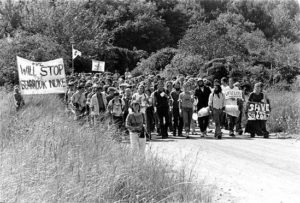
Did I know when I marched at Seabrook in 1977 and spent an incarcerated week as a “guest” of the state of New Hampshire that we were creating a national and international safe energy movement that kept us out of the nuclear fission fiasco for the next 40 years? (We have to do it again, now—that technology is far more about creating new problems than solving the existing ones. I wrote my first book on why nuclear fission makes no sense and updated it after Fukushima. We don’t need it and it’s quite harmful.)

Did the midwives of Exodus, Shifra and Pu’ah, know they were inventing nonviolent civil disobedience and that we would be using it to outsmart dictators more than 3000 years later?

I am an activist because my soul would not let me rest if I weren’t. I’ve been lucky enough to do a few things that worked, including starting the movement that saved a local mountain. But even when it’s defeat after defeat, I keep at it, knowing that if I change one mind or move one person to take action that day, my work has been worthwhile—and if I didn’t, I still made the effort.

Here are a few more examples:

What small step can YOU take that might turn into something much bigger—and where will you get the support to carry it out?


Facebooktwitterpinterestlinkedinmail

In the run-up to the enormous Boston counter-rally against white racism, someone complained that nonviolence is ineffective and passive—and mentioned his desire to go out and slug a few Nazis. This provoked an extended discussion with several people participating. By the time I saw the thread, he had actually said he’d welcome the chance to get trained in nonviolent action.
That thread sparked a desire in me to do some education about the history and power of nonviolence (I wish it were taught in schools!):
First, I totally support this activist’s decision to get nonviolence training. Every person should have nonviolent conflict AND nonviolent de-escalation in their toolkit, and especially every activist.
 
Second, it’s important to understand the enormous difference between active nonviolent resistance and passivity. Nonviolent resistance has been a successful tactic for centuries, and even Forbes noted that it’s typically twice as effective as violent tactics. It’s been used to great effect by:
  • Gandhi and the struggle for Indian independence
  • Martin Luther King, Jr., and the American Civil Rights movement
  • Activists of the Arab Spring
  • The safe energy/no nukes movement in the United States, Britain, and Germany
  • The students who mass-rallied in Tiananmen Square, Beijing
  • A large majority of the South African freedom fighters who reclaimed their country, and the many Eastern European movements who reclaimed theirs

The first recorded example I’m aware of goes all the way back to the Old Testament Book of Exodus: the midwives Shifrah and Pu’ah refused to carry out the Pharaoh’s order to murder all the newborn Hebrew boys. Nothing passive about this! Those two women risked their lives to create resistance to a murderous dictator’s “ethnic cleansing” plan.

Yes, there are some who practice nonviolence in ways that do nothing more than mildly irritate the power structure. But Gene Sharp has documented something like 193 active nonviolence tactics that are actually effective in creating social change, and he was writing in the pre-Internet era. I recommend his From Dictatorship to Democracy as a very readable introduction. It talks about how to get rid of dictators, nonviolently.
 
Sharp and many others have documented effective nonviolent resistance to the most oppressive totalitarian governments, including the Nazis, Stalin’s Soviet Union, the extremely repressive British colonial government in India…
 
Third, I have personally participated (and sometimes organized) numerous effective nonviolent actions with a vast range of scope, tactics, and goals. In one case, I was the only person doing the action on Day 1, and I watched the tide turn by Day 3.
 
The single most effective of all the actions I’ve been part of was probably the Seabrook nuclear power plant construction site of 1977. The state was forced to feed and house 1414 incarcerated protestors, most of whom did “bail solidarity,” refusing to post bail and becoming an enormous financial burden on the state, which also had to pay the salaries of the National Guard reservists who guarded us in their armories. They finally released everyone after 13 days.
 
Not only did we bring both the NH government and the power company to their knees, but by the time we all got out, a national safe energy/no nukes movement had sprung up, copying our structure, tactics, and goals.
And this movement managed to essentially freeze out nuclear power as an option in the US. Richard Nixon had called for 1000 nukes in the US, but I don’t think the number ever got past 104, nearly all of which got their permits before the Seabrook occupation—and all before the Three Mile Island (TMI) accident two years later.
 
Directly and indirectly, that movement can take credit for:
1) media coverage of TMI, Chernobyl, and Fukushima accidents while earlier accidents had been ignored;
2) a national and global shift toward safe energy consciousness, leading to much wider development of solar, deep conservation, and other clean energy technologies;
3) numerous new methods of organizing that were used by other active nonviolent movements such as Occupy and Standing Rock (both of which managed to last for many months despite enormous pressure)
Nonviolent occupiers approach the construction site of the Seabrook nuclear plant, April 30, 1977. Unattributed photo found at https://josna.wordpress.com/tag/anti-nuclear-movement/
 
I write in more detail about some of this in part 4 of the four-part series I did this spring, reflecting on the 40th anniversary of the Seabrook action: https://greenandprofitable.com/40-years-ago-today-we-changed-the-world-part-4-shifts-in-the-culture/ (if you want to read the whole thing, Part 1 is at https://greenandprofitable.com/40-years-ago-today-we-changed-the-world-part-1/ , and each part has a link at the bottom to the next one)
 
And fourth, nonviolent resistance works better than violent resistance. If we engage in violence, we play to the strengths of the opposition. The government has highly trained military and police forces able to inflict extreme violence on us. The fascisti have less to lose in attacking a violent mob and of course the police will be far less interested in protecting us from violent attackers if we ourselves are violent. The public loses sympathy for us and supports the repression.
But if we maintain nonviolent discipline in the face of violent attacks, the public swings rapidly to our side, and some even start thinking about how they can help the resistance. They may not put their bodies on the line, but they can be powerful allies in 1000 ways, if not chased away by political purity hawks who want all or nothing and forget that they, too, evolved their commitments over time.
 
Change happens when we reach a tipping point, when these folks have enough voice that they cannot be silenced, and enough influence that mainstream populations start to support them. And as noted above, throughout history, history, far more struggles for justice have been won in this way than through physical violence.
Facebooktwitterpinterestlinkedinmail