Even though I’ve been in favor of legalizing marijuana since the 1970s and have been in the environmental movement just as long, it never occurred to me that the continuing prohibition on pot actually has negative consequences for the environment.
But this fascinating article shows a number of negative environmental effects from the prohibition, ranging from highly toxic pesticides used both by growers and by law enforcement authorities on down to greater energy usage because the plants are often grown indoors and therefore need artificial light. If I counted right, the article offers six environmental benefits of legalizing pot. Who would’ve thunk it?
Here’s my take, as a long-time peace/environmental activist who also writes about how to leverage social change through business. You have these options:
1. Be a purist and refuse any tainted money or tainted partnerships, defining taint to mean that the company is in some way involved in things you disagree with.
2. “Separation of powers,” where you will work with a company that has dirty hands, but only work on the clean-hands aspects of that company.
3. Use the partnership to actively push the company toward more progressive stances, and eventually to abandon the actions that caused you to look askance in the first place.
I’ve evolved on this issue over time. In the 70s, I’m pretty sure I’d have been a #1. And been out in the streets with the protestors. But that was before I saw how the business world can not only change itself, but become a fulcrum for change in the wider society. These days, I’m at least a #2 and when possible, a #3. I’m even in dialogue with an outfit that does seminars for utility companies—and I told them I would not assist with anything that promoted nuclear (and if they hire me to present, I will definitely be using my bully pulpit to push the #3-style agenda to the utilities attending the conference).
But I do think there might be companies (or governments) whose philosophy is so opposed to mine that I would still be a number 1, still refuse to get my hands dirty.
I also recognize that sustainability is a path, and we are all somewhere on the path. I am not sure you could find a person who is living 100% sustainably. Even my very self-sufficient 90-year-old friend who lives in a mountaintop cabin she and her late husband built themselves, with no electricity or running water, grows most of her own food, and keeps her income below the taxable level—creates carbon emissions with her woodstove.
I think a great example is Walmart. I don’t choose to shop there, because I oppose its policies on labor issues, community development impact, predatory pricing, and a host of other areas. At the same time, I have publicly lauded Walmart, many times, for its groundbreaking, deep, systemic attention to sustainability. And I point out that Walmart is not a company of tree-huggers, but of executives looking to maximize profit. I’m willing to publicly praise Walmart’s ability make and save boatloads of money through enormous initiatives to use less energy and to introduce organic foods/green products to customers who would *never* set foot in a Whole Foods–even while choosing to put my own shopping dollars elsewhere.
I discuss this kind of conundrum a bit in my latest book, Guerrilla Marketing Goes Green.
30 years ago, Dina and I marched in the first-ever Gay Rights march in Northampton, Massachusetts. Organized by a very political—you could even call them militant—group called Gay And Lesbian Activists, the event drew about 500 people. We were proud and defiant in a society where being gay or lesbian was so threatening that some of the marchers wore paper bags over their heads to protect their identities and avoid reprisals. The speeches were all about claiming our place in a rejecting society.
Back then, there was a large contingent of counterdemonstrators from the local Baptist church, shouting slogans and carrying signs that today would be considered hate speech.
A few months later, some prominent lesbians in town received a series of threatening phone calls, and went to the police. A group of activists demanded and received a meeting with public officials. We pressed the mayor for a statement condemning the harassment. He waffled for quite some time until the District Attorney, who’d been quietly watching, said “I’ll give you a statement.” Once he had the political cover of the DA, the mayor quickly agreed as well. And later, the harasser was actually found, tried, and convicted. Yet, shortly after the second annual march, a City Councilor ran unopposed for re-election on a platform of stopping the Gay Rights march. (When his term was up two years later and he still had no opposition, I ran against him. He won that year and was defeated by another progressive two years later.)
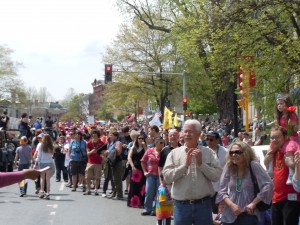
Fast-forward to 2011: yesterday’s 30th annual parade, now officially called the “Noho Pride LGBT [lesbian, gay, bisexual, transgender] Parade and Pride Event” and organized by a group called Noho Pride. The parade stretched for blocks and moved down Main Street to a cheering throng of some 15,000, lining not only both sidewalks but also the midline of our very wide boulevard.
Spectators applaud the Forbes Library contingent, #Nohopride 2011
Contingents included students, teachers, and parents from several elementary and high schools…dozens of churches…our local public library, where I and several other writers marched along with the director, assistant director, and a couple of the trustees…and a number of prominent politicians including both mayoral candidates (one gay, one not), Northampton’s State Representative Peter Kokot, and a candidate for US Senate who actually took a booth.
Vendors at the rally site included banks, home improvement contractors, and other very mainstream businesses. There was almost no political content, although there was a large tent for activist organizations, and the tent was crowded.
The atmosphere was a jubilant one – with hula-hoopers, a group doing intricate formations with shopping carts, drag queens, Rocky Horror Picture Show actors, the Raging Grannies, and countless school groups, some chanting “five, six, seven, eight, don’t assume your kids are straight.”
In the intervening years, a lot has happened in the queer community around Northampton, including national press in the early 1990s in the National Enquirer (which dubbed it Lesbianville USA) and the TV program 20/20. Several openly gay or lesbian politicians have won their races, including Northampton’s openly lesbian mayor, Clare Higgins, who is finishing up her sixth two-year term—longer than anyone else has ever held the post. Same-sex marriage has been legal for years. You have to look really hard to find someone who isn’t aware of same-sex couples in their places of worship, their workplaces, or their circle of friends.
And the Pride event has gone from a defiant statement of our rights to a festive, touristy celebration of culture. So much so that the organizers were publicly criticized by a group of activists including at least two who were there from the beginning, for squeezing the politics of change out of the event.
To me, while I recognize the validity and sincerity of those complaints, that we can now party out tells me that yes, we are making huge progress in this area, among others.
It is now illegal in france to hide your face in a public place—a clear assault on very religious Muslims. Freedom of religion often involves particular manners of dress or hair, and prohibiting them is an act of bigotry. (There is one good thing in the law that I do support: it is now illegal to force someone else to veil herself).
The solution to religious fundamentalism is not religious bigotry. Would there be a protest about banning yarmulkas (the skullcaps Orthodox Jews wear) or crucifix necklaces?
I hope some non-Muslim French citizens organize massive solidarity actions with hundreds or thousands wearing a veil in public—kind of like the King of Denmark donning a yellow star during the Nazi occupation.
Two stories in today’s paper about high consequences for corporate greed—and both of them have significant environmental as well as business ethics interest.
But the cost of this business ethics failure is only 1/1000th of the costs slapped onto oil giant Chevron by the government of Ecuador. While the $8.6 billion amount was less than 1/3 of the court-appointed expert’s recommendation, it is still the largest damage award ere in an environmental damage lawsuit (and probably the first of many more around the world against oil companies, which have been sued for habitat destruction in Nigeria and elsewhere).
Ironically, this suit had originally been filed in US courts against Texaco (now owned by Chevron), and the company’s attorneys successfully argued that the case should be heard in Ecuador.
When Hitler’s troops began invading the Balkan States in the early 1940s, Muslims across Albania took an estimated 2,000 Jewish refugees into their homes en masse and welcomed them not as refugees, but as guests. They disguised these Jews as Muslims, took them to mosque, called them Muslim names, gave them Muslim passports, hid them when they needed to, and then ferried them to inaccessible mountain hamlets. “In fact, Albania is the only Nazi-occupied country that sheltered Jews,” says Gershman. The Jewish population in Albania grew by ten-fold during World War II, and it became the only country in occupied Europe to have more Jews at the end of the war than at the beginning. Records from the International School for Holocaust Studies show that not one Albanian Jew or any of the other thousands of refugees were given up to the Nazis by Albanian Muslims. “They did this in the name of their religion,” Gershman said. “They absolutely had no prejudice what so ever.”
If I can manage to get to NYC before January 29, I am so there! I see two key takeaways in this story:
1. Even in the face of unspeakable evil, there will be people who do the right thing, even at great personal risk.
2. This is one of many pieces of historical evidence that Jews and Muslims can coexist, yet another reason to disbelieve the racists on both sides who say such a thing is impossible.
Nuclear Information and Resource Service reports in a recent newsletter that Congress received 15,000 letters and countless phone calls opposing the inclusion of $8 billion in bailouts (a/k/a “loan guarantees”) for new nuclear plant construction—and that the final interim funding bill to keep the government running did NOT include this boondoggle. The item is not on the NIRS website but you can find the entire newsletter reprinted here.
In other words, the power of an organized populace resulted in a victory, something that’s getting less frequent all the time but is still very much possible. Let’s hope for many more in the coming year.
Do not let anyone try to tell you that nuclear fission is in any way green. It’s an environmental disaster under the best of circumstances, and at its worst, it could make the Deepwater Horizon disaster in the Gulf of Mexico look like a spilled cup of coffee. Here’s a post I wrote some time back that gives some among many reasons to oppose nuclear power (scroll past the feed from this blog).
The Democrats lost the house because of over-conciliation. People voted for change in 08, and in spite of his brilliant marketing during the campaign, Obama has been a very poor marketer of his accomplishments, and very poor at negotiating—so that what did pass failed to constitute “change.”
So…how to move forward?
1. Fight for the sweeping change that Obama has promised but not delivered–not just on the House floor, but by organizing in your home districts. Rapid and complete withdrawal from Afghanistan and Iraq (I am not impressed with a “withdrawal” that leaves 50,000 troops plus mercenaries in place)…a jobs program focused on deep energy retrofits of existing buildings, especially low-income housing and any government property…a much tighter leash for Wall Street. And dare I say it–throw away this year’s health care in favor of a single sentence: The eligibility age for Medicare shall be from birth.
2. Look for places where the agendas of progressives merge with the radical right (for instance, privacy issues, free speech issues) and build common cause, but with a wary eye and a willingness to pull away quickly if things go sour.
3. Demand of the deficit hawks that they start with the military, which is absurdly huge compared to even other superpowers.
4. If you compromise, get meaningful concessions. If you don’t get the concessions, don’t compromise.
5. For goodness sake, learn to frame the discourse to generate sympathy and support. Read George Lakoff’s “Don’t Think of an Elephant.” Don’t let the right-wing crazies back you into a wall with crazy sound-bite framing (“death panels,” for instance). Learn to frame the issues in terms that relate to the self-interest of most Americans, the health and future of the planet, and our place among the nations. This is what Obama was so good at during the campaign, and has failed so miserably since his inauguration.
Shel Horowitz, marketing consultant, primary author of Guerrilla Marketing Goes Green, and author of the monthly syndicated column, “Green And Profitable.”
Grayson will definitely missed, and the next two years promise to be frustrating for progressives. Still, let’s not give up hope and keep organizing. Obama could still regain public support—IF he works as hard to pass a progressive agenda as he did to get elected.
Today is another Blog Action Day for social justice, and today’s topic is water. My slant on this, as someone who writes about environmental issues, is that access to clean, safe water is both an environmental and a justice issue. And that the easiest way to promote safe, clean water around the world is for us resource hogs in the developed countries to be much more careful not to squander the good water we are privileged to have.
Here are some facts provided by Blog Action Day (emphasis added):
1. Unsafe drinking water and lack of sanitation kills more people every year than all forms of violence, including war. Unclean drinking water can incubate some pretty scary diseases, like E. coli, salmonella, cholera and hepatitis A. Given that bouquet of bacteria, it’s no surprise that water, or rather lack thereof, causes 42,000 deaths each week.
2. More people have access to a cell phone than to a toilet. Today, 2.5 billion people lack access to toilets. This means that sewage spills into rivers and streams, contaminating drinking water and causing disease.
3. Every day, women and children in Africa walk a combined total of 109 million hours to get water. They do this while carrying cisterns weighing around 40 pounds when filled in order to gather water that, in many cases, is still polluted. Aside from putting a great deal of strain on their bodies, walking such long distances keeps children out of school and women away from other endeavors that can help improve the quality of life in their communities.
4. It takes 6.3 gallons of water to produce just one hamburger. That 6.3 gallons covers everything from watering the wheat for the bun and providing water for the cow to cooking the patty and baking the bun. And that’s just one meal! It would take over 184 billion gallons of water to make just one hamburger for every person in the United States.
5. The average American uses 159 gallons of water every day – more than 15 times the average person in the developing world. From showering and washing our hands to watering our lawns and washing our cars, Americans use a lot of water. To put things into perspective, the average five-minute shower will use about 10 gallons of water. Now imagine using that same amount to bathe, wash your clothes, cook your meals and quench your thirst.
So…not to leave you sunk, here are a few easy and cheap/free ways to use less water:
Don’t run the water unnecessarily! Whether washing dishes or brushing your teeth, think about low-water methods. For those dishes, clean the insides with a
soapy sponge and then only turn on the water (at modest force) to
rinse. For tooth brushing, wet the toothbrush, turn off the faucet, brush, wet again to rinse–you’ll use teaspoons instead of gallons.
Unbottle yourself. Save bottled water for places where tap water is not safe to drink. Bottling water consumes vast amounts of water (several times what’s actually in the bottle), energy, and plastic (much of which ends up in landfills). And lots of bottled water is nothing more than expensive public water supply water anyway. In much of the developed world, filtered tap water tastes as good as many bottled brands and has a far lower environmental and financial footprint.
Eat less (or no) meat–see #4, above. As a 37-year vegetarian, I can tell you that the wonderful cuisines of the world opened up to me when I stopped eating meat. I eat healthy, tasty, nutritious food, and I don’t miss the stuff I used to eat.
Sign the Blog Action Day UN Water Rights Petition:
Now is President Obama’s chance: with the much-scorned Larry Summers stepping away from US financial policy, there’s room to appoint an economist with a deeper understanding of the causes and cures for our economic woes. If I were Obama, my second choice would be former Labor Secretary Robert B. Reich. My second choice would be Nobel Prize winner and New York times columnist Paul Krugman. And my third choice would be someone from completely outside government: the earth-centered economist Hazel Henderson, author of many influential books from the recent Ethical Markets to the long-ago Creating Alternative Futures.