
Green & Profitable Column

Green And Profitable Monthly Column:
Now Available as an Anthology
For four years, Shel Horowitz’s monthly Green And Profitable column ran on three continents, illuminating readers about profitable green business tactics (marketing and operations), profiling successful green companies, providing advice on issues from influencing government to saving tens of thousands of dollars.
This collected wisdom is now available in one large compilation, and in four smaller books dividing the work into these themes:
- Book 1: Profitable Green Business Practices/Company Profiles
- Book 2: Marketing Strategy/Messages For Green Businesses
- Book 3: Policy And Ethics Issues For Green Businesses
- Book 4: The New Realities Of 21st Century Business
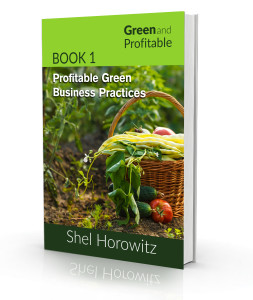
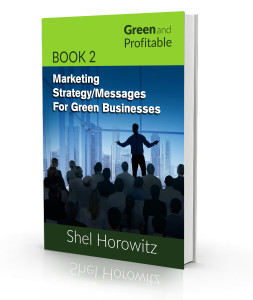


Designed as ebooks, these books are available through iTunes (search for Shel Horowitz on iTunes Store), Nook, and Kindle or paperback (Note: these links go to the full anthology).
When this was offered as a column, I put up several full-column samples as well as the headline and lead for every column. Now that we’ve converted these to books, this prior content serves as a detailed preview of what you get in the anthology. The books are organized thematically, while the listing here is chronological.
New columns are on hiatus, but can resume at any time if there’s sufficient demand. So please peruse the information below, and if the column is right for your needs, please sign up for the waiting list.
Make Inroads Into the Lucrative Cultural Creative Segment by Running Shel Horowitz’s “Green and Profitable” Column Showing businesses and organizations how to profit from green and ethical practices—lowering costs and boosting revenues. A mix of how-to, profile/review, and analysis.
Click here to bypass the detailed information and go directly to the sign-up page.
- Endorsement from Jay Conrad Levinson, Creator of Guerrilla Marketing (and co-author with Shel of Guerrilla Marketing Goes Green)
- Shel’s Qualifications
- Corporate Clients: Grow Your Brand by Private-Labeling Shel’s Column for Your Own Customers
- PR/Marketing Agencies: Increase Clients’ Reputation
- How to Run “Green And Profitable” in Your Publication
- Column Format
- Sample Columns
- Excerpts From Published Columns
Click here to bypass the detailed information and go directly to the sign-up page.
About the Column
Green is HOT right now—but many businesses find themselves asking, “Isn’t green too expensive? Can I really go green and still keep my costs down?” Going green not only lowers costs, it can actually boost profits. Since 2010, bestselling and award-winning author Shel Horowitz’s monthly column, “Green And Profitable,” has been showing small and large businesses, virtual and brick-and-mortar alike, how to go green while staying profitable. Shel adeptly analyzes and distills the latest trends and green information—and shares specific ways that businesses can go authentically green (no greenwashing here) to create loyalty among consumers who demand that green commitment. In the column, Shel:
- Shows your readers how to go green in affordable yet effective ways
- Profiles businesses that have successfully lowered their costs by taking green measures
- Monitors green trends in the business world and among consumers
- Examines the politics of green business and green activism
- Discussed ways to harness the marketing advantages of going green—to turn a company’s green commitment into lower costs—and higher profits.
The column is syndicated internationally by the author, enabling you to cut out the middleman and get this high-quality cutting-edge content for an extremely affordable price.
Click here to bypass the detailed information and go directly to the sign-up page.
Why Your Readers Will Benefit
Business people want to go green, but they don’t always know the best and most affordable ways to do so-or how to find a marketplace eager to hear their green story and the effectively tell it to that market. Shel’s column provides how-to tips, examples of successful companies and green marketing makeovers, and important trends to watch.
Jay Conrad Levinson
Shel’s Qualifications
 Shel Horowitz’s consulting firm, Green And Profitable, is the first business ever to earn Green America’s rigorous Gold Certification as a leading green company
- Shel has written extensively on green business in several of his eight books, most recently Guerrilla Marketing Goes Green: Winning Strategies to Improve Your Profits and Your Planet (published by John Wiley & Sons and co-authored with legendary marketer Jay Conrad Levinson): a #1 environmental category bestseller at Amazon that has made the bestseller list at least 30 months, resold rights internationally, and gained more than 50 endorsements from prominent marketers like Chris Brogan, Mark Joyner and Marcia Yudkin—as well as environmental leaders such as Joel Makower and Jacquelyn Ottman.
- Major media frequently cite Shel, including repeat appearances in The New York Times, The Wall Street Journal, Entrepreneur, Los Angeles Times, and many more.
- Shel has published more than 1,000 articles, including previous regular columns for Business Ethics and the Western Massachusetts Business & Economic Review, a blog since 2004, a weekly guest blog at Fast Company for two years, and his own monthly marketing newsletters since 1997.
- Shel is a popular international speaker who has brought his message of green profitability to green conferences and professional gatherings such as Green America’s Green Fest, Forum Davos (Switzerland), a keynote presentation for the Association of Business Communications, and many others.
Click here to bypass the detailed information and go directly to the sign-up page.
A Few More Endorsements
“Shel’s expertise in both marketing and environmental issues is doubly valuable for eco-conscious entrepreneurs and business owners…he is a powerhouse of effective marketing strategies for social and eco-entrepreneurs.”
—Priti Ambani, Managing Editor, Ecopreneurist
“We were pleased with your work, your speed, your writing ability and ability to grasp complex subjects.”
—Sharon Goldinger, People Speak, California
“You are the best and great to work with. Appreciate your responsiveness, makes things easy on this end!”
—D’vorah Lansky, web publisher
“Thanks for yet another competent and clearly assembled product. It’s a pleasure to say it’s a pleasure doing business with you.”
—Ira Bryck, Director, UMass Family Business Center (14-year steady article writing client)
“Shel never missed a deadline. Publishing the newsletter every two weeks seemed almost effortless to him. Using his publishing background to tap into what readers would like to read—with absolutely no guidance from me—he created several columns that helped to highlight [our] authors and services…I cannot recommend Shel Horowitz highly enough and he continues to do work for me to this day. His professionalism, his ‘shepherding’ approach to working with clients, and his depth of knowledge always make for a successful project.”
—Patrick East, former marketing and product development executive, AuthorHouse (formerly, 1stBooks Library); current president, Hanapin marketing, www.hanapinmarketing.com
“Shel Horowitz is …a mensch, a scholar and a gentleman… also a very talented writer…we happily refer business to him. His latest book is awesome.
—Jeffrey Eisenberg, CEO of Future Now, Inc., The Conversion Rate Specialists
“Shel, when I see your name on an article, I know it’s going to be worth reading.”
—June Campbell, business writer, http//www.nightcats.com
“Wow, your client-oriented attitude is very refreshing. Shel, you did a great job — I love your work! Thank you, and we’ll definitely have many more projects for you soon.”
—Simon K. Grabowski, GetResponse.com, Poland
“I’m one of the legions of authors who have benefited from years of Shel Horowitz’s advice and inspiration—thank you for all the ideas and information you have shared with me and writers around the world.”
—Roger C. Parker, Author of Looking Good in Print and many other books, www.publishedandprofitable.com
“You are absolutely the best in the industry. You deliver when you say you will and do not over commit your time—and your work is stunning in its power and clarity. Not only have I had personal experience with you over many years, but I have referred several others who have been very satisfied also.”
—Merry Schiff, H.R.S., Executive Director, National Electronic Billers Alliance, California
“It’s nice to work with someone who gets it the first time, isn’t a cry baby and knows they aren’t writing the next great American novel.”
—Thomas McEuen, SYNERGY Insurance Solutions
“You provide excellent service and it’s a real pleasure to work with you.”
—Stuart McRobert, CS Publishing, Nicosia, Cyprus
How to Run “Green And Profitable” in Your Publication
For a one-year subscription, the price will be just $10 US per insertion per publication, guaranteed through the end of 2013 (even cheaper with a two-year subscription). A 12-month subscription is $120). For a 24-month subscription, the price goes down to just $8.33 per column ($200), guaranteed through the end of 2014 or the end of your subscription, whichever is later. Please fill out this brief form. Once you’ve chosen your preferred option, we can either set up an automatic Intuit Payment Network (our first choice) or Paypal subscription, charge your credit card, or invoice you for payment by check (drawn on a US bank account, payable in US dollars)—your choice of two years or one year at a time. Save Even More! Run both Shel’s business column, Green And Profitable, and his consumer column, Green And Practical, and pay 25 percent less than buying them separately. Pay just $180 for a year, or $300 for 2 years—that works out to only $7.50 per column for the year, and just $6.25 per article on the two-year subscription—what a deal!
Column Format
You will receive a 600- to 800-word article every month, including a brief blurb with link (three lines, maximum). The blurb must be included.
Click here to bypass the detailed information and go directly to the sign-up page.
Sample Columns
This Major Paper Company Has Been Recycling Since 1950 (717 Words)
Would you believe…a household paper products company that switched to recycled raw materials in 1950, and has been producing recycled paper towels, napkins, toilet paper, and tissues ever since? A company that was so dedicated to creating “paper made from paper, not from trees”(TM) that it actually set up its own paper collection service (and currently collects paper for recycling from a 300-mile radius)? A company that saw no reason to jack up prices and has remained a consistent player in the lower price points? And a company that did this with such humility that it didn’t bother telling the public for decades, and didn’t make a big deal about it until this spring? Click here to continue reading.
Some Big Companies Going Green and Profitable (697 words)
In the corporate world, if you start talking about going green, you’ll often hear messages like this: “Yes, we’re going green, despite the expense. It’s the right thing to do.” Yes, it is the right thing to do. And yes, very small companies are often nimble enough to seize the combined economic and environmental advantages. But smart companies of any size can go green in ways that are highly profitable. Even large, slow-moving companies can save enormously. Want some examples? Click here to continue reading.
Raising the Bar on Green Marketing (719 words)
The old green messages are beginning to look a bit pale. Accusations of greenwashing are rife, and often, those charges have more than a little substance—does anyone really believe BP is a green company anymore? Click here to continue reading.
Can One Community Self-Sufficiency Initiative Really Do All This? (666 words)
What if a single action could: get troubled teens off the streets and into something productive—and develop their entrepreneurship skills in the process…provide fresh local organic food to inner-city people with no other access to quality produce…clean up a blighted neighborhood vacant lot and spark a caring community spirit? What if that action could be done without any significant government or corporate resources, other than a space to have it? Click here to continue reading this article.
Click here to bypass the detailed information and go directly to the sign-up page.
Excerpts From Published Columns
NOTE: Arrangements can be made to publish previous columns (please contact us for details).
Is The Environment Just for the Middle Class? (September, 2014)
This, I think, is a mistake that many of us in the environmental movement have made. We think we’re only talking to ourselves. And maybe we don’t even know how to talk to others who are different. In marketing terms, we’re putting out a message that doesn’t meet our audience, or worse, assuming that poor people are not the audience for any kind of environmental message.
Polarization vs. Unification (August, 2014)
I believe that we make change by harnessing those opposites into something greater than either part. Perhaps you need the doom-and-gloom alarmism of people like anti-nuclear activist Dr. Helen Caldicott of Australia or suburbia-is-dying prophet James Kunstler of the United States before people will respond to the optimism of people like energy futurist Amory Lovins and the late bacterial scholar Lynn Margulis. Perhaps you need the loud unkempt rebels of the Occupy movement to hear the quiet voices of Israeli and Palestinian families joining hands in mutual condolence and holding a banner together for peace.
Failure is Always an Option (July, 2014)
The trick is to fail cheaply and early—and maybe often, make your mistakes, and move on. See what can be salvaged, what can be reinvented, and what should be thrown in the trash. Thomas Edison took 10,000 steps to invent the light bulb. Most people would say he failed 9999 times. He saw it not as a failure but as a 10,000-step process. In other words, our failures teach us enough to achieve our successes.
The Opinions of Others (June, 2014)
In our unvetted society, where the barriers to entry in starting a company, publishing a book, recording a music album, or inventing a new green process have gotten so low that pretty much anyone can do these things, social proof becomes a set of important judging criteria that allow your prospects to sift the offers and choose the ones that are likely to offer quality.
Simplify, Simplify (May, 2014)
A third lesson about complex projects: not only are they more likely to break, but when they break, it can be much harder to figure out what went wrong and how to fix it.
A Pessimist and an Optimist (April, 2014)
He caught birds doing acrobatics and birds speeding through the air. Birds on building gutters and an owl in the back yard of a woman who thanked him for being in the news media and wanting to report something other than a shooting.
What I Learned from my Energy Audit (March, 2014)
If we did everything he told us to, we’d have been looking at well over $18,000. Even if it saved us as much as $500 per year—highly unlikely, considering that’s about 25 percent of an entire heating bill—that’s a 36-year payback. Not a very good return on investment, even for a green guy like me…
Over the next few weeks, I’ll be sealing up a lot of these cracks all around the house. I’m expecting a substantial reduction of energy use and much greater comfort as I work my way through the project. Cost? About $20 US.
Biofuels: Good and Bad Models to Learn From (February, 2014)
In other words, [appropriately designed biofuel technologies] are part of a holistic approach to thinking about the integration of our energy and food systems, and not a poorly-thought-out kludge grafted onto a system not designed to accommodate it, all too often with disastrous consequences.
Look Outside Your Box: What Can Other Industries and Other Environments Teach You About Synergy (January, 2014)
But what’s different is that upcycling has become mainstream. Repurposing is no longer just for frugality geeks or environmental activists; it has even penetrated the elegant boutiques that cater to fashion-conscious upscale consumers. Yes, green is now chic.
Asking for Help from the Cloud Crowd (December, 2013)
And that’s one of the reasons why it helps to participate actively on a list for a while before asking for this kind of help. First, this makes you a known quantity, someone who has helped others and therefore incites others to reciprocate when you need help; you’ll get more, and better, responses. And second, it gives you the judgment to recognize who knows what they’re talking about and who’s just winging it.
How is the Green Economy Saving Money in Your Business? (November, 2013)
The calculator informs us that you eliminated 2500 bulb changes by switching to LEDs, and you won’t have to change them again for 13 years. If I’m figuring this correctly, multiplying $17.70 times 2500 saves an astonishing $4,425,000.
What Green Marketers Can Learn from Ring Tones (October, 2013)
And perhaps even more than in society as a whole, the green world is populated by people who declare their individuality—not just the off-grid recluse with a two-foot-long beard and a shack made from old car parts, but the suburban housewife who wears upcycled fashion jewelry made from old blue jeans and discarded CDs…the craft brewery customer who seeks out an artisan beer that uses fresh organic grain supplied by a local farmer…the college student who proudly bicycles to class… We business owners benefit when we celebrate our customers’ individuality.
Green Advocates Must Convince the Other Side with Economic Arguments (September, 2013)
[paragraph-by-paragraph analysis of a letter to city officials] Paragraph 2: Identifying organic agriculture as an important and growing sector in the local economy. This is critical; organic agriculture is too often seen as marginal and trivial. I shown that tax-paying businesses are affected by the city’s decision—and that the region has been a model for the rest of the country and even the world.
If You’ve Gone Green—Remember to Brag (August, 2013)
So I was figuring mine would go out with something like “Grown right here on this farm by our neighbors, with no pesticides or chemical fertilizers” and the price per pound (they can’t legally say organic, because for our home garden, we don’t go through any certification process.) With a sign like that, I would have expected my chiles to go flying out the door, and I would have had a steady market for the remaining two months of the season.
Convince on Climate Change with Nonenvironmental Arguments (July, 2013)
The arguments that will persuade nongreens are how much better they taste, how many more nutrients are accessible in really fresh foods, and—among the more forward-thinking—how much more of a boost buying local provides to the local economy.
Educate Your Customers to Do an Easy “Green Reboot” (June, 2013)
We are trained to fill up a whole kettle every time we want just one cup of tea, then to either pour the extra down the drain—behavior that borders on criminal, if you ask me—or waste energy to reboil the same water again, sometimes several times. Florists and garden supply stores, why not suggest that your customers water the plants with the surplus water, once it’s cool?
Nature’s Business Model: 100 Percent Recycling, Zero Energy Consumption (May, 2013)
And both the breath cycle and the compost cycle (among many other examples in nature) do their amazing work with zero waste, and with zero need for human-produced energy. Humans can look at how nature works and come up with fresh, creative, dare-I-say brilliant new processes to do what nature does, and to do it without consuming energy. The trick is to look at what can use any particular waste product as a new input for a new process.
d.light: Bringing Sustainable Lighting to Address Desperate Need (April, 2013)
We take a look at one of those companies, simultaneously addressing poverty, education, air pollution/toxic fumes/health risks, energy savings, carbon footprint, and more—and making a huge difference in lives of those at the bottom of the economic pyramid. And the company does all this with a simple three-item product line.
Publicity, Part 3: How to Get Publicity (March, 2013)
In a typical year, I do 50 to 150 interviews in print, Internet, and broadcast media. I do this without a public relations agency, and without a corporate presence; I am simply one solopreneur working from a farmhouse in a rural area. Would you like to get free exposure for your business? It’s not that hard.
Publicity, Part 2: What Kinds of Messages Can Bring You Publicity? (February, 2013)
So if you’ve written a book about zero-waste manufacturing, it won’t be enough anymore to send your local newspaper a press release with the headline, “Green Manufacturing Expert Publishes New Book.” Reporters keep their fingers right near the delete key as they scan hundreds of press releases arriving in their inboxes, and that one won’t make the cut. In today’s world, you have to be much more effective in telling your green story: you have to think like a journalist! And an overwhelmed journalist with a supercrowded inbox and four stories to research and write on a typical work day, at that.
Publicity, Part 1: Should You Seek Publicity for Your Green Business? (January, 2013)
Put yourself in your prospect’s shoes for a moment: if you’re trying to choose a vendor, and you visit one website that shows the product has been covered in the Sydney Morning Herald in Australia, the Business Times in Kuala Lumpur, Malaysia, and the Boston Globe in the United States—but the other websites you visit don’t mention any press—which are you more likely to choose?
Click here to bypass the detailed information and go directly to the sign-up page.
How to Influence Public Officials on Environmental Issues (December, 2012)
For one thing, when government officials take testimony on an issue, they typically have a very narrow scope. In fact, they’re often not even allowed to consider anything outside their purview (this is one of the reasons why change involving action by government enforcement agencies or getting new laws past can be frustratingly slow). So big, sweeping appeals along broad issues have little effect.
Green Variations on Traditional Business (November, 2012)
And they’re basing much of their marketing on these initiatives. Here, for instance, is a passage from the home page of a very environmentally aware B&B: “first solar-powered, off-the-grid, bed and breakfast [in the state]. Our B&B opened in 2008 so we could showcase the ease of solar-living, provide you with a ‘green’ getaway, and share our land, our animals and our farm. We are just 5 minutes from town, but light years from the noise, hustle, and hassle of city life.”
How can you incorporate more green principles into a conventional business—and how can you then get the most marketing advantage from doing so?
Shifting to a Global Perspective (October, 2012)
The creativity of these different maps and the thousands of other variations reminds us that sometimes, simple answers to complex problems such as environmental devastation are a lot easier to see if we shift our perspective (as we talked about in last month’s column on simple elegance). As an example, when looking at the problem of how to transport people in wheelchairs, one Asian company rejected the model of large, gas-guzzling vans with massively complicated hydraulic lifts and gates, in favor of an elegant and lightweight little hatchback that allows a person in a wheelchair to roll right into position, unassisted.
Simple and Elegant Solutions to Complex Environmental Problems (September, 2012)
If your goal is to let astronauts write in deep space, you could spend millions of dollars researching, designing, and prototyping pens that will work without gravity—or you could simply hand out a box of pencils. Maybe they could even be special pencils that make a deeper, darker writing imprint and don’t fade quickly (such pencils already exist).
Just as in the space program, in the world of complex environmental problems, the best solution is often surprisingly simple and very elegant.
Click here to bypass the detailed information and go directly to the sign-up page.
Going Global, Part 2: Creating Positioning for Global Brands (August, 2012)
In the world of green products and services, you’ll construct your USP based in either or both of two different themes: how the product or service improves your customer’s life (solves a problem, meets a need, fulfills a desire)—and how it helps others and the world. While customers who already think green are receptive to the second, to reach people other than committed greens, you also need positioning points in the first category.
Going Global, Part 1: Brand Identity in a Global Economy (July, 2012)
Here’s an example from a completely different industry: natural breakfast cereals. To a shopper in the United Kingdom, Weetabix® is a well-known and diverse line of cereals: the regular kind that’s similar to shredded wheat…organic, crispy minis with chocolate, strawberries, peanut butter, or fruit and nuts…baked with golden syrup…chocolate (non-mini)…crunchy bran…and then variations made with different grains, such as Oatabix. There’s even an o-shaped imitation of Cheerios. But in the US, it’s unusual to see anything other than the basic biscuits.
What’s the point? It’s that large companies go after different markets, and market differently, in different parts of the world.
Greenwashing, Nuclear Power, and You (June, 2012)
And if you think nuclear accidents only happen once in a long while, consider this: We’ve heard about Three Mile Island, Chernobyl, and now, Fukushima-Dai’ichi. But those are only the most publicized in a long line of accidents at nuclear power plants and related facilities. From 1952 to 2009, there were at least 99 accidents causing loss of life or at least USD $50,000 in property damage, and that does not count the Fukushima accidents in 2010 and 2011.
Green As Sexy (May, 2012)
Despite the cold, snowy winters and hot, sunny summers in the Aspen, Colorado snowbelt (one of the downhill skiing capitals of the United States), this house has neither a furnace nor an air conditioner—because it doesn’t need either one.
Click here to bypass the detailed information and go directly to the sign-up page.
The WIIFM Factor and Green Marketing (April, 2012)
When marketing green products and services to an eco-conscious audience, the most important question may be “How does this help the planet?”
But if you also want to reach people who are not committed greens, the most important question for them will be “What’s in it for me?”
One Product, Multiple Benefits (March, 2012)
A guiding principle in thinking green is to achieve multiple purposes with a single item. The item could be a product, a component, a service, or maybe even an idea. Systems that incorporate this principle are generally much more sustainable, need fewer components, and are therefore also more economical.
Does that sound like a bunch of abstractions that’s a bit too complicated to puzzle out? Let’s look at some specific examples.
How to Jumpstart the Renewable Economy Worldwide (February, 2012)
As prices come down due to increased demand and economies of scale, locally administered government programs make renewable and clear technologies available to people who can’t afford them, but in ways that are financially self-supporting. For example, governments and utilities can join forces to set up lease-back programs, where the company that installs an alternative energy system maintains ownership, but leases the energy back to the homeowner or tenant—or the government guarantees loans that enable homeowners to purchase the systems and automatically pay back the loans out of the energy savings.
What’s the Right Clean Energy Solution for You? (January, 2012)
Not every business has the capital for that kind of program. But the good news is every business can find ways to save at least a few percentage points on up to as much as 80 percent of energy consumption. Whether the investment is small or large, the payback can be quick (and the savings reinvested in more energy conservation). If you only need half as much power as you did before, you can put in a smaller and cheaper alternative energy system.
Click here to bypass the detailed information and go directly to the sign-up page.
As Green Gets More Complex…It Also Gets Easier (December, 2011)
Firstly, it says a great deal that the green design and construction niche is big enough to get attention from a publisher like McGraw-Hill, and that this magazine seems to have no trouble finding advertisers, even in a down economy.
And secondly, by looking at the ads, I’m reminded that the bar has gone sharply higher for sustainable design over the past few years. Going green, and being able to convince a skeptical green consumer base that you’ve done so, is a lot deeper now than simply using recycled materials, driving a hybrid, or caulking all the drafty spaces. All sorts of new issues are coming into play. Layers of complexity I never would have dreamed would become mainstream factors are now being talked about every day.
Build Your Expert Reputation, and Let Customers Come to You (November, 2011)
While old-fashioned push marketing is intrusive and even offensive, nobody gets offended when you simply place pertinent, helpful, well-written information in front of your prospects: information that’s easy to access, easy to understand, and easy to implement. What you’re actually doing is creating a relationship and marketing based on that relationship. You build trust, confidence, and a sense that you can help with their problems or goals. And instead of going for the quick hit and expecting people to take action on the basis of interrupting them, you become a presence over time, showing up pleasurably in their mailboxes and social networks, and at the green conferences and trade shows they attend…
Why Greens Hate Hard-Sell (October, 2011)
All of a sudden, this commercial is screaming at you: Go green today! Act NOW to lock in your savings! Call 800-555-CASH or visit www.CashBackEnergySavings.com. That’s 800-555-CASH or www.CashBackEnergySavings.com (note: phone and URL are fictional). How do you feel about this loud, intrusive interruption?
A Whole Country that Runs on Renewable Energy (September, 2011)
In a country with only 318,452 inhabitants as of January 2011 and approximately 116,000 households, this tiny country has the capacity to supply much of Europe’s energy needs. In fact, plans are afoot to build deep-sea cables that will export as much as 5 billion kilowatt-hours of clean, renewable electricity to the rest of Europe–enough to power 1.25 million homes. Those of you based in Europe, especially, should be on the lookout for opportunities to profit from this coming industrial shift. And those in other seismically active parts of the world might want to think about how to get your country into massive geothermal.
Easy Money-Saving Green Tips for Business (August, 2011)
Environmental measures can be easy or hard. Go for the easy stuff with the biggest return first. For example: Most businesses leak huge quantities of heated air in the winter and cooled air in the summer. Simple and very inexpensive measures like insulating outlets and switchplates on outside-facing walls with foam gaskets (and plugging unused outside-wall outlets with baby outlet protectors) can make an immediate difference. So can making sure windows are properly caulked. And ensuring that doors to the outside close tightly and have weatherstripping and heat-trapping rubber sweeps.
Click here to bypass the detailed information and go directly to the sign-up page.
The Certification Conundrum (July, 2011)
On one hand, you want to take full advantage of all the work you’ve done to get those multiple certifications you painstakingly earned–and on the other hand, you still want to create an attractive package with adequate white space and a great design, not cluttered up with a bunch of certification logos. If that were my challenge, I might put text like this on the wrapper: “Certified organic, fair trade, kosher and vegan. Benefits Audubon’s forest, farm, and bird preservation efforts in Costa Rica. For more details, please scan this QR code into your smartphone, or visit www._________.”
Matching Locavores and Local Farms (June, 2011)
When the organization started tracking in 2003, there were only nine farmers markets in the Pioneer Valley-but now there are at least 40 seasonal markets plus four winter markets (a more than 400 percent increase in eight years). CISA has 199 member farmers, 50 retailers, 32 restaurants, and a total membership of 312. And in its three-county service area, reversing the farm-loss trend elsewhere, more acreage is actually in farmland now than when the group was founded. In other words, through a massive branding campaign, this organization actually created a consciousness about buying local. People who in the past had not thought much about where their food comes from have made a conscious shift to buying some portion of their food supply from local sources-and that, in turn, has helped the farm economy to stay solvent. The buy-local strategy, according to CISA’s website, offers these five benefits:
The Secret of Building a New Market Lies within these Five Simple Questions (May, 2011)
If you’ve been struggling to build a green business, or to offer green products or services through an existing business, this column might just make your day-because I’m going to share the single biggest component of determining whether you will have a viable market for your offering. All you have to do is ask yourself five simple questions:
Fukushima Accidents Make It Clear: We Need Safe Energy Policies, World-Wide (April, 2011)
Clean, renewable, non-destructive energy sources like solar, hydro, geothermal, wind, and even exotic sources like molecular or magnetic power can generate enough power so we can dispense with both coal and nuclear (as well as other polluting, greenhouse-gas-generating fuels like wood, which are renewable but not sustainable). But in order to do so, we need to rethink the way we do energy. I propose three basic principles: Energy should be generated close to or at the place where it will be used, to minimize friction and transmission losses. Small-scale systems cause much fewer negative environmental consequences than large ones (for instance, in-river hydro that lets the water keep flowing is far more environmentally benign than large dams). “Negawatts” and “negabarrels”–the energy we save by increasing our energy efficiency-can account for reductions of 50 percent or more in our energy needs. So…how can we Green And Profitable entrepreneurs move this rethinking forward?
Click here to bypass the detailed information and go directly to the sign-up page.
Sustainability Innovators Around the World (March, 2011)
Think about how many resources are consumed by a standard wheelchair van. A huge vehicle with complicated, slow, hydraulic lifts: expensive in both money and materials to build, and consuming huge amounts of fuel to operate. Now…reinvent the whole thing: a one-person electric vehicle, tiny, secure, and empowering the wheelchair user to control his or her own transportation. The user rolls in up a ramp through a rear hatch facing the curb, fastens the chair, and then it’s off to work, play, or whatever.
How Do You Balance Conflicting Environmental Priorities? (February, 2011)
Is it better to switch to no-till farming, which dramatically alleviates soil erosion but is very difficult to do without herbicides–or to build up soil quality naturally through organic or biodynamic methods, and hope that the soil doesn’t blow away in the meantime? What is the real benefit of using biodegradable plastics (such as compostable cutlery or packaging) if the sources of corn or potatoes for these plastics are genetically modified plants? And when food is scarce in many parts of the world, do we really want to divert cropland from food to plastic (or energy) production? Which is more sustainable: a lightweight plastic bag made from virgin materials (i.e., petroleum), or a plastic clamshell using 40 times as much material, but made from recycled water bottles? Is there a “right answer” to these kinds of questions? The answer is situational. For the wheat growers of Washington State where a foot of topsoil has disappeared in the last 40 years, the no-till method sounds pretty compelling. In a different landscape, ravaged by chemical pollution, the organic argument would probably win out.
Don’t Hide Your Light! (January, 2011)
This is a company that’s doing the right thing, right?
Wrong. Both of these logos and statements are on the bottom panel of the box, where no one can see it unless they’ve already bought the crackers–or perhaps if the prospect accidentally knocks the package off the supermarket shelf, happens to land the bottom facing up, and somehow notices the small logos while picking up the box.
Going Green: Private Sector Must Take Up the Slack (December, 2010)
Walmart has taken numerous major steps toward sustainability in both its operations and its product line. Why? 1. Walmart’s always been awesome at slashing the cost and boosting the efficiency of its logistics. So the dozens of green operations initiatives that actually save the company millions of dollars are a no-brainer. Examples range from fitting its long-haul trucks with separate temperature systems so the big diesels don’t have to run just to heat or cool the cab, to switching to LED parking lot lighting in some stores–which slashed energy consumption by 48 percent and maintenance costs by 75 percent-to saving 678,000 barrels of oil and 290,000 metric tons of greenhouse gases a year just by cutting plastic shopping bag waste by a third. 2. The company realized that bringing in green product lines (from energy-efficient lightbulbs to organic food to healthy cleaning and body care lines) opened up enormous revenue and profit potential. In other words, the company realized it could both save a fortune and make a fortune. So what’s not to like? And this is the future of going green…